Categories
Defense

Patriot missile defense system deployed in central Turkey

[ad_1]

Turkey said Tuesday a Patriot missile defence system was being deployed in the centre of the country, a day after NATO intercepted a second ballistic missile fired from Iran in Turkish airspace.
The move was announced after a phone call between Turkey’s President Recep Tayyip Erdogan and Iran’s Masoud Pezeshkian, with the Iranian president denying the missile had been fired from Iran.

“Necessary measures are being taken for the security of our borders and airspace, and consultations are being held with NATO and our allies.

“In addition to the measures we have taken at the national level, NATO has strengthened its air and missile defence measures,” a Turkish defence ministry statement said.

“Within this scope, a Patriot system assigned to support the protection of our airspace is being deployed in Malatya” in central Turkey.

Malatya is the home of Turkey’s Kurecik air base, a key facility manned by US troops which houses a NATO early-warning radar system that can detect Iranian missile launches.

Although Ankara has categorically denied that the radar data has ever been used to help Israel, its presence has rattled Tehran.

The deployment came a day after NATO shot down a second missile from Iran, prompting Washington to shut down its consulate in the southern city of Adana and urge all American citizens to leave southeastern Turkey.

US troops are also stationed at Turkey’s Incirlik air base, another key NATO facility just 10 kilometres (six miles) outside Adana.

Kurecik lies some 350 kilometres further to the north east.

Both bases are a deeply sensitive issue for Turkey, with police arresting three journalists over footage filmed near Incirlik just hours after the war began, citing national security concerns.

‘Missiles didn’t come from Iran’
Iran’s Pezeshkian phoned Erdogan overnight, the Turkish president’s office said in a posting on X.

It said Pezeshkian had told him that “the missiles that entered Turkey’s airspace did not originate from Iran” and pledged to “conduct a comprehensive investigation into the matter”.

Erdogan, who had earlier warned Iran against any further “provocative steps”, told him that “under no circumstances can the violation of our airspace be condoned”, saying Turkey would “continue to take all necessary measures against this”.

He also expressed hope that the choice of Ayatollah Mojtaba Khamenei as Iran’s new supreme leader “would be a means to peace in the region”.

Since the US-Israeli war against Iran started, Tehran has launched strikes across the Middle East. Aside from the two interceptions over the course of five days, Turkey appears to have been spared.

After the first ballistic missile was shot down in Turkish airspace on March 4, NATO said it had strengthened its “alliance-wide ballistic missile defence posture”, but did not give any details for operational security reasons.

Monday’s incident was also denounced by Paris, with foreign ministry spokesman Pascal Confavreux saying: “France condemns in the strongest possible terms” the Iranian missile launch, urging Tehran to “halt its unjustified strikes targeting states in the region”.

[ad_2]

Source link

Categories
Defense

Report: U.S. To Cut Strategic Bombers and Warships Available to NATO

[ad_1]


Reuters

The U.S. intends to significantly reduce military contributions available to assist European allies in a crisis, including fighter jets, warships and mid-air refueling aircraft,…

[ad_2]

Source link

Categories
Defense

Pennsylvania Guard Shapes Army’s Extended Basic Leader Course > U.S. Department of War > Defense Department News

[ad_1]

National Guard members assigned to Fort Indiantown Gap, Pennsylvania, are leading the validation effort for the Army’s expanded basic leader course, refining the curriculum before it is implemented forcewide later this year. 

The 166th Regiment – Regional Training Institute, which provides training and support to develop leaders through professional military education and training, is serving as the validation site for the new 29-day course. 

Conducted from April 28 to May 26, the validation course expands the previous 23-day curriculum, creating a more field-intensive leadership experience that places soldiers in tactical scenarios designed to evaluate decision-making, troop-leading procedures and squad-level leadership under stress. 

The validation builds on a recent active-duty pilot course conducted at Fort Sill, Oklahoma, and positions the Pennsylvania National Guard at the forefront of implementing and refining the Army’s updated curriculum for junior noncommissioned officers before fielding it forcewide. 

As part of the validation effort, Regional Training Institute leaders from Nebraska, Colorado, Ohio, Mississippi and Vermont traveled to Pennsylvania to observe how the 166th Regiment planned and executed the new field-focused training. The visiting instructors reviewed training products, lesson plans and evaluation methods that may later be adopted by Regional Training Institutes across the National Guard enterprise. 

“Nothing from the 23-day [basic leader course] is being lost,” said Army Master Sgt. James Webb, 166th Regiment basic leader course chief of training. “But a lot is being added — what we’re calling reps and sets — which is essentially an additional six or seven days of field training.” 

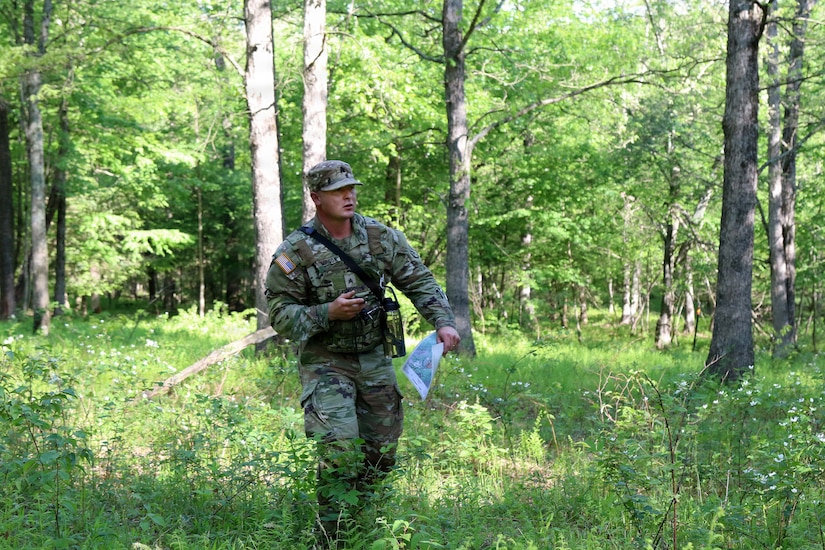
Under the updated program of instruction, students now spend eight days in the field conducting leader-stakes training, land navigation and a culminating situational training exercise that evaluates leadership performance in realistic combat scenarios. 

During the leader-stakes portion of the course, soldiers rotate through training lanes that hone their skill level 10 tasks — entry-level skills required of junior enlisted soldiers, also known as warrior tasks and battle drills. These include medical skills, weapons proficiencies, patrolling techniques and vehicle recovery operations that progressively build tactical proficiency and confidence while preparing soldiers for leadership evaluations later in the course. 

Students train on tasks such as reacting to ambushes and indirect fire, evacuating casualties, requesting medical evacuations, conducting patrol base operations and leading troops. The training grows more complex each day. 

The culminating exercise places soldiers in leadership positions, during which they receive fragmentary orders, develop plans, brief subordinates and execute missions under time constraints and simulated battlefield conditions. 

“The end goal is to develop team and squad-level leaders by putting students in a tactical position and having them execute troop-leading procedures and make decisions,” Webb said. “We’re not grading them on their ability to do battle drills; we’re grading them on the ability to make decisions in a stressful environment.” 

During the course, Army Sgt. Maj. Elizandro Jimenez, a basic leader course manager assigned to the U.S. Army Noncommissioned Officer Academy at Fort Bliss, Texas, visited the 166th Regiment to observe how the team implemented the new program and provided feedback on the evolving courseware. 

“Pennsylvania’s cadre demonstrated exceptional adaptability while implementing this new curriculum,” Jimenez said. “The work being done here is helping shape how the Army develops future noncommissioned officers across the force.” 

Students participating in the pilot course said the additional training time and increased tactical focus have made the experience more valuable and realistic. 

“I think the extra week of training will really help people fully understand their roles as NCOs,” said Army Sgt. Tyler Kase, a combat engineer assigned to the Pennsylvania National Guard. “It’s changed my perspective as a leader and how I’ll handle things moving forward when I return to my unit.” 

Army Sgt. Drayton Coyle, an infantryman and team leader assigned to the Massachusetts National Guard, said the expanded field training better prepares junior leaders for unpredictable operational environments. 

“You don’t know what’s going to happen in the Army,” Coyle said. “The operational environment and the way we fight is rapidly changing. Having that culminating event — that [situational training exercise] at the end of the course — will help us prepare.” 

[ad_2]

Source link

Categories
Defense

Navy green lights seven MUSV marketplace submissions to advance to prototype phase

[ad_1]

WASHINGTON — The Navy has selected seven submissions in the medium unmanned surface vessel (MUSV) marketplace to move forward into the prototype evaluation phase, according to the service. 

The MUSV marketplace launched in March, and more than two dozen designs were submitted, Navy spokesman Capt. Ron Flanders said. 

Flanders did not provide a list of companies whose designs were selected to advance, but said that an announcement was expected within the next few days. At least one firm, Saildrone, revealed at the Sea Air Space Exposition that they submitted a proposal before the first iteration of the marketplace closed in April.

“Selected industry partners must successfully complete at-sea demonstrations to prove the maturity of their systems,” Flanders said in a statement to Breaking Defense today. “After successful at-sea demonstrations prior to October 2026, the Navy plans to work with Industry to have vessels available for Navy leasing or procurement in fiscal year 2027.”

USNI News first reported the update. 

The Navy first unveiled plans for the marketplace as part of a new acquisition model intended to lay the foundation for obtaining other autonomous systems, according to comments made in March by Rebecca Gassler, the portfolio acquisition executive (PAE) for robotic and autonomous systems (RAS). 

Gassler at the time did not share specifics about what type of mission set these vessels will fulfill. However, she said there’s multiple operational needs they could take on as the service implements more tailored force packages, as outlined in Chief of Naval Operations Adm. Daryl Caudle’s Fighting Instructions guidance released in February. 

“There’s a number of missions that we could immediately use these vessels for, and that is part of the strategy now, is that we will now have a skillful way to procure vessels that meet specific mission profiles,” Gassler said then.

Designs submitted must carry at least two 40-ft shipping containers, and travel 2,500 nautical miles at 25 knots in sea state 4 conditions while outfitted with a 25 metric ton load on the payload deck, the solicitation document for the marketplace said. 

Marketplace funding stemmed from President Donald Trump’s “One Big Beautiful Bill” that passed in July that included roughly $2.1 billion for MUSVs.

[ad_2]

Source link

Categories
Defense

India Set To Seal Rafale Request, France Awaits 114-Jet Bid

[ad_1]

India has finalised the Letter of Request (LoR) for the acquisition of 114 Rafale fighter jets, marking a decisive step in its largest-ever fighter procurement program, reported The Print.

The document will be sent to France within weeks, with contract signing targeted by the end of 2026. Around 90 jets will be built in India, making this the first Rafale production line outside France.

India has prepared the LoR after nearly two decades of deliberation over modern fighter acquisitions. The LoR is a formal government-to-government document under the Intergovernmental Agreement route, specifying the required capabilities, quantities and technical parameters.

Once France responds with details on price, availability and logistical support, India will issue the Request for Proposal (RFP).

The Defence Acquisition Council had cleared the proposal three months earlier, and the Cabinet Committee on Security will need to approve the final contract before signing.

The Indian Air Force already operates 36 Rafales, while the Navy is set to induct 26 Rafale-M aircraft for carrier operations.

The addition of 114 Rafales will significantly reduce logistical and training costs by consolidating fleets. Nearly 50 per cent of the new aircraft will feature indigenous content, with around 90 jets manufactured in India through partnerships between Dassault Aviation and Indian firms such as TATA Advanced Systems, Mahindra and the Adani Group. Hyderabad and Nagpur are emerging as potential hubs for assembly lines, with TATA already producing fuselage sections in Hyderabad.

India has been negotiating for access to Interface Control Documents (ICDs), which are technical blueprints enabling integration of indigenous weapons like the Astra missile and BrahMos-NG.

While full access to source codes is unlikely, ICDs would provide operational sovereignty without exposing French proprietary technologies. This balance is critical as India seeks to avoid dependence on foreign-certified weapons.

The timeline is ambitious. Deliveries are expected to begin around 2030 if the contract is signed by late 2026 or early 2027.

The program is valued at approximately ₹3.25 lakh crore, making it one of the largest fighter jet acquisitions globally. It is also strategically vital, as the IAF currently operates only 29 squadrons against a sanctioned strength of 42.

The Rafales will bridge this gap until indigenous projects such as the TEJAS MK-1A, TEJAS MK-2 and the Advanced Medium Combat Aircraft (AMCA) mature.

The AMCA is not expected to enter service before 2035, and planners are considering interim procurement of a fifth-generation fighter, with Russia offering details of its Su-57.

The urgency stems from regional developments. China has expanded its fleet with stealth fighters like the J‑20 and J‑35, while Pakistan is expected to induct the J‑35. India’s older MiG fleets are retiring, and delays in TEJAS MK-1A and MK-2 programs have compounded the shortfall. The Rafale expansion is therefore seen as the fastest route to restoring parity in a two-front scenario.

Air Chief Marshal AP Singh will visit France early next month, followed by Prime Minister Narendra Modi’s visit in June, signalling high-level political commitment to the deal.

The government aims to conclude commercial negotiations swiftly, with CCS approval paving the way for contract signing by year-end. If successful, India will become the first country outside France to produce Rafale fighters domestically, boosting aerospace manufacturing, defence supply chains and skilled employment.

Agencies


[ad_2]

Source link

Categories
Defense

Japan’s Frigate Diplomacy — and What It Could Mean for Taiwan – The Diplomat

[ad_1]

[ad_2]

Source link

Categories
Defense

Space Force needs to prepare for an ‘in-person’ moon conflict with China, new report argues

[ad_1]

The Space Force should prepare to put active-duty troops on the moon and on space stations to counter China’s lunar and military ambitions, a new research paper argues.

The Mitchell Institute’s paper, published Thursday, calls for the Space Force to prioritize the creation of a “human spaceflight” program and redefine federal, active-duty Title 10 orders to compete against China’s military-focused space initiatives—such as the reported goal of putting its Taikonauts on the moon by 2030. Although Chinese officials as recently as last month have said the country believes in the “peaceful use” of space, the paper claims future “competition for control of lunar resources and territory will likely reach a tipping point” and the U.S. military must be prepared.

“With a potential ‘in person’ lunar conflict with China as the contextual touchstone, the U.S. must begin a pragmatic multi-decade effort, leveraging its Space Test Course (STC), as well as partnerships with NASA and commercial space companies, to deliver the skills, tools, and concepts needed for future Title 10 activities to enforce U.S. spacepower-enabling norms and standards,” the report said. “These efforts will require additional funding from Congress for both U.S. Space Force human spaceflight opportunities and residencies at commercial space stations.”

The 22-page policy report calls for blurring the long-standing boundaries between space exploration and militarized operations by allowing Title 10 active-duty federal orders to include “space and lunar habitation” and “warfighting authorities and a national defense mindset in the advancement of human spaceflight.” The 1967 Outer Space Treaty, which the U.S. and China are parties to, calls for the governments to use the moon and other planets for “peaceful purposes” and forbids military bases, testing, and maneuvers. Kyle Pumroy, a retired Space Force colonel and the paper’s author, called for pushing back against those norms.

 “Although The 1967 Outer Space Treaty (OST) prohibits claims of lunar sovereignty and militarizing the moon, China’s habitation plans are closely aligned with their military and are inconsistent with the provisions,” the report said. “Moreover, China’s record of territorial aggression and ignoring treaty agreements must drive a strategic vision unconstrained by the OST. While upholding the OST should be the United States’ desire and priority, pragmatically, it must prepare otherwise.”

Pumory said during a webinar Wednesday that guardians on the moon wouldn’t be “necessarily a violation of outer space treaty” if they weren’t conducting maneuvers, but he also recognized that the treaty would need to be updated. 

“I think at that point, once we have military members on the moon. Again, the treaty would need to be updated, because if one side does it and we say ‘well, you’re violating the treaty, and we’re not going to do that’ we’re just setting ourselves up for disappointment,” Pumroy said. “So I don’t think it’s a violation to send them there, but whether we’re violating the Outer Space Treaty or not is an important fact, but the greater need is for a modernized Outer Space Treaty that appreciates a lunar economy and mining resources from the moon, and mining ice from the moon, and using the moon as a launch pad to get to Mars and other locations.”

Victoria Samson, the Secure World Foundation’s chief director of space security and stability, said the Mitchell Institute’s report is an example of how the norms of space exploration and militarized operations are being challenged.

“It used to almost be a separation of church and state between the two,” Samson said. “Now, that line is being blurred, and I think it’s more a matter of, we have an administration that is supportive of a very active and expanding Space Force.” 

The Mitchell Institute teased the idea of putting guardians in space last year. In a report titled “A Broader Look at Dynamic Space Operations,” the authors pitched the idea of putting troops on critical Space Force assets, to raise the stakes if an enemy decides to strike and to allow for flexibility and responsiveness in high-stakes situations. 

The Space Force hasn’t sent any of its uniformed personnel into space for active-duty operations, but it has loaned its officers to NASA’s exploration missions. In 2020, astronaut Mike Hopkins transferred from the Air Force into the Space Force while aboard the International Space Station. In 2024, Space Force Col. Nick Hague commanded NASA’s SpaceX Crew-9 mission, which lasted 171 days. He was the first active-duty guardian to ever launch into space.

The report also calls for Congress to fund future commercial space station residencies, or even the purchase of “a Space Force-dedicated space station” in future national defense authorization act legislation to help build guardian training and skills on orbit.

“Space station-based operations provide Guardians a trailblazing opportunity for the realistic testing and experimentation of future military concepts,” the report said. “Nothing compares to in-domain, first-hand experience to inform the development of future military requirements. Furthermore, taking this decisive step will send a strong message about the commitment of the United States to maintain space superiority.”


[ad_2]

Source link

Categories
Defense

U.S. F-16s hold the line in the Gulf after Iran campaign ends

[ad_1]

Operation Epic Fury is officially over, but U.S. Air Force F-16s are still flying combat patrol over one of the world’s most volatile airspaces. Newly released photographs taken May 14 in the U.S. Central Command area of responsibility show an F-16 Fighting Falcon carrying a weapons mix that tells the whole story of modern air […]

[ad_2]

Source link

Categories
Defense

ideaForge’s Q6 V2 GEO Receives DGCA Type Certification for Enterprise Mapping and Geospatial Operations

[ad_1]

Mumbai, May 22, 2026. ideaForge Technology Limited, India’s leading UAV technology company, today announced DGCA Type Certification for the Q6 V2 GEO, a multi-purpose enterprise and geospatial UAV designed for advanced surveillance, mapping, inspection, and multi-sensor aerial data acquisition, under the Drone Rules, 2021, in the Small category (2 to 25 kg).

The Q6 V2 GEO addresses the growing demand for reliable aerial surveillance, mapping, surveying, and geospatial data acquisition across enterprise and government operations, spanning infrastructure, mining, utilities, urban planning, forestry, agriculture, environmental monitoring, and disaster response.

Launched at PRAGYA 2025 as part of ideaForge’s geospatial technology initiatives, the platform supports five payload configurations: LiDAR, LiDAR with RGB imaging, high-resolution photogrammetry, 3D oblique imaging, and dual (day & night) payload operations. The platform is suited for applications such as perimeter surveillance and patrolling, terrain modelling, corridor mapping, volumetric analysis, infrastructure inspection, environmental assessment, glacier and avalanche mapping, river basin conservation, rural land digitisation, and high-resolution heritage and terrain documentation across challenging environments.

The Q6 V2 GEO is part of ideaForge’s complete enterprise and geospatial stack, operating with the BlueFire Touch ground control system for terrain-adaptive mission planning and multi-UAV coordination, and FLYGHT CLOUD for video data analysis, mission data management, and processing orthomosaics, point clouds, NDVI layers, and 3D terrain models in the cloud. Together, the platform and the stack deliver an end-to-end workflow from flight to certified data output.

Commenting on the milestone, Mr Ankit Mehta, Co-founder & CEO, ideaForge Technology Limited, said: “We are pleased that Q6 V2 GEO has received DGCA Type Certification. The platform has been developed to address the growing need for reliable aerial intelligence, surveillance, mapping, and geospatial data acquisition across enterprise and government applications supporting safety, security, and governance operations. With support for advanced payloads including LiDAR, Q6 V2 GEO is designed to operate in demanding environments while enabling high-quality data capture for a wide range of surveying, mapping, and inspection workflows.”

With up to 45+ minutes of flight time, the Q6 V2 GEO is designed to support demanding survey and mapping operations across varied terrain and operational environments.

This certification further expands ideaForge’s portfolio of DGCA-certified UAV platforms deployed across defence, homeland security, civil, and enterprise applications.

[ad_2]

Source link

Categories
Defense

The rumored Chinese Expeditionary Mobile Base (ESB) Vessel is finally unveiled.

[ad_1]

 
Well, there it is at last — the long‑rumored Chinese Expeditionary Mobile Base (ESB) finally crawls out of the shadows.

China State Shipbuilding Corporation has now blessed us with an official photo of the civilian version of its ESB concept. And, shock of shocks, it’s built on a civilian bulk carrier hull, roughly 10,000 tons (link), which tracks perfectly with the earlier rumors on the Chinese inter-web.

During Operation Epic Fury, naval logistics suddenly became the hot topic of the moment by professional naval officers, think‑tankers, and online armchair admirals alike, with the role of the Expeditionary Mobile Base (ESB) being front and center. 

The Chinese, of course, have been thinking about this far longer (and with far less drama) as far as I could tell. The PLAN’s usual pattern applies: test the idea on a civilian hull, get something in the water quickly, keep costs down, and if the experiment flops, quietly retire it without having to explain why a bespoke military hull is now a very expensive pier ornament.

And no, the concept isn’t new. The U.S. Navy’s USS Lewis B. Puller (ESB‑3) rides on an Alaska‑class tanker hull and is run by Navy civilian mariners (link). The real distinction is mission scope: the U.S. Navy has global obligations; the PLAN decidedly does not. So a smaller, cheaper, proof‑of‑concept ESB is perfectly reasonable for a navy still workshopping what “naval/marine expeditionary” means in practice.

Well, outside of that island sitting 100 miles (160 km) off the southeastern coast of mainland China, of course.

Back to topic: China’s ESB isn’t a peer to the USS Puller. Not yet anyway. It’s a trial balloon with two helicopter H spots. But it’s a smart trial balloon, and exactly the kind of incremental, low‑risk experimentation the PLAN, sorry I meant, the “Chinese civilian sector” loves.


 Note the huge tanker under construction in the back

 USS Lewis B. Puller (ESB‑3) from (link)


[ad_2]

Source link