Categories
Defense

A New DAWG in the Fight: The Pentagon’s $54 Billion Bet on Autonomous Warfare

[ad_1]

A drone swarm. Image – Adobe Stock/GoldPumaze

In 2023, the Pentagon announced the Replicator Initiative with fanfare, aiming to field vast numbers of affordable, expendable drones as a strategic counter to China. However, by 2025, the program was limping along due to congressional criticism over stalled progress and the absence of a permanent institutional home or consistent funding.

In late 2025, the Pentagon officially dissolved Replicator, absorbing it into the newly minted Defense Autonomous Warfare Group (DAWG). Originally allocated a modest $225.9 million in the fiscal year 2026 budget, DAWG was widely expected to be just another iterative defense working group. 

But the Trump administration’s FY27 budget request has shattered those expectations. The White House is requesting a staggering $54.6 billion for DAWG – a near 24,000% increase in a single fiscal year. Reflecting on the scale of the surge, U.S. Army General and former CIA Director David Petraeus noted that DAWG represents the “largest single commitment to autonomous warfare in history.” 

This is no longer a pilot program. The Pentagon has stopped treating autonomous warfare like a startup project and is now funding it like a permanent branch of the American military apparatus. 

Why Did Replicator Fail?

The unprecedented scale of DAWG’s budget is a direct response to the limitations that stalled its predecessor. 

The Replicator Initiative rushed to procure specific, ready-built drone platforms. However, Replicator’s chosen drones suffered from persistent technical issues, struggled to integrate with existing military command-and-control systems, and were far too expensive and slow to manufacture in the quantity needed. 

Furthermore, the Pentagon was paralyzed by its own procurement process. It struggled with up-front vetting, finding that many systems were entirely unfinished or purely conceptual. Perhaps most critically, Replicator failed to procure software able to orchestrate and command massive swarms of different drones. 

Compounding these technological hurdles was an institutional homelessness. Because Replicator never possessed its own dedicated line-item budget, defense officials were forced to constantly reprogram. Frustrated by the lack of transparency regarding long-term lifecycle costs, Congress increasingly pushed back. 

Managing the $54 Billion Operational Whiplash 

DAWG is designed to rectify the past mistakes of the Replicator Initiative, but its sudden financial windfall has only introduced more questions. How does an office that managed $225 million last year suddenly oversee $54.6 billion?

Pushing this massive sum through traditional Pentagon procurement pipelines risks a bottleneck. DAWG simply does not possess the infrastructure (contracting officers, lawyers, program managers etc.) to obligate that volume of capital in a twelve-month cycle. To prevent this, the Pentagon divided DAWG’s funds. 

Of the $54.6 billion request, only $1 billion sits in the standard, highly restricted base budget. The remaining $53 billion has been tucked away into a flexible future reconciliation pot. This gives DAWG up to five years to obligate the funds. Instead of being forced to frantically dump billions into obsolete hardware before the fiscal clock runs out, DAWG can instead dole out cash incrementally as autonomous technology matures. To ensure long-term viability, DAWG will emphasize procurement, operations, maintenance, training, and sustainment over the first few years before scaling back to ensure active manufacturing lines while avoiding the risk of overproduction

Will DAWG Be Different? 

There are some early signs that the institutional shift to DAWG will be different from the Replicator experience. Unlike Replicator, which sat precariously under the Defense Innovation Unit as a pilot program, DAWG is getting more permanent institutional teeth. Defense Secretary Pete Hegseth recently announced the impending creation of a dedicated Sub-Unified Command for Autonomous Warfare. Simultaneously, U.S. Southern Command (SOUTHCOM) has established its own Autonomous Warfare Command (SAWC), which will work closely with DAWG to identify available expertise and capabilities required for operations. 

Architecturally, the focus has shifted from hardware to software. Acting Pentagon Comptroller Jules Hurst describes DAWG as a “pathfinder,” embedded with private tech firms, live-testing “orchestration tools for autonomy” and providing real-time combat feedback. This software-focused mentality is demonstrated by the recent announcement that Shield AI has been tapped to integrate its Hivemind AI pilot software into the military’s new Low-Cost Uncrewed Combat Attack System (LUCAS). Unlike Replicator, DAWG has introduced a new divergent priority to develop sophisticated software that can be flashed onto any cheap drone frame. 

Yet, lawmakers are starting to raise major red flags. There is a growing anxiety in Congress that the Pentagon’s foundational policy on AI weapons, DoD Directive 3000.09, is completely unequipped for this scale of deployment. The Directive mandates “appropriate levels of human judgement,” but when orchestrating thousands of autonomous systems simultaneously, human-in-the-loop oversight becomes a mathematical impossibility. An uncomfortable reality is beginning to emerge: the Pentagon is throwing a military branch-sized budget at autonomous swarms before deciding on the rules of engagement. 

Ultimately, the creation of DAWG represents a structural shift rather than a guaranteed technological revolution. By shifting the ad-hoc, hardware-first approach of the Replicator Initiative to a permanent, software-focused funding line, the Pentagon is attempting to fix a broken acquisition pipeline that has historically been unable to move at the speed of commercial technology. 

However, funding and execution are different. DAWG’s ambitious plans still heavily rely on a congressional reconciliation process that faces a complicated and uncertain political path. Even if the $54.6 billion request is approved, the Pentagon must still solve the immense logistical challenge of integrating thousands of autonomous systems into a joint force that lacks established doctrine for swarm warfare. 

The Pentagon has clearly signaled where it believes the future of warfare lies. But as DAWG moves from a budget proposal to an operational reality, its success will not be measured by the size of its funding pot, but by whether the military can safely and effectively integrate these algorithmic tools into the reality of modern combat.


Anna Miskelley

Anna Miskelley has cultivated a deep interest in global security, emerging technologies, and military systems throughout her academic and professional career. She is currently a Defense Industry Analyst with Forecast International.

Before joining Forecast International, Anna was a research fellow at the Center for Security, Innovation, and New Technology, where she researched the impact of artificial intelligence on U.S. nuclear command and control systems. Proficient in Mandarin Chinese, Anna has published research on topics including strategic stability, internal Chinese politics, and artificial intelligence.

[ad_2]

Source link

Categories
Defense

Replacing the Quad Bike ATV — Requirements

[ad_1]

The in-service Yamaha Grizzly quad bike ATVs have provided solid service for many years, but spares are increasingly difficult to obtain, and they might need replacing soon.

In UK terminology, a quad bike is typically a four wheeled ride on vehicle with a weight of less than 550 kg, but the definitions and regulations can depend on other factors (click here to find out more)

The first question is, do we really need to replace them?

There is an argument that multi-axle skid steers or side by side UTV’s provide improvements in capability and better value for money, but for the purpose of this post, I will assume a like for like replacement, or similar.

Quad Bike ATV Replacement — Background

It should come as no surprise that the Quad Bike ATV is actually a British invention we failed to exploit.

The Standard Ultra-Lightweight and Jungle Airborne Buggy were produced in 1944 and 1945, the JAB progressed through two prototype versions (Mark II shown below), but the end of the war doomed it, they never went into serial production.

Jungle Airborne Buggy 2Jungle Airborne Buggy 2

Great article here on the JAB.

Three wheeled small ATVs were produced by Sperry Rand and others in the USA during the sixties, with Honda producing their first in 1969, called the ATC90. The first four wheeled ATV was launched in 1982 by Suzuki, the LT125D. A couple of years later, Honda followed with their TRX200TM and Yamaha, the YFM400.

From that point, they achieved success and widespread adoption in the sport, agriculture and utility markets.

Skip forward decades and the British Army showed interest, trialling different designs in 1998, including a Honda FourTrax Foreman

The first models in service were off the shelf petrol engine designs from Honda and Yamaha.

Work completed by Roush/Resolve Engineering on diesel and JP8 engined versions of an Arctic Cat ATV called the DRV paved the way for later UORs by Roush.

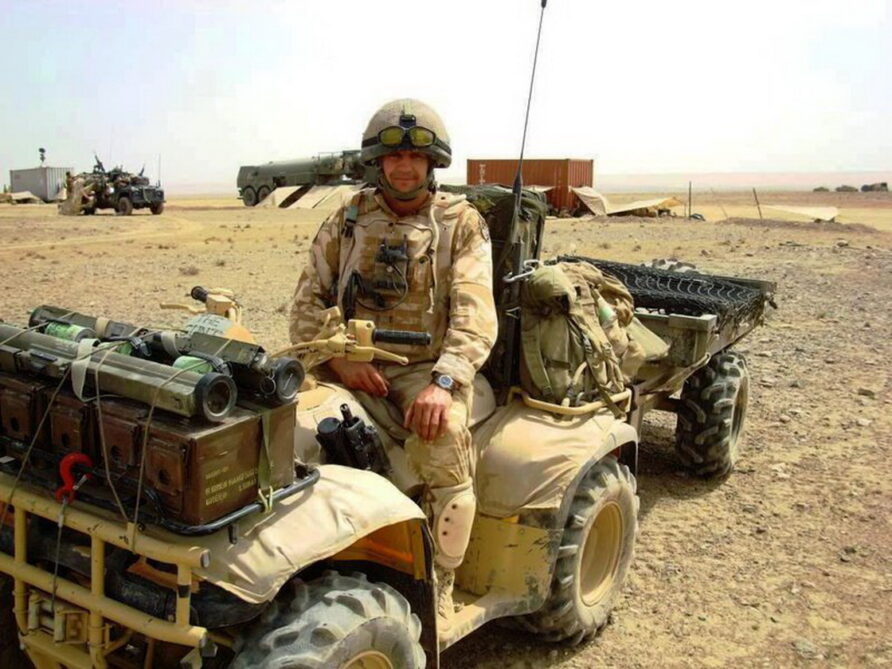
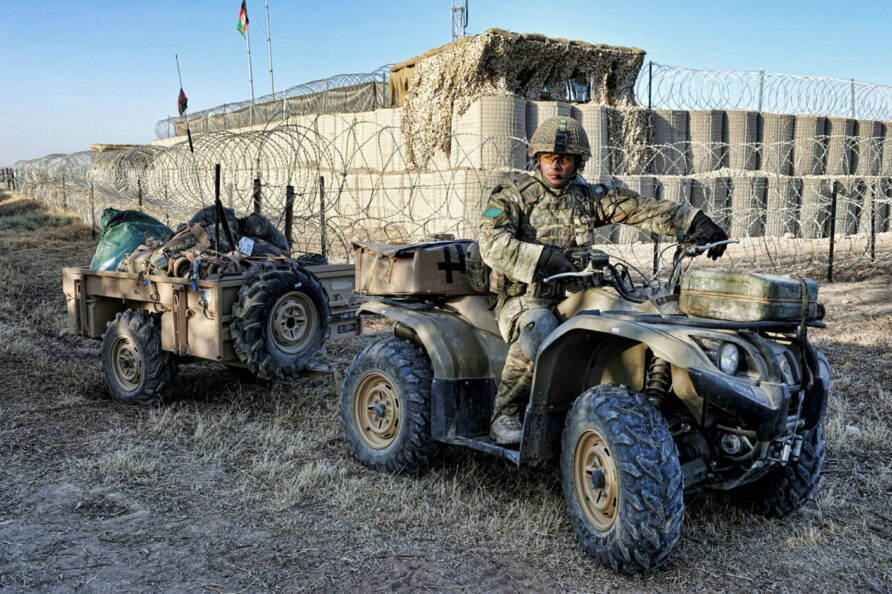
This 2008 UOR with Roush took the standard Yamaha Grizzly 450 units and added a NATO towing hitch, winch, run flat sealant for the tyres, IR lighting, left-hand throttle and other minor modifications, in addition to the diesel engine.

Quad ChinookQuad Chinook
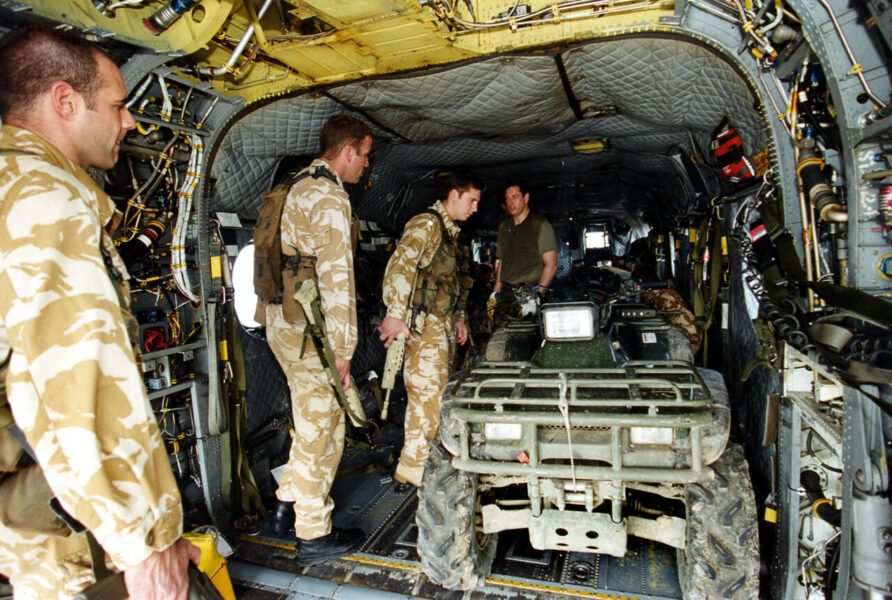
Royal Marines from 40 Commando, load Land Rovers and Quad Bikes into Chinooks from 27 Squadron. 27 Squadron, although based on HMS ARK ROYAL, are operating on the flight deck of HMS OCEAN carring out loading, and load lifting drills. The ships are operating as part of Op Telic in the Arabian Sea

Subsequent contracts were with Yamaha direct, with the Mark II fitted with Carlstar ACT tyres, entering service in 2010.

This second contract was valued at £5 million, providing 200 quad bike ATVs and 200 trailers from Logic. 

The challenging terrain, including narrow tracks and irrigation ditches in the Afghanistan Green Zone, necessitated lightweight, versatile transport for tasks like resupply and casualty evacuation.

Their low noise was also an advantage.

Major Matt Cansdale, 3rd Battalion, Parachute Regiment, said;

The quad bikes proved to be reliable and able to go places that no other vehicle could. The equipment that the quad bikes were able to carry enabled us to launch patrols that covered more distance and were longer in duration than would otherwise have been the case, so we were able to push into areas that the enemy did not expect us.”The ability to evacuate casualties effectively and quickly also meant that we could move away from established routes while limiting the risk to our forces.

Two trailer models were obtained from Logic

The SMT 120B, shown below

Quad Bike ATV Trailer Logic 120BQuad Bike ATV Trailer Logic 120B

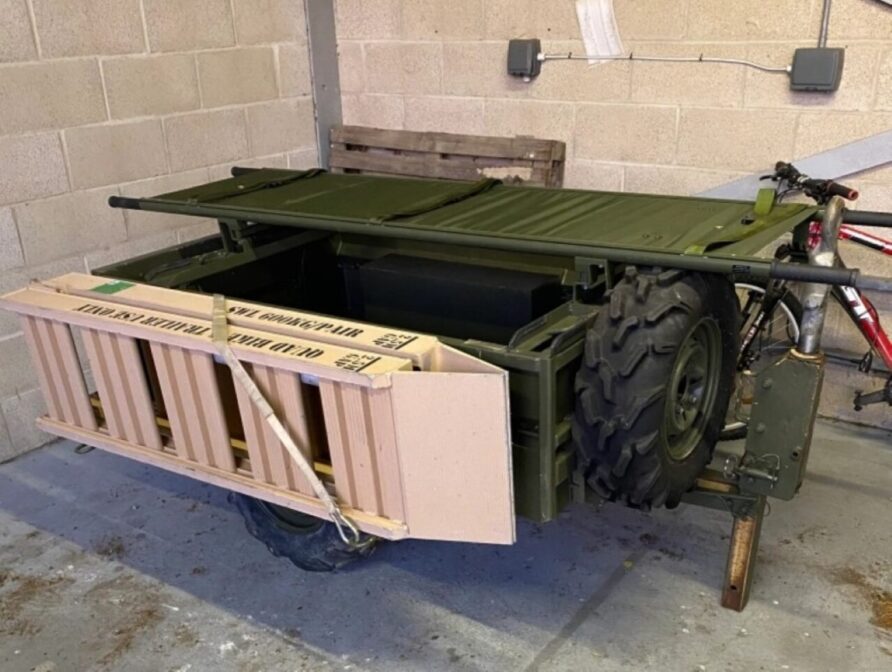
And the larger 150 kg payload SMT 171/172B, with stretcher fixing points and a folding trailer coupling.

Logic ATV trailerLogic ATV trailer

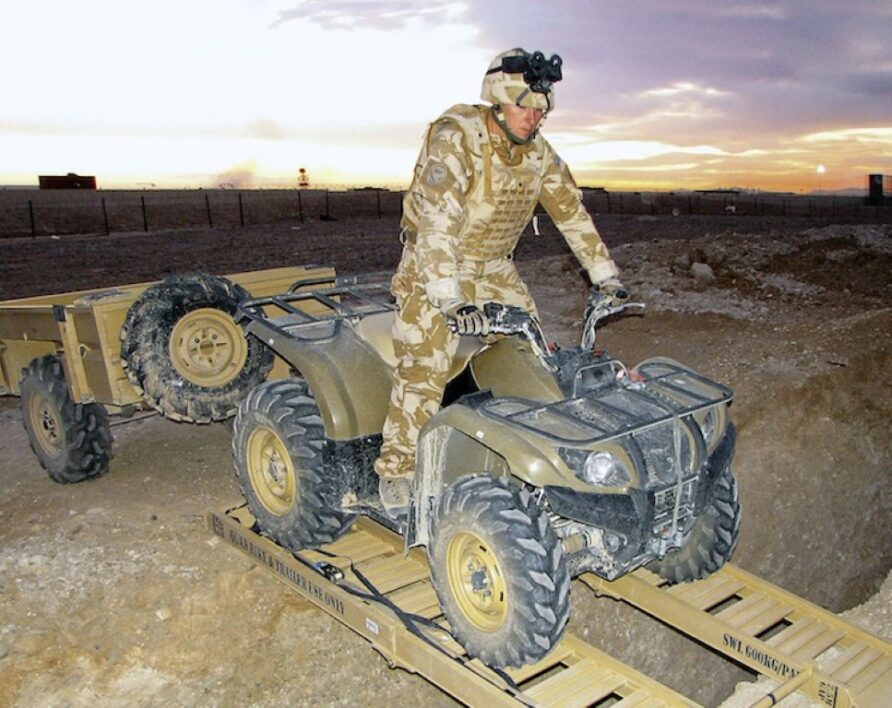
To address mobility issues in Afghanistan, lightweight gap crossing equipment (Gap Crossing Capability Short – Quad (GXC(S) Quad)) was obtained from Mauderer in Germany, or aluminium ramps to you and me.

Quad Bike ATV BridgeQuad Bike ATV Bridge

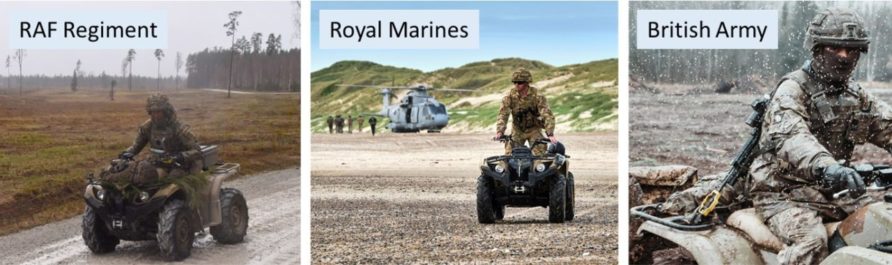
Although many have been disposed of, the Yamaha quad bike ATVs remain in service with the Royal Air Force, Royal Marines, and British Army.

quadsquads

Quad Bike ATV Replacement — Defining a Requirement

The existing Yamaha Grizzly 450 ATV quad bikes are 1.99 m long, 1.09 m wide, and 1.12 m high.

Their Gross Vehicle Mass (GVM) is 477 kg, kerb weight of 267 kg, and a payload of 210 kg (44% of GVM)

The towing capacity is 600 kg.

These are reasonable baseline specifications for any replacement.

Parachute Regiment Quad ATV and TrailerParachute Regiment Quad ATV and Trailer

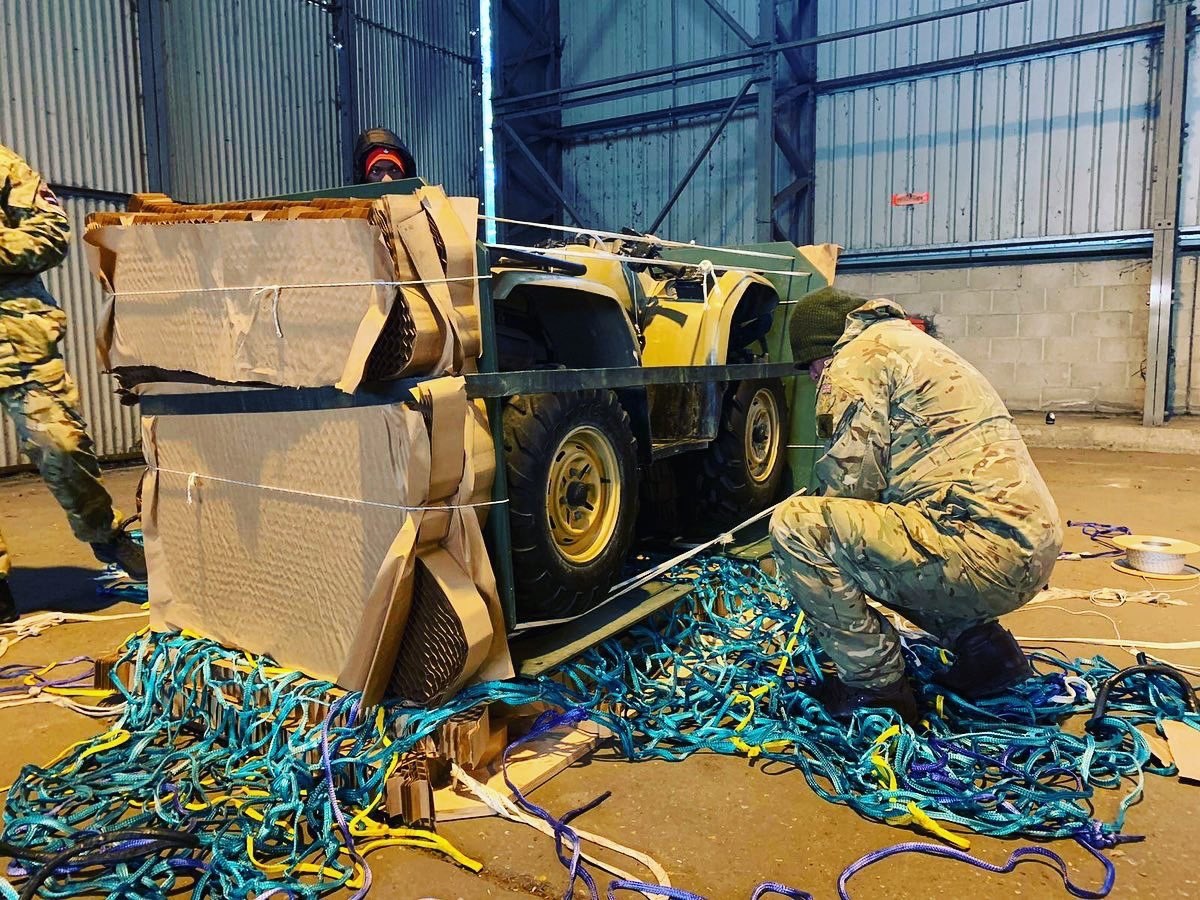
These dimensions also allow it to be parachuted using a double Container Delivery System (CDS).

A double CDS uses a single, elongated skid board to accommodate two A-22 containers side by side, effectively doubling the payload capacity while maintaining compatibility with a single parachute system for airdrop. The key difference is the length of the skid board, which is extended to handle two containers.

And this allows a quad bike to be parachuted from an A400M, we don’t have any options for larger vehicles.

CDS 1CDS 1

The dimensions for a double CDS are approximately:

  • Width: 1.22 meters (48 inches, as the containers are aligned along the length, not side by side in width
  • Length: 2.44 meters (96 inches, as it accommodates two 1.22-meter-deep containers end to end
  • Height: 2.11 meters (83 inches, unchanged, as the height is dictated by the container and parachute)

The internal width of a standard 20ft (ca. 6 m) shipping container is approximately 2.35 meters.

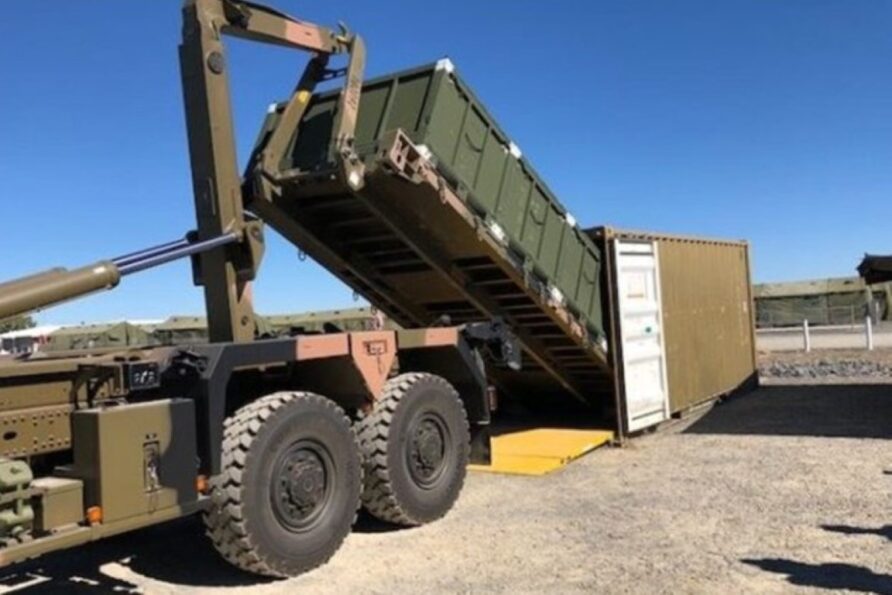
A JMILS Container Roll Out Platform (CROP) is 2.32 m wide.

JMIC CROPJMIC CROP

Keeping below the 2.32 m width of a CROP would not only allow the quad ATV replacement to be carried across its width, but also width ways in an ISO container, and parachuted using a double CDS.

Height tends to be less of a problem for this class of vehicle but if it less than 1.2 m and theoretically, they can be double stacked in an ISO container.

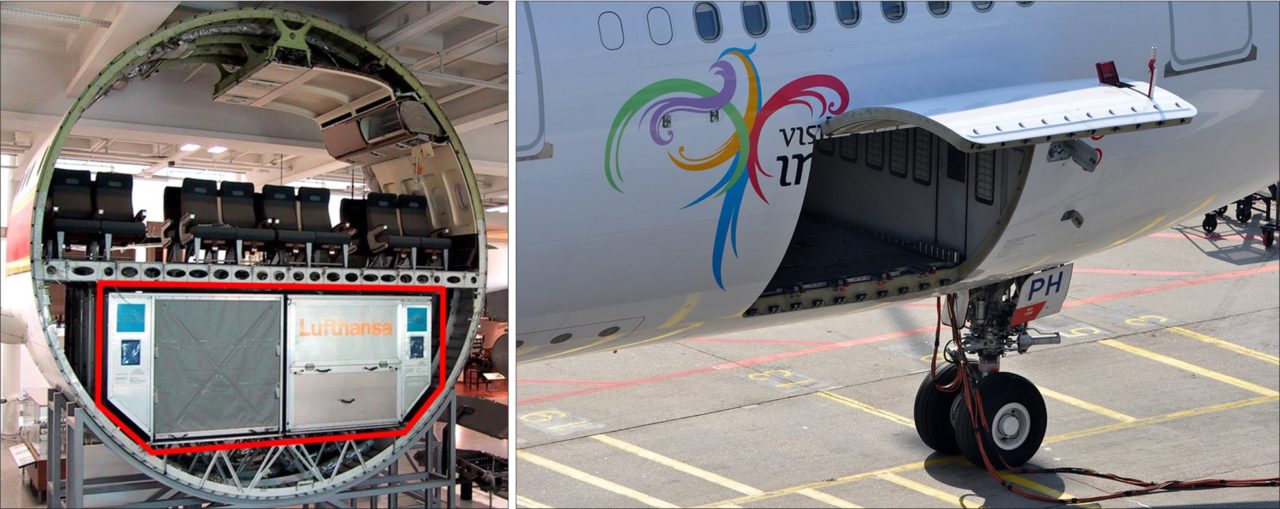
Strategic and civilian aircraft can also be used, e.g. RAF Voyagers and civilian cargo aircraft. Although the image below is not an Airbus A330 (Voyager), it does provide a good illustration of what a typical wide-body airliner’s lower deck looks like. 

Airline lower deckAirline lower deck

Those aluminium containers on the lower deck, indicated by the red outline, are called LD3 Unit Load Devices (ULD)

The lower deck of an RAF Voyager can carry a combination of military 463L pallets and civilian LD3 and LD6 containers, potentially 8x 463L, 1x LD6 and 1x LD3, 25x LD3 or 13 LD6 and 1 LD3. Without going into too much detail on these, most ULD’s have a maximum internal height of 1.6 m, within the 1.2 m max target height.

This means, rapid deploy forces that might use any combination of civilian airliners, can also take some vehicles with them.

Stacking ATV quad bike ATV’s using transport racks is facilitated by compliance with the same basic dimensions as an in-service Yamaha.

Stacking ATV PalletStacking ATV Pallet

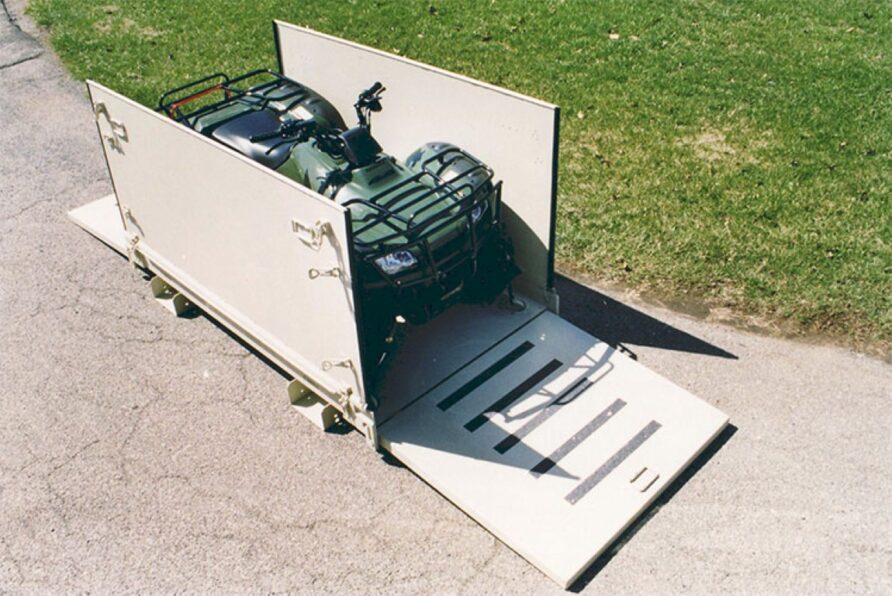
ATV pallets can also be of the enclosed, like this from Wel Fab

ATV Pallet ContainerATV Pallet Container

On weight…

Stay under a tonne, and it can be lifted by a Wildcat helicopter, with multiples for other aircraft.

Again, stay at somewhere in the one tonne bracket and two or three could be easily carried on a lightweight trailer, towed by a Land Rover type vehicle, driven on a BE licence.

Or even a low-cost single ATV trailer like this, from Cochet.

Lightweight Quad TrailerLightweight Quad Trailer

All these transportability constraints are not hard limits, they are simply combinations of weights and dimensions that can be considered.

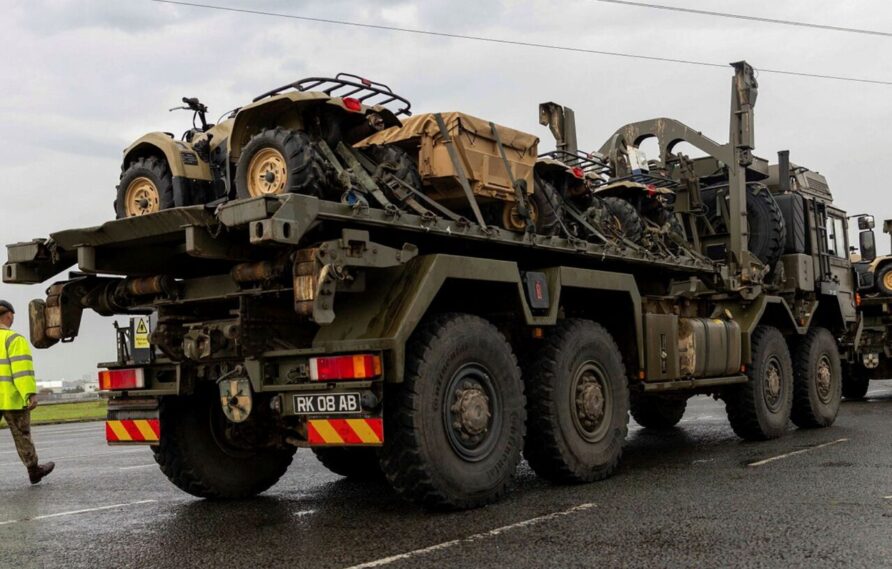
If the weight could be held at less than 400 kg, double stacking in a curtain-side or fixed side trailer would allow sixteen to eighteen quad bikes to be carried at one.

Systems like the Jolada Skate and Track System make loading and unloading quick and easy.

Substitute a Yamaha for a trailer for a more realistic load.

Which would be quite an improvement on current methods.

MAN SV EPLS Quad ATVMAN SV EPLS Quad ATV

Diesel quad bike ATVs are uncommon now, as the market has moved to electric, hybrid, and petrol engines.

This creates a dilemma for the MoD if it wants something similar to the Yamaha Grizzly, choice is limited. It might also create an opportunity to look at those other options, and widen the circle of potential vehicles.

Quad bikes are quite a viable candidate for low noise hybrid or electric drivetrains, existing designs can be noisy and reveal support and evacuation lines. Power export is another advantage, especially when power demand, even for light role dismounted forces, is increasing.

Does a replacement need to be manually steered, are tracks a better alternative, and how fast do you really need to go.

Another question is the role of the trailer.

A quad bike does not need a trailer, but beyond the rider and their personal equipment, options can be quite limited.

A trailer then becomes an essential component (obvs!), and any conversation on quad bikes cannot omit them.

There is also the question of the role of the quad in the context of robotic platoon vehicles and similar uncrewed load carriers.

This is another reasonable question, but for the sake of this series, I will also assume this question is for another post.

To summarise, a replacement for the in-service Yamaha quad bike ATV’s should look something like the in-service quad bike ATV.

Unless it doesn’t.

The next part of the series will examine two sets of vehicles, those that fit within the footprint of the existing quad bike ATV, and those that don’t.


To help me keep the show on the road, I ask that you support the site in any way you can. It is hugely appreciated.

You can click on an affiliate link, Buy Me a Coffee at https://ko-fi.com/thinkdefence, download an e-book at https://payhip.com/thinkdefence or even get some TD merch at https://www.redbubble.com/people/source360/

Youtubers, if you are going to lift content from here, the decent thing to do would credit me


[ad_2]

Source link

Categories
Defense

Israel strikes central Beirut as Lebanon death toll tops 630

[ad_1]

Israel carried out a strike in the heart of Beirut on Wednesday for a second time since Lebanon was dragged into the Middle East war, as the death toll in the country climbed past 630.

In New York, around 30 countries backing the UN peacekeeping force in Lebanon voiced concern over the fighting in the country, which became a front in the wider conflict last week when Hezbollah attacked Israel in retaliation for the killing of Iranian supreme leader Ayatollah Ali Khamenei.

Israel, which had kept up strikes in Lebanon even before the war despite a 2024 ceasefire with Iran-backed Hezbollah, has since launched air raids across the country and sent ground troops into border areas — an offensive that has killed 634 people, including 91 children, according to authorities.

Israel’s UN envoy Danny Danon said Wednesday that Israeli forces would continue to operate in Lebanon “as long (as) there will be a threat against us”.

Lebanon’s state-run National News Agency (NNA) said “the enemy targeted an apartment in the Aisha Bakkar area” in central Beirut, a densely populated neighbourhood close to one of the city’s biggest shopping malls.

AFPTV’s live broadcast captured the sound of an air strike followed by a fireball erupting in an apartment in a multi-storey residential building.

An AFP correspondent saw destroyed walls on the building’s seventh and eighth floors, with damaged cars nearby and security forces present at the scene.

When the strike hit, “I ran from room to room, pulled my wife and daughter out of the rooms and hid them behind a wall, then the second strike hit”, said Fawzi Asmar, owner of a bakery on the same street.

Samer Knio, a civil defence paramedic, said glass and debris fell on his team as they were evacuating casualties “but God protected us”.

‘Who do I blame?’
Lebanese authorities said Wednesday that about 816,000 people had been registered as displaced, with around 126,000 staying in collective shelters.

Some residents fear being caught in Israeli air raids targeting people sheltering nearby.

“We don’t know who they’re targeting. Maybe someone related to something, maybe not,” Amal Hisham, 46, said.

“Who do I blame? Who do I not blame?”

The health ministry announced an initial toll of four people wounded in the apartment strike — the second in central Beirut after Israel a seafront hotel days ago, saying it was targeting Iranian foreign operations officers.

Iran later said the raid killed four of its diplomats.

Senior UN officials and member states called on Wednesday for an end to fighting in Lebanon at a Security Council meeting in New York.

Jerome Bonnafont, the French ambassador to the United Nations, told reporters before the meeting that “we troop-contributing countries to the UN peacekeeping force in Lebanon, joined by several other member states, express our deep alarm at the escalation of hostilities in Lebanon”.

Red Cross paramedic
Also on Wednesday, the Israeli army resumed strikes on Beirut’s southern suburbs, where Hezbollah holds sway, after issuing a new evacuation warning.

AFPTV live footage showed smoke rising from the area following strikes.

Israeli air raids also continued in southern and eastern Lebanon, with the NNA reporting strikes in several areas.

The health ministry eight people killed in a strike in the southeastern Bint Jbeil district, with NNA reporting the toll included five members of one family.

The ministry said seven people were also killed in a strike on the east Lebanon town of Tamnin al-Tahta, while “successive raids” overnight on the southern town of Qana in the Tyre district killed five people.

In Hennawiyeh, also in the Tyre area, the ministry said an overnight Israeli strike wounded two people who were then killed in a subsequent attack along with a rescue worker who attended the scene.

It also announced the death of a Red Cross paramedic from wounds sustained when “the Israeli enemy targeted the ambulance he was travelling in… on a rescue mission” two days earlier in the same district.

An AFP correspondent saw mourners, including some in Red Cross uniform, taking part in the paramedic’s funeral procession on Wednesday in Tyre city.

Authorities said 15 healthcare workers are among those killed in Israeli strikes since March 2.

[ad_2]

Source link

Categories
Defense

Node Wrangler? Which Part of the Joint Kill Chain?

[ad_1]


Marine Corps Compass Points

One U.S. Marine Corps unit has earned a significant honor, designation as a SOC qualified Special Purpose MAGTF

[ad_2]

Source link

Categories
Defense

Service Member Olympians Meet With Secretary of War > U.S. Department of War > Defense Department News

[ad_1]

Soldiers and airmen who participated in the 2026 Milan Cortina Winter Olympic Games in Italy with the World Class Athlete Program visited the Pentagon April 17. During the visit, the athletes also got an unexpected opportunity to meet with Secretary of War Pete Hegseth. 

“I welcomed 10 American Olympians — who also wear the uniform — to the Pentagon,” Hegseth said via social media. “They represent the very best of our nation.” 

This isn’t the first time the secretary has talked with the world-class athletes. In advance of the Olympic Games, he called them directly to wish them luck in the competition.  

The visit highlighted the War Department’s support for service member athletes and reinforced military appreciation across the sports community. During their visit to the Pentagon, the athletes and their leadership met with the secretary, toured the Pentagon and also met with their respective military service branch leaders. 

Olympic bobsledders Army Spc. Azaria Hill and Sgt. Frank Del Duca said their focus on fitness as Olympic athletes and soldiers aligns squarely with the secretary’s fitness standards. 

“We are definitely big on fitness,” Hill said. “That’s kind of the basis of what we have to do — what we do day to day.”

Hill is a motor transport operator in the Army and a bobsled brakeman as an Olympic athlete. During the 2026 Winter Olympics, she and her bobsled driver ranked in fifth place in the 2-woman bobsled competition. 

Del Duca, who joined the Army a little over six years ago, is an infantryman and also a bobsled driver.

“Fitness is a huge part of my performance as a soldier, as well as my performance as an athlete in the World Class Athlete Program,” he said. “I do both, and I have to stay sharp and fit for both. And then there’s also the positive benefits just to your general health as well. My obligations as a soldier require a high, high level of fitness, and that spreads to every part of my life.”

As a soldier and an athlete, Del Duca said there’s a balancing act that has to happen to make sure everything gets done right.

“It’s full time for both,” he said. “Sometimes the slider will shift one way or the other, depending on the time of year. So, during the Olympics and during the competitions to qualify for the Olympics, I’m doing mostly World Class Athlete Program things. Then that immediately shifts after the season, and I go do my infantry things.”

Del Duca said he was excited to meet with Hegseth and said the secretary was impressed with what he saw from the athletes.

“He just had a lot of support for our program and what we’re doing, both as soldiers and then in the athlete program,” Del Duca said.

In the 2026 Winter Olympics, Del Duca and his teammate came in 4th in the 2-man bobsled competition.

Both the Army and the Air Force run a World Class Athlete Program, where athletes can work with expert trainers within the military as they prepare for world-class competitions — such as the Olympics — while at the same time, be service members and have a future job after their competition days are over.

The program serves both the athletes and the military, said Eli Bremer, an advisor to the Air Force’s program.

For athletes, Bremer said, pursuing Olympic dreams while serving means a much more stable and greater level of support than what they might get going it alone. As civilians, athletes often find it hard to both train to the level they need to train and also support themselves. So, for many, it’s a struggle to be an athlete. However, joining the Air Force or the Army through the World Class Athlete Program means those athletes can use their training and athletic performance as part of their career.

“It’s really hard for them to hold jobs and have even consideration of a career while training for competition as a civilian,” Bremer said. “That’s why the military is such a positive aspect, because we have a program that allows them to pursue … the Olympics for the United States, but after that, it’s also an off-ramp into a real job.”

And for the military, Bremer said those stellar athletes in uniform showcase to the whole world two of the things the military is all about: fitness and discipline.  

Program athletes advance their own goals by serving, but they advance the military by being top-level ambassadors who authentically demonstrate what the U.S. military is capable of achieving. When they share that they both serve in uniform and represent their nation at the Olympics as athletes, they make military service appealing to young Americans who also value fitness, discipline and patriotism and who are looking for a place that will make use of what they know they can bring to the table.

“It’s a symbiotic relationship,” Bremer said. “Athlete endorsers are the highest sought endorsers … and these authentic testimonials are the gold standard. And so, what we have are some of the world’s greatest athletes who have actually joined the military, who are actually serving the military, actually pursuing a career in the military — you cannot get a better testimonial … than that.”

Following their visit to the Pentagon, the athletes traveled to Nationals Park in Washington, where they met with the MLB team during batting practice and were recognized before the first pitch. Just before the start of the game, the Olympic athletes took the field and welcomed the Nats to their positions.

[ad_2]

Source link

Categories
Defense

In contested seas, autonomy has to think ahead, not just steer

[ad_1]

As maritime operations become more contested, distributed, and exposed to anti-access/anti-denial (A2/AD) threats, gray zone activity, and emerging dangers to subsea infrastructure, the demand signal for autonomy is shifting beyond unmanned navigation and edge-computing. The challenge now is not just sending a platform from point A to point B and sensor-data collection, but giving operators the ability to understand mission effectiveness, actually predict problems before they escalate, and adapt in real time across long-range, long-endurance operations in degraded communications environments. 

This challenge is being met by Integer Technologies, ranked #95 out of 5,000 on Inc.’s 2025 list of America’s Fastest-Growing Private Companies. Breaking Defense talked about predictive intelligence with Integer co-founders Duke Hartman, CEO, and Josh Knight, COO, and how their software called DIGIT is being used by the Defense Innovation Unit on its Combat Autonomous Maritime Platform Project (CAMP) developing extra-large, extended range unmanned undersea vehicles.

Breaking Defense: Describe the maritime threat scenarios where autonomy and predictive intelligence play key roles.

Josh Knight, COO, Integer Technologies

Knight: The threat environment that we’re looking at in maritime is increasingly complex, but also contested in the ocean environment. Traditional manned operations are getting progressively more costly and risky because of threats like growing anti-access/area denial capabilities and gray zone activities. We’re also starting to see the emergence of more undersea threats to vulnerable critical infrastructure, seabed infrastructure.

Those are the types of threats that are driving a lot of the work that we’re doing in long-range autonomy – long range, but also long endurance. Of course, looking at theaters like the Pacific and from where the United States has historically operated, they would require long range.

But there’s also missions like continuous monitoring of threats to subsea infrastructure that require long endurance to be practical. Systems that enable persistent surveillance, scalable presence, affordable mass, these are all things that are going to pay dividends in these sorts of high-risk maritime-threat environments.

Certainly, there is a contemporary reminder that mine countermeasures is still very much a real mission in the ocean or maritime domain, and we’re looking at technologies that support missions like mine countermeasures and persistent operations in A2/AD types of environments.

How do you position Integer to address this need and what’s different about what you provide?

Knight: Integer is an agile defense technology company that transforms raw data into decision advantage, protecting our country and ensuring a safer world. We partner with industry and academia to create purpose-built solutions that refine complex information into actionable intelligence, empowering humans and autonomous systems to predict the probabilities in uncertain environments. Our digital engineering solutions portfolio spans robotic and unmanned systems, sensors and perception, power and energy systems, advanced manufacturing and cyber-physical systems.

When we talk about digital engineering and software, we’ve developed predictive intelligence and what we call ‘mission assurance’ software. We’re not positioning ourselves as a vehicle platform vendor, nor strictly an autonomy provider, nor strictly a command and control company. We’ve found what we view as an important capability gap for Navy operations where systems today, whether they’re manned or unmanned, are in many cases reactionary to information as it comes in.

This mission-assurance software is bringing a new capability to predict some degree into the future so that you can have better awareness of what’s going on in your theater and better predictive tools for how to adapt to changing conditions.

We’ve already started to partner broadly with the best-of-breed vehicle and autonomy providers of surface and subsurface, manned and unmanned vessels. Our mission-assurance layer is the new aspect (in maritime autonomy).

How did Integer come together? Why specifically address the maritime domain?

Duke Hartman, CEO, Integer Technologies

Hartman: Josh and I both come from maritime engineering backgrounds, Josh being a naval architect and myself being a mechanical engineer whose work has always been in the ocean. When we started Integer in 2021, we saw that many of the other industries were adopting technology at a much faster rate than the maritime industry, and there was a lot of stagnation in the maritime sector, which was often a technology laggard. We thought that’s a problem given the way the geopolitical situation was changing; we are a maritime nation and we decided we needed to help to change that.

The basis of our company was partnering with universities on focused and applied research that had a targeted aim – to produce a prototype that would actually function in a relevant environment. Integer’s job within that partnership is to carry that innovation across the Valley of Death, so to speak, and we have found funding models to do that.

That’s where the magic has happened, because we can have one foot on the academic side where the greatest scientists and engineers are doing their research in a university setting, and crave real world problems to research and solve.

Then we have another foot in the closed, secure environment of the defense industry. We get to focus those innovations on operational applications for the Department of War and make sure they work. These cannot be science experiments if they are on a fleet asset.

That’s where we’ve focused on helping the Navy and other services, the operators in uniform, make better decisions faster.

What do you mean by predictive intelligence? What is it that you’re predicting?

Hartman: This method of prediction is really our differentiator. We start with physics. We understand the physics of your own vehicle or your platform or your system of systems, whatever engineered systems you’ve got.

We then take in sensor information in real time and update models that we have of those engineered systems in faster than real time, as well as the environment and estimates of other assets in theater, including Red assets. If you can fuse all of those things together and you have compute on your platform that’s powerful enough to run, in some cases, Monte Carlo scenarios that can allow you to look ahead, you can analyze the impact on your mission.

Does a change in the environment or in the posture of my own assets or of the adversary’s assets change my mission effectiveness or not? In what way? You can predict what might happen if you see a given behavior in, say, an adversary system and then adapt in real time. You’re predicting the move of the adversary.

The term ‘digital twin’ is thrown around a lot and has become a buzzword, so it’s worth defining how we use it. These are operational models of the battlespace that are run at the edge on vehicles or platforms. We have digital twins of the vehicles, the platforms, the environments, and the adversaries’ vehicles. Having those running faster than real time, you can develop a ‘world model’ that allows you to predict mission outcomes with a complex system of systems, which empowers operators to make better decisions more rapidly.

Also, once you’re evaluating multiple paths and courses of action, you can decide which one is the best by running those scenarios out. Should I send this set of USVs west to execute on this ISR mission or not? What happens to the mission if half of them have a mechanical failure? It allows you to think ahead in the same way that warfighters do today.

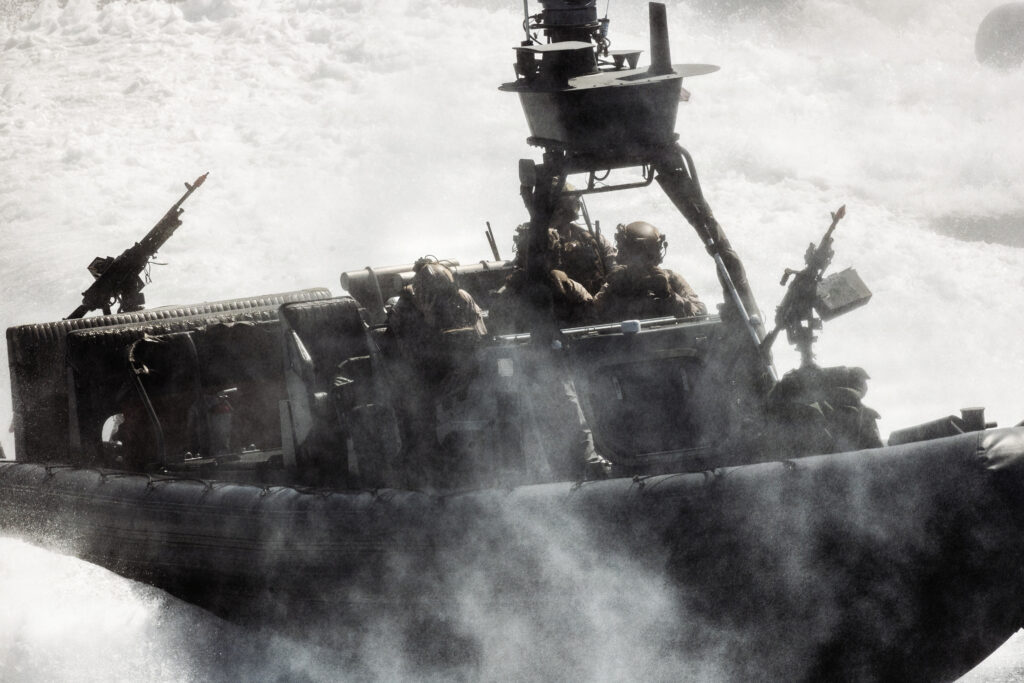
U.S. Marines with the Maritime Raid Force, 11th Marine Expeditionary Unit, ride in a rigid-hull inflatable boat during a visit, board, search, and seizure exercise in the Pacific Ocean, Feb. 28, 2026. (U.S. Marine Corps photo by Lance Cpl. Luke Rodriguez)

Describe DIGIT, how it works and what problems it solves for warfighters.

Knight: DIGIT is our mission assurance software platform with which we build these physics-based digital twins that fuse real-time data and AI to give operators better awareness and decision aids for operating their systems, whether it’s UUVs, USVs, or ships and groups of those.

It provides this predictive layer in-between that extends the capabilities of today’s autonomy and command-and-control systems to give you this better predictive ability, which is about preempting problems before they become a big deal. You want to understand exactly what’s at play with your systems, exactly the health of your mission, and whether you need to make a change in order to continue to have a successful mission. That’s the why.

Importantly, it’s not just something that operates in a lab environment or a pristine environment. It’s been designed from the ground up to operate in these degraded, denied, intermittent, limited communications environments.

We have a growing number of successful partnerships with both platform and autonomy companies today. Our software is modular, interoperable, and platform agnostic; we do partner with existing autonomy providers to extend their capability with this mission-health mission-assurance capability.

What do you mean when you talk about the ‘health’ of the mission, and what’s its role in the Defense Innovation Unit’s Combat Autonomous Maritime Platform project (CAMP) program?

Hartman: The DIU CAMP program we believe is a critical step in giving the US Navy the unmanned persistent presence in foreign environments that it needs, especially in complex maritime environments.

We are teamed with Metron, who is the prime, and we are integrating DIGIT for predictive mission health management as a vital component of scalable and reliable long endurance autonomy for Cellula Robotics’ commercial off-the-shelf, fuel cell-powered Guardian AUV. What DIGIT helps any platform to do is both understand your own ship better and evaluate courses of action. It gives you a better ability to answer the questions even as you’re underway in a mission in which you may not be communicating with an operation center for a long time.

We believe that capability is critical to the Navy maintaining its edge. I’m not talking about just predictive maintenance or only the health of the vehicle; this is the health of the overall mission, and that’s going to be the critical, next generation of autonomy.

Describe your transition from a small startup to a company now backed with private funding from Razor’s Edge.

Hartman: Josh and I founded Integer as a bootstrapped two-person startup in Columbia, South Carolina, with a vision to grow into a consequential and valuable company in the defense tech space. We are now over 80 employees with offices in four states, including Washington DC, and are growing significantly.

We realized that we needed a capital backer to be able to finance the larger programs that we continue to win. We were careful and diligent in selecting a capital partner. We absolutely believe that our success lies in the people and the partnerships. We knew that we wanted to have a partner we could trust who actually added strategic value, as well.

We landed on Razor’s Edge because they are founders and business operators and have been doing this for many years and proven highly successful. Having their vision and strategy and also capital backing has allowed us to take Integer to the next level.

We are opening a handful of new offices in the next 12-18 months, so we’ll be expanding our footprint quite a bit and growing substantially. The upcoming initiatives that I can mention are expanding the DIGIT mission assurance platform, integrating AI for predictive analytics, and absolutely strengthening our corporate partnerships because we are a software provider. We partner heavily, especially with platform providers and large primes, as well as the new primes.

Final thoughts?

Knight: Big picture, we want people to understand that we’re one of the fastest growing companies in the country thanks to our unique business model where we have found an ability to partner with or to bridge academia, industry, and government in a way that provides better outcomes, faster outcomes to the warfighter.

Everybody wants innovation; there’s talk all over the place about how the defense industrial base isn’t innovating fast enough. We’re bringing a new model, and we’ve been scaling that for five years because of the success of that model.

We also want people to know that we’re creating high-skill jobs in some places that are non-traditional for defense. We talked about Columbia, South Carolina; there’s not a ton of defense industry in that area. We’re also working in places like Mississippi and Louisiana that are geared around bringing high-tech STEM-first research into operations, and helping to bring the capacity of other parts of the nation to bear on this kind of innovation problem.

The other thing is navigational autonomy – the ability to go from point A to point B and turn on a payload or a sensor. The next generation of defense tech, we believe, is going to be defined by software that can anticipate and not just respond. That’s a key to unlocking trusted operations farther forward, longer duration, longer endurance, more consequential missions.

This is actually a fundamental shift toward software that understands and is aware of the intent of the mission and not just running a script.

Hartman: The investment in a lot of research, including by the Department of War, is coming to fruition here with the DIU CAMP program, which is a groundbreaking program for the next gen XLUUV (Extra Large Unmanned Undersea Vehicle) asset class, and using this platform to prove to the world that you can have a long duration mission in which the autonomy is aware of its own mission and able to make decisions to increase the mission effectiveness and mission health on its own.

Proving that this is not just ready for a demonstration, but ready to be deployed to the fleet is the purpose of that program. We’re excited to be teamed with Metron on it.

[ad_2]

Source link

Categories
Defense

GTRE Invites Indian OEMs To Build Infrastructure For Indigenous High-Thrust Jet Engine Development

[ad_1]

The Gas Turbine Research Establishment (GTRE) is actively seeking Indian Original Equipment Manufacturers (OEMs) to establish infrastructure for the production of indigenous aero gas turbine engine components.

This initiative is directly linked to the ongoing development of an advanced high-thrust class jet engine, which is under progress at GTRE. The move represents a significant step in India’s drive towards self-reliance in critical defence technologies, particularly in the domain of propulsion systems for advanced combat aircraft.

The establishment of such infrastructure is crucial for ensuring that India can design, manufacture, and sustain complex aero engine technologies without relying on foreign suppliers.

By involving Indian OEMs, GTRE aims to create a robust domestic industrial base capable of supporting the lifecycle requirements of advanced jet engines.

This includes not only the production of components but also the integration of specialised processes, testing facilities, and quality assurance mechanisms that meet global standards.

The advanced high-thrust class jet engine currently under development at GTRE is intended to power future generations of indigenous combat aircraft. Its successful realisation will mark a technological leap for India, enabling the country to field aircraft with enhanced performance, endurance, and operational flexibility.

The engine’s development requires precision engineering and cutting-edge materials, making the participation of capable Indian OEMs essential to achieving the desired outcomes.

GTRE’s call for OEMs reflects a broader strategy of indigenisation within India’s defence sector. By fostering collaboration with domestic industry, the organisation is laying the foundation for a sustainable ecosystem that can support advanced propulsion technologies.

This approach not only reduces dependence on imports but also ensures that India retains full control over critical technologies that underpin its airpower capabilities.

The infrastructure being sought will encompass advanced manufacturing facilities, specialised tooling, and testing environments tailored to the unique requirements of aero gas turbine engines. Indian OEMs will be expected to bring in expertise in precision engineering, metallurgy, and systems integration, while also investing in research and development to keep pace with evolving technological demands. 

This collaboration is expected to accelerate the timeline for the engine’s development and eventual deployment.

The initiative also aligns with India’s national vision of building end-to-end capability in aerospace and defence manufacturing.

By engaging domestic OEMs, GTRE is not only addressing immediate developmental needs but also creating opportunities for long-term industrial growth. The project will likely stimulate innovation, generate employment, and strengthen India’s position as a credible player in the global aerospace sector.

GTRE’s effort to involve Indian OEMs in setting up infrastructure for indigenous aero gas turbine engine components underscores the strategic importance of propulsion technology in modern air combat.

It is a decisive step towards achieving technological sovereignty, ensuring that India’s future combat aircraft are powered by engines designed, developed, and manufactured within the country.

Agencies


[ad_2]

Source link
Categories
Defense

Stop managing NATO. Start rebalancing it.

[ad_1]

The Atlantic alliance can no longer be managed through reassurance, communiqués, or the fiction that its internal tensions are political noise. They are structural. Mark Rutte’s recent visit to Washington made that clear. NATO requires rebalancing: a more credible distribution of responsibility, capability, and strategic weight across the alliance.

Beneath this lies a growing crisis of trust. Europeans no longer simply ask whether the United States will stay engaged; they worry that ambiguity or sudden shifts in Washington could hollow out deterrence and tempt adversaries to test what was once an ironclad commitment. Unequal burden‑sharing has shifted from a long‑running grievance to a hard instrument of leverage. The American message to Europe is blunt: step up or live with more conditional U.S. guarantees. Europeans, for their part, argue they are already carrying heavier financial and political costs. They also demand a seat at the table: they expect to be consulted, not simply informed, when decisions with direct consequences for European security are made. 

The alliance cannot afford to remain trapped in this cycle of mutual recrimination—it must move decisively to embrace rebalancing as a strategic imperative that serves the long-term interests of both sides of the Atlantic.

The simultaneous wars in Ukraine and the Middle East have revealed just how critical transatlantic rebalancing is. Russia’s war against Ukraine has been the alliance’s most clarifying test in decades. Without Washington’s intelligence, industrial capacity, and political resolve, Ukraine’s resistance would have looked very different. That European dependency is a structural condition, built over thirty years of unbalanced burden-sharing, that now constitutes a strategic liability for the Alliance as a whole. In the Strait of Hormuz, the calculus ran in the other way: the United States recognized that it needed European military bases, naval presence, and diplomatic cover to manage escalation in a region where allies are deeply exposed. Taken together, these two theaters make the case that neither side can afford to act alone. 

This is an inflection point—one that requires the terms of the transatlantic relationship to be reset and clarified. Against this backdrop, GMF’s new Europe Defense Roadmap lays out three structural reforms that allies urgently need to operationalize.

First, Europe must transform defense spending into integrated strategic capability. The structural shift from a U.S.-led security order in Europe to a European-led framework—supported but no longer directed by the United States—is no longer hypothetical. It is accelerating. Spending announcements are not capabilities. The historic shifts in German defense investment, Poland’s military buildup, and Nordic-Baltic rearmament are real and significant—but fragmented national procurement will not produce the interoperable architecture a rebalanced Alliance requires. The issue is no longer whether Europe spends more. It is whether Europe can pool procurement, expand industrial depth, and generate interoperable force at the scale required on NATO’s eastern flank. Without that, burden-shifting will remain a slogan. 

Second, NATO must replace its outdated burden-sharing metrics with a framework that actually measures strategic value. The 2 percent, and now 5 percent, benchmark is a political signal, but it is not, by itself, a serious measure of alliance contribution. Both NATO and the EU already use more granular mechanisms to track defense efforts, covering force readiness, deployable units, intelligence sharing, logistical capacity and resilience to hybrid threats. Taken seriously, these tools offer a more accurate picture of who delivers what to collective defense than headline spending alone. They would also recast the transatlantic argument: from an annual quarrel over percentages to a more rigorous and measurable assessment of strategic partnership.

Third, the Alliance must settle the European strategic autonomy debate—permanently—and embrace strategic complementarity instead. The decade-long argument that European defense capacity somehow threatens Alliance unity has served no one. The choice is not between a Europe that duplicates American power and a Europe that remains permanently dependent on it. The choice is between a Europe that can act and fill operational gaps when the U.S. is stretched across theatres and one that cannot. Ukraine and Iran, taken together, make the case. Rutte effectively hinted at this shift in Washington when he argued that Europe must move from “unhealthy co-dependence” to “true partnership”. That is the right formula. A stronger European pillar does not weaken deterrence and defense. It makes it more credible.

The transatlantic relationship will be preserved and strengthened only by being transformed. The task is to build a version of the alliance suited for the strategic conditions of the next decade: one in which American commitment is sustained by European capability, and European ambition is anchored in a strategic contribution framework that reframes the conversation in terms Washington can act on and Brussels can deliver: not just how much Europe spends, but what Europe can do—reliably and at scale, within EU, NATO and/or coalition frameworks. Europe will need clear planning, coordinated investments, and a shared pathway for collective defense and crisis management. That is the real message: Stop managing NATO. Start rebalancing it.


[ad_2]

Source link

Categories
Defense

U.S. Army Secretary says Ukraine changed how humans fight wars

[ad_1]

U.S. Army Secretary Dan Driscoll publicly acknowledged before Congress that the American military is actively adopting lessons from the Ukrainian Armed Forces, calling Ukraine’s wartime innovations a fundamental transformation of how humans engage in armed conflict. Driscoll made the remarks during a congressional hearing, speaking directly to Ukraine’s battlefield performance since Russia’s full-scale invasion began. […]

[ad_2]

Source link

Categories
Defense

GAGANYAAN Mission: Astronauts Safe Return to Earth-Explained

[ad_1]

By R Anil Kumar

Bengaluru, April 17, 2026. The Gaganyaan crew module, which houses the astronauts, orbits the Earth at a velocity of about 7,800 metres per second. On its return, the module must shed this immense kinetic energy during re-entry.

Atmospheric drag acts as the primary brake, dissipating most of the energy through aerobraking. Once the module descends below 12 kilometres altitude, a multi-stage parachute system is deployed, initiated by pyro-actuated mortars, to further reduce velocity for a controlled landing.

A recovery system is essential to ensure a safe touchdown, whether at sea or on land. It includes parachutes, locating devices to identify the splashdown site, and an up-righting system to maintain the correct orientation in case of a sea landing.

Crew modules such as SpaceX Dragon, NASA Orion, and India’s Gaganyaan are designed for sea landings. For land-based recovery, additional braking motors or inflated airbags are used to reduce impact velocity. Russian Soyuz and Chinese Shenzhou modules employ retro-rockets to achieve controlled terrestrial landings.India defense analysis

Parachutes alone are insufficient for land landings because the ground is unforgiving. A safe terrestrial touchdown requires velocities as low as 1 to 2 metres per second, whereas sea landings can tolerate higher speeds of 7 to 9 metres per second thanks to water’s natural energy absorption.

Reducing velocity to below 2 metres per second using parachutes alone is impractical due to the inverse-square relationship between speed and drag area. To slow a module from 7 metres per second to 1 metre per second would require a parachute nearly 49 times larger, which is both unmanageable and prone to deployment issues.

The landing zone is elliptical rather than pinpoint. This is because the module’s kinetic energy is concentrated along its flight path. At hypersonic speeds, small variations in atmospheric density or re-entry conditions can cause overshooting or undershooting by hundreds of kilometres. Lateral deviations are minimal, resulting in an elongated landing footprint along the trajectory.

Selecting sea or land as a landing site involves balancing geography, safety, and logistics. Land landings demand vast, uninhabited areas to avoid populated zones, but they allow easier crew recovery and faster refurbishment of the module.

Sea landings are favoured by nations without large deserts or plains, though they require extensive logistics such as recovery ships, flotation bags, and specialised equipment to ensure crew safety in rough waters.

Crew training covers both nominal landings and emergency aborts. Astronauts are prepared to exit the module under stressful conditions such as fire or leaks. Training includes removing pressure suits, donning waterproof gear, and deploying life rafts.

Off-course landings in remote areas are mitigated by a 48-hour survival kit containing rations, medical supplies, and signalling tools like satellite phones, flares, flashlights, mirrors, and whistles. In extreme cases, parachutes can be repurposed as tents. Some missions, such as Soyuz, even provide firearms for protection against wildlife.

The up-righting system ensures the module floats correctly after splashdown. Ideally, modules are monostable, naturally flipping upright due to a low centre of gravity. However, many are multi-stable and risk floating upside down. To counter this, up-righting floats are inflated at the top of the module, pushing it into the correct orientation.

Locating a floating module in the ocean is challenging due to waves and currents. Recovery teams rely on predictive tracking, electronic signalling, and visual aids. The module transmits GPS coordinates and homing signals via radio beacons, while releasing bright green fluorescent dye for aerial spotting.

At night or in poor visibility, high-intensity strobe lights are used. To enhance visibility against the sea, the module and flotation bags are painted international orange.

The Gaganyaan recovery operation will be led by the Indian Navy with other stakeholders. After parachute-assisted descent, the module will splash down in the Bay of Bengal. Parachutes will be released immediately to prevent entanglement, and flotation bags will inflate automatically to keep the module upright.India defense analysis

The module will transmit GPS and beacon signals while releasing sea marker dye for aerial spotting. Naval divers will then secure the module with a flotation collar and towing gear, enabling it to be winched onto a ship’s deck for safe crew extraction in a nominal mission.India defense analysis

This comprehensive system of aerobraking, parachutes, flotation devices, signalling aids, and naval recovery ensures that Gaganyaan astronauts can return safely to Earth.

[ad_2]

Source link