On July 7, 1946, the Republic of China held a military parade in Changchun to commemorate the Marco Polo Bridge Incident. The photographs reveal a striking mix of equipment: former Japanese Type 97 tanks operating alongside U.S.-made M101A1 105 mm howitzers and Willys jeeps. At that stage of the civil war, the ROC/KMT forces were comparatively well equipped, especially when contrasted with their CCP/PLA counterparts. These images also dispel the common myth that only the CCP/PLA relied on captured IJA weapons.
South Korea’s defense planning is increasingly shaped by a constraint that is not military but demographic. As the country’s population ages and its pool of conscription-eligible personnel contracts, questions of military capacity are shifting away from manpower and toward industrial and technological substitution. In this context, South Korea is seeking to evolve defense cooperation with the United States beyond procurement or alliance coordination, positioning it as a mechanism for sustaining production capacity itself.
A Strategic Ask Framed as Manufacturing
On April 2, 2026, Hanwha Group President and Global Chief Strategy Officer Alex Wong highlighted the need to extend the U.S.–South Korea alliance beyond traditional security cooperation into deeper industrial integration aimed at expanding defense production capacity.
Rather than functioning solely as an economic proposal, Wong’s remarks reflect a broader shift in how South Korea conceptualizes deterrence. As manpower constraints become more pronounced, defense strategy is increasingly oriented toward capabilities that emphasize scalability, automation, and sustained production output. This approach aligns with earlier efforts to institutionalize industrial and technological cooperation, notably through the Defense Science and Technology Executive Committee, established following the October 2024 Security Consultative Meetingbetween the U.S. and South Korea, which prioritizes cooperation in autonomous systems, artificial intelligence, and crewed–uncrewed integration.
Demographics as a Strategic Constraint
South Korea’s demographic trajectory continues to shape long-term defense planning, even amid modest short-term stabilization. The country’s total fertility rate rose to 0.80 in 2025 from 0.75 the previous year, marking a second consecutive annual increase after years of decline. While symbolically notable, this shift does not materially alter the structural constraint of a shrinking working-age and conscription-eligible population.
As a result, demographic change operates more as a persistent structural limitation. It influences how defense institutions evaluate force design, particularly the sustainability of personnel-intensive military models over extended time horizons.
Analysis
South Korea’s evolving approach to the United States reflects a broader shift in how alliance value is defined under conditions of long-term demographic constraint. Rather than viewing defense cooperation primarily through force coordination or procurement, South Korea is increasingly engaging the alliance through an industrial logic in which production capacity itself becomes a central component of deterrence. Co-production arrangements, supply chain integration, and joint development programs are no longer efficiency measures alone, but mechanisms designed to offset structural manpower limits by enabling sustained force generation through industry.
The ability of the United States and South Korea to align manufacturing timelines, technology development, and sustainment capacity may shape deterrence signaling as much as traditional force posture, particularly in scenarios involving North Korea’s conventional capabilities or broader Indo-Pacific contingencies.
South Korea’s turn toward industrialized alliance cooperation represents a pragmatic adjustment to demographic reality. Rather than attempting to counter population decline through force expansion, Seoul is prioritizing technologies and production models that reduce personnel demands while preserving operational effectiveness. Achieving this at scale requires a reliable partner capable of sustaining high‑volume, technologically advanced production, hence the deeper integration with U.S. industrial capacity. While this approach is unlikely to serve as a permanent solution, it offers a meaningful reduction in strategic strain and provides South Korea with a margin where domestic capacity alone can no longer fully suffice.
Lauren Estrada has a background in global and cyber intelligence, with a strong interest in communicating technical threats to non-technical audiences. She currently works as an Editor & Analyst with Forecast International and Military Periscope, where she contributes to research and analysis on defense technologies. Her previous experience includes defense technology research, regional risk assessments, client-facing intelligence reports, trend analysis, threat of actor behavior, and cyber-focused research.
While pursuing her B.S. in Global Security and Intelligence Studies at Embry-Riddle Aeronautical University Prescott, Lauren co-led a cross-disciplinary initiative to introduce cybersecurity fundamentals to students across all majors. Her team designed and proposed a course that bridged cybersecurity and non-technical disciplines, fostering inclusive engagement with cyber skills. This work led to speaking engagements at university industry board meetings and the 2025 National Conference on Undergraduate Research in Pittsburgh, PA.
Continuing the series, this post casts a wide net and examines a range of options, all available off the shelf.
They are split into two groups, those that fit within the double CDS footprint, and are about the same size as the in-service Yamaha Grizzly ATV’s, and those that are slightly larger.
As usual, an eclectic mix.
In Gauge
If we use the double CDS as a defining constraint, the limiting dimensions are 1.22 m wide and 2.54 m long. This is about the same as the in-service Yamaha Grizzly 450’s.
Vehicle
Length (m)
Width (m)
Height (m)
Kerb Weight (kg)
Payload (kg)
Towing (kg)
Yamaha Grizzly 450
1.99
1.09
1.12
267
210
600
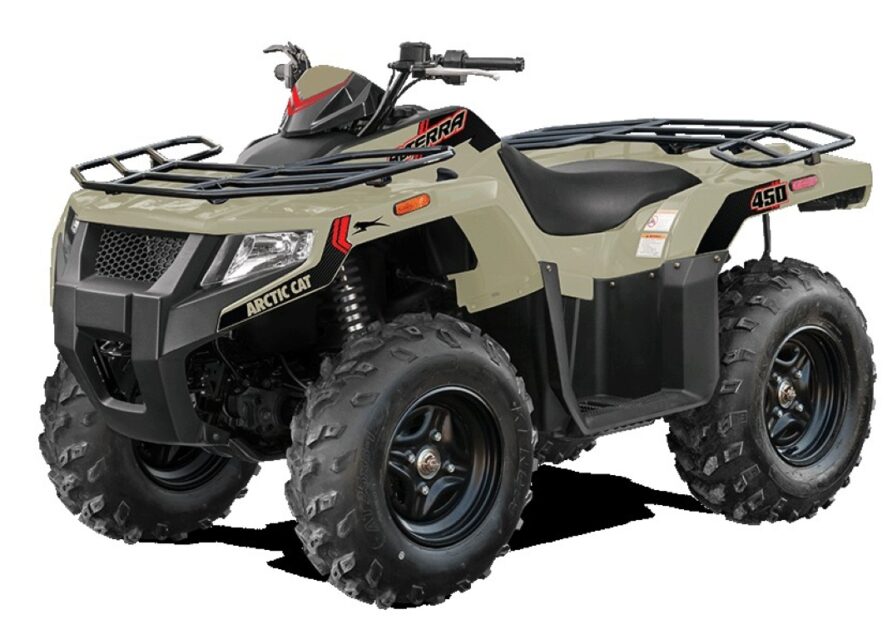
Arctic Cat Alterra 450
2.13
1.12
1.19
278
200
476
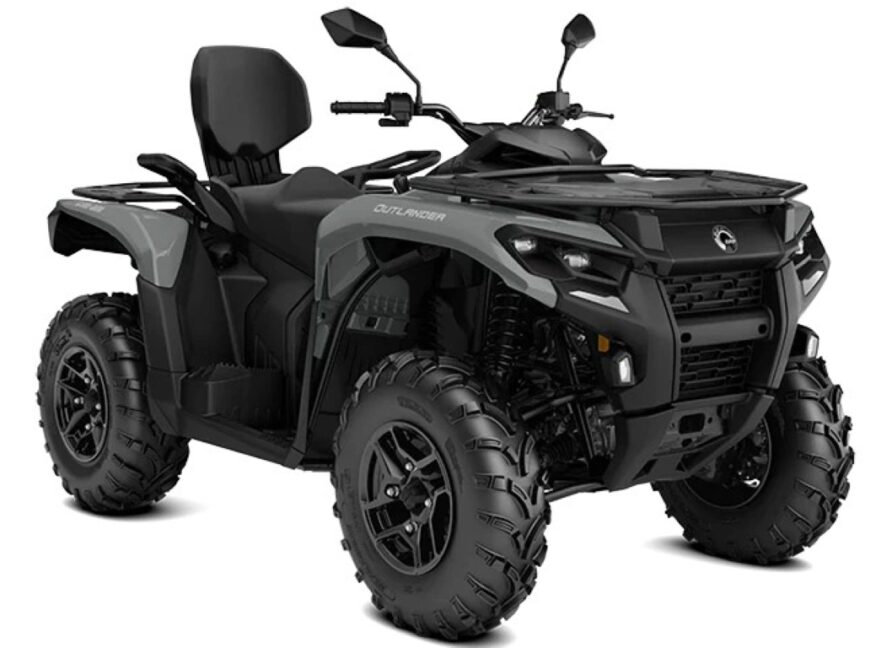
Can-Am Outlander Max
2.39
1.21
1.37
364
263
830
DTV Shredder
1.19
0.69
0.58
114
120
230
Fort IT Horizon
1.99
0.71
Fresia F-18
1.99
1.04
0.85
540
400
500
Geier Series 60
2.18
1.10
2.18
1,180
480
Honda Foreman TRX 520
2.10
1.20
1.21
288
119
384
Kubota B1181
2.36
0.94
2.21
635
540
650
Lennartsfors Flex 2
1.78
1.11
1.12
520
500
920
Mattro Ziesel
1.39
1.22
1.62
350
150
500
Mira Cingolino
1.80
0.91
0.90
590
150
470
MTT-154
2.23
0.58
0.64
290
226
1,400
Polaris MV850
2.44
1.20
1.52
524
270
680
Rokon Ranger
2.01
0.84
1.04
98
272
907
Rokon Range + Sidecar
2.01
1.70
1.04
126
542
907
Suzuki King Quad 500
2.15
1.22
1.20
315
360
600
Vaellan
1.70
1.18
1.10
128
130
150
Yamaha Kodiak 700
2.10
1.18
1.24
311
140
600
The vehicles described above all fit within that gauge.
Arctic Cat Alterra 450
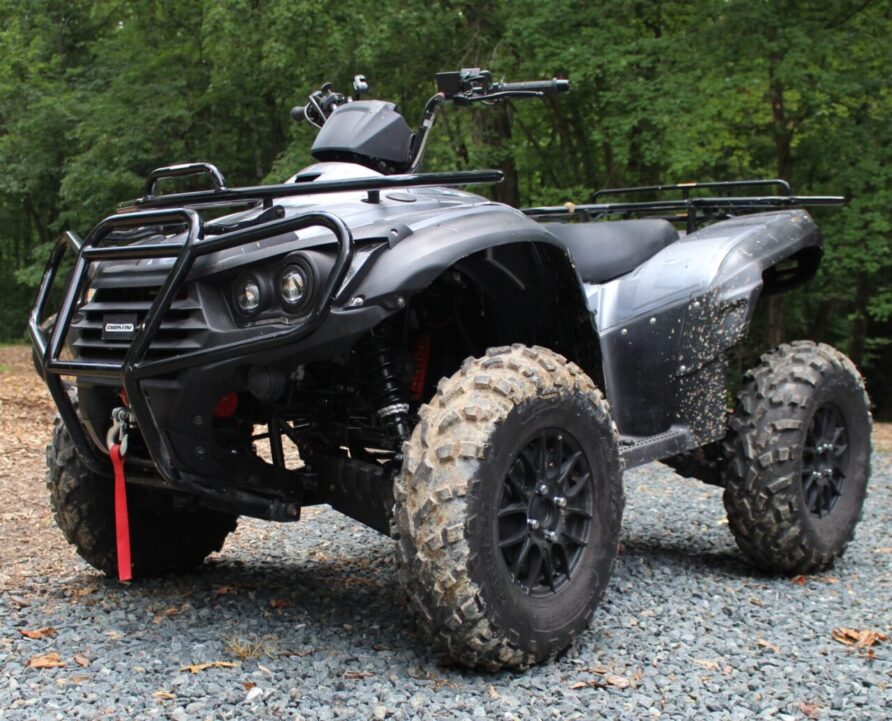
The Alterra 450 from Arctic Cat in the USA is a representative mid-range ATV that uses a 443cc single-cylinder, liquid cooled, EFI engine.
The Alterra 450 has a kerb weight of 278 kg, with a payload of 199.5 kg, and a towing capacity of 476 kg.
Length is 2.39 m and width, 1.21 m, with a kerb weight of 364 kg.
Payload on the front and front rack is 54 kg and 109 kg on the rear.
Towing capacity with a braked trailer is 830 kg, and unbraked, 394 kg.
DTV Shredder
The DTV Shredder, from Canada, is a leisure and utility-tracked skateboard, now available in an electric version.
As can be seen, it is quite compact and easy to transport, less than 600 mm high with the handlebars folded.
With air despatch in mind, three could be carried on a double CDS.
Although it can only carry 120 kg, it can tow approximately 250 kg.
DTV started with a petrol engined version but has now moved to an all-electric drivetrain. This provides 2 hours of run time with a maximum speed of just under 50 kph.
One might be forgiven for thinking it is a toy, and it is certainly mostly aimed at the sports utility market, but its low noise, small size, and reasonable towing capacity means it should not be written off.
The two-hour battery duration is an obvious limiting factor, although they are hot swappable.
Chinese knock-off versions are available, including a sit-down petrol engined configuration.
Fort IT Horizon Tractor
At the other end of the speed spectrum that the DTV Shredder, a tracked sub-compact tractor option is the Fort-IT Horizon
Top speed is slightly more than a snail, but if towing capacity and if good terrain accessibility is a priority, it would be worth considering
Fresia F-18
This vehicle has quite a long heritage, used in mountainous terrain, but the two-seat F-18 is still made in Italy by Fresia.
It can carry 400 kg and tow 500 kg, so in return for lower speed, there is a potential for more capacity in any given combination.
Dimensions are 1.1 m width and 2.1 m length.
With four-wheel steering, the F-18 is quite nimble.
Whilst they are never going to win any speed races, they are faster than a compact tractor.
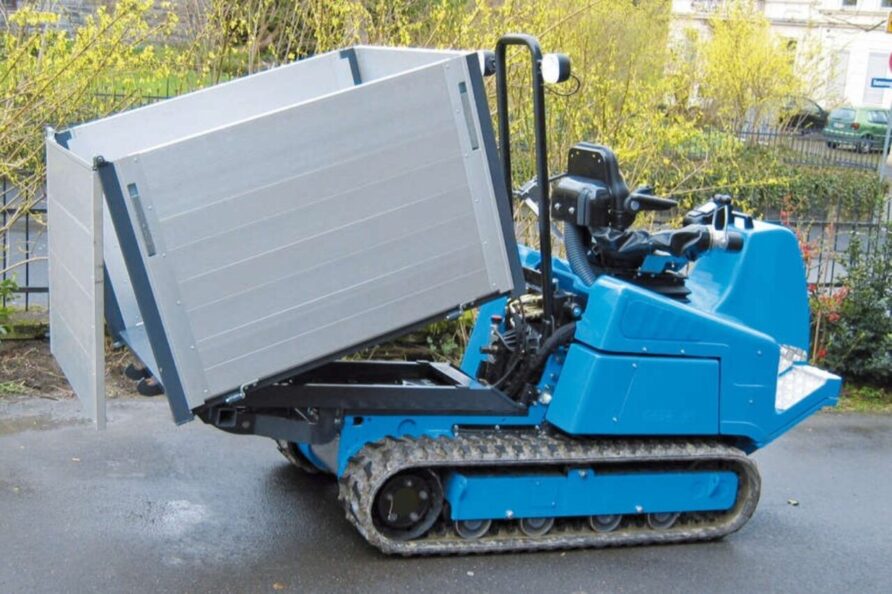
The Geier Series 60 is a specialist tracked vehicle for use in the viticulture industry, steep slops and narrow gaps.
It is 1.1 m wide, 2.18 m high, and weighs 1.18 tonnes empty. With a maximum speed of 10 kph, you would be faster walking, but they have an impressive towing and carrying capacity.
A rear mounted tipping load bed can be fitted, but this would exceed the gauge length.
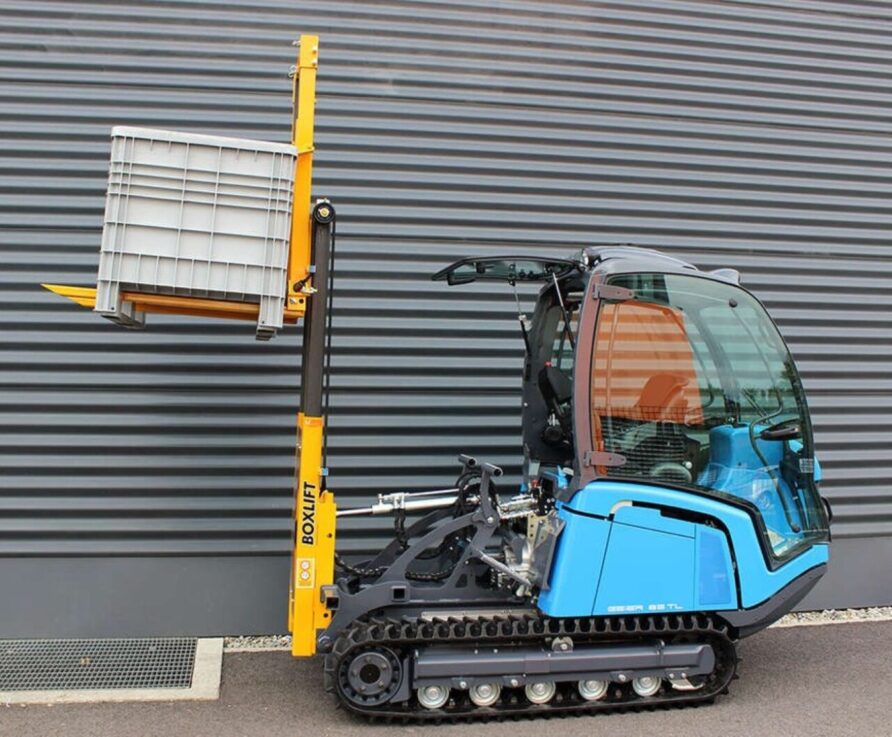
Among the numerous agricultural implements that can be fitted, the forklift would be the most useful in a military context, shown below on the slightly larger 80 series (although the Series 60 can use it as well)
It could be used for unloading pallets or pallet boxes from trucks, and simply drop them at the destination.
With a pallet, the overall length would take it out of gauge, but by using folding forks (unloaded), it is within.
One of the most popular ATVs in the UK, the Honda TRX 520 is 2.1 m long, 1.2 m wide, and weighs 288 kg.
Payload on the front rack is 39 kg, and the rear rack, 80 kg.
The towing capacity is 384 kg.
Kubota B1181
The Kubota B1181 is an example of a wheeled sub-compact tractor, at 635 kg, its midpoint PTO betrays its heritage as a ride-on mower.
At 2.36 m long, it is quite close to the gauge length, but at 0.94m wide, is well within the limit. A road legal version is also available.
The towing capacity is 650 kg.
Sub-compact tractors like the Kubota B1 offer a wide range of front and rear attachments including forestry winches, post drivers, loading shovels, clearance blades, backhoes, pallet forks, demolition grapples, root grapples, plate compactors, and grader blades.
A backhoe could be a useful attachment for digging in.
When fitted, the backhoe and tipper bucket would take it out of gauge, but for transport, they can be moved separately.
These would all need to be carried on a separate CDS pallet for air despatch, and attached once on the ground after de-rigging.
Lennartsfors Flex 2
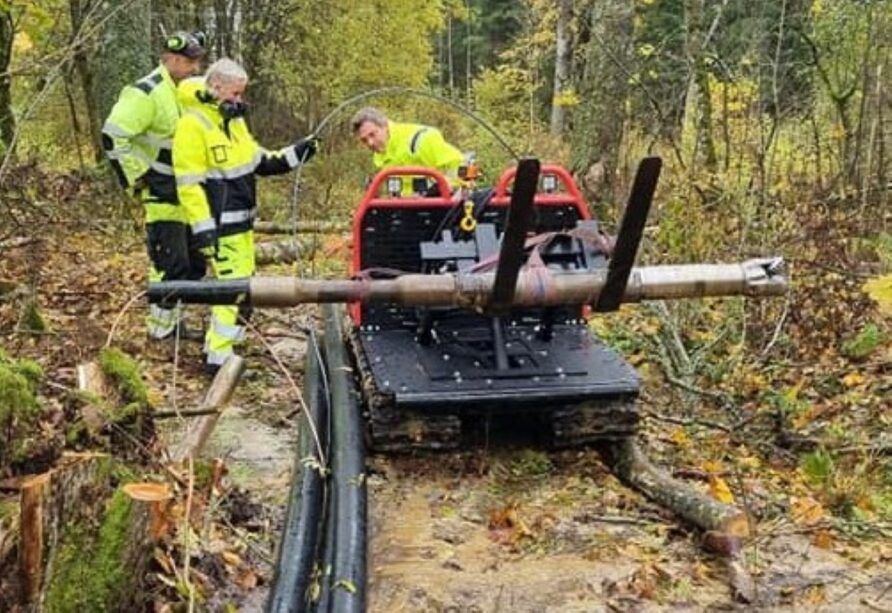
From the forestry industry, the Flex 2 is a stand or walk in front multipurpose vehicle that is mostly used for skidding felled logs through difficult terrain.
It can be fitted with a remote control kit and different attachments, including a load bed and forklift.
Various trailers can also be used.
Including a hydraulic traction assist logging trailer with loader crane.
Like many of these industrial vehicles, it is relatively slow, 7kph.
Length is 1.78m, width 1.11m, and it weights 520 kg, with a towing capacity of 920 kg.
Mattro Ziesel
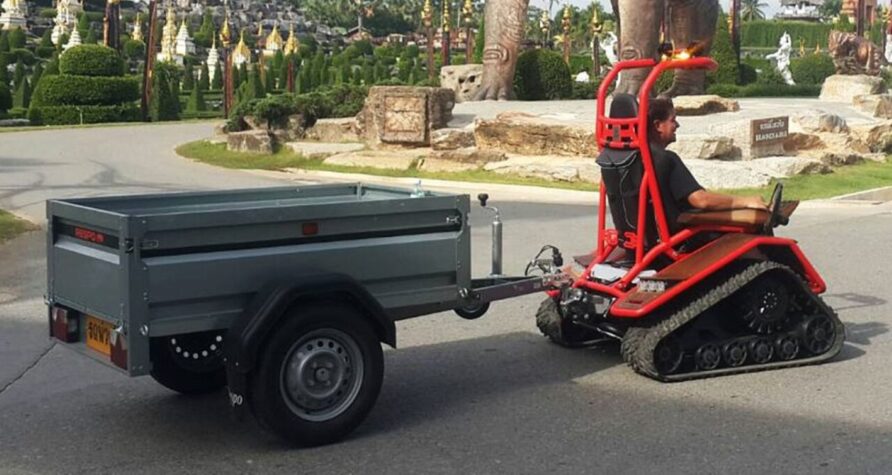
The Mattro Ziesel was originally developed as an off-road wheelchair, but it has been developed by some partner organisations for usage in agriculture
One such example is the Aebi EC-170, which has a front-mounted PTO.
With a 60-degree side slope, low ground pressure, and a top speed of 35kph, they are mobile over extreme terrain. With a low centre of gravity, integral folding roll bar and four-point harness, they are potentially safer than a quad bike ATV, and there is even a road-legal version.
Their towing ability is equally impressive, over 500 kg.
The vehicle is 1.32m long (plus 77 mm for the towing coupling) and 1.22m wide, height to the top of the ROPS is 1.62m.
Like all electric designs, battery life is a key limiting factor to employment, 3 hours for this one.
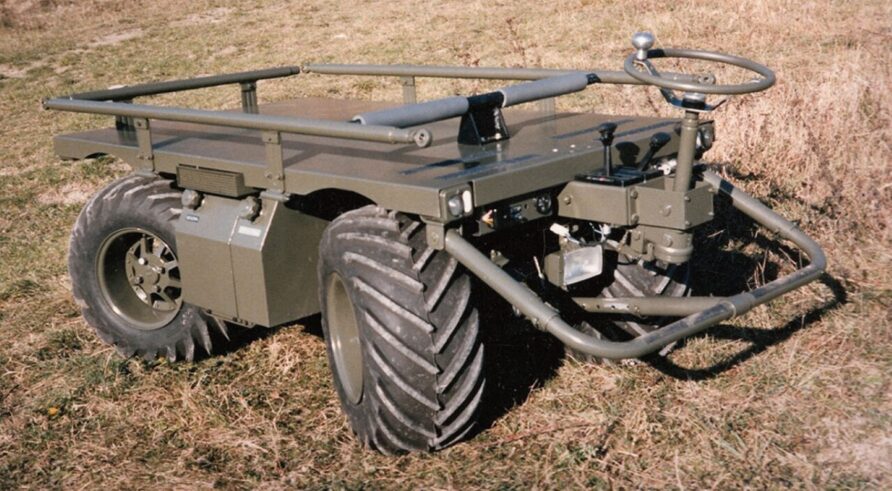
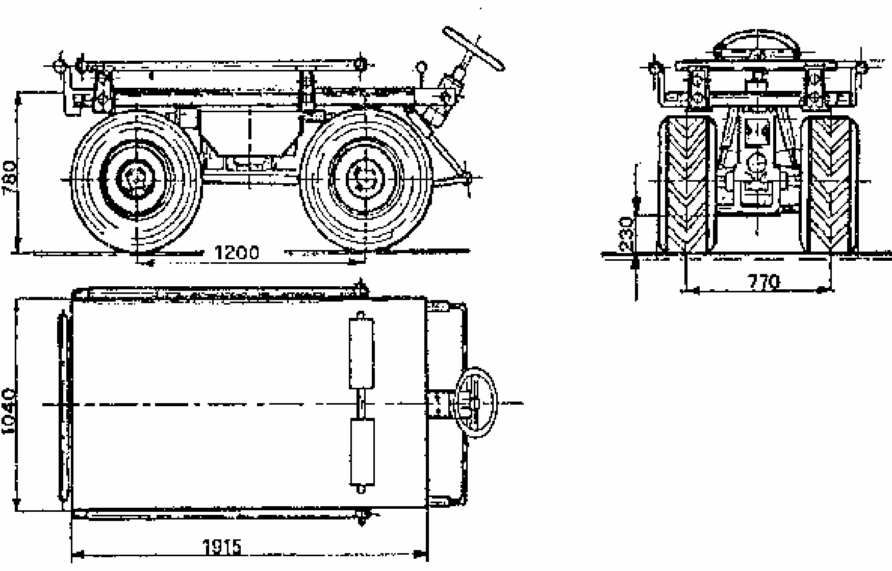
Hawe Mattro has developed a more compact version as a base platform for UGV developers, including Dhiel, as part of the Integrated Modular Unmanned Ground System (IMUGS) demonstration.
It is too wide for CDS, but use a folding chair. Because it is battery-powered, it should be OK to rig vertically so it would fit within the constraints of a double CDS, thus, included in the ‘in gauge’ category.
Mira Cingolino
The Mira Cingolino is a tracked sub compact tractor from Italy.
At 910 mm over tracks wide, 1,800 mm long and weighing less than 600 kg, it would be a comfortable load for a double CDS. Unlike a quad bike ATV, this has a three-point rear lift and a PTO for attachments and tools.
A Rollover Protection System can also be fitted, but it is an excruciatingly slow and noisy ride!
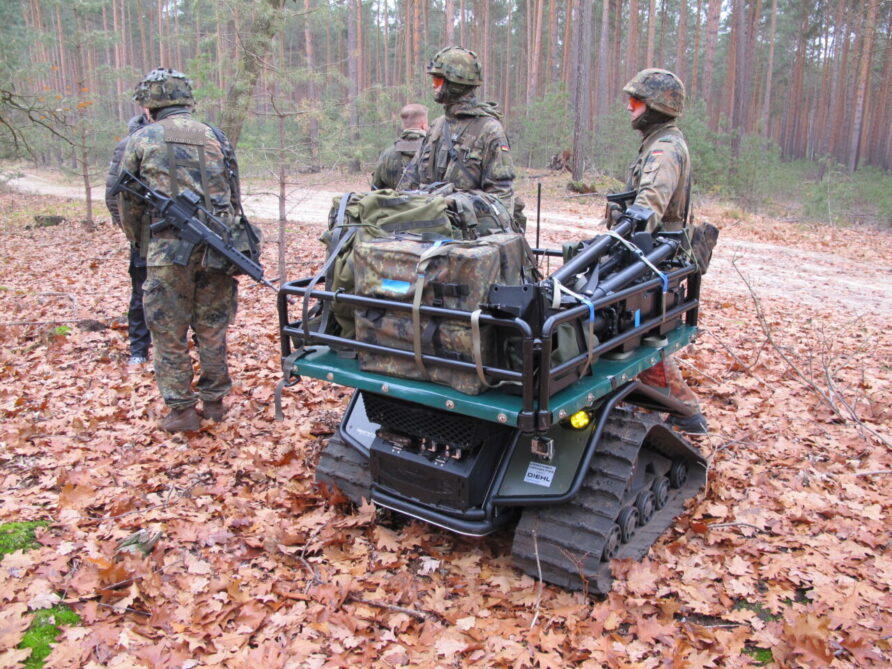
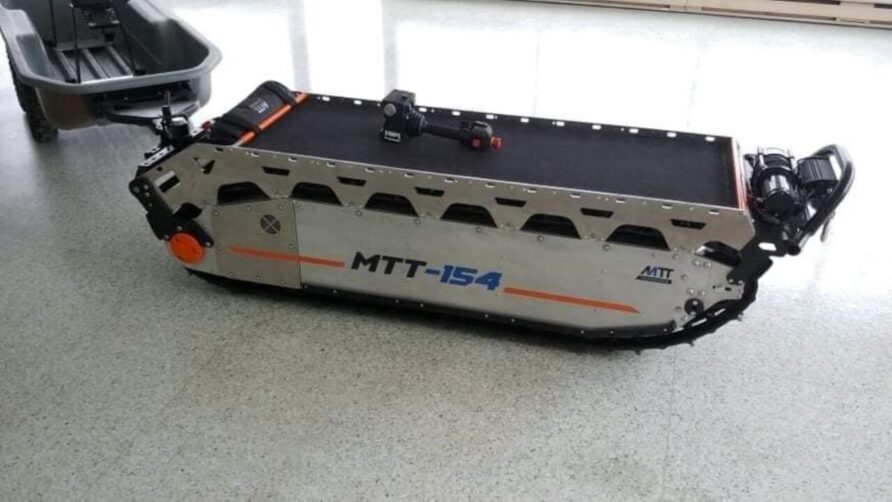
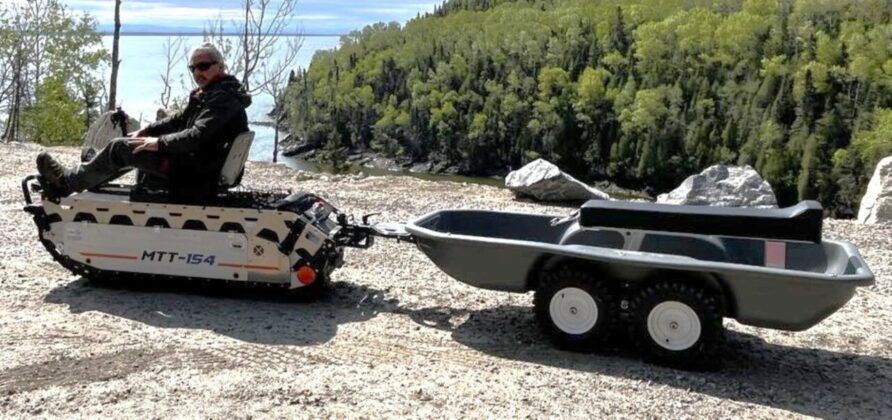
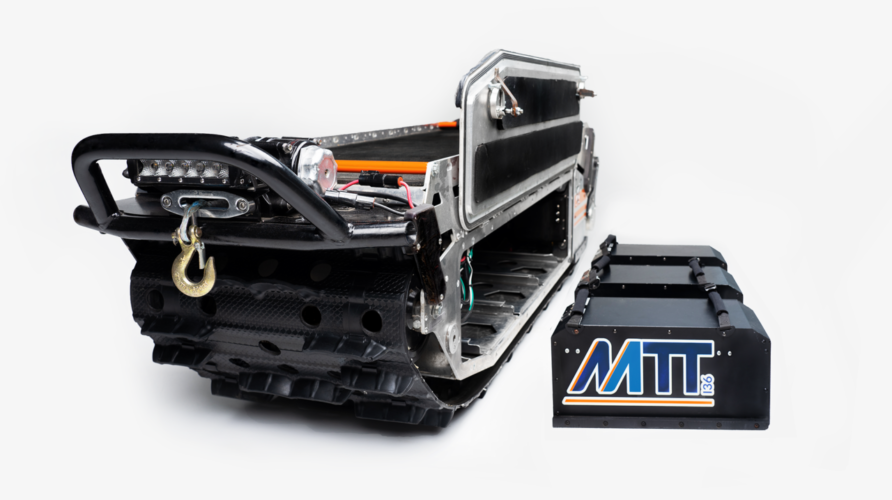
MTT-154
I wrote about this a while ago, and think it is quite an interesting and well-designed concept that sits somewhere between a tracked utility vehicle and a tractor unit.
The MTT-154 is an electric all-terrain tracked ‘tug unit’ that can be used singly or connected, and operated as a ride-on or via remote controls, used to push, pull or carry loads and trailers.
One of the unique aspects of the design is the ability to connect multiple units for a greater payload. They can be connected inline (like a snake), side by side, or in a quad configuration.
The side-by-side configuration can also have a load bed platform between them, similar to the Milrem Themis. The difference between this and the Milrem unit is that the centre is not fixed.
Because they are just under 600 mm wide, they are very transportable.
For example, three could easily be carried abreast in either Merlin or Chinook and because they are only 650 mm high, three can also be stacked. With stacking, a Merlin could carry eighteen, a Chinook, 27, with a couple of tonnes of payload margin, or combinations that include trailers.
When arranged down the centre of the cargo area as a stack of three, on either helicopter, it would leave enough room for seated personnel on the seats, 6 in a Merlin and 9 in a Chinook.
The unit is a single-track device, powered by lithium-ion battery packs. 1 battery provides up to 4 hours (35 km) of runtime, with three allowing up to 12 hours of runtime or a 105 km range.
With three batteries fitted, a single unit weighs 290 kg.
The system can also be used to supply export power for power tools or other battery charging.
Batteries can be quickly swapped, and unlike the two-wheel tractor, cannot be heard from 3 weeks away, top speed is also a more respectable 24kph.
A single unit can carry up to 250 kg on the load bed and tow 1.4 tonnes on a flat surface, reduced to 450 kg in extreme terrain.
The video below shows a double unit towing a ski trailer, the trailer could be used for seating or stores. This configuration would be comfortable for a Merlin.
Polaris Sportsman MV850
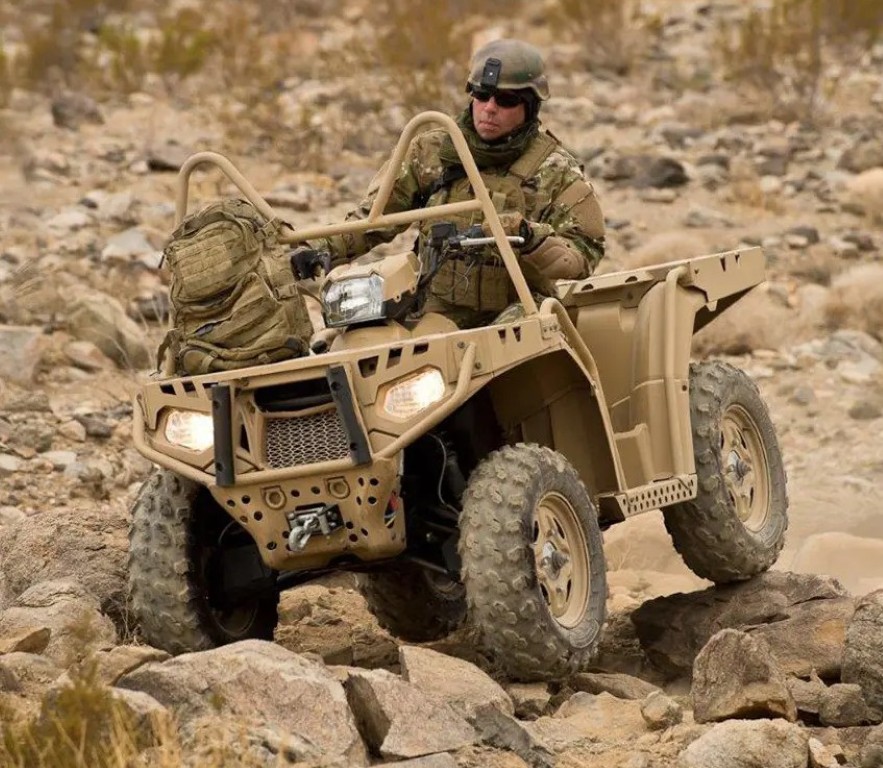
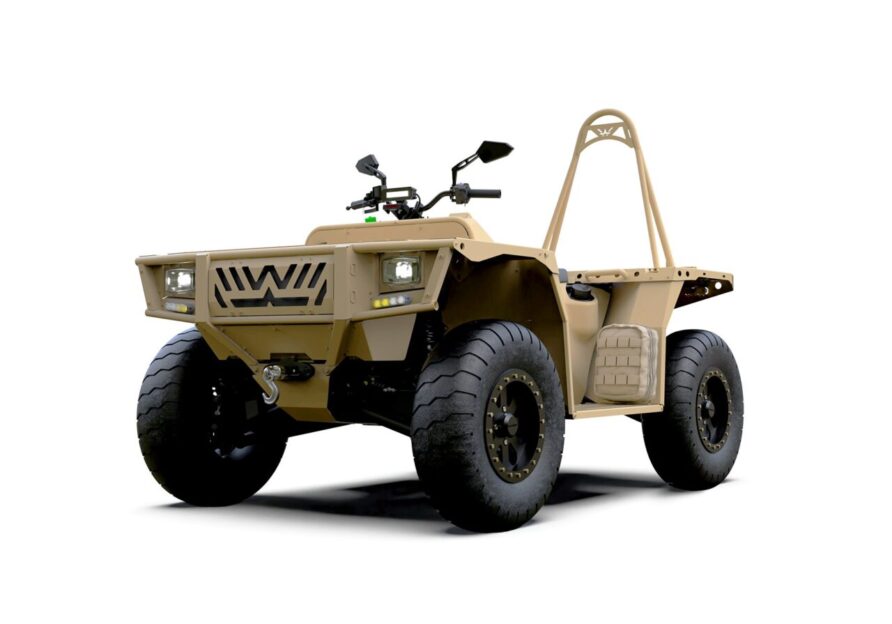
The Sportsman MV850 is a powerful ATV with a designed optimised for defence use.
Towing capacity is 680 kg, with a maximum load of 180 kg on the rear bed, and 90 kg on the front. The kerb weight is 524 kg.
The overall length is 2.44 m, and the width is 1.2 m
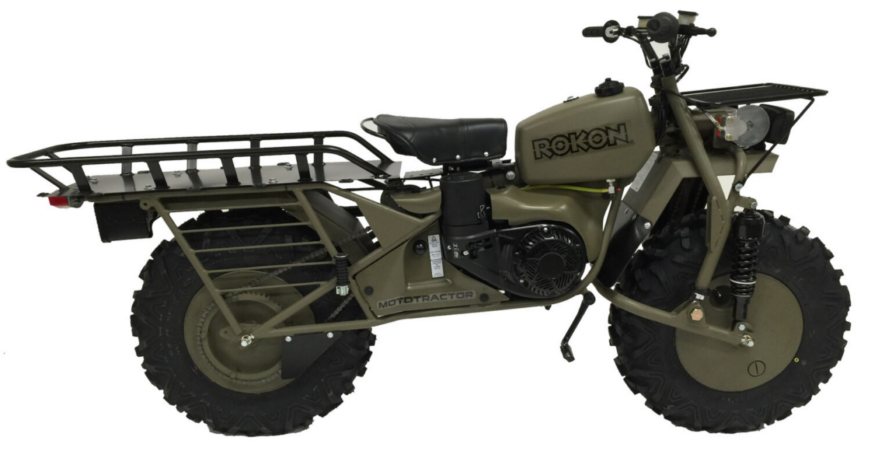
Rokon Ranger Two-Wheel Drive Motorcycle
Addressing this problem of load carriage and terrain accessibility, Rokon has manufactured 2-wheel drive motorcycles for 50 years.
With a focus on torque, load carriage, and traction, they are a practical alternative to a quad bike ATV.
Different models are available that substitute a rear seat for a cargo rack, and the tyres can be filled with water or fuel, both wheels are powered and the 200cc petrol engine can tow 900 kg loads.
There is also a longer wheelbase version available that has an extended load bed called the Mototractor and various sidecars and trailers can be used, including a single-track rescue trailer.
The Rokon lightweight single-track-width trailer could be stacked on top of the motorcycle such that it would not consume any additional floor space when transportation is being considered.
Recently introduced, the Universal Accessory Rail (UAR) is a modular rail system for attaching storage accessories such as ammunition canisters, gun boots, soft storage and toolholders.
The Rokon sidecar can be easily attached using a single quick tun bolt
What makes it attractive, apart from the additional 270 kg payload, is the ability to carry it on top of the motorcycle for transport and then attach it later, great for helicopter internal carriage.
Sorry about the cheesy image!
In the same footprint as a quad ATV, it can carry two people and close to 400 kg of stores, it can also tow 900 kg.
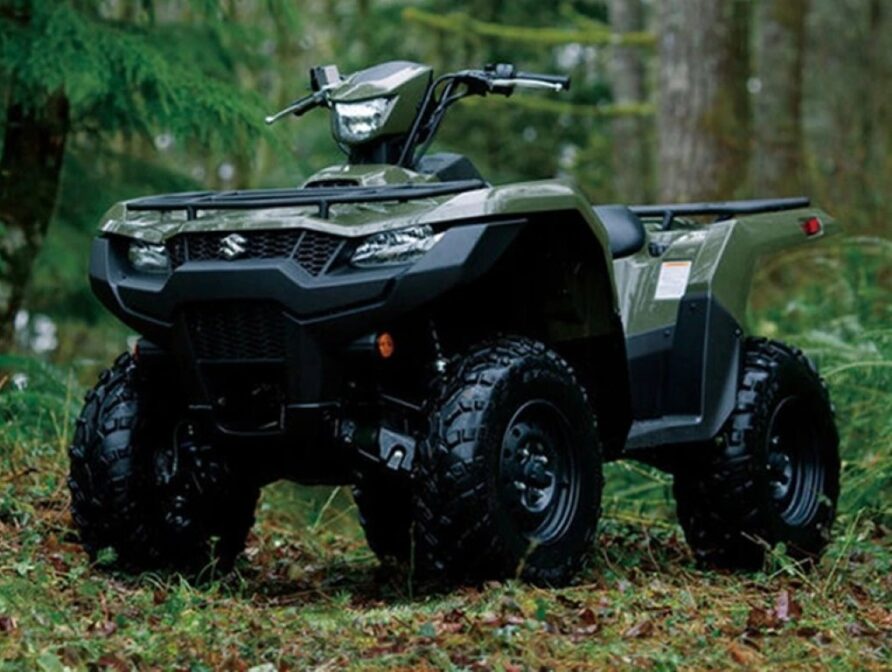
Suzuki King Quad 500
Another popular model in UK markets, the Suzuki King Quad 500 is 2.15 m long and 1.22 m wide, with a kerb weight of 315 kg.
Towing capacity is 600 kg and total payload is 300 kg on the front rack, and 60 kg on the rear.
Vaellan
The Vaellan is an unusual vehicle from Finland that uses a common frame with three driveline options, tracks and skis, tracks and wheels, all wheels.
The tracked only and combination variants would be slightly too wide, but the wheeled variant is 1.7 m long and 1.18 m wide.
Kerb weight is only 128 kg, but the payload is a modest 130 kg.
Last in this section, the Yamaha Kodiak 700 is another popular UK choice.
Designed for industrial and agricultural use, it is 2.1 m long and 1.18 m wide.
The Kerb weight is 311 kg, and it has a payload of 50 kg on the front rack, and 90 kg on the rear.
The towing capacity is 600 kg.
Out of Gauge
Out of gauge vehicles are, basically, those that are slightly larger than the in-service Yamaha 450 and too large for a double CDS pallet.
Vehicle
Length (m)
Width (m)
Height (m)
Kerb Weight (kg)
Payload (kg)
Towing (kg)
Yamaha Grizzly 450
1.99
1.09
1.12
267
210
600
Argo Explorer Pro XRT
2.55
1.29
1.25
554
245
557
Can Am Outlander 6×6
3.17
1.23
1.65
597
363
907
Christini Hybrid ATV
1.90
1.32
1.21
287
102
227
Defenture Skorpion
2.53
1.27
1.49
700
500
380
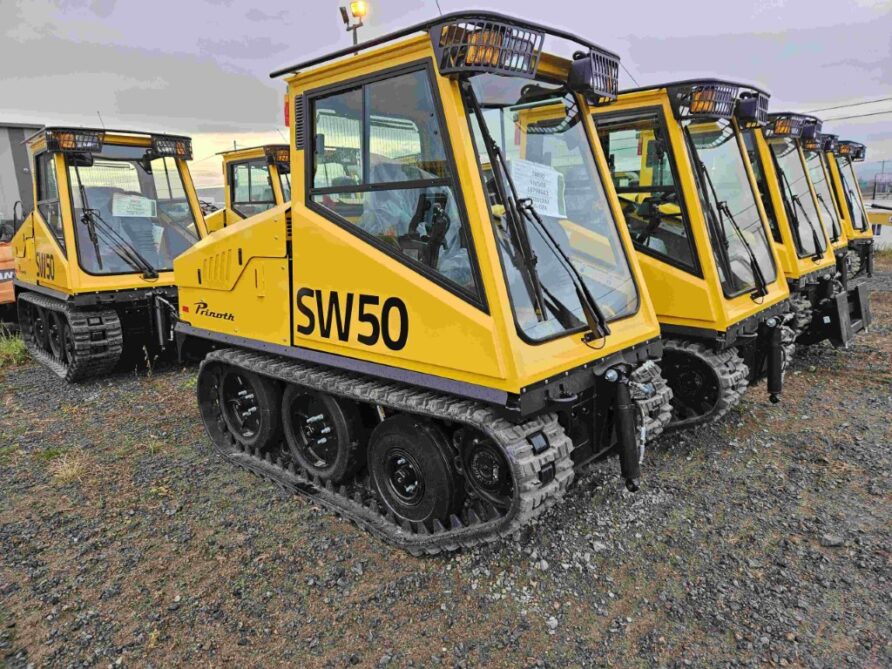
Prinoth SW50
3.23
1.29
2.24
3,061
964
c3,600
Reeq ATV (Ermine)
2.55
1.55
1.5
875
525
750
Yanmar AC21
2.33
1.25
1.82
830
250
c800
Argo Xplorer Pro XRT
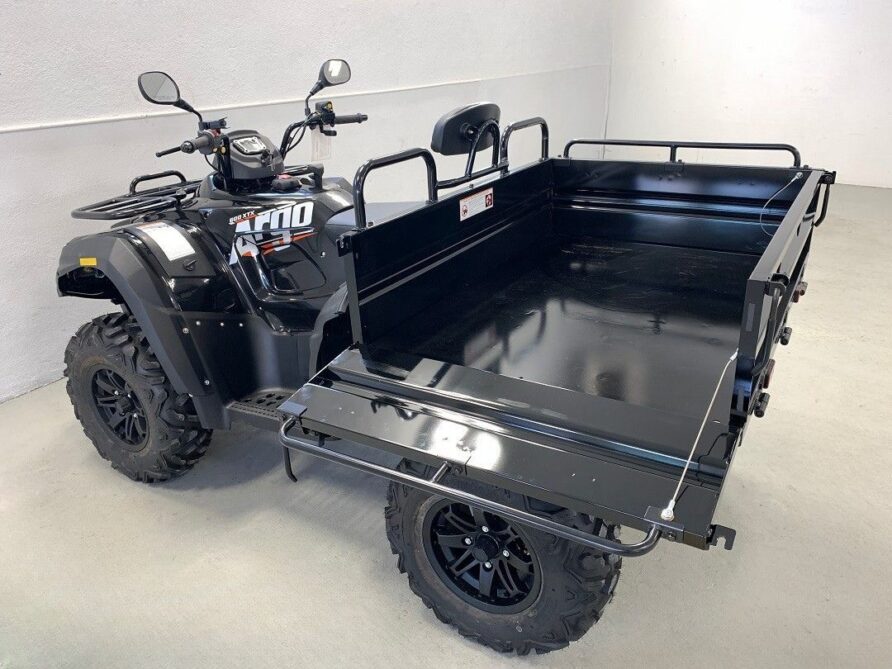
From Argo in Canada, the Xplorer Pro XRT 600 XTX is a conventional ATV with the addition of a tipping load bed.
The load bed has much more usable space than most other similar ATVs.
Length is 2.55m, width, 1.29 m, and it has a kerb weight of 454 kg.
Load capacity on the front rack is 45 kg, and the rear rack, 200 kg.
Towing capacity is 557 kg.
Can Am Outlander Max 6×6 XU+ 1000T
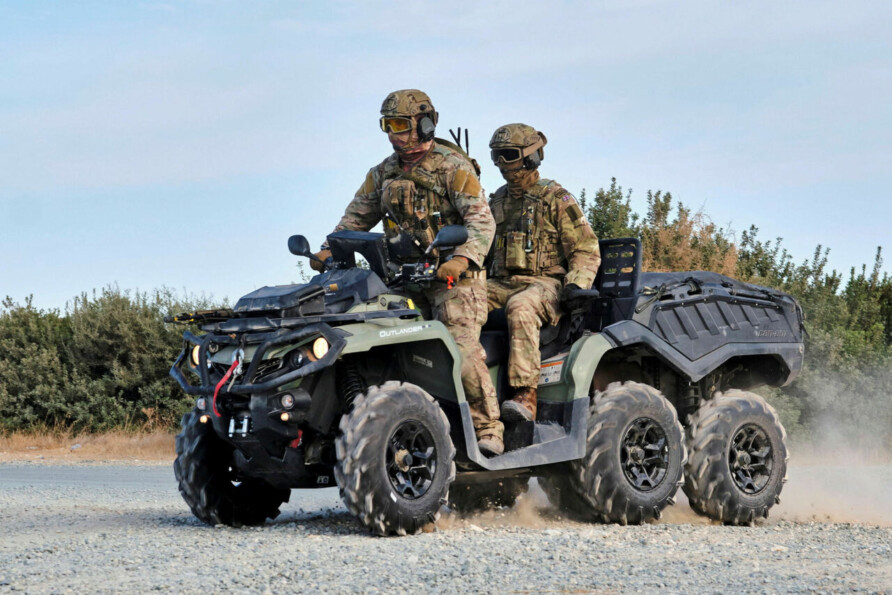
Adding a driven axle to a quad ATV creates a decent load bed size, added passenger seat and larger payload without needing a trailer, the Can-Am Outlander 6×6 is shown below.
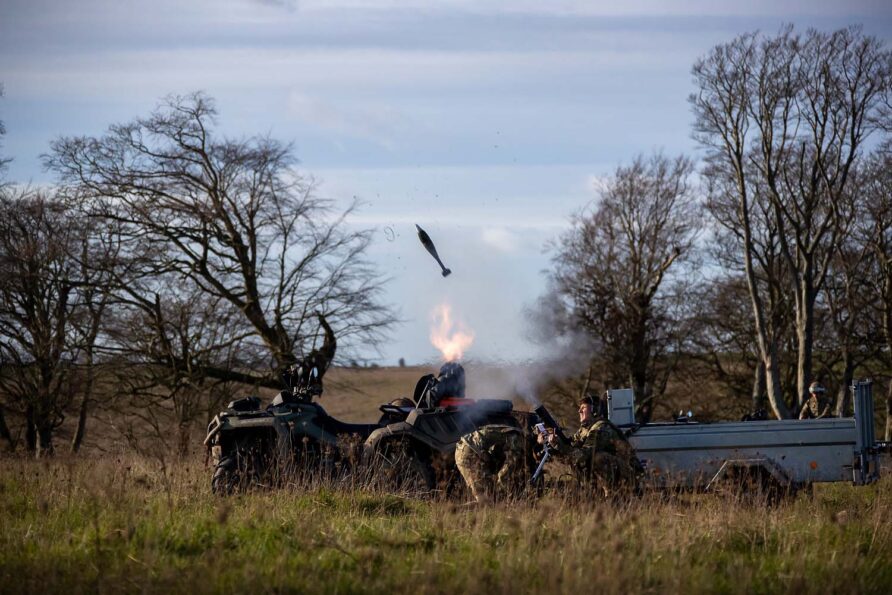
The Can-Am Outlander 6×6 has a tipping rear deck, 45 Commando Royal Marines recently trialledthem with their mortar platoon.
Royal Marines tested their ability to outfox radar using new all-terrain vehicles to move mortars around Salisbury Plain.
Kerb weight is 597 kg, payload on the front rack is 45 kg, and the rear, 318 kg.
Like many similar models, they can be fitted with after market track kits
The towing capacity is 907 kg.
Christini Hybrid ATV
The Christini Hybrid Electric ATV uses four independent hub motors to eliminate the complexity of a traditional drivetrain, and this, coupled with an onboard range extending generator, provides approximately 250 miles (ca. 402 km) of range.
The battery only range is 50 miles (ca. 80 km), and there is enough fuel onboard to recharge four times, whilst in motion.
It also has a power export feature.
Length is 1.9m, but taking it out of gauge is the width, at 1.32m
Kerb weight is 287 kg, with 34 kg payload on the front rack, and 68 kg on the rear.
The towing capacity is 227 kg.
Defenture Skorpion
Based on a Suzuki design, the Skorpion is quite heavy, at 700 kg, but has an impressive 500 kg payload.
Length is 2.53 m and width, 1.49 m.
Unlike most other ATVs, it uses a diesel engine and has 4 wheel steering.
Prinoth SW50
The Prinoth SW50 is a specialist vehicle used for pavement snow clearing.
At 1.285 m wide, it is only slightly out of gauge, although the 3.225 m length would make it far too long for CDS air despatch.
The maximum speed, at 30kph, is lower than most of the more conventional ATVs, but its tracked driveline will provide excellent mobility in poor conditions.
A 3,061 kg, it is also much heavier than other vehicles in this post, but that, and the tracks, mean it would be able to tow a considerably larger and heavier trailer than 4×4 wheeled ATV’s.
The enclosed cab would also be a useful feature in many environments.
Although the ploughs, gritting, and blower equipment would not be fitted in a defence context, the hydraulics, and mounting point could be used for a dozer blade, PTO trailer, or other more useful tools.
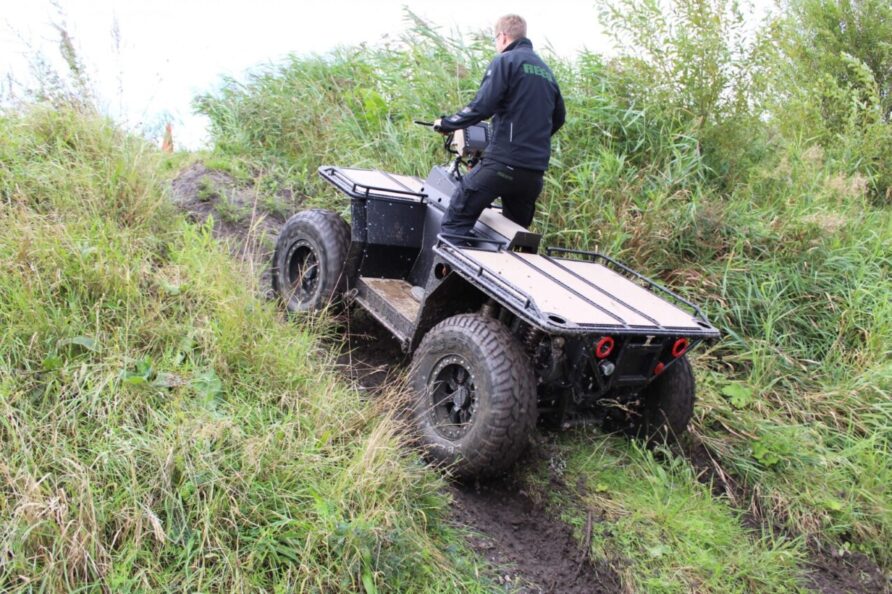
Reeq ATV
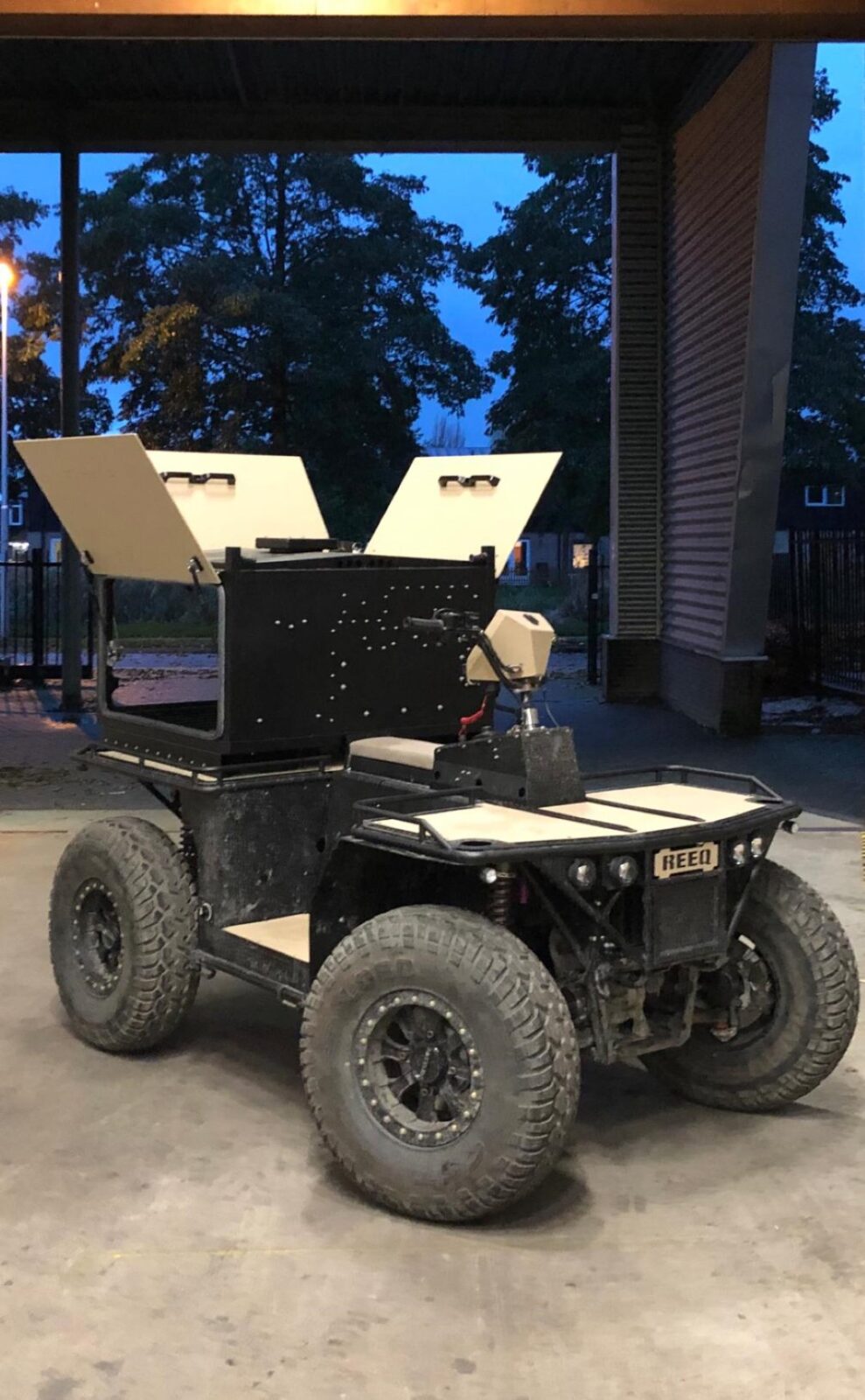
In service with the Dutch armed forces, the REEQ ATV from the Netherlands is available in two models, fully electric and hybrid electric, with the latter having a range of up to 1,000 km (although I suspect that is in ideal conditions)
Reeq was purchased by Rheinmetall, who now market it as the Ermine.
At 750 kg unladen, it is quite heavy for a quad ATV, but it has a relatively large load bed (635 mm x 1,340 mm) that can carry 500 kg.
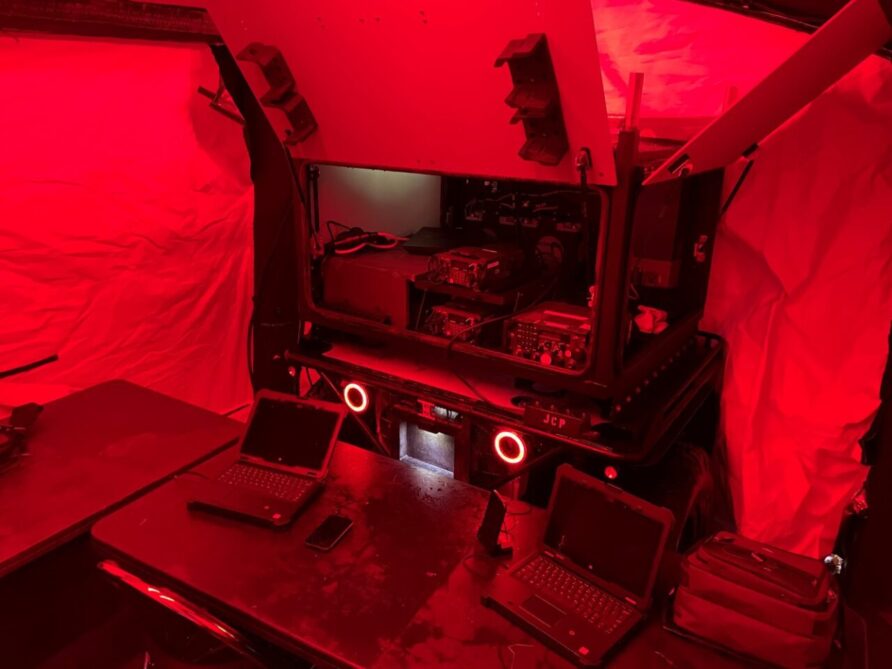
There are electric quad ATVs available now but the REEQ, with its hybrid power system, has advantages such as allowing it to be used silently, including when static as a small command post.
The enclosure holds power and communications equipment, and the shelter itself.
With the shelter erected around it.
A load bed extender and added axle are available, like a Can-Am 6×6, although it is unclear if the rear axle is driven.
Yanmar AC21
I am not 100% sure if Yanmar makes these any longer, but the diesel AC21 (and similar models) was a capable and compact machine, and only slightly out of gauge.
Weighing 830 kg, it was 2.33m long, 1.25m wide, and 1.82m high to ROPS.
It has a rear-mounted PTO, so it could potentially be used with a PTO powered driven axle trailer.
Think Defence is a hobby, a serious hobby, but a hobby nonetheless. I have removed those annoying adverts, but hosting fees, software subscriptions and other services add up.
To help me keep the show on the road, I ask that you support the site in any way you can. It is hugely appreciated.
The opening week of the war against Iran cost the United States more than $11.3 billion, lawmakers were told in a Pentagon briefing, according to a New York Times report underscoring the pace at which the conflict is consuming weapons and resources.
The Times, citing unnamed sources familiar with Tuesday’s closed-door briefing, said members of Congress were told that the figure excludes many costs connected with the buildup to the strikes — suggesting the final tally for the first week could rise substantially.
Defense officials had previously told Congress that roughly $5.6 billion worth of munitions were expended in just the first two days of fighting, according to US media — a burn rate far higher than earlier public estimates.
The Center for Strategic and International Studies (CSIS) independent think tank in Washington estimated that the first 100 hours of Operation Epic Fury cost $3.7 billion — or more than $891 million per day.
Most of these costs, $3.5 billion, had not already been budgeted, the CSIS said.
The Iran War Cost Tracker website, which estimates the cost of the conflict in real time, showed a figure of more than $17 billion on its counter at around 08:00 GMT on Thursday.
According to the site, the United States is spending $1 billion per day on the war.
However, it points out the true cost of the war is likely higher, as the figures do not take into account long-term expenses such as veteran healthcare.
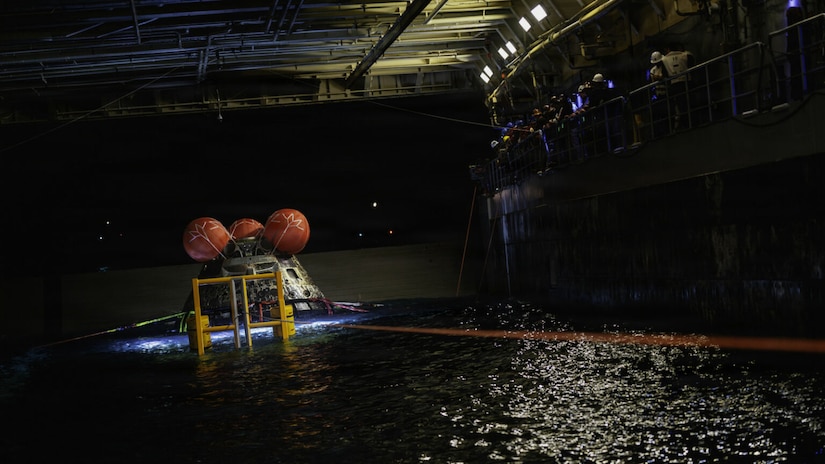
The first faces the Artemis II crew saw upon their splashdown off the coast of San Diego, April 10, were Navy sailors.
Navy Lt. Cmdr. Jesse Wang and Navy hospital corpsmen Senior Chief Petty Officer Laddy Aldridge, Chief Petty Officer Vlad Link and Petty Officer 1st Class Steve Kapala made up the dive medical team that opened the Orion capsule upon its return to Earth.
The team conducted initial medical assessments of the Artemis II crew and assisted them out of the capsule safely and efficiently.
They provided initial one-on-one assistance to Christina Koch, Jeremy Hansen, Reid Wiseman and Victor Glover, respectively. Training was a yearslong process for the four team members, who served as first-contact medical providers inside the capsule.
Often working in expeditionary warfare communities, Navy dive medical personnel are certified divers and undergo specialized training, making them experts in decompression illnesses and other undersea medical considerations. Their mission is to care for and ensure that dive-qualified service members are safe to conduct diving operations.
Following the Orion’s reentry into Earth’s atmosphere and splashdown in the Pacific Ocean, the medical team entered the capsule to conduct initial exams for the crew, provided triage care as necessary and assisted the astronauts in egress onto the inflatable raft set up outside by Navy divers. The first-contact medical providers then prepared the crew to be airlifted by Helicopter Sea Combat Squadron 23 back to the amphibious transport dock ship USS John P. Murtha for follow-on evaluations.
Wang, assigned to Explosive Ordnance Disposal Group 1, served as the lead for the team. From Laguna Beach, California, he is a board-certified emergency medicine doctor by trade, having completed residency training at Lincoln Hospital in New York City. He joined the Navy in 2021 and was designated as an undersea medical officer in 2024.
“As a proud member of the undersea medical community, I am particularly humbled to play a part in this mission,” Wang said. “It is the honor of a lifetime to stand here today, ready to provide the absolute best care to the Artemis II crew.”
Aldridge, from Cushing, Oklahoma, was the first member to make contact with the crew upon their return. Assigned to Explosive Ordnance Disposal Expeditionary Support Unit 1, he opened the capsule, entered the space and began medical assessments.
“Coming from three generations of military service in my family, I’m honored to serve as the senior dive independent duty corpsman for this mission,” Aldridge said. “This effort is the culmination of both our training to bring world-class care to the Artemis II crew and countless dedicated years of Navy diving and Navy medicine.”
Dive independent duty corpsmen like Aldridge, Link and Kapala are specifically trained in dive medicine.
Link, assigned to Explosive Ordnance Disposal Mobile Unit 1, is the third member of the team and hails from Chelsea, Massachusetts. He has 18 years of experience in dive medicine, but he shares that this mission is already a highlight of his career.
“I have been exposed to the Navy since I was a young teenager, and I’m proud to represent both my family and hometown,” Link said. “Contributing our efforts to NASA and the Artemis II mission is something we take great pride in as part of that legacy.”
The fourth member, Kapala, assigned to Explosive Ordnance Disposal Mobile Unit 11, hails from Alpena, Michigan, and has been practicing dive medicine since 2018. He notes the significance of the historical mission as a unified effort, both for himself and everyone involved.
“I grew up reading sci-fi novels and watching space movies, never thinking that I would play a part in a recovery mission like this,” Kapala said. “It is surreal to play a part in safely recovering the astronauts from the capsule to get them home safe to their families; [it’s] an effort that really makes you realize this team is bigger than just the four of us.”
With immense levels of experience and specialized training under their belts, this team of expeditionary medical providers gave the Artemis II crew a warm welcome back to Earth following the 10-day lunar mission.
“Our fellow divers, the sailors on the ship, the helicopter squadron, our partners at NASA and everyone supporting this mission are ready to bring the Artemis II crew home,” Wang said. “This team is undoubtedly making history.”
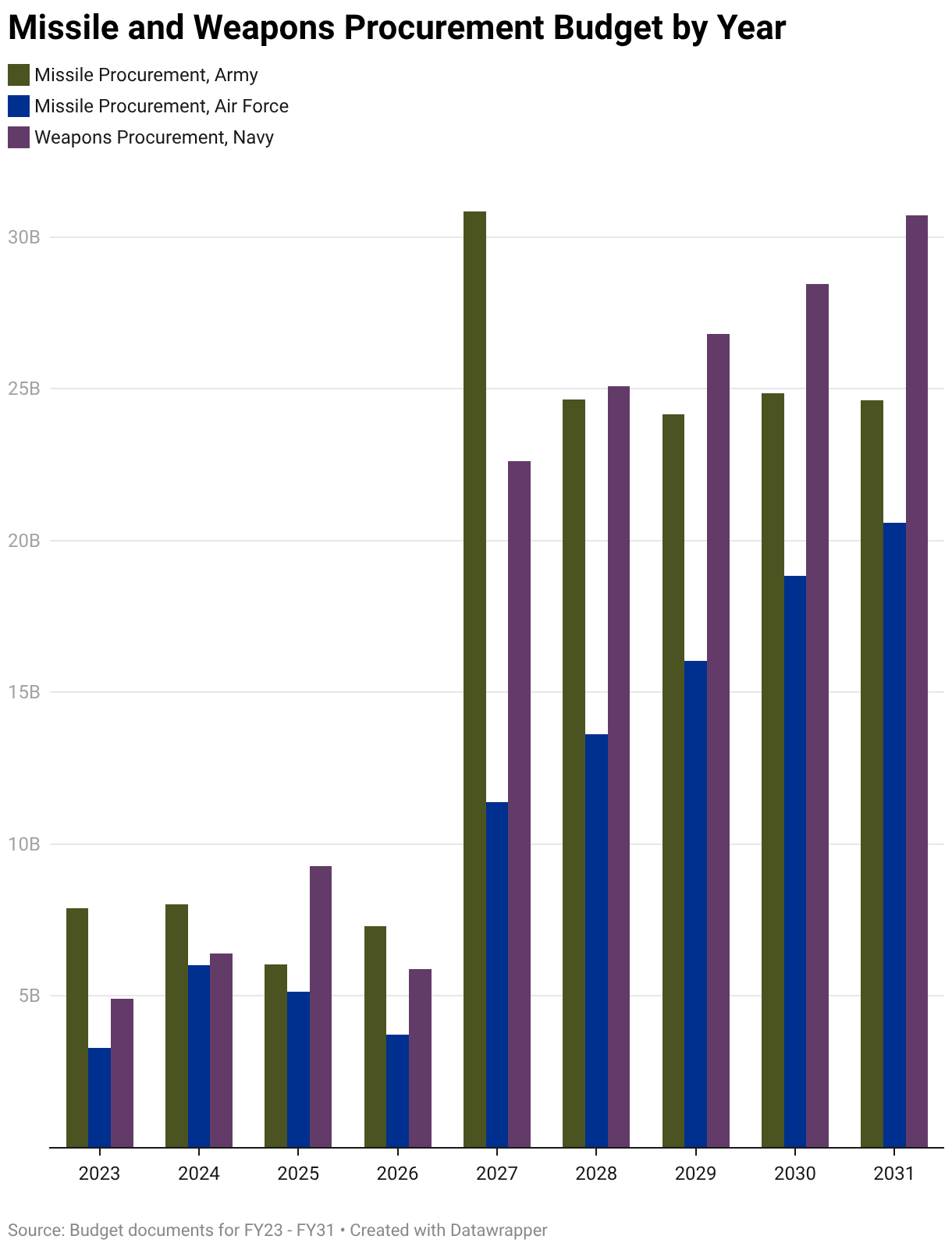
WASHINGTON — The Pentagon’s budget request for fiscal 2027 increases funding for missile procurement by 188 percent — a shocking spike in demand that experts agree completely outstrips the defense industry’s production capacity.
As a result, the experts say, the Pentagon and Congress are likely to provide the ability to spend this year’s funding over multiple years, while sending a signal to industry that munitions are a long-term priority amid global uncertainty.
“I think the Pentagon is viewing this as a generational budget, as something to try and overcome some of the longstanding challenges that existed and to essentially reposition the United States so that it does have the stockpiles it needs in the future,” said Becca Wasser, the defense lead for Bloomberg Economics.
That budget request, delivered to Congress earlier this month, calls for $1.5 trillion in defense spending for FY27 with $1.15 trillion in the base budget request and an additional $350 billion from a forthcoming reconciliation bill. (A separate supplemental funding request for operations in the Middle East could be forthcoming too.)
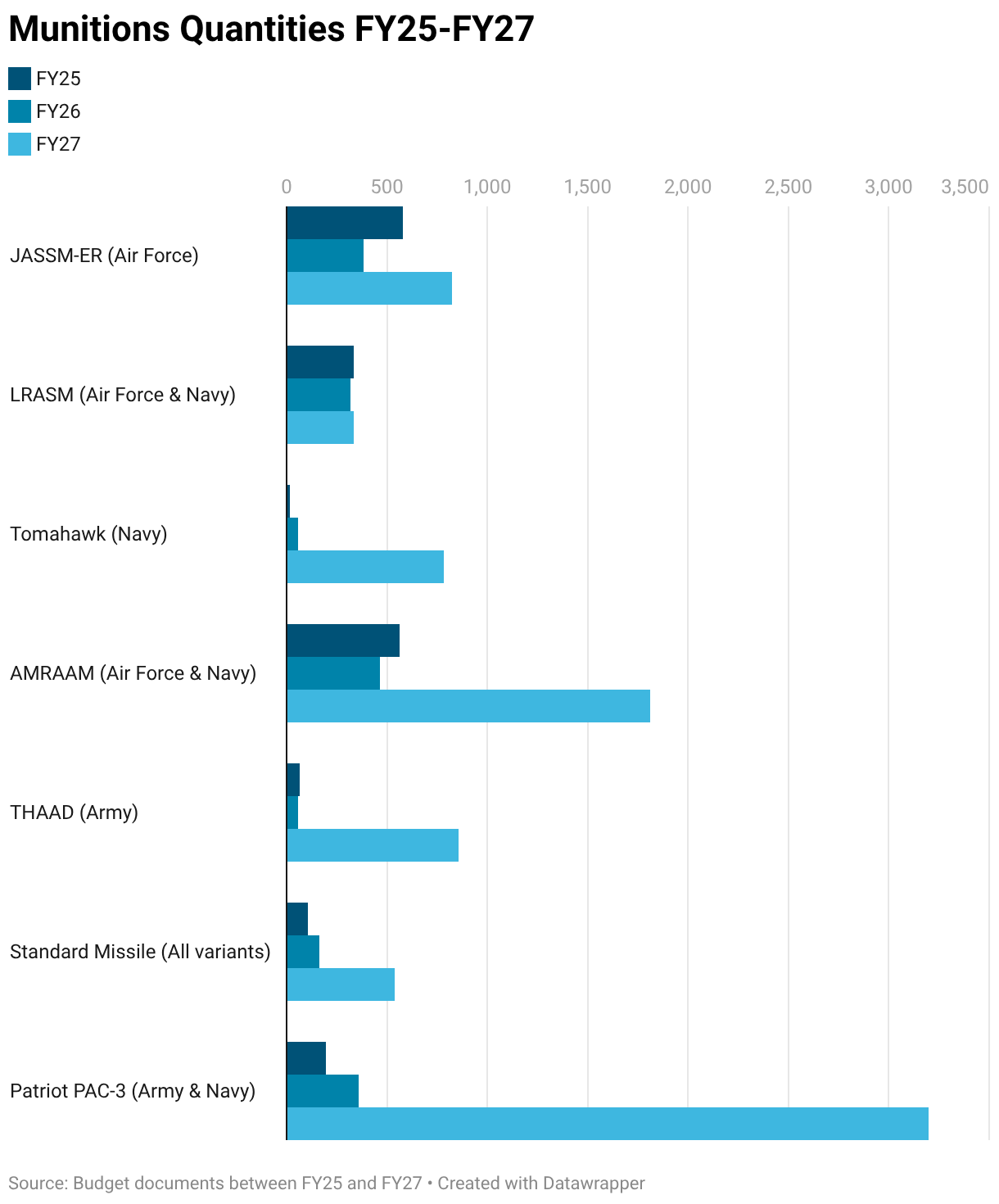
Within that $1.5 trillion plan for FY27, budget documents broadly detail a roadmap for spending approximately $70.5 billion on missiles and other related line items — $36.6 billion for the Army, $22.6 billion for Navy weapons, and $11.3 billion for the Air Force. By comparison, the munitions figures for the three services combined were just under $20 billion in FY25 and $24.4 billion in FY26 — meaning FY27’s request is a 188 percent increase over what was approved for FY26.
“This is a recognition of the fact that there is a munitions gap, that there is a problem with the US not having sufficient levels of some of its higher end munitions and recognition that they would need more, which isn’t something that we always hear from the Pentagon,” Wasser said.
“Ultimately, what this request does,” Wasser said, “[is] it puts the onus on Congress. It says, ‘Here’s what the Pentagon is willing to do. You’ve told us to be more steady in procurement. That’s what we’re going to do. Now you’ve got to fund it.’”
A Gamble
For several years Pentagon leaders have been eyeing ways to boost weapons numbers ahead of a potential military contingency with China, and as they watched Ukrainian and Russian forces burn through munition rounds. That sense of urgency has only intensified as US forces draw deep into stockpiles of key weapons like Tomahawk cruise missiles and PAC-3 interceptors for Operation Epic Fury against Iranian forces.
Those pushes have taken several shapes, including gaining congressional approval to sign multiyear buys for certain weapons such as the Patriot Advanced Capability-3 (PAC-3) Missile Segment Enhancement interceptors.
And, more recently, the Pentagon has inked a series of framework deals designed to boost munition production over the next seven years by having companies invest in their manufacturing facilities for programs like PAC-3 interceptors, the Precision Strike Missile (PrSM), and seekers for both Terminal High Altitude Area Defense (THAAD) interceptors and PAC-3 interceptors. While subsequent production contracts to actually buy more of those weapons have not yet been finalized, the Pentagon on Thursday awarded Lockheed Martin a $4.7 billion undefinitized contract action to begin work associated with the framework deal.
The Pentagon has not yet released budget justification documents that could provide additional details on how the department will structure buys, and the services did not directly answer Breaking Defense’s questions about weapon spending plans.
But Tom Karako, a missile defense expert with the Center for Strategic and International Studies, said the FY27 budget request likely includes funding that will be spread over multiple years, as the huge production increases laid out in FY27 simply cannot be achieved in a single year.
As an example, he pointed to the Terminal High Altitude Area Defense (THAAD) interceptor line. In FY26, 55 interceptors were funded, a number that mushrooms to 857 in FY27.
The budget request also includes funding for 785 Tomahawk missiles — broken into 58 Tomahawk missiles in the base budget and another 727 in reconciliation. That sum is a whopping 1,327 percent increase from FY26, when the Navy procured 55 Tomahawks, itself a major boost from 20 units in FY25.
“They can’t buy that many in a single year, and [Tomahawk-producer] Raytheon can’t produce that many at once,” said Todd Harrison, a defense budget expert with AEI. “But the intent is they will have the money there so that they can go to Raytheon and say, ‘Hey, we want to place a big order. We know you can’t build them all at once, but we want you to expand your production and we already have the funding. We can now guarantee this to you.’”
“It’s even better than a multiyear procurement,” Harrison added, “because in multiyear procurement, you still have to wait for future appropriations.”
Several analysts also emphasized that roughly $40 billion, or around 55 percent, of the munitions request is being sought through reconciliation, which opens more flexibility to the services because that “mandatory” funding is available over a longer period than is typical for discretionary funds.
“Things they put into reconciliation, they tend to be things where they are essentially pre-funding acquisition,” said Harrison.. “It’s things where they know they’re not going to be able to buy that many of that item at once in one year. But they also know that reconciliation money, unlike regular appropriations, is available for longer.”
But getting a second reconciliation bill over the finish line before Democrats likely reclaim a chamber of Congress in the upcoming midterm elections will be a strategic “gamble,” Karako said.
“The plan for reconciliation is a little bit of a risk, but I think it’s probably a good one, because [including the weapons] makes it a must-pass. But the gamble of putting the things that we really need the most into the reconciliation makes it harder to vote against,” he explained.
But Harrison noted that while the munitions budget is typically an area where there is bipartisan support, deep cuts to the nondefense budget and the overall scale of the defense budget boost could result in more “hangups” on weapons spending.
What The Budget Buys
The Pentagon’s Munitions Acceleration Council has identified a dozen or so munitions as “critical,” many of which could receive a large windfall in FY27. That includes eight munitions Congress approved multiyear procurement authority for in the FY26 appropriations bill:
PAC-3 MSE: These Patriot missiles could jump from 357 rounds on the books for FY26 for just the Army to 3,203 in FY27 for the Army and Navy — nearly a nine times hike.
Standard Missile-3 and Standard Missile-6: When it comes to all varieties of the Standard Missile, the department received funds for 166 of those weapons in FY26 but is now looking to boost that to 540 in FY27, of which 434 would be funded through reconciliation.
Long Range Anti-Ship Missile (LRASM): The Air Force and Navy plan to buy a total of 333 LRASMs next year, a slight bump up from the 314 total for FY26.
Joint Air-to-Surface Standoff Missile Extended Range (JASSM-ER): The Air Force wants funding for 821 rounds, up from the 381 count included in the FY26 budget.
THAAD interceptors: The Army is requesting funds to cover 857 THAAD interceptors in its FY27 budgets, with 830 included in reconciliation, a large increase over the 55 interceptors budgeted for the year before.
Advanced Medium Range Air to Air Missiles (AMRAAM): The Air Force and Navy are hoping to fund 1,811 AMRAAMs in FY27 with the bulk coming from reconciliation funding. If approved, that would nearly quadruple the number of 464 AMRAAMs greenlit in FY26.
Tomahawk Cruise Missiles: The Navy is requesting funding for 785 Tomahawk missiles with 58 missiles placed inside the base budget and another 727 in reconciliation. That sum is a 1,327 percent increase from FY26, when the Navy procured 55 Tomahawks.
Spokespeople for both RTX and Lockheed Martin did not directly address questions about how their respective companies could meet the missile and interceptor numbers detailed in the FY27 budget request.
RTX, instead, referred to previous statements that the company plans to spend $3.1 billion on capital expenditures in 2026, while Lockheed said it has invested more than $7 billion since President Donald Trump’s first term to expand capacity for priority systems.
“Lockheed Martin is planning a multibillion-dollar investment over the next three years to expand production and build and modernize more than 20 facilities in Arkansas, Alabama, Florida, Massachusetts and Texas,” a company spokesperson said. “This includes upgrading existing facilities and incorporating advanced manufacturing techniques, production lines, tooling and plant layouts to meet urgent production demand.”
Ultimately, Congress is going to have to take a serious look at what industry can actually deliver before it signs off on such a historic spending plan, said Carlton Haelig, a defense budget expert at the Center for a New American Security.
“I would suspect that right now there is an extreme delta between what the department expects on an annual basis and what industry is able to produce with the supply chains and the manufacturing pipelines that they have in place right now,” he said. “I fully support the amount of munitions being requested. I think it’s the right call. But we need to start talking about the defense industrial base support for that request.”
And there are already signs that Congress is hungry for more information about the Pentagon’s planned munitions ramp up, thanks to language included in the FY26 appropriations legislation that requires the Pentagon to provide two reports on the state of the industrial base.
First, it requires the department to submit a classified report on expended munitions to the congressional defense committees, while also requiring a second unclassified report asks the department to detail the maximum production rates for critical munitions achievable by the industrial base.
A Senate staffer told Breaking Defense that neither report has been sent to Capitol Hill yet, but that both are expected to be delivered later this month when the Pentagon issues detailed FY27 budget justification documents.
Ultimately, Wasser said, the Pentagon, Congress and industry are all going to have to have honest conversations about what is and isn’t possible, or lose the chance for a historic plus-up that could redefine the country’s arsenal for years to come.
“Do they have additional floor capacity? Do they have the supply chains that can enable this level of production?” she said. “And for munitions, I think we’re going to see solid rocket motors and seekers continue to be really significant bottlenecks, and I’m not sure that there’s a dollar figure that can overcome those bottlenecks.”
Michael Marrow, Carley Welch and Diana Stancy contributed to this reporting.
The US‑Iran peace talks supposedly brokered by Pakistan in Islamabad ended without agreement after a marathon 21 hours of negotiations on Saturday 11 April, with the American delegation departing after presenting what it described as a final and best offer.
Vice‑President J.D. Vance, who led the US team, declined to disclose the detailed terms and said he would not continue negotiating in public after the prolonged private discussions, but he made clear that the central sticking point was Iran’s nuclear programme.
Vance insisted the United States required an explicit, long‑term commitment from Tehran that it would not pursue a nuclear weapon or the means to assemble one quickly, framing that demand as the core objective of President Donald Trump and the purpose of the negotiations.
He argued that Iran’s previous enrichment facilities had been destroyed and posed a rhetorical question about whether Iran possessed the will to forgo a nuclear weapon in perpetuity; he answered that question in the negative, saying the US had not yet seen such a fundamental commitment.
Vance characterised the US delegation as having negotiated in good faith, describing his team as “quite flexible” and “accommodating”, and said they had made their best efforts at the President’s instruction to secure a deal.
When asked whether frozen Iranian assets had been part of the discussions, Vance confirmed that that issue and many others had been raised, but said the parties could not reach a point where Iran would accept the US terms.
Iran, for its part, has repeatedly maintained it is not seeking an atomic bomb. Iranian state media reported that Tehran blamed what it called the United States’ unreasonable demands for the failure of the Islamabad talks.
Iran’s state broadcaster IRIB said the Iranian delegation had negotiated continuously and intensively for 21 hours to safeguard national interests, and that despite various initiatives from Tehran, the American side’s demands prevented progress and brought the talks to an end.
Press TV, Iran’s news network, reported that a range of issues were on the table during the talks, including tensions around the Strait of Hormuz, which remained among the points of contention between the delegations.
The article also recalled that the US and Israel had struck sensitive Iranian sites both during the war that began on 28 February and in the previous year, a context that underpins the deep mistrust between the parties.
Asked about contingency plans should the talks collapse or if Iran refused to reopen the Strait of Hormuz, President Trump said there was no “plan B”, asserting that Iran’s military had been defeated, that its missile and manufacturing capabilities were severely diminished, and that US forces had “hit them very hard”.
Taken together, the public statements after the Islamabad meeting underline a wide gap between Washington’s demand for an unequivocal, long‑term renunciation of nuclear weapons and Tehran’s insistence that it is not pursuing a bomb, with other strategic issues such as frozen assets and maritime security adding further complexity and preventing a breakthrough.
President Donald Trump’s threats to destroy power plants and bridges in Iran before saying he was prepared for a “whole civilization” to die have renewed questions about what constitutes an illegal order and what, if any, repercussions officials could face for committing war crimes.
The issue originally surged to the forefront last year when the Trump administration repeatedly struck boats in the Caribbean officials alleged were carrying illegal drugs. Democratic lawmakers with backgrounds in the military and intelligence community then published a video reminding troops they “can” and “must refuse illegal orders.”
“No one has to carry out orders that violate the law or our Constitution. We know this is hard and that it’s a difficult time to be a public servant,” they said. “But whether you’re serving in the CIA, in the Army, or Navy, or the Air Force, your vigilance is critical.”
The issue of legal versus illegal military orders surfaced again this week when Trump escalated his threats against Iran, leading to bipartisan condemnation from members of Congress before he gave that country’s leaders two more weeks to negotiate.
But what exactly violates international law or rises to the level of a war crime is often murky, as is who would be willing to prosecute U.S. troops, according to experts interviewed by States Newsroom.
Rachel E. VanLandingham, professor of law at Southwestern Law School in Los Angeles and a former judge advocate in the U.S. Air Force, said that “at the end of the day, the law of war does allow for a great deal of violence and a great deal of civilian suffering.”
But several of the threats Trump has made, including to destroy power plants and bridges in Iran, would likely violate the law if the military were to carry them out, she said.
“Under no stretch of interpretation would that be lawful, right? Because that just fails to distinguish whatsoever the civilian objects versus lawful military objectives, even if we stretch the definition of what’s a lawful military objective,” VanLandingham said.
The boat strikes in the Caribbean, including the decision to order a second strike on two survivors, could also have been illegal, she said.
VanLandingham doesn’t expect the Trump administration will hold anyone accountable for actions the military has already taken or may take. But she noted there is no statute of limitations on the charges that would likely apply under the Uniform Code of Military Justice for military members or the War Crimes Act for anyone not subject to the military justice system.
“The next administration could come in and investigate our service members for alleged war crimes. And they should, to demonstrate renewed fidelity to U.S. law, to the law of war,” she said.
Congress doesn’t have the authority to prosecute anyone for violating the law, but could hold oversight hearings with Defense Department officials, a scenario that would become more likely if one or both chambers return to Democratic control following the November midterm elections.
“They can have public, open hearings and drag in every single military member that was involved in the chain of command of orders for striking Iran, if they wanted to,” VanLandingham. “That’s not a criminal prosecution, but it’s transparency.”
Lawmakers could also provide more funding and require the Pentagon to reinstitute the Civilian Harm Mitigation Program, which she said “the Trump administration has gutted.”
Geneva Conventions
Leila Sadat, the James Carr Professor of International Criminal Law at WashU Law School in St. Louis, Missouri, said that in a situation where the president directs the military to violate the laws of war, it’s highly unlikely military commanders or the Department of Justice would then turn around and prosecute those actions.
Even if a prosecutor were to try, Trump would likely be insulated from any domestic prosecution for “official acts.” And as president he could issue preemptive pardons for any military members he believes could face future prosecution, either in the military or civilian justice system.
Trump has a history of absolving military members accused of violating military law, including in 2019, when he pardoned two officers in the Army for actions in Afghanistan and restored the rank of a Navy Seal who had been demoted for his conduct in Iraq. Trump later pardoned four contractors for killing more than a dozen Iraqi civilians in 2007.
But those protections only apply within the United States.
The Geneva Conventions’ provision on universal jurisdiction would apply internationally and any country could choose to prosecute.
“Now you still have to catch them, you have to get the evidence, but every state in the world is a party to the Geneva Conventions,” Sadat said. “So committing violations of the Geneva Conventions by attacking civilian objects, by attacking marketplaces, or hospitals, or schools, or electrical infrastructure, those kind of crimes can be prosecuted by every country in the world. So people should think about it before they do it.”
France, Germany, and Sweden have all used the principle of universal jurisdiction to prosecute Syrians for crimes they committed during the war in their home country, she said.
“The one debate is, do you have to have the person on your territory before you can go forward? Or can you do an investigation even if the person is not on your territory?” Sadat said. “And many have argued that you can do the investigation even if the individual is not on your territory. Different countries have different rules on whether they accept trials in absentia.”
Sadat said that gets a bit more complicated when the Status of Forces Agreements that give the U.S. jurisdiction over alleged wrongdoing by U.S. troops in dozens of countries come into play.
Sadat, who was a special adviser on Crimes Against Humanity to the International Criminal Court Prosecutor from 2012 through 2021, said if the U.S. military were to carry out some or all of the threats Trump posted to social media, that could have led countries to reconsider those agreements.
“It could create a huge security problem for the United States eventually. And that’s why I hope calmer heads are prevailing. Saying, ‘You know, there’s an entire complex web of treaties and agreements,'” she said.
Trump would also likely pressure countries not to try U.S. military members for violating international law, but he may not always be successful, she said.
“Eventually there’s going to be a country in which that’s not going to work,” Sadat said. “And so that’s why you really do have to think of this a little bit differently, because there are external forces and external actors that could decide we’re going to enforce the law, even if the United States is not going to enforce the law.”
Investigating US forces
Susana Sacouto, director of the War Crimes Research Office at American University’s Washington College of Law, said the Geneva Conventions require the U.S. to “investigate and … deal with alleged violations of the law of war by its own forces.”
How well that works in practice has “varied over time,” she said.
“The problem is, we have an architecture, but those cases, particularly the criminal cases, are really exceptional, and they’re really exceptional, especially regarding senior officials,” Sacouto said. “So there’s been a lot of criticism about whether that architecture that exists is actually functioning to routinely investigate our own military actions for potential war crimes or (international humanitarian law) violations.”
There is the possibility a future presidential administration may have defense officials or the Department of Justice look into allegations that emerge during the Trump administration. But Sacouto said, “past history with respect to accountability for U.S. officials, especially senior officials, is not very encouraging.”
Congressional investigations into the Central Intelligence Agency’s use of torture in the aftermath of the 9/11 terrorist attacks is one example Sacouto pointed to of a long-term investigation that did not lead to any high-level prosecutions.
“Even then, no senior officials were really ultimately held accountable for their role in that program,” she said. “There were lower-level Abu Ghraib prosecutions, but no senior-level folks were found accountable.”
The Alaska Air National Guard’s 168th Wing accepted four additional KC-135 Stratotanker aerial refueling aircraft at Eielson Air Force Base, Alaska, expanding the unit’s fleet and sharpening America’s refueling capability in the Arctic region. The four additional aircraft bring the 168th Wing’s total KC-135 inventory to twelve tankers. The unit had previously operated eight Stratotankers, […]
































 The Alaska Air National Guard’s 168th Wing accepted four additional KC-135 Stratotanker aerial refueling aircraft at Eielson Air Force Base, Alaska, expanding the unit’s fleet and sharpening America’s refueling capability in the Arctic region. The four additional aircraft bring the 168th Wing’s total KC-135 inventory to twelve tankers. The unit had previously operated eight Stratotankers, […]