
The UK is roughly halving the climate aid it allocates to developing countries, when accounting changes and inflation are factored in, according to new analysis by Carbon Brief.
On 19 March, the government announced that the UK would provide “around £6bn” of international “climate finance” over the next three years.
This replaces a previous goal to provide £11.6bn across the 2021-2026 period to help nations in the global south cut their emissions and deal with climate threats.
The new target was reported as a spending reduction of up to 14% compared to recent years, reflecting the UK’s wider plan to cut development aid and spend more on defence.
In fact, Carbon Brief analysis reveals that the cut is far larger in real terms, with the new target worth around 30% less per year once inflation is taken into account.
When also excluding the government’s use of widely criticised “creative accounting” to boost apparent spending, the new pledge is roughly 50% lower than the old one.
The drop in climate finance means that – alongside other major donors – the UK is diverging from an international target, agreed in 2024 at COP29 in Baku, to ramp up climate aid to $300bn a year by 2035.
‘Innovative reforms’
Under the Paris Agreement, the UK and other developed countries committed to provide financial support for climate action in developing countries. This “climate finance” comes from the UK’s wider budget for “official development assistance”.
Successive governments have pledged set amounts of climate finance over five-year periods, supporting everything from solar energy in Nigeria to mangroves in Indonesia.
In 2019, the Conservative government promised to “double” the previous target of £5.8bn for the financial years 2016-17 to 2020-21 and reach a total of £11.6bn between 2021-22 and 2025-26.
The current Labour government inherited this goal in 2024, at a time of geopolitical instability, conflict and threats to global climate action.
Alongside other developed countries, the UK then pledged at the COP29 climate summit in2024 to roughly triple the total amount of global climate finance to $300bn a year by 2035.
With its £11.6bn target expiring in April 2026, the government has been under pressure to set a new goal that would increase climate finance in line with this global ambition.
Instead, since COP29, the UK has announced it will cut overall aid spending to 0.3% of gross national income, compared to the historic 0.7%, to raise money for military spending.
This continues a trend of aid cuts started by the former Conservative government and mirrors similar cuts taking place in other countries. Most notably, the US has virtually eliminated its contribution to international climate finance.
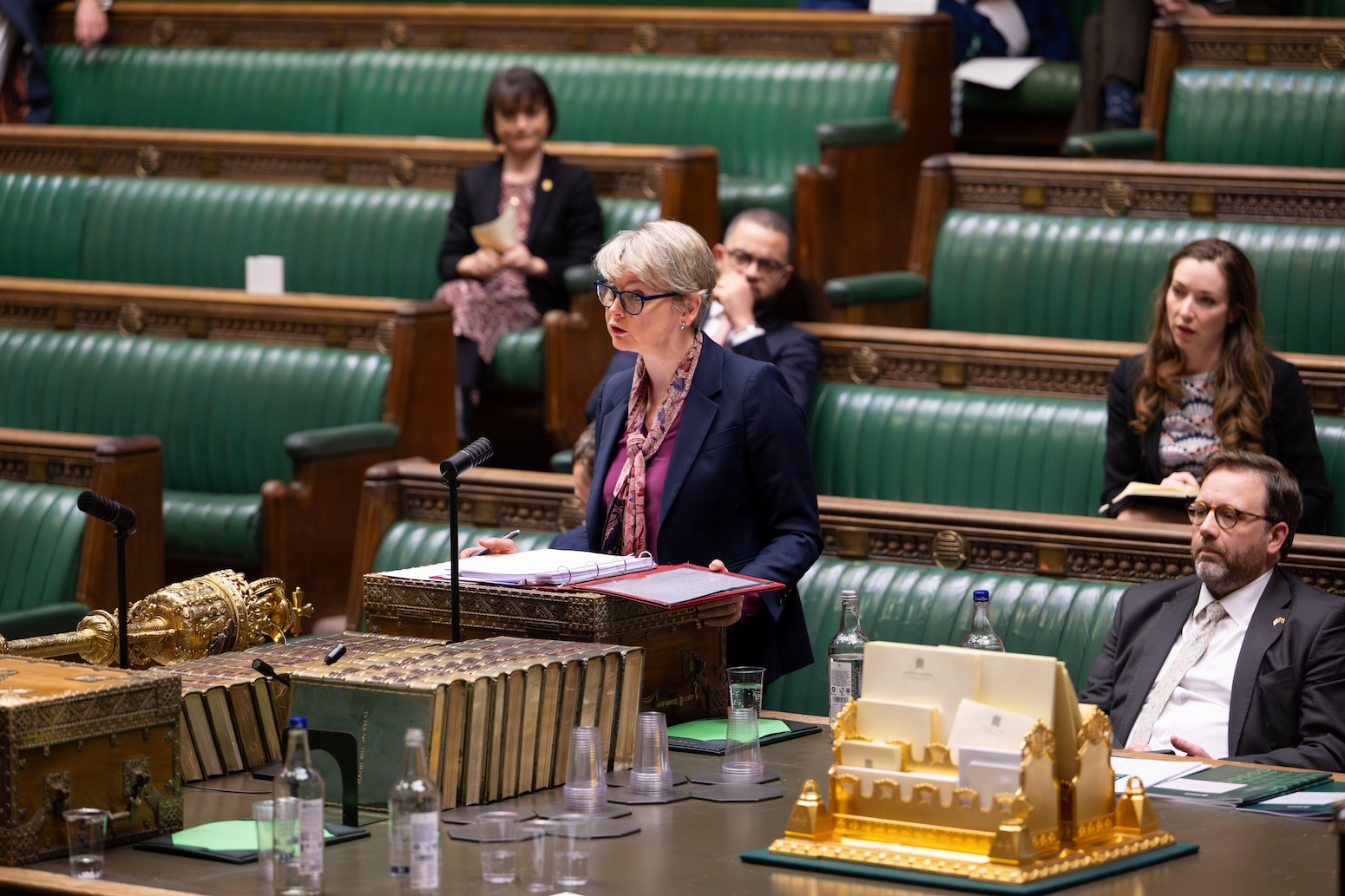
In March, foreign secretary Yvette Cooper finally announced details of how the UK’s headline cuts in overseas aid would impact specific spending priorities between 2026-27 and 2028-29, including climate finance. She said:
“Over the next three years, the UK will spend around £6bn of official development assistance as international climate finance. We will balance support between mitigation and adaptation and maintain a focus on nature.”
This amounts to a clear cut in annual climate-finance spending, even without considering the impact of inflation or accounting changes, as the chart below shows.
Despite Cooper’s pledge to “maintain a focus on nature”, the government also scrapped the “ring-fencing” of funds for nature and forest conservation, as well as the practice of setting five-year goals to provide more certainty to climate-aid recipients.
(The relatively vague “around” £6bn is also notable, given the previous targets were set at precisely £11.6bn and £5.8bn. This could allow the government to ultimately spend less than £6bn.)
The government is also clear that it is shifting its focus to using public development aid to “unlock private investment for development”, framing its overall approach as “innovative development reforms”. Cooper stated that, as well as the £6bn in climate finance:
“We will aim to generate an additional £6.7bn of UK-backed climate and nature positive investments and to mobilise billions more in private finance.”
Cooper described “climate and nature” as two of the government’s four “priority” themes for its dwindling aid spending.
Nevertheless, the international development committee of MPs expressed “deep concern” about the new climate pledge and NGOs called it a “backward step”.
Accounting changes
Media coverage of Cooper’s announcement stated that the new climate-finance target was 13-14% lower than the previous one.
This is based on the difference between average annual contributions out to 2029 under the new pledge – around £2bn – and the £2.3bn average from the previous period.
However, Carbon Brief analysis suggests that this straightforward approach makes the target seem more ambitious than it actually is.
When the £11.6bn target was set in 2019, only specific, climate-related projects funded directly by the UK government counted towards it. Then, in 2023, the Conservative government decided to loosen the criteria for the funds it counted towards the target.
This included relabelling existing support for multilateral development banks (MDBs), humanitarian aid and more private-sector investments as “climate finance”.
This approach – which mirrors that of other climate-finance donors – means the government is now on track to hit the £11.6bn target. (For more details, see Carbon Brief’s previous coverage.)
NGOs criticised this “creative accounting” at the time. Similarly, the UK’s official aid watchdog described the changes as “moving the goalposts”, as they meant the government could meet its target without providing as much new money. Nevertheless, the current Labour government has retained the changes.
The government released a list of specific aid allocations alongside Cooper’s recent announcement, which includes how much it plans to give to MDBs, as well as the UK-owned development body, British International Investment (BII).
Most of this money would not have been counted as climate finance under the old accounting system. Under the new system, a large portion of it will be.
Carbon Brief estimates that £1.7bn of new climate finance over the next three years – roughly 28% of the total – would not have counted as climate finance before the government’s accounting changes.
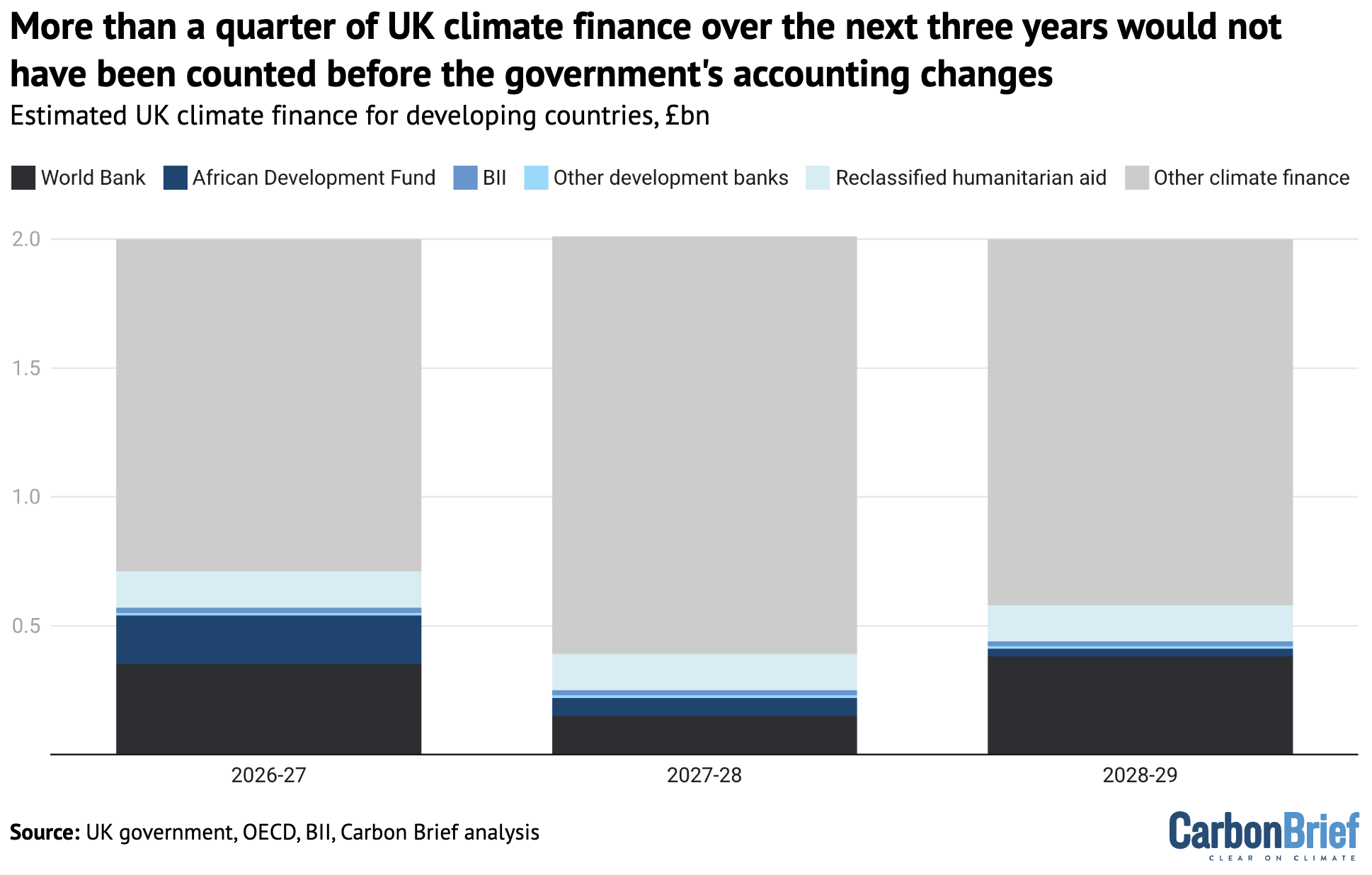
As the chart above shows, much of the money reclassified as climate aid will derive from automatically counting a fixed share of UK funding for MDBs as “climate-relevant”.
MDBs, including the World Bank and the African Development Bank, are major contributors to global climate finance. Member states, such as the UK, pay money into these banks, which then use their financial resources to support development projects.
Notably, while virtually all of the UK’s traditional climate finance has been provided as grants to developing countries, MDBs provide most of their support as loans. The prevalence of loans in global climate finance is a long-standing point of contention for developing countries.
Including inflation
The second key factor that influences the comparison between the UK’s old and new climate-finance targets is inflation. Experts have highlighted the importance of correcting for inflation when considering long-term finance targets.
This issue is particularly important now, as in recent years there has been significant inflation in the UK and around the world. This means the finance that the UK committed to give back in 2019 would not go as far today as it did then.
Adjusting for this inflation, Carbon Brief estimates that the £11.6bn target would equate to £14.3bn today, using 2021-22 – the start of the £11.6bn target – as the base year.
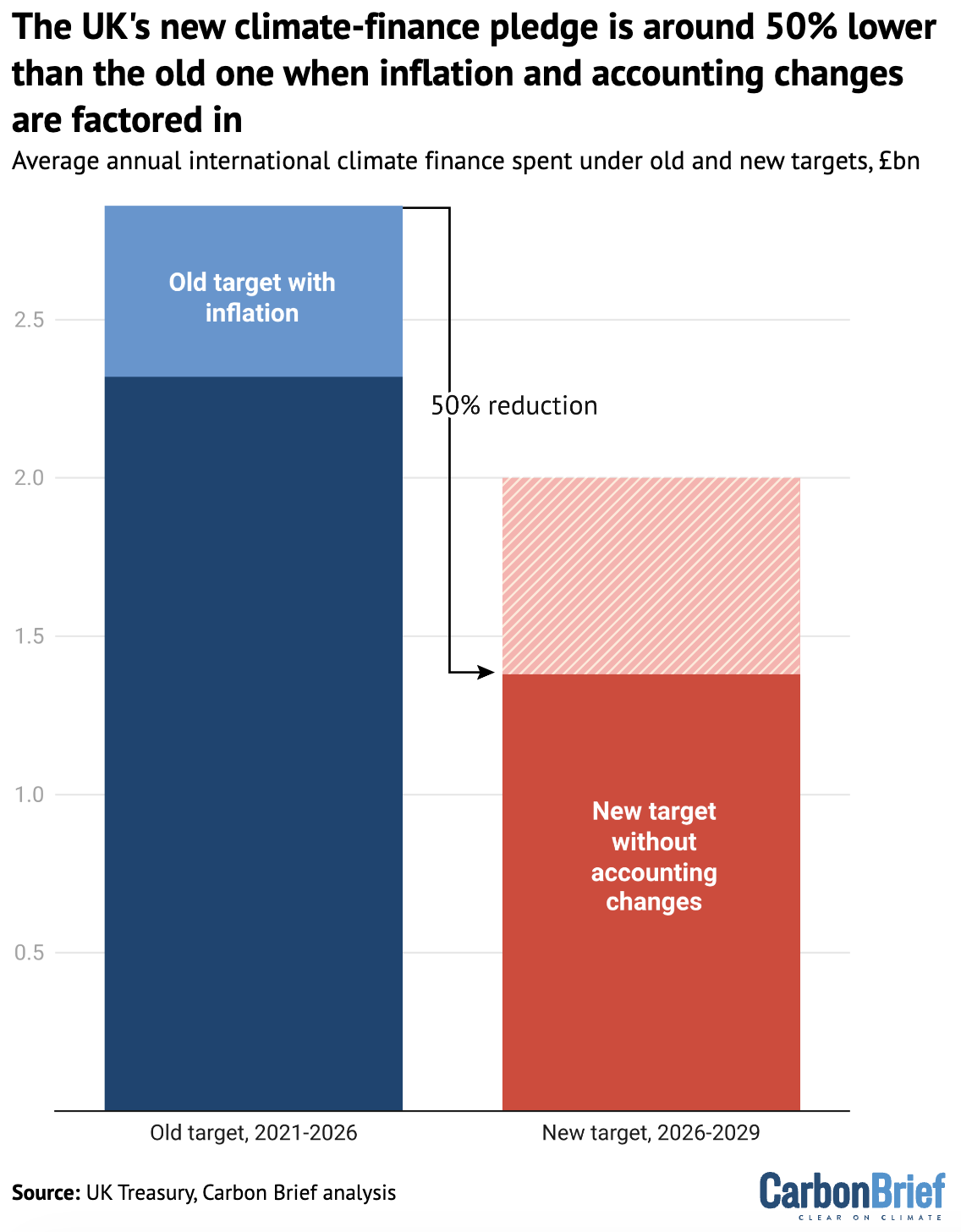
This means the government would have to pledge £14.3bn over five years – or £2.86bn a year – just to match the spending power of its previous goal. This new goal of £2bn a year is effectively a 30% real-terms cut in annual climate finance from the UK.
As the chart below shows, the previous climate target from five years ago is roughly twice as large per year as the new 2026 target, after correcting for inflation and once accounting changes have been removed.
Of course, ultimately, the government relied on accounting changes to meet the previous £11.6bn target as well.
Nevertheless, this comparison shows the significant backsliding in ambition, from 2021 when the plan was an £11.6bn goal, relying on a narrow range of sources – to a 2026 target that is lower in real terms, while drawing from a wider range of sources.
Global cuts
In 2024, developed countries such as the UK collectively agreed to raise their global climate-finance contributions to $300bn a year by 2035, as part of their Paris Agreement obligations.
This international target replaced the previous goal of $100bn per year by 2020, which was belatedly met in 2022.
While the new target will include large contributions from the private sector and MDBs, there is an expectation that a significant portion of it will still come directly from developed countries.
In this context, it is clear that the trajectory of UK climate finance is going in the wrong direction – falling, rather than increasing
The UK is certainly not alone in this regard. Speaking in parliament, Cooper told MPs that “allies such as Germany, France and Sweden have made similar choices” to cut aid in order to fund military spending.
Very few developed countries – and none of the biggest donors – have officially announced new or updated climate-finance targets for the coming years.
However, analysis by aid organisation CARE International last year concluded that other major climate-finance donors, including Germany and France, will also see their climate finance fall over the coming year, following cuts to their aid budgets.
The most significant drop has come from the US, which has effectively cut its international climate finance from several billion dollars a year to zero, under the Trump administration.
In addition to cutting its overall contribution, the UK is signalling that it will focus less on grant-based climate finance from government spending and more on “unlocking” billions of pounds in private-sector finance for climate action, as well as on “reform of the international development system”.
Such approaches may end up playing a major role in nations hitting the $300bn target by 2035.
However, this is highly contentious, with many developing countries arguing at UN negotiations that developed countries are reneging on their responsibilities to directly “provide” climate finance.
Methodology
The UK has announced that it will spend “around £6bn” on international climate finance between 2026-27 and 2028-29. Alongside this announcement, it released a list of “official development assistance (ODA) programme allocations 2026-27-2028-29”. These include details of “planned multilateral ODA programming” – covering MDBs – and spending on “arm’s-length bodies, private sector investments, subscriptions”, including BII.
Carbon Brief calculated the climate-related shares of core MDB finance – which the UK now counts as climate finance – using the climate shares for each MDB identified by the Organisation for Economic Co-operation and Development (OECD) in 2023. These estimates may be conservative, as MDBs have committed to increasing the shares of their projects that are climate-related.
Carbon Brief calculated the extra BII contributions that the UK will count as climate finance by assuming, based on the most recent BII annual accounts, that 41% of its commitments each year will be climate-related. Previously, only 30% of BII contributions were counted as climate finance, so Carbon Brief assumed the difference between these shares would be additional.
The government has also said it now automatically counts 30% of all humanitarian assistance provided to the 10% most climate-vulnerable countries as climate finance. Based on figures provided to Carbon Brief via freedom of information request, this amounts to roughly 10% of all humanitarian assistance in recent years. The government has said it will “spend approximately £1.4bn each year in the places with the highest humanitarian need over the next three years”. Carbon Brief assumed that 10% of this – £140m each year – would count as climate finance.
To calculate the impact of inflation on the £11.6bn target, Carbon Brief used the UK Treasury’s GDP deflator, with 2021-22 as the baseline year.
The figures in this analysis are estimates based on the data released by the government so far. Climate-finance data is subject to various accounting changes and the final figures – when they are released – are likely to be different.


Discussion about this post