
SINGAPORE AIRSHOW: Military Helicopter Market in Indo-Pacific Set for Growth
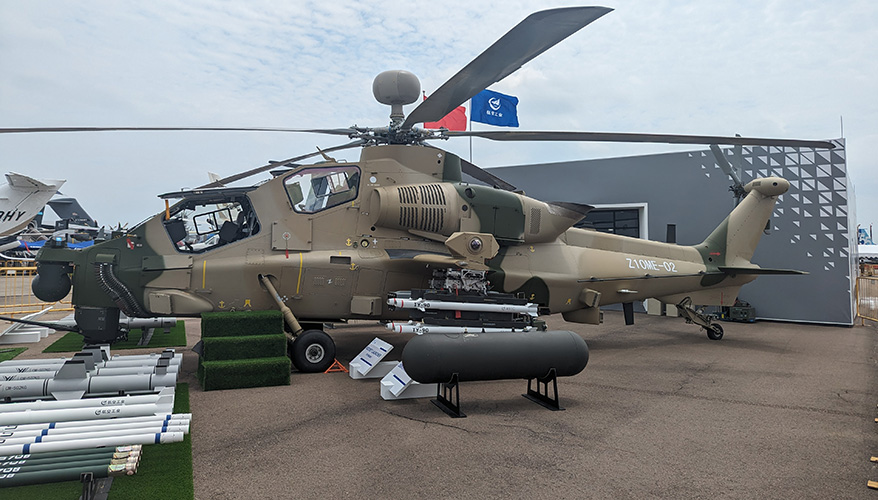
China’s Z-10ME attack helicopter on display at the Singapore Airshow
Josh Luckenbaugh photo
SINGAPORE — Many of the major providers of military helicopters in attendance at the 2024 Singapore Airshow said the marketplace for their wares presents both opportunities and challenges.
The Indo-Pacific is set to be a major player in the rotorcraft market for years to come, to the tune of 1,500 new military helicopters delivered to the region over the next decade, according to aerospace corporation Airbus.
“Demand for military helicopters is anticipated to be on the upward trend as Asia-Pacific military fleets are due for renewal and modernization, focusing on medium utility, specialized attack and heavy combat and naval lift capabilities,” an Airbus release stated.
China at the airshow displayed an export version of its Z-10ME attack helicopter, which has drawn comparisons to the U.S.-made Boeing AH-64 Apache.
Bernd Peters, vice president of business development and strategy for Boeing Defense, Space and Security, said the company continues to receive demand for the Apache.
“We view [Apache] as the most capable attack helicopter in the world, and as do many of the nations who currently operate it,” Peters said during a media briefing at the airshow. Boeing has “significant opportunities” to either build more Apaches or upgrade existing fleets, he added. Indonesia, India, Singapore, Japan, South Korea and Taiwan currently fly the Apache in the region, with Australia is also set to begin receiving a new fleet of 29 Apaches in 2025.
Singapore’s Chief of Air Force Maj. Gen. Kelvin Khong said in a written interview published Feb. 18 that the country wants to extend the service life of its Apache fleet beyond 2030.
But despite Airbus’s projections of a healthy customer base for military rotorcraft going forward, several nations are rethinking their investments in helicopters. Japan in the English translation of its Defense Buildup Program released in January 2023 said “in order to optimize the air structure, the air units of divisions and brigades” within its Ground Self-Defense Force “will be abolished, with some exceptions.” The force’s anti-tank and combat helicopters — including its fleet of Apaches — and observation helicopters will be replaced by unmanned aerial vehicles for “utility/attack,” surveillance and reconnaissance, the strategy stated.
In February, the U.S. Army discontinued its Future Attack Reconnaissance Aircraft program, the fourth effort to replace the out-of-service OH-58 Kiowa scout helicopter to be canceled prematurely. The service said that “in reviewing the FARA program in light of new technological developments, battlefield developments and current budget projections, Army leaders assessed that the increased capabilities it offered could be more affordably and effectively achieved by relying on a mix of enduring, unmanned and space-based assets.”
Victor Chin, senior manager for military sales and strategy at Bell, said the company is still confident in the 360 Invictus platform it developed for the FARA program.
“The capability is there,” Chin said in an interview at the airshow. “Our aircraft is actually pretty much ready to fly … I would say 99 percent ready.”
Bell is “assessing as a company what the next steps are” with the 360 Invictus, Chin said. “Our senior [leadership] — in conjunction with the U.S. Army and U.S. government — we’re trying to see what the assessments are and how to move forward.”
It’s not all bad news for Bell, which is on contract with the Army to provide its V-280 tiltrotor for the service’s Future Long Range Assault Aircraft program. While Chin declined to comment on the specific foreign sales strategy for the V-280 as that will be determined by the Army, he said there is “a lot of interest” in the company’s tiltrotor technology, which offers more speed and range than traditional fixed-wing aircraft.
This is especially important in a region such as the Pacific Ocean with its vast distances of water, he said. “You need an aircraft that can go” those great distances “without refueling if you can, and then get there faster.”
For militaries that don’t have the resources of the United States to acquire next-generation platforms such as the V-280, Bell is offering what Chin called “special mission aircraft,” which are “commercial aircraft that have been tailored for the military based on the configuration they want.”
For example, the company can take its Bell 407 commercial helicopter, which has “a good amount of power, good speed,” and retrofit it with payload hardpoints and a weapons management system to transform it into an armed aircraft, he said. There are other potential configurations as well, such as adding encrypted radios or self-protection systems, he added.
“So, it’s just very tailorable … within a budget,” he said. “Not everybody has billions of dollars to spend, but they still have a requirement to either ferry troops or be able to conduct offensive fights against whatever enemies they have. … So, it makes it much easier for them to acquire the capabilities they need.” Chin said there are customers currently operating these special mission aircraft, but declined to identify them.
In its announcement canceling FARA, the Army also committed to a new multi-year contract to procure the UH-60M Black Hawk, the latest variant of the helicopter’s line produced by Lockheed Martin subsidiary Sikorsky.
Felipe Benvegnu, director of strategy and business for army and air force systems aftermarket at Sikorsky, said during a media briefing Feb. 22 the UH-60M features an improved airframe and wide chord blade to offer better survivability and situational awareness. “Today’s version can fly higher and carry more payload than its predecessors ever did,” he said.
The Army’s current multi-year contract is for 255 Black Hawks to be delivered through 2027, “both for U.S. Army operations as well as foreign military sales for international customers,” he added.
“We are very encouraged by the Army’s intention to extend our current production line,” Benvegnu said. Not only is this driven by international customer demand, but the Army has stated it wants to operate Black Hawks into the 2070s, which will naturally entail “requirements for modernization,” he said. “We continue to invest significant research and development dollars on what that next generation of Black Hawk will look like.”
A major focus for Sikorsky to ensure the Black Hawk remains relevant into the future is joint operations. The U.S. Defense Department is hard at work implementing its Combined Joint All-Domain Command and Control concept, the goal of which is to link sensors and shooters across the U.S. armed services and their allies to form a common operating picture.
Sikorsky is looking to modernize the aircraft’s digital architecture to “ensure that the helicopter can operate [in] an ecosystem of future vertical lift and joint all-domain operations,” Benvegnu said. Additionally, “the Army has made significant investment” in the new GE Aerospace-built T901 engine — which the service said it will delay entering into production to ensure there is adequate time to integrate it with Black Hawks and Apaches — and Sikorsky is “having conversations” about ways to improve the Black Hawk’s flight dynamics, such as upgrading the rotor systems.
Sikorsky has also considered the potential of “teaming unmanned and manned” helicopters, he said. During the Army’s last Project Convergence exercise in 2022, Sikorsky and the Defense Advanced Research Projects Agency successfully demonstrated how a Black Hawk could fly autonomously and perform logistics or rescue missions.
The helicopter “takes off, [and] no one’s controlling it,” the aircraft’s autonomous flight system ensuring the “helicopter can operate itself,” he said.
Topics: Global Defense Market, International, Rotary Wing


Discussion about this post