
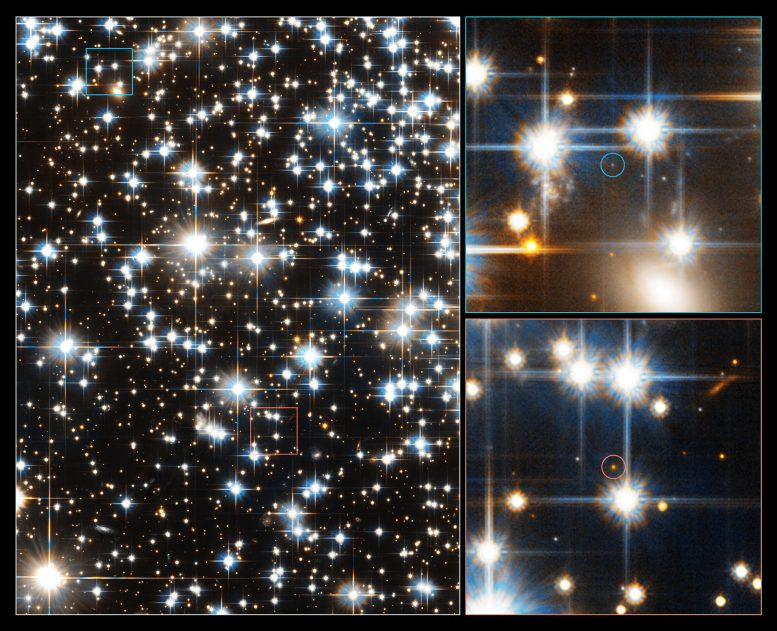
Looking like glittering jewels, the stars in this Hubble Space Telescope image at left are part of the ancient globular star cluster NGC 6397. Scattered among these brilliant stars are extremely faint stars. Hubble’s Advanced Camera for Surveys has taken a census of the cluster stars, uncovering the faintest stars ever seen in a globular cluster. Globular clusters are spherical concentrations of hundreds of thousands of old stars. Credit: NASA, ESA and H. Richer (University of British Columbia)
What Is a White Dwarf?
A
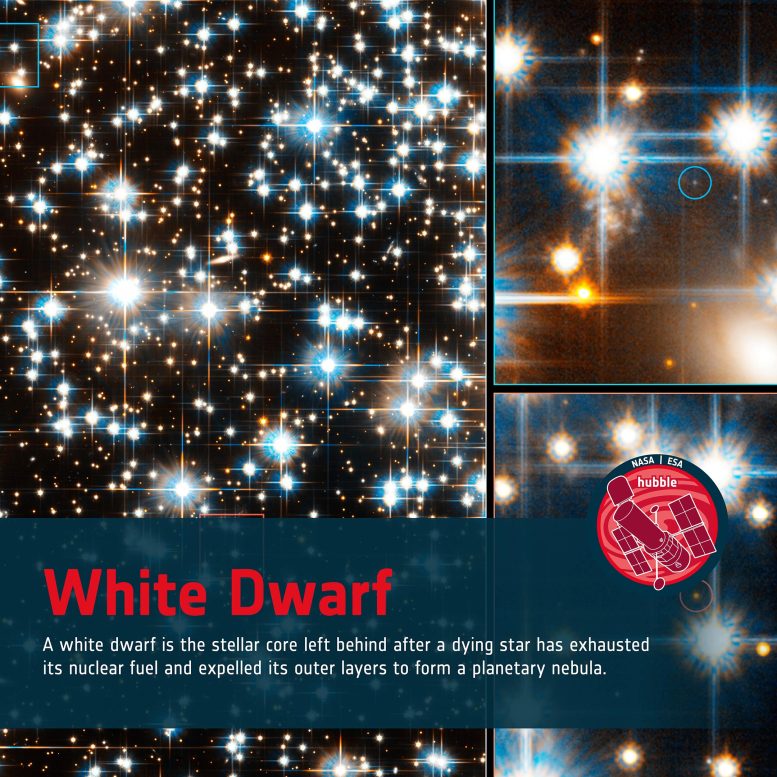
A white dwarf is the stellar core left behind after a dying star has exhausted its nuclear fuel and expelled its outer layers to form a planetary nebula. Credit: ESA/Hubble, directly observe white dwarfs in globular star clusters, which astronomers reported as the dimmest stars ever seen in a globular star cluster. Hubble’s Advanced Camera for Surveys completed a census of two distinct stellar populations in one cluster, known as NGC 6397, and surveyed the faintest dwarf stars.
Credit: NASA, ESA and H. Richer (University of British Columbia)
Hubble’s Discoveries in White Dwarf Research
In 2013 Hubble found signs of Earth-like planets in the atmospheres of a pair of white dwarf stars roughly 150 light-years away and only 625 million years old. Hubble’s spectroscopic observations identified silicon in the atmospheres of the two white dwarfs, a major ingredient of the rocky material that forms Earth and other terrestrial planets in the Solar System. Silicon may have come from asteroids that were shredded by the white dwarfs’ gravity when they veered too close to the stars. The rocky debris likely formed a ring around the dead stars, which then funneled the material inwards.