Australia will command a fleet of eight nuclear-powered submarines within three decades under the AUKUS agreement with the United States and United Kingdom – a deal that could cost up to $368 billion.
Australia will be hosting “rotational deployments” of US and UK submarines in Perth within four years, and acquire three US Virginia-class nuclear submarines from approximately 2033, before Australia is able to produce its first locally-built boat.
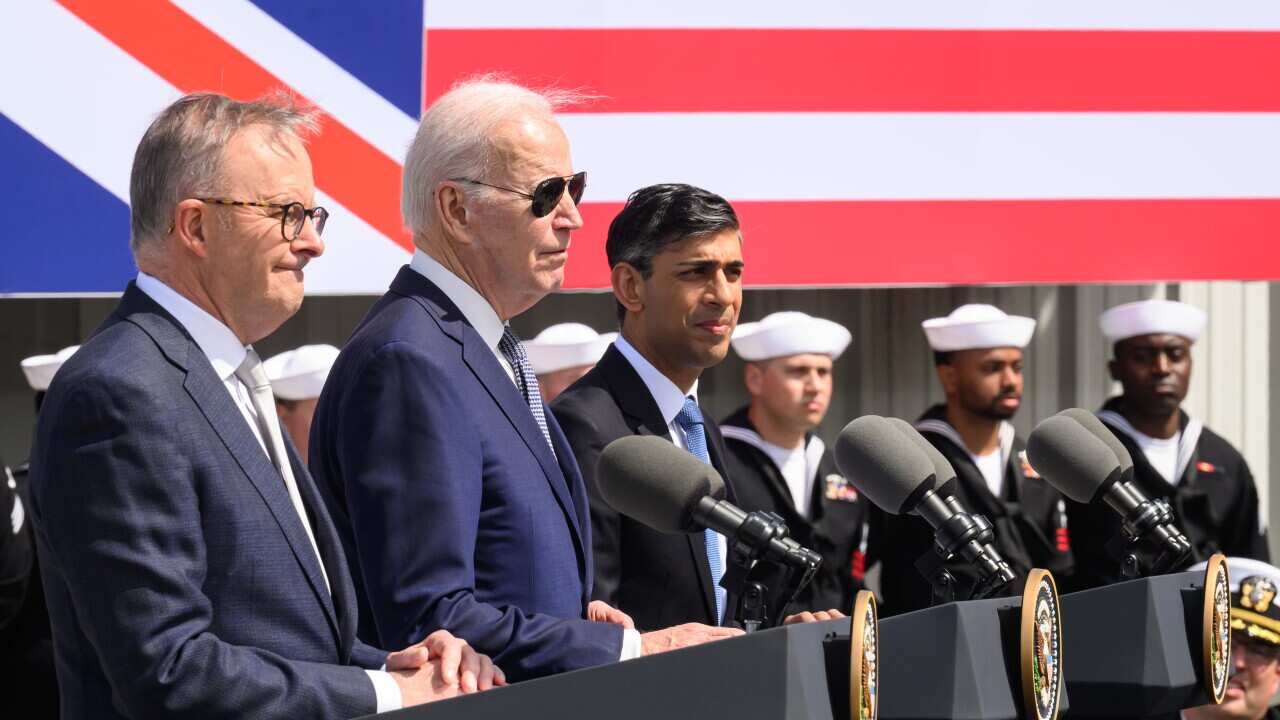
Appearing with US President Joe Biden and UK Prime Minister Rishi Sunak, Prime Minister Anthony Albanese said the agreement was the single biggest investment in Australia’s defence capability.
“What the United States, the United Kingdom and Australia hold in common is more fundamental and more universal than our shared histories,” he said at the Point Loma naval base in San Diego.
The three leaders annoucned the deal at Point Loma naval base in San Diego. Source: AAP / Stefan Rousseau
Mr Biden said the agreement was a testament to the strong ties between the three nations.
“As we stand at the inflection point in history … the United States can ask for no better partners in the Indo-Pacific, where so much of our shared future will be written,” he said.
‘Nuclear-powered, not nuclear-armed’
Mr Biden repeatedly stressed the deal did not pave the way for Australia to have “nuclear weapons of any kind”, saying the three countries remained “deeply committed” to strengthening nuclear non-proliferation.
“I want to be clear to everyone from the outset, right off the bat, so there’s no confusion or misunderstanding on this critical point: these subs are powered, not nuclear-armed subs. They’re nuclear-powered, not nuclear-armed,” he said.
“Australia is a proud non-nuclear weapons state and has committed to stay that way.”
Asked later whether the pact would survive another isolationist US president – former president Donald Trump is launching a second tilt at the White House – Mr Biden was declarative.
“Yes,” he said.
It’s the first time the US has shared its nuclear technology in 65 years and only the second time in its history.
UK Prime Minister Rishi Sunak added the three navies would operate and maintain the boats together.
“For the first time ever, it will mean three fleets of submarines working together across both the Atlantic and Pacific, keeping our oceans free, open and prosperous for decades to come,” he said.
Reactions in Australia
Mr Albanese insisted offsets from the scrapped deal with French manufacturer Naval Group, and $3 billion in savings to be unveiled in the upcoming Defence strategic review, would cover the projected cost of the new project until 2026-27.
Coalition leader Peter Dutton said he was supportive of the “necessary” decision, describing AUKUS as a “huge achievement” four or five years in the making.
But Mr Dutton said it was disingenuous for Labor to claim the spending, projected to cost between $268 billion and $368 billion by the mid-2050s, would have no short-term impact on the budget bottom line.
“We have to make sure that there is transparency and honesty with the Australian people about the cost involved in AUKUS,” Mr Dutton told reporters in Canberra.
“It’s not credible for the government to say that there’s no net impact, even over the forward estimates. We can’t allow Labor to cannibalise the Defence Force to pay for AUKUS.”
Mr Dutton demanded Labor explain how it would fund the new announcement, saying it would only be possible via heavier debt, tax rises, or cutting spending elsewhere.
The Coalition leader suggested this week that he would support cuts to the National Disability Insurance Scheme to cover the new AUKUS outlay.
US ambassador to Australia Caroline Kennedy described Tuesday’s announcement as “incredibly historic” for Canberra, given it will include Washington sharing its most sensitive technology.
“It’s historic for the United States, as well, because Australia is emerging as such a significant ally,” she said.
“It always has been, but I think this is really going to take it to another level. And Australia’s contributing to the US, training with the US, so I think that the partnership is just going to get closer and closer.”
Acting Prime Minister Richard Marles said it was “fundamentally important” for Australia to be able to defend itself at sea, with the long-range submarine “at the heart” of the nation’s defence strategy.
“It will enable us to hold adversaries at risk further from our shores. But the true intent of this submarine of this capability is to provide for the peace and stability of our region,” he said on Tuesday.
China’s reaction
China’s state-owned publication the Global Times ahead of the AUKUS announcement, saying the agenda was about “confrontation”, and that Beijing was not “knocking at Australia’s door to invade”.
“China provides economic opportunity and prosperity, while the US is offering death and destruction,” the op-ed wrote.
Treasurer Jim Chalmers said all countries in the region, including China, have an interest in maintaining peace.
“The announcements that we made today need not necessarily be an affront to anyone,” he said.
With AAP
















Discussion about this post