









By News Americas Now Travel Editor
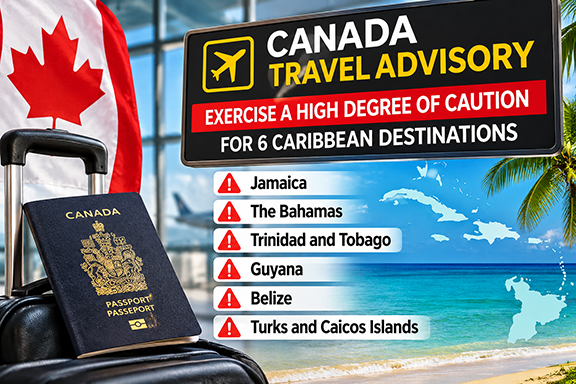
News Americas Now, MIAMI, FL, Fri. Nov. 20, 2026: Canadians intending to travel to the Caribbean this winter are being advised to exercise heightened caution in six specific destinations, primarily due to concerns over crime and violent incidents, as indicated by the latest federal Travel Advisory.
The Canadian government has classified Jamaica, The Bahamas, Trinidad and Tobago, Guyana, Belize, and the Turks and Caicos Islands under the advisory level of “exercise a high degree of caution.” This classification does not imply that travel is discouraged; rather, it encourages travelers to remain vigilant, be aware of their surroundings, and heed local advisories due to potential risks or fluctuating conditions.
Jamaica
Travelers to Jamaica are advised to maintain a high degree of caution owing to the prevalent violent crime rates, particularly outside tourist hotspots. An advisory update from November 13 highlights that while violent crimes such as armed robbery and homicide have seen a decline in recent years, areas like Kingston, Montego Bay, St. Catherine, and May Pen continue to pose safety concerns.
Authorities note that police presence is significant in major tourist areas and resorts, where crime rates are comparatively lower; however, incidents of assaults and robberies can still occur.
The Bahamas
In The Bahamas, the advisory recommends a high degree of caution due to substantial crime rates, especially in Nassau and Freeport. Travelers should be particularly mindful of potential robberies near cruise ship terminals and popular resort areas, even during daytime.
Trinidad and Tobago
The government has advised travelers to Trinidad and Tobago to exercise a high degree of caution due to the threat of violent crime. Specific areas are deemed particularly unsafe, leading to recommendations against non-essential travel to Beetham Estate Gardens, Cocorite north of Western Main Road, and certain parts of downtown Port of Spain, Laventille, and Sea Lots, which are affected by gang-related violence.
Guyana
Travelers are similarly cautioned when visiting Guyana, where high crime rates persist. The advisory also points to security concerns along the border with Venezuela, describing the situation as volatile due to ongoing territorial disputes and gang-related violence.
Belize
In Belize, the advisory highlights significant levels of violent crime throughout the country, with a particular warning for Southside Belize City. Travelers are urged to avoid non-essential travel to this area, south of the Haulover Creek River, due to gang and drug-related violence, including incidents of murder and shooting. A state of emergency was declared on October 31 in certain sectors of Belize City, Belize District, and Cayo District in response to escalating violent crime.
Turks and Caicos Islands
The Turks and Caicos Islands are also categorized under the high-caution level, with crime reported throughout the territory but most notably on Providenciales, the most populated island.
Understanding the Advisory Level
The Canadian government employs four travel-risk categories. The designation “exercise a high degree of caution” serves as the second level, indicating that travelers should adopt additional precautions compared to what they would typically observe in Canada.
This classification is distinct from the more severe categories, “avoid non-essential travel” and “avoid all travel,” which reflect greater safety and security risks. Other Caribbean destinations such as Barbados, Antigua and Barbuda, Grenada, Dominica, St. Kitts and Nevis, St. Vincent and the Grenadines, Puerto Rico, and the Cayman Islands maintain a lower advisory level of “exercise normal security precautions.” Travelers are encouraged to check official advisories prior to their departure, as risk levels and regional warnings may change. Canada also advises against all travel to Haiti.







Discussion about this post