









Global food systems are responsible for around one third of planet-warming greenhouse gas emissions each year.
Producing less meat, using less synthetic fertiliser, stopping food waste and integrating nature into farms are among the ways that scientists say can reduce environmental harms from producing food.
However, some critics of these approaches note the possible trade-offs, such as lower yields compared to “conventional” forms of intensive farming.
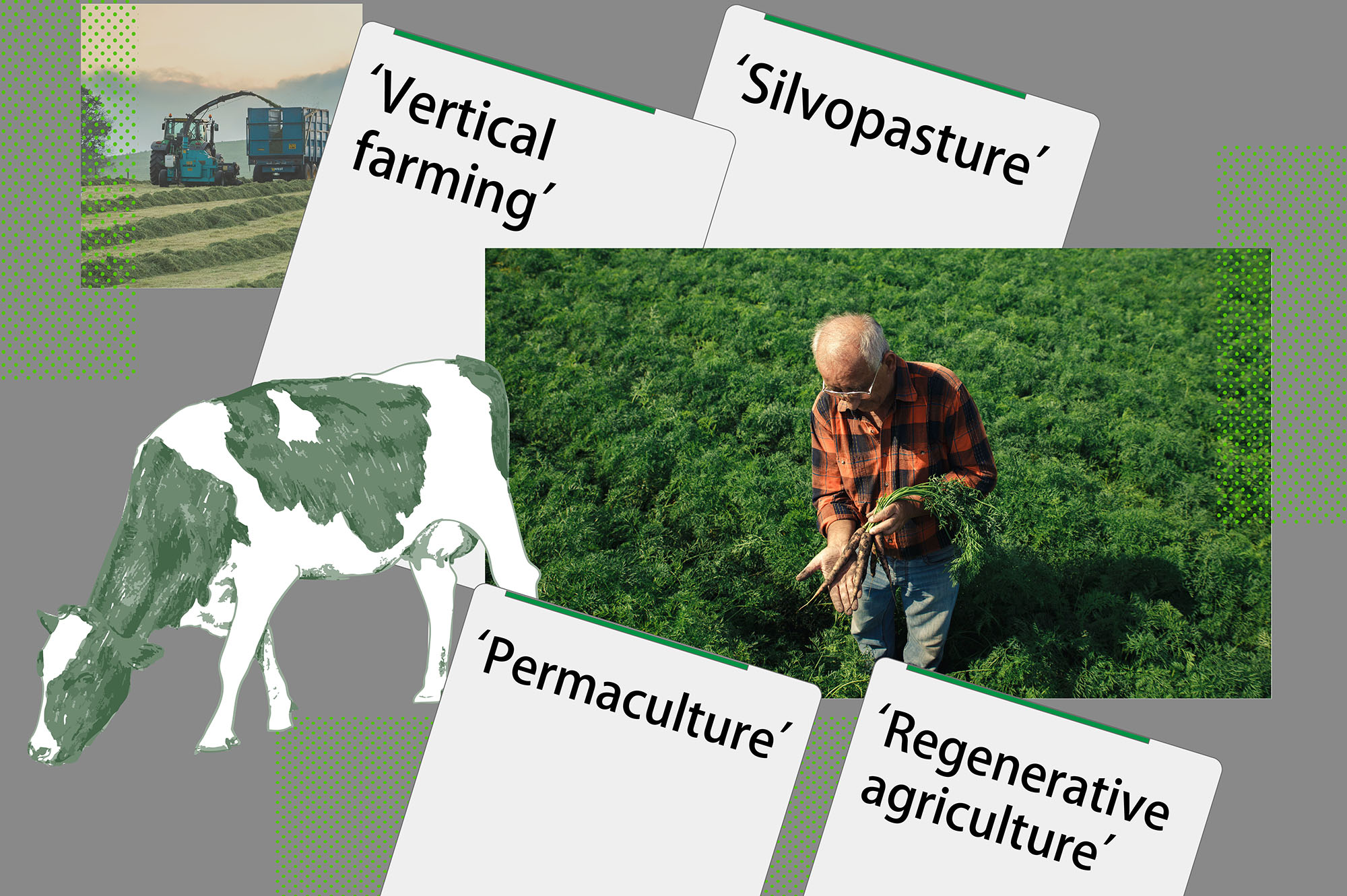
Various terms are used to describe these more “climate-friendly” ways of farming.
Some of these practices have set definitions and are evidence-based, while others are buzzwords whose meanings vary depending on the source. Many share similar approaches.
To break through the jargon, Carbon Brief has identified 24 commonly discussed climate-relevant farming methods and key terms.
According to the FAO, agroecology is a “holistic and integrated approach that simultaneously applies ecological and social concepts and principles to the design and management of sustainable agriculture and food systems’. It is “concurrently a science, a set of practices and a social movement”, the FAO adds.
Agroecology uses ecological science and social principles, such as the right to food, fair access to resources for all and inclusion of marginalised groups, to produce diversified crops without the use of synthetic fertilisers and pesticides.
Agroecological practices aim to foster interactions between species, humans and the environment to produce “long-term [soil] fertility, healthy agroecosystems and just livelihoods”, IPES-Food says. This holistic approach includes different knowledge systems, including those from Indigenous traditions.
A method of land management where trees are grown alongside crops and/or livestock on farms. This can give farmers another income stream, improve soil health, support biodiversity and absorb carbon dioxide (CO2) from the atmosphere. Planting trees on farms can also help to protect land and buildings from extreme weather – providing shade for crops and livestock, reducing rainfall runoff and shielding against wind.
 Example of an alley cropping farm. Source: Nature and Science / Alamy Stock Photo
A farming method that combines crops and trees. It involves planting economically important hardwood tree species in parallel rows. Then, farmers grow crops – such as cereals, legumes, vegetables and vines – in between the rows. According to the European Agroforestry Federation, trees farmed using this approach provide fruits and wood products for farmers, as well as shelter for crops. They also act to store carbon and protect soil. This system is labour-intensive and thrives best in humid lowlands, such as the coastal regions of Kenya.
A 2024 review paper found that yields in alley-cropping systems “often vary substantially”, depending on the species planted, the design of the system and other factors. It noted that yields of the plants closer to the trees were generally lower, due to competition with the trees for nutrients. But, farther from the trees, yields were often found to be higher than in conventional farming systems, it added.
A form of organic farming that focuses on soil health, biodiversity and an overall “holistic” approach to food production. It is similar to organic agriculture, but “incorporates metaphysical ideas in treating soil and crop growth”, a 2022 study said. It is popular in Germany, France and Australia, but makes up less than 1% of global certified organic farmland. A 2022 study found that biodynamic agriculture “enhances soil quality and biodiversity”, but noted that there is not a huge amount of data available.
The practice is considered by some to be “pseudoscience”. It was developed based on the works of philosopher Rudolf Steiner, who “encourage[d] farmers to look to the cosmos before planting and harvesting crops”, the Guardian reported. These methods have changed over time and farms can now become certified by private organisations as biodynamic in dozens of countries.
A type of agriculture that aims to boost the amount of carbon sequestered through soils and plants on a farm. This can be achieved by applying organic compost or biochar to soils, minimising soil disturbances and varying the type of crops grown. One point often raised about carbon farming and other soil-reliant practices is that they are not permanent – carbon can be released from the soils due to extreme weather or future changes in farming practices. Carbon farming falls under the umbrella of climate-smart agriculture.
A method of farming practices where the emissions from a farm equal the amount of CO2 it takes up from the atmosphere. In theory, if a livestock farm contained forested land that was absorbing the same amount of CO2 from the atmosphere as its cows and sheep were emitting, it could be considered “carbon neutral”. These emissions could also be balanced out by a carbon-offset project. (There is mounting evidence that offsets, such as forest protection and clean cookstove schemes, have overstated their ability to cut emissions.)
A type of farming that aims to be less harmful to the environment than high-yield, intensive practices. This could be achieved through reducing greenhouse gas emissions, using less synthetic fertiliser and planting trees. There is no set definition for climate-friendly farming and the term is often used to refer to a wide variety of practices, including climate-smart agriculture.
A set of agricultural approaches that aims to sustainably increase farm productivity and incomes, help farmers adapt to climate change and cut greenhouse gases “where possible”, according to the FAO. These objectives are intended to be applied in an appropriate way in each local context. This approach has been promoted by many agribusiness companies, including Corteva and BASF, as well as philanthropies, such as the Gates Foundation. Some civil-society and farmer groups are concerned that the term can be used to “greenwash” industrial farming practices. Several terms in this glossary – such as regenerative agriculture – fall into the category of climate-smart agriculture.
A type of farming that aims to be less harmful to the environment than high-yield, intensive practices. This could be achieved through reducing greenhouse gas emissions, using less synthetic fertiliser and planting trees. As with climate-friendly farming, there is no set definition for eco-friendly agriculture.
A type of agricultural system that seeks to integrate certain characteristics of ecosystems into farming. For example, cultivating high biodiversity in the soil is thought to grow healthier food and reduce pests. According to Greenpeace, there are seven principles of this system, with some relying on agroecological principles, such as food sovereignty and benefits for farmers and rural communities. Ecological farming aims to reduce harmful environmental impacts while improving food yields, a 2024 study said. The research claimed that it “not only lowers production costs, but also improves the quality and market value of agricultural products”.
A land-use strategy to include spaces for nature on farmland to boost biodiversity. In most cases, this decreases agricultural yields. It can reduce the negative impact of farming on land and involves a range of actions, such as restoring hedgerows and limiting the use of synthetic fertilisers. There is debate about whether land sharing or land sparing is more beneficial for nature conservation. Both approaches aim to “minimise trade-offs between increasing agricultural production and conserving biodiversity”.
A land-use strategy to carry out high-yield, intensive agriculture in one part of a farm and leave land aside for nature in another. This could involve maintaining forest, wetland and grassland habitats and would separate spaces for agriculture and nature. There is debate about whether land sharing or land sparing is more beneficial for nature conservation. Both approaches aim to “minimise trade-offs between increasing agricultural production and conserving biodiversity”.

Tractor using disc harrows for ploughing. Credit: agrofruti / Alamy Stock Photo
A type of agriculture that aims to protect the soil without using traditional tillage methods, which consist of preparing soil for cultivation by turning or ploughing. This system uses lighter equipment to perform shallower cultivations, thus disturbing the soil as little as possible. Compared to conventional tillage, this method increases the concentrations of soil organic carbon and nitrogen. It can also allow the soil to retain more water.
A type of agriculture that avoids the use of machinery by using a drill to plant crops directly into the soil. This helps mitigate greenhouse emissions, keep carbon in the soil and reduce soil erosion. For corn, soybean and wheat, this method is associated with lower operation costs and greater net returns per acre, compared to conventional tillage.
A type of practice where farmers set aside a portion of land for a large number of livestock to graze, especially during short periods, while other swathes of land are left to rest and recover. This results in an efficient use of land and the optimisation of forage growth and soil health. It requires monitoring and control of activities, such as forage supply or grazing time and space. Yet, it yields “significantly higher” biomass of certain pastures in rangelands and “could promote the weight gain of grazing sheep”, compared to other grazing options, according to a 2025 study.
A method that aims to grow food in a way that improves the health of soil, animals and plants. It seeks to prevent pest outbreaks and conserve nutrients in the soil through the use of ecologically based fertilisers, biological pesticides and crops that add – or “fix” – nitrogen into the soil. A 2017 study found that organic farming requires more land than “conventional” methods, but reduces nitrogen surplus and pesticide use.
Organic crop yields are more than 18% lower than “conventionally” farmed food, according to a 2023 study. The research notes: “The productivity of organic farming systems and their capacity to address the global food demand of a rapidly increasing population has been debated.” A 2019 study found that, in addition to overall lower yields, organic farming resulted in more variable yields, pointing out that “stable crop yields are necessary to ensure reliable access to nutritious foods”. It added that organic agriculture is more profitable for farmers due to the organic “premium” that consumers pay.
There are various certification schemes for farmers that meet organic farming practices, such as the USDA certifications, the EU Organic logo and the IFOAM standard.
A type of holistic farming approach that seeks to reduce waste and protect wildlife and land. It is a portmanteau of the words permanent and agriculture. It incorporates “crop rotation, rainwater harvesting, renewable energy use and low-impact livestock farming”. A 2024 study found that, in central Europe, farms using permaculture had 27% more carbon sequestration and a 201% higher abundance of earthworms compared to farms practising conventional agricultural techniques. The study called it an “effective tool to promote sustainable agriculture”. There has not been extensive research into the yield impacts of permaculture.

An agricultural drone spraying pesticides on a paddy field in Malaysia. Source: Mohd Izzuan Roslan / Alamy Stock Photo.
A type of farming that uses data and technology to make more efficient and productive work, by reducing inputs, such as water, fertilisers and pesticides. This approach relies on GPS, aerial vehicles, soil sensors and other technologies to obtain and process data on the variations of crops, animals and soil, so farmers can “tailo[r] inputs to desired outputs”, CSIRO notes. For example, mobile phones can be used to provide alerts on weather, pests and diseases. This approach leads to lower costs, less physical labour and a smaller environmental footprint, “ultimately enhancing the profitability of farming”, according to the UN Development Programme.
A method of farming crops and/or animals in a way that prioritises soil quality and ecosystem biodiversity. It also aims to boost farm carbon storage. The term has multiple definitions, with some focusing solely on soil health and others on wider ecosystem benefits. Some studies show soil health benefits. The farming method aims to work in “harmony with nature”, according to the FAO, while WWF says it offers a “holistic approach to restore and maintain ecosystem health”.
Many agribusiness companies, including Bayer, Corteva and Danish Crown, hail its benefits. But some organisations make “big promises” on the method’s ability to address climate change that are “more than it may be capable of delivering”, notes DeSmog.
A livestock-rearing approach that involves grazing animals on one patch of land for a period of time before moving to another patch. The first area is then left fallow to allow grass to regrow ahead of the next grazing period. A field is split into smaller paddocks for this type of grazing. This aims to improve grass quality, grass production and soil health, as well as extend the amount of time animals can graze outdoors. Some studies have identified improved soil health and other ecosystem benefits in certain types of farms using this grazing method. But a 2025 study found that short periods of grazing did not benefit soil carbon sequestration.

Grazing sheep in a silvopasture environment in Sweden. Source: Knut Ulriksson / Alamy Stock Photo.
A method, part of agroforestry, that refers to the integral management of trees, fodder plants and grazing activities in a plot, to obtain forest, forage and livestock products. In silvopasture systems, farmers use rotational grazing to raise animals, including chickens, turkeys, horses, sheep, cattle and even bison and deer, which benefit from the pastures and trees to get food and shade. Such a rotation “maximise[s] vegetative plant grow[th] and harvest”, according to the US Department of Agriculture. The Irish initiative Farming for Nature and the University of Wisconsin-Madison list benefits of the approach, such as soil health, animal welfare and increased income. Trees also increase biodiversity and improve water quality.
A type of agriculture using practices that conserve biodiversity and soil in order to feed current and future generations. This system promotes the farming of diverse crops and crop rotation, which can reduce the reliance on chemical pesticides and fertilisers and improve soil conditions. It can also be “profitable and provide decent revenues” to farmers, according to the Institute for European Environmental Policy (IEEP). The Rainforest Alliance sees sustainable agriculture as a “journey” towards regenerative agriculture and is one of various international organisations, including SCS Global Services, that provide certificates for farmers that use sustainable practices.
An approach aiming to implement innovations for scaling up productivity on existing arable lands, while addressing social and environmental concerns, such as profitability, equity and resilience. This system attempts to minimise “pressure on the environment” rather than converting more lands into croplands, IPBES says. The International Institute for Environment and Development notes that this approach can be controversial, as it can be seen as “an excuse for perpetuating the current corporate model of intensive farming with a sugar coating of sustainability”.

Underground vertical farm in London. Credit: Jeff Gilbert / Alamy Stock Photo
A type of crop cultivation in vertical structures, usually in big greenhouses or inside buildings, often without soil or sunlight. Crops are farmed with hydro-, aqua- or aeroponic systems, through which they receive nutrients diluted in water or water vapour. Farmers control conditions such as humidity, temperature, light, CO2 and water. This system is ideal for leafy green vegetables, fruits and herbs, according to the European Parliament, and it allows a “year-round, predictable production”, regardless of the climate and weather conditions. However, “the costs in both money and energy are still high”, BBC News notes. Sustainability by Numbers estimated that to produce 1kg of lettuce in the UK by vertical farming, the electricity costs alone are roughly equal to the wholesale price of conventionally grown lettuce.
A mix of farming methods and a grassroots peasant movement in India that uses many homemade, locally sourced materials, rather than synthetic fertilisers and pesticides. Specific actions include using cow dung, urine and plant residues to provide nutrients to soil and crops. Its central mission is to cut costs for farmers. Some benefits have been identified for crop yields and farmer incomes, but there is limited data on its sustainability effectiveness.









Discussion about this post