Categories
Energy

Cropped 27 March 2024: Bankrolling meat and dairy; EU nature restoration pushback; Missing cherry blossoms

Welcome to Carbon Brief’s Cropped. 
We handpick and explain the most important stories at the intersection of climate, land, food and nature over the past fortnight.

This is an online version of Carbon Brief’s fortnightly Cropped email newsletter. Subscribe for free here.

Bankrolling meat and dairy

LIVESTOCK GROWTH: Banks provide “billion-dollar support” for the “unsustainable” expansion of meat and dairy production around the world, according to a new report covered by the Guardian. Over 2015-22, financiers provided the world’s top 55 industrial livestock companies with “average annual credit injections of $77bn (£60bn)”, found the report produced by Feedback, a campaign group in the Netherlands and UK. Some banks “appeared to compromise their own anti-deforestation policies to do so”, the newspaper said. This credit “is designed to help companies expand”, the report noted, adding that meat production rose by 9% globally and dairy by 13%, between 2015 and 2021. 

AGRI ROADMAP CRITIQUE: A 2023 UN roadmap to end hunger while limiting agricultural emissions lacked transparency in how it was produced and did not include recommendations to “reduc[e] animal-sourced food production and intake”, according to a Nature Food comment article by a group of researchers. The roadmap, released by the UN’s Food and Agriculture Organization (FAO) last December, is a “welcome step” towards food system changes, the article said, but it did not include a list of authors and lacked information around the reasons for its recommendations. David Laborde, the director of the FAO’s agrifood economics and policy division, told the Guardian that the report emphasises the “importance of dietary shifts” and said a methodology and author list are in the full version of the report, which is not yet available online. 

‘CLIMATE-FRIENDLY’ BEEF?: Sentient, a not-for-profit news outlet focused on intensive farming, looked at a range of ongoing efforts to “make beef more climate-friendly” – such as seaweed feed for cows and the use of “regenerative agriculture”. The outlet noted that research into feeding cows “a type of red kelp” in an attempt to cut methane emissions received “plenty of media attention”, but it “isn’t as effective” as some initial reports claimed. The piece also analysed “holistic grazing” techniques, a “methane mask” to convert cow burps into other gases and a US “climate-friendly” label for beef. 

Forest clearing

TICKET TO RIDE: More than 7m trees were felled between 2019 and 2023 to build the Maya Train, a railway in the ​​Yucatán peninsula in south-east Mexico, according to news website Animal Politico. The controversial train project connecting tourist sites has been “criticised by environmental groups for its damage to caves, cenotes [natural sinkholes] and aquifers”, the outlet said. Last year, the website reported that at least 3.4m trees had been removed. Fonatur Tren Maya, the country’s tourism agency responsible for the project, said at the time that each tree and more would be re-planted. Fonatur did not respond to a new request for comment before publication, Animal Politico said. 

TAKING FLIGHT: Meanwhile, Mongabay reported on concerns from experts and locals in south-east Peru regarding the paving over of a famous bird-watching “winding dirt road” to allow more traffic to pass through. The Manu Road is a “once-in-a-lifetime experience for many bird-watchers who come here for the rich biodiversity”, according to the outlet. It passes along the edge of the Manu National Park – one of the world’s most biodiverse protected areas. Last year, authorities “quickly paved the road, allowing for greater motor vehicle traffic”, Mongabay said. Experts and locals now believe that the area’s “wildlife, its ecotourism industry, and even bird-watchers” are at risk due to increased vehicle speeds and road accidents. 

BRAZIL DEFORESTATION: A separate Mongabay piece looked at the details of a new report showing that deforestation from soy is ongoing in Brazil’s Cerrado and Amazon rainforest. The report from Mighty Earth, an environmental group, found evidence of almost 27,000 hectares of deforestation and forest degradation in the Cerrado biome between September and December 2023, Mongabay said. In the Amazon, around 30,000 hectares were affected during this time. Mongabay said the deforestation was “located near grain silos used by the seven biggest soy traders in Brazil”. The report used satellite imagery to monitor short-term deforestation and degradation linked to soy and cattle ranching. Meanwhile, the presidents of Brazil and France launched an Amazon “green investment plan” to raise €1bn in public and private funds over the next four years, Le Monde said. 

World water roundup

DRY DAYS: Zimbabwe’s maize harvest is expected to be 70% less than last season – and the lowest since 2016 – after an El Niño-induced drought “decimated crops”, newZwire reported. As 2.7m Zimbabweans face hunger, DeutscheWelle reported that national authorities have declared the 2024 farming season “a total failure” and have urged families to conserve food. The World Food Programme (WFP) said it “might not be able to assist families in Zimbabwe facing food insecurity”, DW added, even as locals in rural areas pin their hopes on WFP aid, according to allAfrica. As Zimbabwe mulls declaring a state of emergency, Malawi and Zambia have both declared a state of disaster over drought, the Press Trust of India reported. It noted that, according to the WFP, last month was the “driest February in 40 years for Zambia and Zimbabwe”, while Malawi, Mozambique and parts of Angola had “severe rainfall deficits”. Voice of America News reported that Russia donated 25,000 tonnes of grain and 23,000 tonnes of fertiliser to Zimbabwe, but “the fertilisers may not work…as most crops have been dried out by a lack of rain”. 

WATER FOR PEACE?: As drought and conflicts rage on, women and girls are the “first to suffer” when drought impacts poor or rural areas across the world, the UN said “in a plea to countries to mend conflicts over water resources, the Guardian reported. As climate change, pollution and over-use are exacerbating conflicts over water, the benefits of including cooperation over water in peace strategies are “often overlooked”, according to the UN’s annual report on water and development covered in the story. The report did not delve into “politically sensitive” conflicts, despite its “water for peace” theme, the outlet noted. Elsewhere, a comment article in the New Humanitarian called on the international community to “take a stand against weaponising water”, and the Financial Times ran a special series on the future of water.

URGENT CONFLUENCE: Climate change needs to be “the urgent catalyst for collaboration” for three major river basins in Asia and the future of a billion people and the ecosystems on which they depend, said the International Centre for Integrated Mountain Development (ICIMOD). Along with the Australian Water Partnership, the eight-nation Hindu Kush Himalaya body released three major new studies on the Ganga, Indus and Brahmaputra basins. Researchers called on governments to “build fresh consensus” and focus on shared challenges, despite collective action being fraught and “mistrust and power asymmetry among countries” being high. “The humanitarian, economic and environmental cost of our failing to embrace these new approaches now hugely outweighs the risks: and this is one arena in which science can galvanise action,” ICIMOD’s Arun Shrestha told Carbon Brief.

GAZA FAMINE: On 18 March, the UN Food and Agricultural Organization (FAO) warned that famine in the Gaza Strip was “imminent”, the Middle East Eye reported, citing new analysis by the Integrated Food Security Phase Classification (IPC) global initiative. According to the report, Gaza’s entire population of 2.3m people was “enduring acute food insecurity”, while over half were experiencing hunger levels classified as catastrophic. FAO’s deputy director general Beth Bechdol told the Washington Post: “This is 100% a man-made crisis. There’s no hurricane, there’s no cyclone, there’s no 100-year flood. There’s no protracted year-on-year drought.” According to Al Jazeera, a new Oxfam report found that Israel was “deliberately” blocking food and other aid, while EU foreign affairs chief Josep Borell accused Tel Aviv of using “famine as a weapon of war”. UN chief António Guterres – who described the IPC report as an “appalling indictment” – called once again for a humanitarian ceasefire “amid urgent efforts to avert famine”, the Guardian reported. 

NATURE STANDSTILL: A final vote by EU ministers on the bloc’s embattled nature restoration law was shelved after growing pushback from individual countries, Euronews reported. The law, detailed in a Carbon Brief Q&A, was approved by the European parliament in February. The EU council vote – which requires a “qualified majority” to pass – is usually a straightforward next step, but governments in Sweden, Italy, Finland, Austria, Hungary, Poland, the Netherlands and Belgium indicated they would oppose or abstain from the vote, which was due to take place on 25 March, the outlet reported. Hungary, whose newly raised opposition led to the deadlock, said it was concerned about a “lack of leeway to pursue national policies”, the outlet said. The EU’s environment chief, Virginijus Sinkevičius, said this “raises serious questions about the consistency and stability of the EU decision-making process”, the article reported. He added: “The EU’s and its member states’ international reputation is at stake.” Meanwhile, farmer protests also continued in Brussels this week, Politico reported.

COCOA CRISIS LATEST: Cocoa prices rose above the cost of copper as the continued “supply crunch grips the market”, Bloomberg said. The poor cocoa harvest, previously covered in Cropped, comes after “bad weather and crop disease” hit growers in west Africa where “most of the world’s cocoa is grown”, the outlet said. This will cause, among other things, “Easter egg prices hikes” around the world, another Bloomberg piece noted. A recent rapid attribution study found that the “dangerous humid heat” that engulfed western Africa in mid-February was made 10 times more likely by human-caused climate change, Carbon Brief reported. The heatwave potentially affected millions of people, the study said.

CARBON WITHOUT CONSENT: The state of Sabah in Malaysian Borneo declared its intent to press ahead with an “opaque nature conservation agreement”, despite concerns flagged by UN special rapporteurs, Mongabay said. In 2021, Sabah state officials signed over “rights to carbon and other marketable ecosystem services from more than half of [its] forests in secret” to Singaporean firm Hoch Standard, the article reported. The company has “no record in carbon trading” and is controlled by a “myster[ious]” company in the British Virgin Islands, it added. According to the letter by the UN special rapporteurs, the deal grants “100 years of monopoly rights” over 2m hectares of forest, “fails to acknowledge the presence of Indigenous Peoples in the area” and was signed without their free, prior, informed consent (FPIC). Sabah state, in its response, reiterated its “commitment to uphold FPIC”, special rapporteur Prof Surya Deva told Mongabay. But, he added that he believes “the government [and] the relevant company should do more to obtain a social licence from affected Indigenous Peoples”. Separately, a new study found Australia’s main method to generate carbon offsets to be “a failure on a global scale”, the Guardian wrote.

WALK THE PLANK: The International Seabed Authority’s (ISA) member states are considering “strip[ping] Greenpeace of its observer status”, as the body met again to decide on rules for deep-sea mining, BBC News reported. Canada’s The Metals Company – which has a mining joint venture with Nauru – “claims Greenpeace activists disrupted a research expedition when they boarded its vessel in the remote Pacific” last year, the article explained. In response, Greenpeace said the incident “was a peaceful protest aimed at protecting a pristine ecosystem”, it noted. Separately, the Wall Street Journal reported that hundreds of former US government and military officials, including Hilary Clinton, are calling for the US Senate to ratify the ISA’s parent treaty: the UN Convention on the Law of the Sea (UNCLOS). As a non-voting member of the ISA, the US “can’t be awarded exploration contracts to mine the seafloor in international waters”, the newspaper said, unlike China which currently has five contracts. The Financial Times reported that Chinese and Russian diplomats at the talks called a “US claim to an extended area of seabed…unacceptable”, given its current position on UNCLOS. Separately, a Nature editorial warned that deep-sea mining talks “should not be rushed”, as “too little is known about the deep-sea ecosystem”. 

SAKURA MATATA: The Korea Times reported that South Korea’s “iconic” cherry blossom festivals in the south of the country have been significantly set back by “[t]he delayed blooming of seasonal flowers primarily attributed to climate change”. Local governments that moved their dates up to respond to last year’s “abnormally early blooming caused by warming” have found themselves “grappling with flowerless venues” this year, it added. Cherry blossom festivals are a major part of the local economy and, according to one report in the story, “create ripple effects of some 300% surges in sales” in tourism district shopping revenues. Last month, South Korea recorded its highest average February temperature since 1973, followed by “abnormal” sub-zero weather and low rainfall, failing to give the spring flowers what they needed to fully bloom, the article explained. Meanwhile, a new study estimated that climate change could drive cherry blossoms to extinction in Japan by 2100, reported the South China Morning Post.

AMBANI’S ARK: A two-part Himal Southasian story investigated a new wildlife “rescue” centre run by petrochemical giant Reliance, housing critically endangered species “at the world’s largest [petroleum] refinery complex”.

ATE LEGS: A Yale Environment 360 piece looked at the wider questions around controversial plans from a Spanish company to “factory farm octopuses for their meat”. 

FOREST RIGHTS: The Guardian’s Science Weekly podcast examined the “growing movement” to give legal rights to nature. 

FEET IN WATER: On World Water Day, a comment piece in Nature featured reflections from four scientists on what it takes to build better access to water and justice.

Climate change impacts and adaptations of wine production
Nature Reviews Earth & Environment

Research found that as much as 70% of the world’s wine-producing areas face “substantial risks” of being less suitable to make wine at a global temperature rise above 2C. The researchers extensively reviewed other studies of the effects of climate change on grape growing and wine production around the world. They found that climate change poses “huge challenges” for wine production. They noted that a temperature rise below 2C may benefit wine-growing in some regions, indicating that this limit could be a “safe threshold” for just over half of traditional vineyards. The study outlined the risks of increased heat and drought, extreme weather and the unpredictability of pests and disease in key wine-producing areas such as northern California, France, Spain, Chile and Argentina. 

Spillover effects of organic agriculture on pesticide use on nearby fields
Science

Pesticide use in organic croplands reduces when there are other organic fields nearby, a study found. However, it said pesticide use in conventionally grown fields increases when they are close to organic fields due to pest “spillover” when tackled using different methods. The researchers looked at pesticide use and crop data from around 14,000 fields in Kern County in the US state of California between 2013 and 2019, alongside wider US data to help simulate how organic agriculture affects pesticide usage. The findings of this analysis suggest that “clustering” organic croplands together could help to reduce the overall use of pesticides.  

Elevation modulates the impacts of climate change on the Brazilian Cerrado flora
Diversity and Distributions

A new study found that about half of all plant species in the ecologically-rich Brazilian Cerrado “will experience a net range loss due to climate change” and two-thirds of its landscapes will face species losses by 2040. Using species distribution models, the study estimated how warming temperatures might cause more than 7,000 species in the region to move. The researchers found that elevation “exerts a central role” in how plants respond to climate change, with lowlands more likely to “become local extinction hotspots” as many species move upslope, but mountaintop species will have “nowhere-to-go”. The authors concluded that climate change mitigation “is key for safeguarding the integrity of Cerrado ecosystems in the long term” and “urge[d] the incorporation of climate adaptation measures into conservation and restoration decision-making to increase climatic resilience”.

Cropped is researched and written by Dr Giuliana Viglione, Aruna Chandrasekhar, Daisy Dunne, Orla Dwyer and Yanine Quiroz. Please send tips and feedback to [email protected]

Sharelines from this story

Categories
Energy

Prevalon Energy Secures Contract with Idaho Power for New Integrated Battery Energy Storage System (BESS)

-Contract further establishes Prevalon as an experienced global leader in battery energy storage solutions with over 30 projects and 3GWh of utility-scale projects deployed worldwide
-Agreement emerged from a competitive bidding process initiated by Idaho Power to secure resources for providing reliable, cost-effective service to its customers

Prevalon Energy LLC, a Mitsubishi Power Americas company, announces it has contracted with Idaho Power for a complete Battery Energy Storage System (BESS) along with a robust long-term service agreement. The project will provide grid resiliency as a net peak solution, helping the utility continue providing reliable power during peak demand periods. The service agreement includes maintenance as well as remote monitoring.

“We place high value on the partnering mindset and are looking forward to working closely with Idaho Power as they incorporate our end-end integrated battery energy storage solution to ensure a stable and reliable grid for their customers.” – Tom Cornell

Post this

The four-hour battery storage project with up to 328 MWh from Prevalon will align with Idaho Power’s plan to integrate more than 5,000 megawatts (MW) of energy from wind and solar projects over the next 20 years. The BESS will ensure energy produced by those intermittent sources can be stored for future dispatch. The company’s “Prevalon Battery Energy Storage Platform,” a complete AC solution including the battery enclosures, inverters, medium voltage transformers and EMS (Energy Management System), will be the cornerstone of the utility’s battery storage project, which will make a significant contribution to Idaho Power’s goal of providing 100% clean energy by 2045. The BESS from Prevalon is designed to meet the utility’s specific needs, including robust safety and security protocols and reliable operations. The project is expected to be fully operational in 2025.

“This order is a testament to the hard work of a very talented team that has positioned Prevalon as a skilled and established business partner for our customers with deep project experience in the fast-moving and growing development of battery energy storage,” said Prevalon President and CEO Tom Cornell. “We place high value on the partnering mindset and are looking forward to working closely with Idaho Power as they incorporate our end-end integrated battery energy storage solution into their long-range plans to ensure a stable and reliable energy grid for their customers.”

Battery energy storage has emerged as a critical technology in the march toward a cleaner, sustainable energy future. Prevalon is committed to innovating battery energy storage products and services to store electrical energy, much of it from renewable sources such as wind and solar, so that it can be utilized at a later time. This approach enables a more efficient, reliable, and sustainable electricity grid as it is designed to respond quickly to grid demand and supply changes.

About Prevalon Energy LLC

Commitment, reliability, expertise. These are the ideals that guide our decision making, design philosophy, and relationship building. Prevalon Energy LLC (Prevalon), a Mitsubishi Power Americas Company, is empowering companies to deploy flexible energy solutions and accelerate a more sustainable energy future. With 10 years of global battery energy storage experience and over 3 GWh of utility-scale battery energy storage projects deployed, Prevalon develops an end-to-end integrated battery energy storage solution that delivers throughout the entire lifecycle of your project and ensures performance. From design and engineering, energy management systems integration, commissioning, and long-term service programs, the Prevalon Battery Energy Storage Platform meets the demands of your energy system today and into the future. For more information, visit PrevalonEnergy.com and follow us on LinkedIn.

About Idaho Power

Idaho Power, headquartered in vibrant and fast-growing Boise, Idaho, has been a locally operated energy company since 1916. Today, it serves a 24,000-square-mile area in Idaho and Oregon. The company’s goal to provide 100% clean energy by 2045 builds on its long history as a clean-energy leader that provides reliable service at affordable prices. With 17 low-cost hydroelectric projects at the core of its diverse energy mix, Idaho Power’s residential, business and agricultural customers pay among the nation’s lowest prices for electricity. Its 2,100 employees proudly serve more than 630,000 customers with a culture of safety first, integrity always and respect for all.

IDACORP Inc. (NYSE: IDA), Idaho Power’s independent publicly traded parent company, is also headquartered in Boise, Idaho. To learn more, visit idahopower.com or idacorpinc.com.

Categories
Energy

DeBriefed 28 March 2024: Amazon fund; China faces trade storm; How lifestyle changes could slash EU emissions

Welcome to Carbon Brief’s DeBriefed. 
An essential guide to the week’s key developments relating to climate change.

Nature in the balance

AMAZON RECOVERY: Brazil and France have launched a €1bn “green” investment plan for the Amazon at a meeting in Belem, the city that will host the UN climate summit COP30 in 2025, Le Monde reported. The four-year plan aims to create a carbon market that will help prevent deforestation in the Brazilian and Guyanase Amazon, Le Monde said. It also includes support for Indigenous communities, Deutsche Welle reported.

‘HUGE DEADLOCK’: Meanwhile, the EU’s flagship nature restoration law is on the “verge of collapse”, according to the Guardian. The law was due to be passed by EU member states this week, but the vote was shelved after Hungary withdrew its support at the last minute, reported the Associated Press. Carbon Brief has an in-depth explainer on the EU’s restoration law.

NATURE’S RIGHT: Aruba could become the second country in the world, after Ecuador, to enshrine the rights of nature in its constitution, Inside Climate News reported. The country’s nature minister has put forward a draft amendment to the constitution, which is due to be reviewed by the country’s advisory council in April, said the outlet.

China under pressure

CHINA-US DISPUTE: The US Treasury secretary Janet Yellen has “warned China not to flood the world with cheap clean-energy exports, saying they would distort global markets and harm workers”, the Financial Times reported. Speaking from a solar manufacturer in Georgia ahead of a two-day trip to China, Yellen said she would make “overcapacity” a “key issue” in her discussions with Beijing, according to the FT.

‘DISCRIMINATORY’ SUBSIDIES: It comes after China lodged a complaint against “discriminatory” subsidies from the US for electric vehicles at the World Trade Organisation, reported the South China Morning Post. The complaint relates to terms within the US Inflation Reduction Act that require EVs to undergo final assembly in the US to qualify for subsidy, the newspaper said. The Associated Press suggested that the case would “likely go nowhere”, even if the WTO rules in favour of China.

XI’S PLAN: In a frontpage long-read, the Financial Times dug deeper into slowing economic growth in China and whether president Xi Jinping’s plan centred on growing China’s clean manufacturing industries can succeed. With weakening domestic demand, this strategy relies increasingly on exporting more of these goods abroad and, as a professor told the newspaper, “the rest of the world is unlikely to [accommodate] that”.

  • ‘HISTORIC MILESTONE’: India has produced more than 1bn tonnes of coal and lignite in the current financial year that ends in a few days, according to Hindu BusinessLine, with the country’s coal minister calling it a “historic milestone in India’s quest for energy security”.
  • ‘MAJOR CHANGES’: Bassirou Diomaye Faye is set to be Senegal’s new president, after a campaign where he vowed to improve control over the country’s natural resources and prevent “economic enslavement”, France24 reported. JeuneAfrique noted that, as part of this, he has promised to renegotiate oil and gas contracts.
  • MAC AND CHEESE: The US energy agency has announced $6bn in funding for 33 industrial projects, including new heat pumps at mac-and-cheese factories, the New York Times reported. 
  • ‘DIRE SITUATION’: UNICEF has estimated that 45 million children in south and eastern Africa are experiencing severe food insecurity, which has been exacerbated by climate change, according to AllAfrica.
  • BOOZE IN TROUBLE: BBC News reported on attempts to rescue the UK pint from the threat of climate change, with hop yields down by 20% last year. Meanwhile, the Daily Mail covered a study that suggests winemaking in southern Europe could be reduced by 90% due to climate change. 
  • NEW CHIEF: Singapore has a new inaugural climate action ambassador, who will represent the country at international climate discussions, reported EcoBusiness. 

The percentage of European voters that think tackling climate change is a priority, according to a new Euronews poll of 25,916 people across 18 countries.


  • A study in Nature Communications Earth and Environment found that global inflation could increase 0.3-1.2 percentage points per year by 2035 solely due to climate change impacts, with even greater inflationary impacts on food prices.
  • Poorer and more densely populated neighbourhoods in New Delhi, India are more likely to face the “compounded effects” of extreme heat and dengue fever than those in richer and less densely-populated neighbourhoods, according to a new study in  PLOS Climate. 
  • Australian soils could flip from being a net absorber of carbon dioxide to being a net emitter as the climate continues to warm, said a new study published in NPJ Climate and Atmospheric Science.

(For more, see Carbon Brief’s in-depth daily summaries of the top climate news stories on Monday, Tuesday, Wednesday and Thursday.)

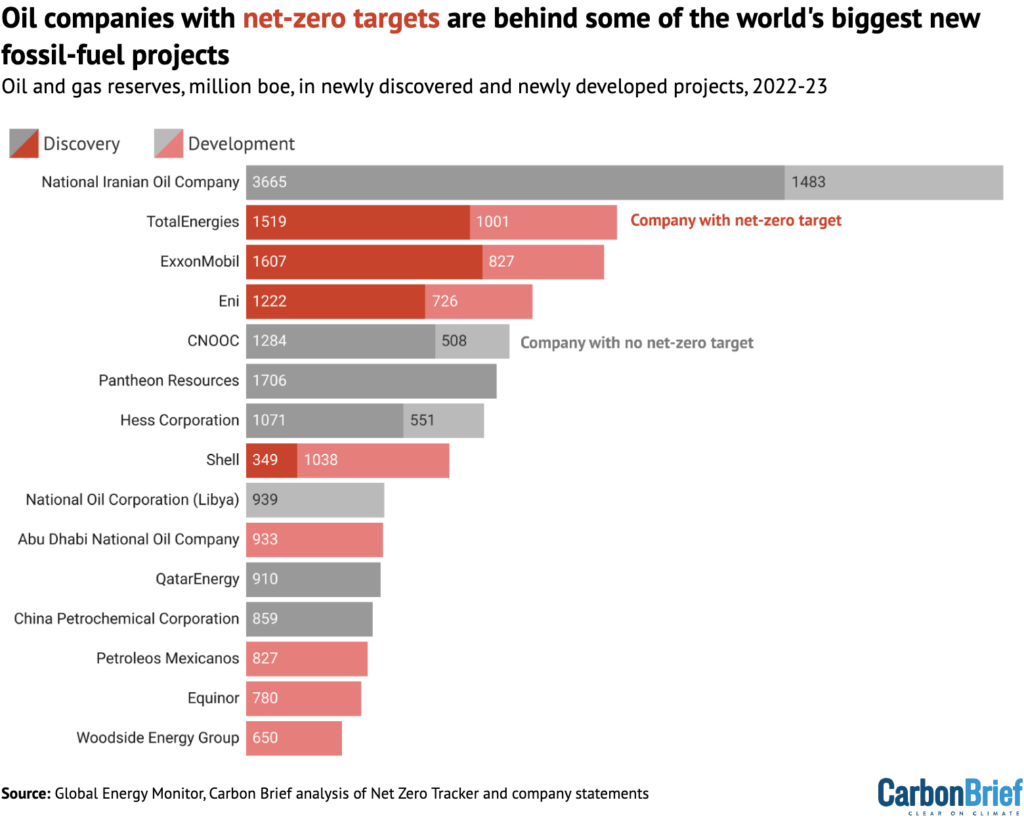
Top 15 companies by ownership of new oil and gas projects that were either discovered (dark red) or reached their “final investment decision” (light) in 2022-23.

A large percentage of the world’s new oil and gas developments since 2022 are from companies that have set net-zero emissions targets, such as TotalEnergies and ExxonMobil, according to Carbon Brief analysis of a new report from Global Energy Monitor. Carbon Brief has estimated that both TotalEnergies and ExxonMobil could generate roughly 1,000m tonnes of CO2 each with their expansion plans, which is equivalent to Japan’s annual total.

How lifestyle changes could help the EU reach net-zero

This week, Carbon Brief explores an underreported pathway to net-zero in the EU that highlights the potential additional benefits enabled by lifestyle changes.

Last month, the EU set a new intermediary target to reduce emissions by at least 90% by 2040, relative to 1990 levels.

Buried within the impact assessment released with the announcement, there was a unique scenario called “LIFE” that offers an alternative pathway to reach the EU’s new target largely through lifestyle changes.

What is LIFE?

The LIFE (short for “lifestyle”) scenario is unique among the modelled scenarios because it does not consider a different level of ambition, but, rather, a different way of reaching the emissions reductions target of the most ambitious scenario (known as S3). 

(LIFE is similar to the “1.5LIFE” scenario that the EU considered when setting out its vision for a climate-neutral economy in 2018.)

Both LIFE and S3 achieve the EU target of at least a 90% emissions reduction by 2040. In contrast to S3, which achieves this by assuming high levels of deployment for novel technologies such as carbon capture and e-fuels, LIFE “assumes more sustainable lifestyles and a move towards a more circular and shared economy”.

Comparing S3 with LIFE offers a comparison for two paths to net-zero: one more reliant on technology and one more reliant on lifestyle changes.

What would LIFE mean for EU lifestyles?

The LIFE scenario targets modest reductions in the most-emitting and inefficient forms of transport and food, while encouraging “circularity”. 

Compared to S3 in 2040, car driving is reduced by 5%, flying is reduced by 10% and meat production is reduced by 25%, (caused by diet change rather than more exports). People are assumed to travel more by train, use more video conferencing and eat more plant-based foods.

People are expected to heat their homes more efficiently through smart meters and be more mindful consumers of products, reusing and repairing them where possible. 

The assessment notes that these changes are in line with “possible expected individuals changes in daily life and willingness for action in changing consumption patterns”. 

What are the benefits of LIFE?

There are multiple proposed benefits to the LIFE pathway in terms of cost, ease of transition, health and biodiversity, in comparison to S3.

The total investment needs for LIFE are, on average, 8% lower, representing average annual savings of €129bn, or €2.58tn total, across 2031-2050.

Enabled by lower electricity demand overall, the total renewable capacity required in 2040 is reduced by around 240GW (11%), or around half of 2020 capacity.

Health benefits from better air quality are further improved, claim the modellers, and there are significant health benefits from lower levels of cardiovascular diseases, cancer, diabetes and obesity due to healthier diets.

Under the pathway, some 11m hectares of farmland are instead used for forests, natural vegetation and rewetted soils, leading to less fertiliser use and improved biodiversity. As a result, there are 104m tonnes more emissions savings from the land sector, including agriculture, by 2040.

This, say the modellers, reduces the need for industrial carbon capture and carbon removal by 19% and 64%, respectively, reducing the risk of scaling these nascent technologies.

NO BLOOMS AHEAD: The South China Morning Post considered the threats faced by cherry blossoms due to climate change in Japan.

E-BIKE EMISSIONS?: Youtuber Simon Clark explored the environmental impact of electric bikes compared to other forms of transport.

NATURE’S END: Euractiv’s podcast broke down why the EU’s restoration law is facing opposition from several EU member states.

  • Green Alliance, head of climate policy | Salary: £46,962-£55,348. Location: London
  • WattTime.org, research scientist, data fusion (climate trace) | Salary: $160,000- $195,000. Location: Remote (US-based)
  • Science Based Targets Initiative, transport analyst | Salary: Unknown. Location: Remote
  • Green Climate Fund, accredited entities officer | Salary: $96,200. Location: Incheon, South Korea
  • Friends of the Earth International, programme communications coordinator | Salary: €4,314-4,778 per month. Location: Amsterdam, Netherlands (or remote)

This is an online version of Carbon Brief’s weekly DeBriefed email newsletter. Subscribe for free here.

DeBriefed is edited by Daisy Dunne. Please send any tips or feedback to [email protected]

Sharelines from this story

Categories
Energy

Natural Power supports DIF Capital Partners’ sale of UK onshore wind farm

Leading renewable energy consultancy and service provider, Natural Power, has acted as vendor’s technical advisor on behalf of DIF Capital Partners to support the sale of the 13-turbine, 26MW, Wadlow Wind Farm in Cambridgeshire, England.

Closing of the transaction is subject to customary conditions and approvals and is expected to take place in Q2 2024.

The due diligence assignment included a review of the key project agreements, design, operational review and life extension analysis. Natural Power also conducted a post-construction yield assessment as well as a site visit and wind turbine inspection.

Gregory Dudziak, Head of Advisory (Europe) at Natural Power, said: “The UK needs more onshore wind if we are to meet and exceed COP28 expectations. It’s an area where we have extensive expertise as a team, and we’re delighted to be supporting our client DIF Capital Partners in moving this latest project to the next stage in its lifecycle.”

Natural Power previously acted as technical advisor at Wadlow in 2016, and also completed operational reporting on the project from 2013 to 2018.

Categories
Energy

Analysis: New oil and gas projects since 2021 could emit 14bn tonnes of CO2

Burning all the oil and gas from new discoveries and newly approved projects since 2021 would emit at least 14.1bn tonnes of carbon dioxide (GtCO2), according to Carbon Brief analysis of Global Energy Monitor (GEM) data.

This would be equivalent to more than an entire year’s worth of China’s emissions. 

It includes 8GtCO2 from new oil and gas reserves discovered in 2022-23 and another 6GtCO2 from projects that were approved for development over the same period.

These have all gone ahead since the International Energy Agency (IEA) concluded, in 2021, that “no new oil and gas fields” would be required if the world were to limit global warming to 1.5C .

Since then, world leaders gathering at the COP28 summit at the end of 2023 have also agreed to “transition away from fossil fuels”.

Despite this, nations such as Guyana and Namibia are emerging as entirely new hotspots for oil and gas development. At the same time, major historic fossil-fuel producers, such as the US and Iran, are still going ahead with large new projects.

Additionally, oil majors such as TotalEnergies and Shell that have made public commitments to climate action, are among the biggest players investing in new oil and gas extraction around the world.

More oil, more CO2

In 2021, the IEA issued its first “net-zero roadmap”, setting out a pathway for the world to limit warming to 1.5C. The influential agency concluded that:

“Beyond projects already committed as of 2021, there are no new oil-and-gas fields approved for development in our pathway.”

This statement has become a rallying cry for campaigners and leaders pushing for a phase out of fossil fuels.

The IEA has since clarified that there would be no need for new oil and gas developments if the world gets on track for 1.5C. It has also slightly softened its language, by allowing for new oil and gas projects with a “short-lead time” within its 1.5C scenario.

Yet it has also warned of the risk of “overinvestment” in new developments, noting that current spending is “almost double” what would be needed under its 1.5C pathway.

In any case, the IEA’s message has been widely ignored by oil and gas companies, which have continued to search for new extraction opportunities.

In its new global oil and gas extraction tracker, GEM identifies 50 new sites discovered in 2022 and 2023, after the IEA issued its initial net-zero roadmap. The oil and gas reserves from these projects amount to 20.3m barrels of oil equivalent (Mboe).

The tracker also identified a further 45 projects that have reached “final investment decision” (FID) since the IEA’s roadmap, with an extra 16Mboe of reserves. FID is the point at which companies decide to move ahead with a project’s construction and development.

If all the oil and gas in the newly discovered reserves is burned in the coming years, an extra 8GtCO2 would be released into the atmosphere, according to Carbon Brief analysis. Adding the reserves discovered between 2022-23 brings this total to 14.1GtCO2.

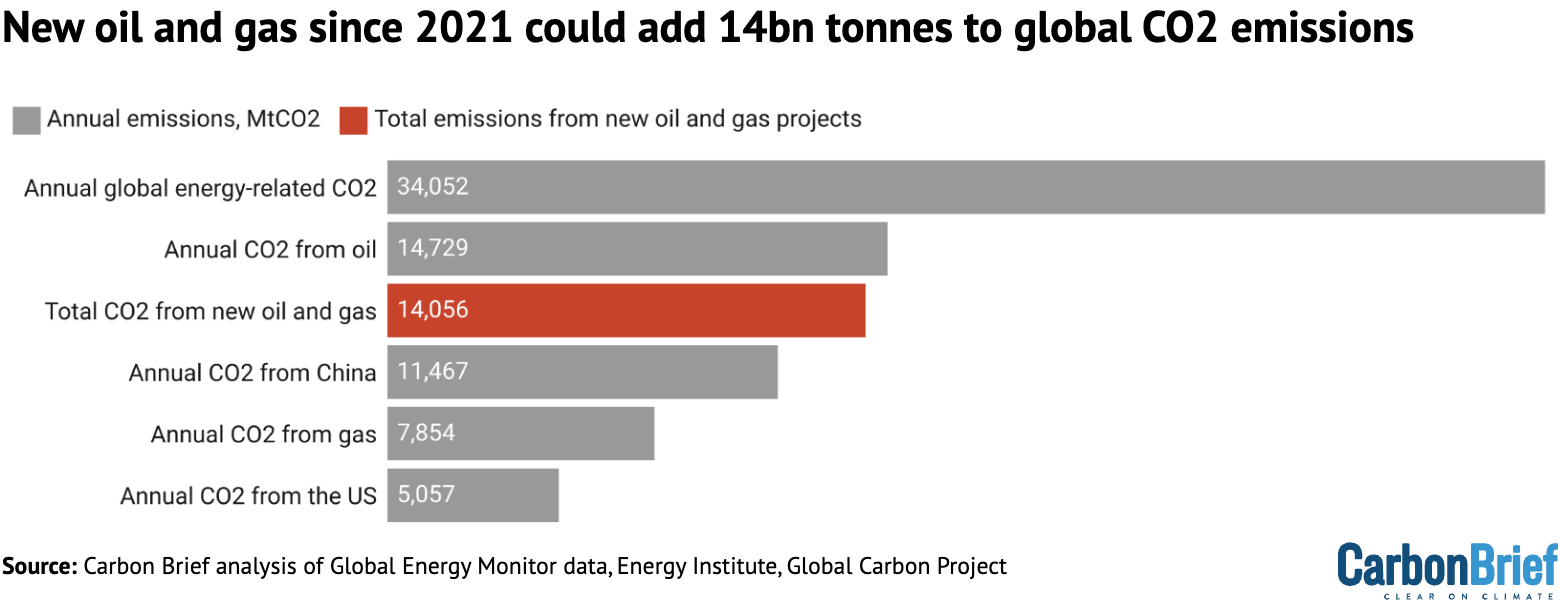
This is equivalent to more than one-third of the CO2 emissions from global energy use in 2022, or all the emissions from burning oil that year, as shown in the chart below.

New oil and gas since 2021 could add 14bn tonnes to global CO2 emissions
Total CO2 emissions that would be emitted if all the oil and gas reserves from newly discovered and newly developed projects between 2022-23 were burned (red) compared to annual emissions from different countries and energy sources in 2021 (grey). CO2 emissions were calculated based on oil and gas reserves listed in the GEM global oil and gas extraction tracker database. When the fuel type was not specified, Carbon Brief assumed a 50:50 split. Source: Carbon Brief analysis of Global Energy Monitor data, Energy Institute, Global Carbon Project.

These findings are in line with mounting evidence that both company and government plans for fossil fuels are not aligned with their own climate goals. 

According to the most recent UN Environment Programme “production gap” report,  companies are planning for oil and gas production that is 82% and 29% higher, respectively, than would be needed in a 1.5C pathway.

The remaining “carbon budget” of emissions that can be released while retaining a 50% chance of limiting warming to 1.5C is just 275GtCO2, according to the Global Carbon Budget consortium of scientists. Burning all of the contents of the new oil and gas schemes identified by GEM would use up 5% of this remaining budget.

Moreover, the GEM report points out that new projects take, on average, 11 years to start producing significant amounts of oil and gas. This means that most will not enter production until the 2030s. 

By this point, according to the IEA, fossil-fuel demand would have fallen by “more than 25%” if the world gets on to a 1.5C-compliant pathway.

GEM also notes that its analysis likely underestimates the scale of new fossil fuel developments. It excludes smaller sites and those where the size has not been publicly announced, such as new gas fields discovered in Saudi Arabia in 2022.

The IEA updated its net-zero scenario in 2023 to reflect the continued expansion of fossil-fuel projects since its previous report. It stated that:

“No new long lead time conventional oil and gas projects need to be approved for development.”

It added that falling demand for fossil fuels “may also mean that a number of high cost projects come to an end before they reach the end of their technical lifetimes”, again if the world gets onto a 1.5C pathway.

To reflect the IEA’s new language around avoiding “long lead time” and “conventional” projects, GEM excludes expansions of existing projects and “unconventional” sites from its analysis. The report notes that including them would roughly quadruple the size of the reserves that reached a FID in 2022-23.

Oil majors

Many oil companies have made it clear that they do not intend to wind down their fossil-fuel operations in the near future. 

This is true even for those that have made commitments to climate action, such as Shell and TotalEnergies. (Some oil majors have also watered down their pledges in recent months.)

As the chart below shows, many of the companies with the largest share of new oil and gas schemes have also announced net-zero targets.

Top 15 companies by ownership of new oil and gas projects that were either discovered (dark red) or reached their “final investment decision” (light) in 2022-23.
Top 15 companies by ownership of new oil and gas projects that were either discovered (dark red) or reached their “final investment decision” (light) in 2022-23. Companies often share ownership of projects, so reserves have been divided up based on the percentage share of each project belonging to companies. Source: Global Energy Monitor, Carbon Brief analysis of Net Zero Tracker and company statements.

The top rankings are dominated by publicly traded oil majors, such as ExxonMobil, and national companies, such as the Abu Dhabi National Oil Company (ADNOC) – which is led by COP28 president Sultan Al Jaber. Saudi Aramco, the world’s largest oil company, is missing from the GEM tracker, likely due to the lack of data from Saudi Arabia.

The emissions that could result from new gas fields run by the state-owned National Iranian Oil Company alone amount to 1,700MtCO2, according to Carbon Brief analysis. This is higher than the annual carbon footprint of Brazil.

Meanwhile, oil and gas in new projects being developed by TotalEnergies and ExxonMobil could generate roughly 1,000MtCO2 – equivalent to Japan’s annual total – for each company.

At the recent CERAWeek industry conference, many oil and gas industry leaders argued against a transition to cleaner forms of energy. For example, Saudi Aramco chief executive Amin Nasser told attendees: “We should abandon the fantasy of phasing out oil and gas.”

As companies continue searching for more oil and gas, executives have consistently emphasised that demand for fossil fuels, rather than production, is the problem.

Most recently, in an interview with Fortune, ExxonMobil chief executive Darren Woods placed the blame on the public, who he said “aren’t willing to spend the money” on low-carbon alternatives.

New country ‘hotspots’

New nations, mainly in the global south, are opening up as “global hotspots” for oil and gas projects, according to GEM. 

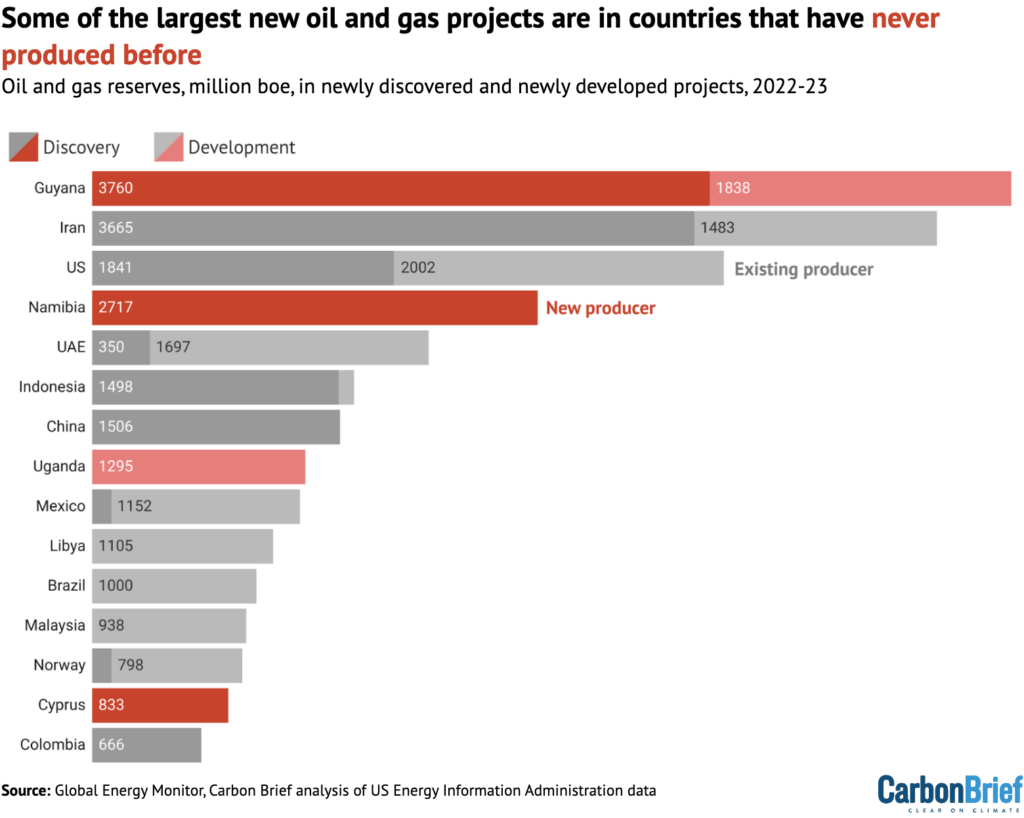
Notably, Guyana is set to have the highest oil production growth through to 2035. Over the past two years, it has already been the site of more new oil and gas discoveries than any other country. Namibia has also opened up as a major new frontier in fossil-fuel extraction. 

The chart below shows how nations that have recently been targeted for oil and gas exploration, now make up a large portion of new discoveries and developments.

Top 15 countries by location of new oil and gas reserves that were either discovered (dark red) or reached their “final investment decision” (light) in 2022-23.
Top 15 countries by location of new oil and gas reserves that were either discovered (dark red) or reached their “final investment decision” (light) in 2022-23. Source: Global Energy Monitor, Carbon Brief analysis of US Energy Information Administration data.

The expansion of oil and gas production in the global south is a highly politicised topic. 

Many African leaders, in particular, argue that their countries are entitled to exploit their natural resources in order to bring benefits to their people, as global-north countries have done. At COP28, African Group chair Collins Nzovu stated that oil and gas were “crucial for Africa’s development”. 

(It is worth noting that, according to GEM’s analysis, companies based in the global north such as ExxonMobil, Hess Corporation and TotalEnergies own most of the reserves in the new global-south projects.)

Meanwhile, wealthy oil producers such as the US, Norway and the UAE justify their continued fossil-fuel extraction by saying their production emissions are relatively low. Others, such as the UK, argue that they need to exploit domestic reserves to preserve their energy security.

Even in a 1.5C scenario, the IEA still includes a significantly reduced amount of oil and gas use in 2050. Most of it goes towards making petrochemicals and producing hydrogen fuel.

However, in last year’s report on the position of the oil and gas industry in the net-zero transition, the agency also emphasises that this does not mean everyone can continue producing.

“Many producers say they will be the ones to keep producing throughout transitions and

beyond. They cannot all be right,” it concludes.

Sharelines from this story