Categories
Energy

China Briefing 4 April: Heat-driven impact on economy; Coal capacity ‘pushed down’; China’s WTO complaint

Welcome to Carbon Brief’s China Briefing.

China Briefing handpicks and explains the most important climate and energy stories from China over the past fortnight. Subscribe for free here.

Key developments

China submits WTO complaint against US over EV tax credit

US-CHINA SUBSIDY CONFLICT: On 26 March, China filed a complaint with the World Trade Organisation (WTO) against the US’s “discriminatory” requirements for electric vehicles (EV) subsidies, which, it argues, makes EV containing components made in China, Russia, North Korea and Iran ineligible for tax credits worth $3,750 to $7,500, said the Associated Press. A day later, the US treasury secretary Janet Yellen raised the issue of “overcapacity” of “green technologies” from China, including solar, EV and lithium-ion batteries, during her visit to a solar cell factory in the US, reported the New York Times. The outlet quoted Yellen saying “China’s overcapacity distorts global prices and production patterns and hurts American firms and workers, as well as firms and workers around the world”.

PRESIDENTIAL CONVERSATION: Earlier this week, Chinese president Xi Jinping and US president Joe Biden held a phone conversation. The read-out of the conversation released by the US embassy in China said: “President Biden also raised continued concerns about the PRC’s unfair trade policies and non-market economic practices, which harm American workers and families.” But it said the two leaders “reviewed and encouraged progress on key issues discussed at the Woodside summit…and continuing efforts on climate change.” The briefing from the Chinese Ministry of Foreign Affairs said: “The two sides agreed to stay in communication…carrying out dialogue and cooperation in such areas as counternarcotics, artificial intelligence and climate response.”

CLIMATE DIPLOMACY: Meanwhile, Rick Duke, the deputy US special envoy on climate change, told Reuters that the cooperation between the US and China on methane emissions is “advancing”. He added: “We are, indeed, in the process of propelling that work together.” According to Politico, EU climate envoy Tony Agotha and top climate diplomats from Germany, France, Denmark and the Netherlands will join a trip to Beijing on 8 April to build a “multinational diplomatic track to engage China on climate change”. Separately, the US embassy and Chinese foreign ministry confirmed upcoming visits to China by Yellen on 4-9 April and US secretary of state Antony Blinken “in the coming weeks”.

EV EXPANSION: According to a report in the Hong-Kong based South China Morning Post, anti-subsidy probe and trade restrictions “reduced” the export volume of Chinese EVs to the EU and US by 20% and 42%, respectively, in the first two months of this year, prompting Beijing to look towards other markets. Chinese EV sales in Central Asia have increased 2.3 times during the same period. Meanwhile, an analysis by Transport & Environment showed Chinese EV sales are “on track” to reach 25% of electric car sales in the EU by the end of 2024. The outlet added that the bloc should not aim to shield its carmakers from “meaningful competition”, which would limit affordability of EVs for Europeans.

EU probes Chinese solar firms

SOLAR INVESTIGATION: The Financial Times reported that the EU has opened investigations into the subsidiaries of two Chinese solar manufacturers which may have “been granted foreign subsidies that distort the [EU’s] internal market”. The outlet adds that “the probes reflect a hardening stance in Europe towards cheap Chinese imports, which the EU’s solar industry has blamed for the heavy losses and plant closures of several European solar panel manufacturers”.

SECOND INQUIRY: The South China Morning Post said that this marks the second use of the EU’s foreign subsidies regulation to investigate Chinese firms, which “demonstrates Brussels’ willingness to use the commercial weaponry at its disposal to counter what it sees as unfair competition from Beijing”. In February, the EU investigated a Chinese rail firm, which later withdrew its bid to enter the Bulgarian market, it added.

Renewable installations push coal capacity share down

COAL SHRINKING?: The China Electricity Council, a government-affiliated research thinktank, announced that coal’s share of installed capacity has fallen to 39% of the total mix, as of February 2024, according to industry news outlet BJX News. This was driven by the rapid installation of renewables, the outlet added. China Energy Net reported that, in January and February this year, China installed 36.7 gigawatts (GW) of solar, which is 80% more than last year. Total installed solar capacity stood at 650GW at the end of February, a 56.9% increase, while wind capacity grew 21.3% to 450GW. However, it added, utilisation of both solar and wind shrank slightly in the first two months of the year compared to a year ago.

GRID OVERLOAD: According to Bloomberg, following “record” solar and wind power installations last year, “several regions in China have shown strains handling the new surges of electricity”. Meanwhile, London Stock Exchange Group analyst Chen Xuewan shared on Twitter that the southern provinces of Guangdong, Yunnan and Guizhou may face “power gaps” this year unless power system flexibility is improved.

2024 TARGETS: The National Energy Administration (NEA) released its guidelines for the department’s energy work in 2024, which pledges both to “focus on improving energy security capacity” and to “focus on promoting green and low-carbon energy transformation”. It aims to have non-fossil energy comprise 55% of the energy mix and 18.9% of power consumption. More specifically, wind and solar power will account for more than 17% of power generation by the end of the year. Meanwhile, coal production will be “stabilised and increased”, while oil production will be “stabilised at more than 200m tonnes” and natural gas will “maintain its rapid pace of production”.

China’s climate envoy reinforces role of fossil fuels at Boao

‘CLEAN’ FOSSIL FUELS : At this year’s “Boao forum for Asia” in Hainan – Asia’s version of Davos – China’s climate envoy Liu Zhenmin said that “[China] will still keep our fair share of fossil fuels, but they must be used purely”, adding that this was a “critical” point, Bloomberg reported. Liu also said that the world needs to “massively scale up deployments of solar, wind and hydropower”, but that US trade restrictions increase the cost of clean energy overseas and slow the energy transition, added the outlet. State news agency Xinhua quoted Liu saying at the same event that “humanity’s response to climate change depends on the development of technology” and that developed nations must help meet the financing needs of developing nations.

‘GREEN’ ECONOMY: Zhao Leji, chairman of the standing committee of the National People’s Congress, China’s legislative body, also spoke at Boao. He stated that “[China is] speeding up efforts to promote green and low-carbon economic and social development” and will “strive” to meet its dual carbon goals, according to the Associated Press. CGTN published the full text of Zhao’s speech, in which he also said the country will “cultivate large-scale new growth drivers in green infrastructure, green energy, green transportation and green lifestyle, which is expected to generate investment and consumption markets with a size of 10tn yuan ($1.4tn) every year”. Other notable speakers, the South China Morning Post said, included former central bank governor Zhou Xiaochuan and former deputy trade minister Long Yongtu, who both argued that overcapacity in the “clean-energy sector” will be temporary, as long as global demand for energy transition technologies remains robust.

Spotlight

How climate change could reduce China’s GDP growth

A new study by a group of Chinese scientists, published in Nature, finds that China could significantly constrain future economic growth, due to the impact of climate change on global supply chains.

Carbon Brief invites the paper’s lead authors Prof Guan Dabo and doctoral candidate Sun Yida from Tsinghua University to outline their main findings of the potential impacts of global warming on China’s manufacturing capabilities and economic growth.

In recent years, global supply chains have faced a global pandemic, commercial ships under attack in the Red Sea and a container ship getting wedged in the Suez Canal for six days. The impact of each of these events has rippled across the global economy.

In our new research, published in Nature, we show that climate change poses a similar threat to supply chains around the world, bringing economic losses that will increase exponentially relative to the rise in global temperatures.

Focusing on heat extremes, our research team constructed a “disaster footprint” model to assess the health risks and economic losses associated with heatwaves.

To estimate the impact of extreme heat on global GDP, our model combines projections of future climate, simulations of future population dynamics in response to warming and estimates of heat-induced labour loss on the global economy and supply chains.

Our study is the first to chart “indirect economic losses” from climate change on global supply chains, underscoring the risk to regions that will likely be less affected by warming directly.

The results suggest that, by 2060, China could suffer soaring economic losses amounting to 1.5-4.8% of GDP growth by 2060. Some of its industries, including construction and manufacturing, could lose around 4.6-6.4% of their value.

How could indirect disruptions affect economic growth?

While the direct mortality and productivity loss resulting from heat stress have been extensively studied, previous analysis has yet to account for indirect economic loss.

Indirect economic loss is the reduction in economic output or welfare due to disruptions caused by feedback loops after a shock to the economic system, rather than by a direct impact from a shock. These losses could be due to changes in production, consumption or employment.

For example, crop failures, labour slowdowns and other economic disruptions in one part of the world can affect the supply of raw materials flowing elsewhere. This can cause production stagnation where trading partners cannot access the supplies they need.

These indirect disruptions could cause a projected net economic loss of $3.75-$24.7tn globally by 2060, depending on how quickly climate change is tackled.

We estimate expected economic losses across three scenarios, called “shared socioeconomic pathways” (SSPs), broadly covering futures under very low, intermediate and very high emissions.

The charts below illustrate the potential economic losses as a percentage of GDP China may face under the SSP1-1.9, SSP2-4.5 and SSP5-8.5 scenarios, which project an average global temperature rise of around 1.5C, 2C and 2.5C by mid-century, respectively. Economic losses are split into indirect losses (dark blue), labour losses (blue) and health losses (light blue).
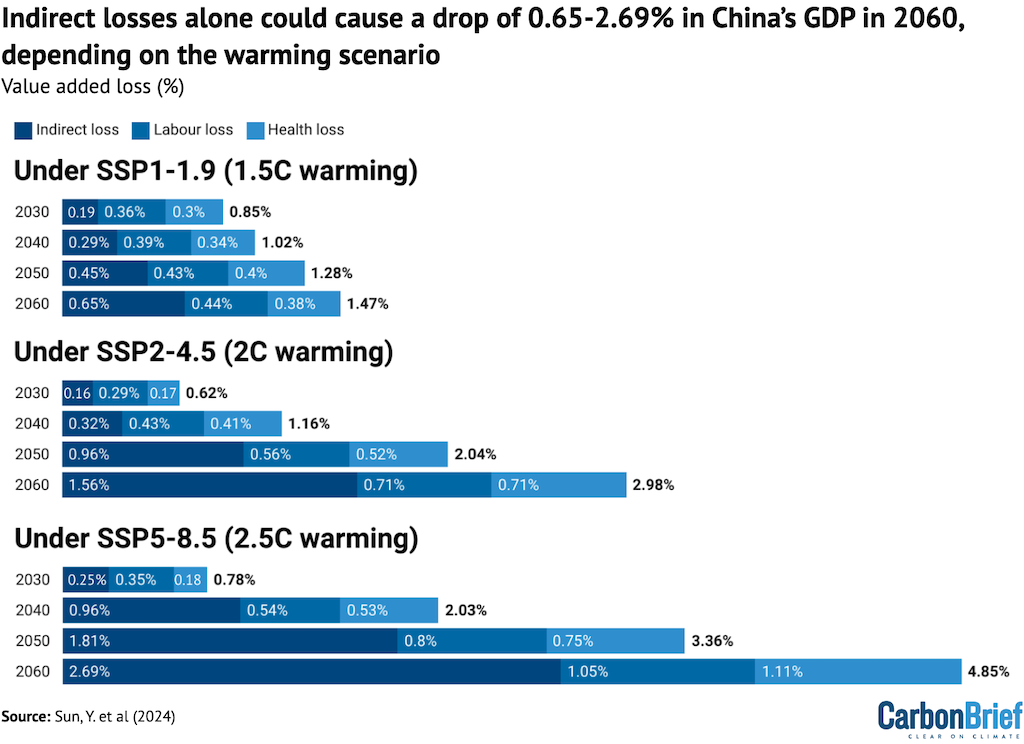
Indirect losses alone could cause a drop of 0.65-2.69% in China's GDP in 2060, depending on the warming scenario.

What is the impact on China?

As the global economy has grown more interconnected, disruptions in one part of the world have knock-on effects elsewhere in the world.

For example, as a manufacturing-heavy country, China faces indirect economic losses of up to 2.7% of total GDP in 2060.

Overall, indirect losses were the most significant component of China’s economic losses, accounting for just over half of total losses.

By 2060 China’s heat-induced economic losses could total about 1.5% of total GDP under 1.5C of global warming, 3% under 2C of warming and 4.9% under 2.5C of warming.

Sectors such as the extractive industries, construction and non-metallic manufacturing – which are some of China’s “key industrial sectors” – could see the highest losses.

These industries are not only located in regions with significant warming, but also import large quantities of upstream primary products from south-east Asia, Africa and South America – regions which are expected to face heightened exposure to production volatility caused by high temperatures.

They are projected to lose about 4.6-6.4% of their “value-added” under the compounded impacts of direct production reductions and indirect spillover shocks.

In addition, under the lowest emissions scenario, 2060 could see an additional 590,000 heatwave deaths annually across the globe, rising to 1.12m additional annual heatwave deaths under the highest scenario. This human toll entails economic costs as well, such as increased healthcare costs and production losses stemming from lost labour.

What next?

This research is an important reminder that preventing every additional degree of climate change is critical.

It should be noted that China’s recent investments in south-east Asia, the Middle East and Africa have shifted towards renewable energy and low-emission mining technology, rather than coal projects and large-scale infrastructure. This will contribute to building climate resilience and creating more stable global supply chains.

In addition, understanding which nations and industries are most vulnerable is crucial for devising effective and targeted adaptation strategies, including establishment and targeted use of the “loss-and-damage funds” agreed at COP27 in 2022.

Watch, read, listen

HUMAN COST: Environmental activist Wang Xiaojun gave a TED talk on his experience growing up in China’s top coal-producing province and the impact that environmental degradation had on his village and family.

SECURITY DILEMMA: The state broadcaster CCTV “exposed” a case of the illegal use of reserved farmland being converted into a solar power plant in Hubei.

FEATURE OR BUG?: An article in World Politics Review argues that excess capacity is a “tolerated feature” of China’s industrial system because it allows China to meet high-level targets, while “local governments clean up the mess [of] bankrupt firms or laid-off workers”.

LITHIUM’S FUTURE: A podcast by the Oxford Institute for Energy Studies discussed the possible path of the lithium market as it matures and grapples with China’s dominance of lithium processing.


575

In gigawatts, the estimated heat pump capacity for buildings (residential and commercial) in China by 2030 under the stated policies scenario (STEPS), according to a report by the International Energy Agency on the future of heat pumps in China.


New science

End-year China wind power installation rush reduces electric system reliability
Energy Economics

Research identified “significant adverse effects” of the rapid installation of wind power on electricity reliability. It found that a faster rate of installation led to lower reliability rates and more power outages. The authors raised the importance of “improvements in grid infrastructure and management in the transition to a low-carbon world”.

Managing fragmented croplands for environmental and economic benefits in China
Nature Food

A new study found that improving the management of croplands could “achieve synergies between food security, economic benefits and environmental protection” without needing to use more land. It revealed that “10% of Chinese croplands have no potential to be consolidated for large-scale farming” and, if the land was instead used to grow animal feed, nitrogen and greenhouse gas emissions could drop by 10% and 101%, respectively.

China Briefing is compiled by Wanyuan Song and Anika Patel. It is edited by Wanyuan Song and Dr Simon Evans. Please send tips and feedback to china@carbonbrief.org

jQuery(document).ready(function() {
jQuery(‘.block-related-articles-slider-block_02d0d77dfd6b3c8478b04a9d9a8815b4 .mh’).matchHeight({
byRow: false
});
});

The post China Briefing 4 April: Heat-driven impact on economy; Coal capacity ‘pushed down’; China’s WTO complaint appeared first on Carbon Brief.

Categories
Energy

CE+P to Partner with International Agribusiness Experts Booker Tate Ltd. on Sugar Valley Energy Sugarcane and Ethanol Production

International sugar and agribusiness consultant Booker Tate Ltd. to help guide sugarcane cultivation plans and ethanol production for Sugar Valley Energy, an approximately $650 Million, 160-acre sugarcane ethanol refinery and bioenergy facility planned near Brawley in Imperial County.

Brawley, CA — April 3, 2024 — California Ethanol + Power (CE+P) has named international sugar and agribusiness consultant Booker Tate Ltd. to help guide sugarcane cultivation plans and ethanol production for Sugar Valley Energy, an approximately $650 Million 160-acre sugarcane ethanol refinery and bioenergy facility planned near Brawley in Imperial County.

Based in Thame Oxfordshire, UK, Booker Tate are experts in the areas of sugarcane, farming, bioenergy, and ethanol refining and have provided management and technical leadership on more than 1,500 projects in 120 countries in the past 55 years, including in North, Central and South America, Europe, Middle East, India, Asia and Africa as well as in Australia and the South Pacific.

“As we proceed through the final financing phase of our project to our anticipated construction, CE+P is excited to partner with one of the world’s most preeminent experts on sugarcane and ethanol production,” said CE+P CEO Dave Rubenstein. “Sugar Valley Energy has an exceptionally strong team to deliver the project and its numerous regional economic and community benefits.”

Booker Tate will supply the Sugar Valley Energy project with management and engineering personnel to work in concert with the project’s EPC contractor during the construction and operational startup phases. Functional roles will include civil, electrical, mechanical and instrument engineers as well as agricultural managers and agronomists to review all aspects of local sugarcane production.

“We have been working closely with CE+P and the Sugar Valley Energy team from the original investigation of the project concept to the current financial phase. We are looking forward to assisting with the construction and being part of the operations once the project is commissioned’ says Robert Hodgson, Project Director for Booker Tate. ‘We are proud to be associated with such an important renewable energy project and are fully committed to its success.”

“We will integrate and apply our scientific and commercial knowledge of renewable resources to create maximum value for CE+P and the Imperial Valley community in which it operates,” Hodgson added.

The team has planted 100 acres of sugarcane to date and is developing schedules for planting an estimated 48,000 acres within the Imperial Valley. The project is in discussions with area farmers who will contract with the Sugar Valley Energy project to grow sugarcane feedstock for the plant.

“Imperial Valley’s growers are among the most sophisticated in the world when it comes to the region’s superior water resources and know-how to produce quality crops, which are exported and consumed internationally,” said Steve Benson, Chief Agricultural Officer for CE+P. “We welcome the added expertise of Booker Tate as we prepare to scale up our sugarcane and energy product production.”

The completed Sugar Valley Energy campus will support an estimated 200 permanent new jobs onsite and in the Imperial County community, as well as hundreds of agriculture-related jobs associated with cultivating sugarcane. Construction of the facility alone is estimated to support more than 9,000 jobs in various trades. The project represents a $1 Billion investment in the Imperial Valley region.

About Booker Tate Ltd.

Booker Tate is a leading international agribusiness consultancy providing unrivalled agriculture and crop processing expertise. It supports clients in implementing new agriculture-based projects, and optimizing existing operations in an environmentally, socially, and economically sustainable manner.

Booker Tate has wide-ranging experience in the growing and processing of a variety of crops, primarily sugarcane, extending from small scale farming through to large scale, integrated agribusiness projects. For more information, visit www.booker-tate.co.uk

About California Ethanol + Power (CE+P)

CE+P is a development company that intends to develop, construct, operate and own numerous facilities that will convert locally grown sugarcane into Essential Ethanol™ sustainable, renewable and extremely low carbon transportation fuel that will assist California in meeting its groundbreaking AB32 requirements. CE+P is committed to employing processes and equipment that are both commercially proven and financeable, while also meeting California’s stringent environmental regulations. For more information, visit www.californiaethanolpower.com.

###

Categories
Energy

Lion Energy Unveils POWERsave Cabinet and Container Series, Delivering State-of-the-Art Energy Management for Companies

Revolutionary POWERsave Systems Provide Three Key Benefits: Back-Up Power,
Minimized Energy Costs and Integration of Renewable Clean Energy

Lion Energy, a leader in safe, silent and eco-friendly power solutions that help individuals, families and organizations become energy independent, today announced the launch of its POWERsave™ Energy Storage Solutions (ESS), comprised of the POWERsave Container Series and POWERsave™ Cabinet Series. POWERsave offers companies custom, large-scale energy solutions including back-up power, energy time shift, renewable energy integration, load management and power system recovery.

“Companies cannot afford to be offline due to electrical grid failures as it risks alienating customers, lowering employee productivity and losing revenue,” said Tyler Hortin, president of Lion Energy. “The POWERsave Energy Storage Solutions are economical and eco-friendly solutions that not only create energy independence from electrical grid outages but also minimizes a company’s energy costs.”

Lion Energy’s POWERsave solutions stores energy using high-grade, extremely safe lithium phosphate battery storage technology. Lion Energy’s USA-based team designed these solutions to be scalable, fireproof and resistant to corrosion, which enables them to meet the demands of projects large and small and to adapt to various environmental conditions. Both the POWERsave Cabinet and Container Series are custom solutions where multiple units can be combined for increased capacity applications.

The POWERsave Cabinet Series for indoor and outdoor C/I energy storage systems helps reduce peak energy costs from equipment and operations. Its power and capacity ranges from 30kW/50kWh to 90kW/180kWh. This solution is modular and expandable to meet larger energy storage requirements.

The POWERsave Container Series is an outdoor containerized energy storage system for utility grid tie or C/I behind the meter applications. The Container Series offers two enclosure model configurations (PS20, PS30) which have been configured to meet each customer’s specific power(kW) and capacity storage(kWh) requirements from 675kw/1032 to 1.7MW/3.44MWh per container. The containers are available in 20ft configurations and multiple units can be combined for even more capacity.

For more information about Lion Energy’s POWERsave Cabinet and Container Systems, please visit: http://www.lionenergy.com/ https://lionenergy.com/pages/powersave

Categories
Energy

SGX-Listed Mooreast Secures Anchor Order for Floating Offshore Wind Project in Southern France

Located off the French coast of Port-La Nouvelle and Gruissan in Southern France, Eolmed is a project developed by Qair, a European independent energy company, with TotalEnergies and floating technology supplier BW Ideol.

SINGAPORE, Apr 2, 2024 – (ACN Newswire) – Mooreast Holdings Ltd. (“Mooreast” or the “Group”) has secured an order to supply its proprietary anchors for a pre-commercial floating offshore wind farm. Located off the French coast of Port-La Nouvelle and Gruissan in Southern France, Eolmed is a project developed by Qair, a European independent energy company, with TotalEnergies and floating technology supplier BW Ideol.

Singapore Exchange-listed Mooreast, a total mooring solutions specialist and Asia’s only ultra-high power anchor manufacturer, announced today that it has partnered with French Installation Contractor Bourbon Offshore to supply Mooreast’s MA5S mooring drag anchors. The latter will provide transport and installation services to the 30MW pre-commercial project, which is the biggest of the first three floating wind energy projects to be developed in the country.

Up to 35 tonnes each, the anchors command a holding power of up to 1,210 metric tonnes, underscoring its remarkable strength-to-weight ratio and efficiency. The anchors will be used to moor three floating wind turbines. The anchors are expected to be delivered by October 2024, and the order will contribute positively to Mooreast’s FY2024 performance.

Singapore-based Mooreast is leveraging more than 30 years of mooring and offshore marine expertise to target the floating offshore wind sector worldwide. The fresh order marks Mooreast’s 15th offshore wind-related project since undertaking its first project in 2013, underscoring its strong track record in the emerging sector.

Apart from specialist anchors and equipment, Mooreast also offers geotechnical and geophysical studies such as soil data analysis to determine project feasibility and engineering design for mooring configuration for floating wind turbines.

The anchors will be manufactured at Mooreast’s yard at 51 Shipyard Road, Singapore, where the Group has also developed a range of anchors, chain stoppers and buoys to moor floating platforms.

Mr Sim Koon Lam, founder, Executive Director, CEO and Deputy Chairman of Mooreast, said, “The project win in France underscores the growing confidence that international players in the floating renewable industry have in us. The European floating wind energy sector is known for its rigorous standards and we are proud that Mooreast is able to achieve market acceptance in this region.”

“Already, we are in active discussions with several project developers looking to tap into our expertise and capacity for subsea foundation production. As more floating wind farms gain traction, Mooreast can add value through its specialist solutions and products. We are establishing a manufacturing facility in Aberdeen, Scotland, in addition to our regional marketing office in the Netherlands. We remain focused on offering differentiated value even as we see to capture more opportunities in the near future in this exciting sector.”

None of the Directors or substantial shareholders of the Group, as well as their respective associates, has any interest (direct or indirect) in this new project, other than through their shareholdings in the Group.

This press release has been prepared by the Company and its contents have been reviewed by the Company’s sponsor, W Capital Markets Pte. Ltd. (the “Sponsor”). This press release has not been examined or approved by the Singapore Exchange Securities Trading Limited (the “SGX-ST”) and the SGX-ST assumes no responsibility for the contents of this press release, including the correctness of any of the statements or opinions made or reports contained in this press release.

The contact person for the Sponsor is Ms Alicia Chang, Registered Professional, W Capital Markets Pte. Ltd., at 65 Chulia Street, #43-01 OCBC Centre, Singapore 049513, Telephone (65) 6513 3525.

Issued for and on behalf of Mooreast Holdings Ltd. by WeR1 Consultants Pte Ltd.

About Mooreast Holdings Ltd.

Mooreast is a total mooring solutions specialist, serving mainly the offshore oil & gas (“O&G”), marine and offshore renewable energy industries, with operations primarily in Singapore, the Netherlands through its wholly-owned subsidiary in Rotterdam Mooreast Europe, and the United Kingdom through Mooreast UK, an office based in Scotland.

Mooreast’s solutions include the design, engineering, fabrication, supply and logistics, installation and commissioning of mooring systems. Mooreast is applying its experience and expertise in mooring solutions to floating renewable energy projects, in particular floating offshore wind farms. It has successfully participated in developmental and prototype projects for floating offshore wind turbines in Japan and Europe.

For more information, please visit https://mooreast.com/

Categories
Energy

Kiwa Announces Integration of Key Solar Businesses

The strategic initiative strengthens the Kiwa Group’s renewable energy service offerings.

Today the Kiwa Group announces the official integration of Kiwa’s previously acquired member solar companies PV Evolution Labs (PVEL), PI Berlin, and Extel Energy together under one brand. Kiwa, a global leader in testing, inspection and certification services, had previously acquired each of the individual member companies as part of their commitment to address the needs of the worldwide renewable energy market.

As market leaders in the service of solar photovoltaic (PV) and energy storage projects, PVEL, PI Berlin, and Extel Energy have previously operated in collaboration as members of the Kiwa Group. With this announcement, the organizations will now operate under the Kiwa umbrella, better signifying the relationship of these solar industry companies as integrated solutions providers under the Kiwa brand.

“While Kiwa is already active in the solar and energy storage markets, the integration of these powerful brands signifies how Kiwa continues to lead as an expert in renewables, particularly solar,” said Luc Leroy, CEO of Kiwa. “Kiwa provides value across the entire solar supply chain. We offer our clients around the world a one-stop-shop for testing, inspection and advisory services that de-risk solar and energy storage projects.”

Kiwa PVEL will continue to provide extended reliability testing for PV modules and equipment, including its flagship Product Qualification Program (PQP). Kiwa PI Berlin will continue to offer all current technical advisory, risk management, and quality assurance services for PV plants, modules, inverters, transformers, and battery storage systems. Kiwa Extel will continue to perform inspections, analysis, and technical advisory for PV plants.

The importance of testing, inspection, and certification for solar development

As solar energy contributes to be one of the fastest growing sources of energy capacity available worldwide, the need for technical advisory and inspection services has grown. According to the IEA, solar PV accounted for the majority of all renewable capacity additions worldwide last year, with global generation expected to reach 1,991 TWh in 2024.

“Every day, new solar technologies are being developed and deployed. We need to be adequately assessing how these products will perform over the long term,” said Kevin Gibson, Managing Director of Kiwa PVEL. “For years we’ve worked with PI Berlin and Extel Energy to help create trust in building the foundations of a strong solar industry. Now we’re able to more closely align our services to ensure our clients have the best possible quality assurance for solar procurement and project development into the future.”

“Our combined expertise affords us a broader global reach, reinforcing our commitment to serve clients across North America, Europe and Asia,” said Luca Votta, Global Business Sector Leader Renewable Energy. “As we enhance our capabilities, we want to emphasize that for our valued clients, it will be business as usual. We’ll continue to deliver the seamless service and high industry standards that already help create trust in the development of gigawatts of solar worldwide.”

About Kiwa

We are Kiwa. With our assurance, testing, inspection, certification, training, consultancy and data services, we create trust in our customers’ products, services, processes, (management) systems and employees. We do so in a wide variety of markets segments, ranging from construction and energy supply to drinking water, healthcare, food, feed & farming. Areas of expertise include management systems, corporate social responsibility and lab testing, among many others.

We have clients in manufacturing and process industries, (business) services, public and private utilities, governments and international institutions. Kiwa employs over 10,000 people in over 40 countries, in Europe, Asia, the Americas and Oceania. Since 2021 we are a member of SHV Family of Companies.

Categories
Energy

Development of hydropower plants under the V.O.D.A project as a type of alternative energy sources

The V.O.D.A project defines the development by a team of specialists of new hydropower plants for generating electricity using the kinetic energy of a liquid created forcibly by an external device and (or) natural environmental factors. The project is aimed at introducing technological innovations and developing alternative sources of electricity using laws of nature: the force of gravity and the property of liquid.

The V.O.D.A project provides for research, studies, development and design work to achieve the indicators, design-and-engineering solutions necessary and sufficient for the design and production of technical power generating devices for universal or specialized applications in industry, at infrastructure facilities for various purposes.

At the initial stage, the implementation of the V.O.D.A project is carried out by “WETER” LLC, established for the implementation of research and development in the field of natural and technical sciences, devices (systems) for the production and transmission (distribution) of electricity, urban infrastructure systems. During the implementation of the project, for the progressive development of a new hydropower plant having an inventive level and industrial applicability with the name “Energy Generator”, cooperation with scientific, design and other institutions (organizations) of the relevant profile with competence in the development and design of hydropower plants is expected.

WETER LLC actively promotes the V.O.D.A project and participates in the development of new efficient power generating devices that do not have a harmful effect on the environment.

The company has developed a number of concepts for the combined placement and use of energy installations under development in the infrastructure of modern cities (settlements) and in the construction of megacities of the future.

The company has a production and research office in the UAE: TIAGLIN HUB, WETER LLC; UAE, DUBAI, DIP 1, W10.

Information about WETER LLC, the V.O.D.A project and the investment program of participation are available on the Official Website: https://tiaglin.com.

The technological process of generating electricity by a hydropower plant is determined by the technically complex design of the Energy Generator, which is based on the use of gravity and the buoyant force of a liquid (Archimedes force) alternately (cyclically).

The proposed technical solution has a closed cycle of operation, the technological process is isolated from the environment and has no harmful factors.

The claimed technical solution defines a complex, combined design of the device, where the technological process of generating electric energy is based on the laws of nature.

The energy generator is capable of producing electricity due to the kinetic energy of a moving liquid having a constant volume in an airtight vessel – a vertical cylinder, which at the same time is the space in which the piston moves.

The generation of electricity by a generator connected to a turbine on a piston, which sets the motion alternately down and up by the force of gravity and the buoyant force of the piston by a liquid (Archimedes force), respectively. The piston, turbine (generator power drive) and generator form a movable module. The piston moves in a cylindrical sealed cylinder (housing) filled with a liquid with a constant total volume. When the piston moves downwards, liquid flows through the holes and channel of the movable module from the cylindrical space under the piston into the cylinder cavity above the piston. When the piston moves upwards, the liquid flows in the opposite direction. This cyclic movement of the liquid sets the rotation of the turbine and the generation of electricity by the generator. The cavity in the lower part of the piston creates a positive buoyancy of the movable module (upward movement). Pressure relief in the cavity above and below the piston is carried out by mechanical valves.

In a hydropower plant, various devices can be used that create pressure under the piston, including those using renewable (natural) energy sources, which can define the Energy Generator as an environmentally safe technical solution for electricity production.

Such an effective technical solution of an electric generating device can arouse public interest, attract the attention of specialists, and the V.O.D.A. project itself has prospects in its implementation. A hydropower plant can be in demand in the market of alternative energy sources and find wide application in infrastructure that provides human life with high efficiency, taking into account the growing demand for electricity, depletion of traditional energy sources, unfavorable habitat, high technological and operational costs for the production and transmission of electricity.

Categories
Energy

Renewable Energy Industry Developments Generating a Brighter Future

The Asia Pacific renewable energy Industry size was estimated at USD 0.46 Trillion in 2023 and is expected to surpass around USD 2.28 Trillion by 2033 and poised to grow at a compound annual growth rate (CAGR) of 17.42% during the forecast period 2024 to 2033. Renewables set for a variable-speed takeoff as historic investment, competitiveness, and demand propel their development, while also exacerbating grid, supply chain, and workforce challenges.

In a bifurcated renewable landscape, the solar Industry brightened in 2023, while wind faced sweeping challenges. The latter bore the brunt of project inputs, labor and capital cost pressures, interconnection and permitting delays, and transmission limitations. Meanwhile, supply chain constraints started easing as historic clean energy and climate laws took effect.

In the United States, utility-scale solar capacity additions outpaced additions from other generation sources between January and August 2023—reaching almost 9 gigawatts (GW), up 36% for the same period in 2022—while small-scale solar generation grew by 20%.1 Only 2.8 GW of wind capacity came online during the same period, down 57% from last year, resulting in renewables accounting for just over half of capacity added versus two-thirds last year.2 However, renewable energy’s share of US electricity generation remained level at 22%.3 By the end of 2023, the US Energy Information Administration expects utility-scale solar installations to more than double compared to 2022, to a record-breaking 24 GW, and wind capacity to rise by 8 GW.4

Renewables as a resilience strategy: Amid widespread misperceptions, renewables can save the day

As the frequency and intensity of extreme weather events, outages, and potential electricity supply shortages rise, renewables have often outshined conventional power sources, generating electricity when the latter could not. Renewables are increasingly becoming a resilience strategy, especially when coupled with storage. This reality does not match with perception, however. More respondents of the Deloitte 2023 power and utilities industry survey were concerned about the resilience of renewables than supply chain challenges and the interconnection queue. Most survey respondents believe that gas, followed by nuclear power, is the most resilient to extreme weather events in their territory, while renewables ranked the lowest

But, in contrast to the surveyed respondents’ perception, experience with a record number of extreme weather events and outages over the past year shows that gas poses greater reliability challenges than renewables. For instance, during Winter Storm Elliott, unplanned generation outages reached a record 90.5 GW across the Eastern Interconnection, mainly driven by natural gas infrastructure reliability issues.118 The impact on the Pennsylvania-New Jersey-Maryland Interconnection (PJM) was especially striking given the grid’s historical reliability, familiarity with cold weather, and location atop shale gas basins that directly supply many power plants. A fifth of gas plants, including new ones, failed to ramp up to half capacity during the grid’s two emergency calls due to a range of malfunctions across the system, from mechanical problems to frozen transmitters, valves and wells, pipe pressure issues, compressor stations failures, and supply scheduling gaps.119 Gas accounts for 46% of PJM capacity, but drove 70% of forced outages.120 Shifting seasons and states, in the summer, thermal plant outages unexpectedly went above the 11,000 MW red line, which, according to the Electric Reliability Council of Texas (ERCOT), could put its grid at risk.121

Nuclear also faces increasing reliability concerns as warmer and lower water levels caused by climate change impact operations. Over the past summer—a season when nuclear is most needed to meet power demand—a hot weather alert factored into a shutdown of the nuclear Vogtle plant reactor in July.122 Another nuclear plant shut down later in the summer due to coolant leakage, contributing to a total of 31 unplanned nuclear outages from January through October 2023 and a 25% rise in total nuclear capacity outages in the summer of 2023 versus that of 2022.123

Meanwhile, renewables paired with storage are taking on the role of gas peakers that can quickly respond to demand spikes and avoid blackouts. During Winter Storm Elliott, strong wind generation helped the Midcontinent Independent System Operator meet demand and continue exports despite 49 GW of forced outages.124 When Texas experienced 10 demand records this summer, batteries discharging in the evening played a key role in avoiding blackouts, while solar and wind generation covered more than a third of demand load in ERCOT during the day and helped prevent power price spikes.125 As a result, ERCOT included storage for the first time as a resource able to meet high net load in its fall Seasonal Assessment of Resource Adequacy for fall 2023.126 Similarly, renewables contributed to a fifth of generation during a heatwave that drove record loads in the Southwest Power Pool.127

Green Energy: The present and future of electricity

Renewable energies are energy sources that naturally regenerate over time and do not run out. They are the most important part of the transition to an energy system that moves away from fossil fuels, thus countering global warming. And they are clean energies that safeguard human health and the environment.

The main sources of renewable energy are:

  • solar energy;
  • wind energy;
  • hydropower;
  • geothermal energy;
  • biomass energy;
  • marine energy.

All countries in the world share the same need to produce increasingly more renewable energy and to abandon conventional sources. According to data from the latest International Renewable Energy Agency (IRENA) report, in 2022 as much as 83 percent of all electricity capacity added lo was from renewable sources. While in 2021, according to a report published by the independent climate think tank Ember, renewables generated 38 percent of the world’s electricity.

Renewables are destined to become the most advantageous source of electricity for the planet and for economic development. Because renewable energy, when produced thanks to an integrated vision that spans the entire value chain – from the production site to the suppliers – and with a commitment to mitigating the impacts on local areas and communities, ends up being truly, totally sustainable. Creating shared value, a circular economy approach and commitment to the UN’s Sustainable Development Goals are the ways renewables reinforce their answer to the one important question: what will be the energy of the future?

The global renewable energy Industry size was estimated at USD 1.14 trillion in 2023 and is projected to hit around USD 5.62 Trillion by 2033, growing at a CAGR of 17.3% during the forecast period from 2024 to 2033.

Key Takeaways:

  • Asia Pacific accounted for a significant revenue share of 40.98% in 2023.
  • The Industry in North America is expected to grow at a significant pace over the forecast period.
  • The solar power segment accounted for the largest Industry share of 41% in 2023
  • Hydropower segment accounted for a significant revenue share of 18% in 2023.
  • Wind power and bioenergy segments are also expected to increase steadily over the forecast period
  • The industrial segment led the Industry in 2023 and accounted for a revenue share of 71%.
  • The expansion of solar PV panels facility in residential applications is expected to increase product demand over forecast period.

Growth Factors

There are various renewable sources of energy such as wind, hydropower, solar, geothermal, and bioenergy. It is estimated that around 7% of the global energy demand is fulfilled by the renewable energy sources, currently. This share is expected to increase significantly in the forthcoming future. The rising awareness regarding the harmful effects of the fossil fuels on the environment, rising government initiatives to promote the adoption of clean and green energy, rising public and private efforts to curb carbon emission, and growing adoption of the green energy among the consumers are the major factors that are expected to foster the growth of the global renewable energy Industry. The rising industrialization and urbanization in the developing countries across the globe is expected to drive the demand for the various renewable energy sources like geothermal energy and solar energy during the forecast period.

The increasing developments in the technology are resulting in the decline costs of the renewable energy and the increasing competitiveness of the battery storage systems is positively impacting the growth of the renewable energy Industry. The rising concerns related to the climate change and ESG concerns all over the globe is attracting huge investments towards the adoption of the renewable energy sources. The government in various developed and developing economies is offering subsidies to the corporate sector to shift towards the clean and green energy in order to promote sustainability and preserve the environment. These factors are prominent in the growth of the renewable energy Industry across the globe.

Product Insights

The solar power segment accounted for the largest Industry share of 41% in 2023, and is expected to grow at a significant rate over the forecast period. It is low cost, offers a home or business ‘green label’, and reduces electricity interruptions. Grid electricity has a lot of power outages and even hydroelectric power is prone to power outages during transmission; however, solar systems are more efficient when it comes to transmissions. Hydropower segment accounted for a significant revenue share of 18% in 2023.

Hydropower, also known as hydroelectric power, offers advantages to communities and plays a crucial role in helping climate change by providing storage, power, and flexibility services. Wind power and bioenergy segments are also expected to increase steadily over the forecast period as traditional energy sources get replaced by renewable energy. As of 2020, China leads with wind energy with an installed capacity of 221 GW followed by the U.S. with 96.4 GW, Germany with 59.3, India with 35 GW, and Spain with 23 GW.

These factors combined with environmental concerns regarding the use of fossil fuels are expected to drive the demand for wind energy over the forecast period. Geothermal energy is renewable energy derived from the earth’s heat and can be harnessed as a source of renewable electricity and for cooling & heating applications. The U.S. leads the world’s geothermal energy capacity with 3.7 GW. Furthermore, the largest geothermal plant in the world is located in California, and with strong industry adoption, geothermal energy is expected to meet 10% of the U.S. electricity demand in the near future. These factors are expected to drive Industry demand over the forecast period.

Application Insights

Based on application, the Industry is further divided into industrial, commercial, and residential segments. The industrial segment led the Industry in 2023 and accounted for a revenue share of 71%. The growing demand for clean electricity is expected to increase the number of utility projects and fuel PV modules Industry growth across industrial sector. According to the Solar Energy Industries Association, there are over 37 GW of power plants in operation in the U.S. as of 2020, with an additional 112 GW in development. These factors are expected to drive demand for solar PV panels in industrial application segment over the forecast period.

The expansion of solar PV panels facility in residential applications is expected to increase product demand over forecast period. In July 2023, Bakersfield Refinery Solar PV Park announced the installation of a solar PV power project with a capacity of 10MW. It is set to take place in California and will be built in a single step. It is anticipated to begin in 2023, with commercial operations beginning in 2024. Commercial solar PV panels have a lifespan of over 15-20 years and can be used to power industrial buildings in off-grid or remote locations, pre-heating ventilation air, and water heating in offices, businesses, etc. the rapid adoption of PV modules in corporate offices, hotels, and hospitals is expected to drive product demand across the commercial sector coupled with increased power demand in communication base stations and data centers.

Key Renewable Energy Companies: Acconia S.A.; General Electric; Enel Spa; Tata Power; Innergex; Suzlon Energy Ltd.; Invenergy; ABB; Siemens Gamesa Renewable Energy, S.A.; Xcel Energy, Inc.; Schneider Electric

Deep Dive Analysis: click here

Categories
Energy

Lightshift Energy Raises $100 Million From Greenbacker Capital Management to Expand Utility Scale Battery Storage Across North America

The growth equity infusion will enable further expansion of the company’s diverse, multi-gigawatt energy storage solutions

Today, Lightshift Energy (“Lightshift”), formerly known as Delorean Power, announced capital infusions totaling $100M from Greenbacker Capital Management LLC (“Greenbacker” or “GCM”). The company has secured $20M from a GCM-affiliated investment vehicle dedicated to making growth equity investments in sustainable infrastructure development platforms. These funds will be used to scale Lightshift’s team, accelerate sales, and grow its pipeline. In addition, Lightshift has secured $80M from a second GCM-affiliated investment vehicle that invests in sustainable infrastructure assets. This capital will support the construction and operations of Lightshift’s portfolio.

“Greenbacker’s expanded partnership with Lightshift Energy reaffirms our company’s commitment to expediting the integration of sustainable energy across the United States,” said Benjamin Baker, Head of Greenbacker’s growth equity strategy. “Lightshift is uniquely positioned to assist utilities in optimizing battery storage for their systems, meeting growing demand for grid resiliency, and integrating an increasingly complex power system with energy storage solutions.”

These commitments build upon Greenbacker’s initial strategic equity investment in the company in 2021—a $20M investment from Greenbacker Development Opportunities Fund I, LP. These recent investments come on the heels of Lightshift Energy’s recent rebrand from Delorean Power, and are earmarked for bolstering the company’s operational capacity and expanding projects to meet the burgeoning demand for integrated grid solutions.

“Utility-scale grid storage is revolutionizing electricity management, and Lightshift’s battery solutions provide both energy reliability and cost stability,” said Dan De Boer, Head of Infrastructure for Greenbacker’s sustainable infrastructure strategy. “As rural and urban utilities continue to seek cost-efficient, sustainable options that increase their communities’ energy resilience, Lightshift is a proven partner to meet those needs.”

Founded in 2019 by energy transition veterans Michael Herbert and Rory Jones, Lightshift has experienced unprecedented growth and is now among the most trusted providers of innovative energy storage solutions. Since Greenbacker’s previous financial commitment, Lightshift has added an extraordinary bench of talent and significantly expanded its pipeline. The recent investments will help Lightshift meet the fast-growing demand for its projects across public power, investor-owned utilities and large corporate consumers in the U.S.

“Rapidly increasing electricity demand and the growing appetite for renewable energy are straining our legacy energy infrastructure and creating major supply, cost and reliability challenges across the country. Our storage projects are purpose-built to address these challenges, helping our utility partners achieve major cost reductions while paving the way for reliable and sustainable growth,” said Rory Jones, Managing Partner, and co-founder of Lightshift. “Our unique approach to storage development and operations considers the full landscape of technical and economic challenges confronted by our partners and uses the flexibility of batteries for maximum impact.”

With over 20 battery projects under contract to date and a pipeline in excess of 4,000 MW, Lightshift is leading America’s integrated grid energy transition. The company’s 10.5 MW battery facility in Danville, Virginia, which has been operating since 2022, is expected to save the city of Danville more than $40 million, providing a significant boost to local ratepayers while supporting broader grid reliability. Lightshift is replicating this level of impact across its geographically diverse pipeline.

About Lightshift Energy

Lightshift Energy, formerly Delorean Power, is a utility-scale energy storage development company with headquarters in Arlington, Virginia. Founded in 2019 and backed by funds managed by Greenbacker Capital Management, Lightshift is developing a diverse pipeline of energy storage projects, ranging in size up to 250 MW across the US. Lightshift possesses leading energy storage analytics, application design, finance, and development expertise and focuses on the development of energy storage projects that maximize value for utilities and other customers. For more information, please visit www.lightshift.com.

About Greenbacker Capital Management

Greenbacker Capital Management LLC is an SEC-registered investment adviser that provides advisory and oversight services related to project development, acquisition, and operations in the renewable energy, energy efficiency, and sustainability industries. For more information, please visit https://greenbackercapital.com.

About Greenbacker Development Opportunities

Greenbacker Development Opportunities is a middle-market private equity strategy that invests in growing sustainable infrastructure platforms serving high-value markets across the US. The strategy is managed by Greenbacker Capital Management, LLC. For more information, please visit https://greenbackercapital.com/greenbacker-development-opportunities.

Categories
Energy

Explainer: Why some countries are aiming for ‘net-negative’ emissions

Last month, Germany became the first major economy to announce that it intends to introduce a target to reach “net-negative” emissions later this century.

While “net-zero” describes a state where a country’s emissions are balanced by the amount of greenhouse gases it can remove from the atmosphere, “net-negative” describes a state of removals exceeding emissions. 

Therefore, when a country achieves “net-negative” emissions, it has not only stopped its contribution to climate change, but is actively helping to reduce warming.

Many of the scenarios for achieving the world’s most ambitious climate goals require the world to become net-negative in the second half of this century.

In these scenarios, failure to cut emissions fast enough in the near term causes the world to “overshoot” its climate targets, meaning they can only be met later on in the century by removing billions of tonnes of carbon dioxide (CO2) from the atmosphere.

Some experts have also called on developed countries to aim to reach net-negative emissions earlier on this century, arguing they have a moral responsibility to reduce climate change and to create space for other countries to emit as they develop. 

However, the ability of countries to remove CO2 from the atmosphere is defined by a range of factors, including their land area, forest cover and population size.

There is also a risk that setting distant net-negative targets could become a “distraction” from the urgent need to reduce emissions this decade, a researcher tells Carbon Brief.

Below, Carbon Brief explores which countries are or have targets to be net-negative, as well as the moral and scientific arguments for setting such a milestone.

What is meant by ‘net-negative’ emissions?

According to the Intergovernmental Panel on Climate Change (IPCC), “net-negative emissions” is achieved when human-caused greenhouse gas removals exceed human-caused greenhouse gas emissions.

The specification of “greenhouse gases” rather than CO2 ”makes a very big difference” when it comes to net-negative emissions, says Prof Joeri Rogelj, an IPCC lead author and climate scientist at Imperial College London. 

The reason for this, he explains, is that there are some non-CO2 greenhouse gas emissions that will be almost impossible to eliminate completely. This is true even if the world makes every effort to meet the goals of the Paris Agreement, the global deal aimed at keeping temperatures well below 2C by the end of the century, with an ambition of keeping them below 1.5C.

This includes, for example, methane emissions from rice production. There are currently no technologies available to eliminate these emissions completely – and it is unrealistic to expect rice production to cease entirely in the future.

Scientists call these kinds of emissions “residual non-CO2 emissions”. Rogelj explains:

“Because of residual non-CO2 emissions, we will always reach net-zero CO2 emissions before we reach net-zero greenhouse gas emissions.”

To reach net-zero greenhouse gas emissions, some additional CO2 removal will be needed to compensate for impossible-to-eliminate non-CO2 emissions, he adds:

“To reach net-zero greenhouse gas emissions, we already need to reach net-negative CO2 emissions – because we know that non-CO2 emissions will always be an emissions contribution.”

Because of this, a national target to reach net-negative greenhouse gas emissions can always be interpreted as “significantly more ambitious” than a net-negative CO2 target over the same timescale, he adds.

Back to top

Which countries are already at net-negative emissions?

Though the vast majority of countries are not close to being net-zero – let alone net-negative – there are a small number of global south countries that already remove more CO2 from the atmosphere than they emit each year.

This net-negative group includes Suriname in South America, Panama in Central America and Bhutan in south Asia.

Suriname is one of the most highly forested countries in the world. It has trees over 97% of its land surface.

Trees absorb CO2 as they grow and can store it in their leaves, trunks and roots. Tropical forests are particularly carbon dense, storing a quarter of all the world’s land carbon.

As well as being heavily forested, Suriname is also the smallest country in South America by population, with just 618,000 people.

Its low consumption combined with its ability to remove large amounts of CO2 through its forests each year has allowed Suriname to remain a net-negative country.

However, Suriname’s UN climate plan, known as its “nationally determined contribution” (NDC), says that “significant international support is needed” from developed countries in order for its forests to keep being protected.

Colorful traditional boats on the Suriname river.
Colorful traditional boats on the Suriname river. Credit: Marcel Bakker / Alamy Stock Photo

In 2023, Reuters reported that Suriname has plans to sell forest carbon offset credits to developed nations under the Paris Agreement.

This means that Suriname wants to sell off some of its ability to remove CO2 from the atmosphere through its forests to more-polluting developed countries, who can then claim that they have effectively paid to reduce their own emissions. 

Suriname argues this will bring in finance needed to protect its forests, Reuters said. 

However, experts have questioned whether developed nations should be able to claim that they have reduced their own emissions by protecting Suriname’s forests. This is because these forests may have remained intact even without developed nations’ investment. If this were the case, it would mean that no real emissions reduction would have taken place.

(See Carbon Brief’s in-depth carbon offsets series to understand more about the accounting problems associated with forest carbon offset schemes.)

Much like Suriname, Bhutan in south Asia is characterised by high forest cover and a small population. It has trees covering 71% of its land, and 51% of its total land area is covered by strict laws ensuring forest cover is maintained.

At the COP26 climate summit in Glasgow in 2021, Bhutan started a “carbon-negative” club with  Suriname as a founding member.

The Punakha Dzong (monastery) in Punakha, Bhutan.
The Punakha Dzong (monastery) in Punakha, Bhutan. Credit: Peter Adams / Alamy Stock Photo

During the summit, Panama’s president declared that the country was also net-negative and that it would be joining the carbon-negative club.

According to Panama’s NDC, its emissions are currently more than balanced by its CO2 removals, which come largely from its forests. This is despite the country’s tree cover declining by 8.5% between 2000 and 2022.

The country has targets to restore 50,000 hectares of forest by 2050 and to cut its energy emissions by at least 24% by 2050, when compared to a business-as-usual baseline, according to its NDC.

At COP28 in Dubai in 2023, Panama also joined the Group of Negative Emitters, a small alliance of countries that are or are aiming to be net-negative led by Denmark (more on this below).

Aside from these three countries, there are other global south countries that claim to be “carbon sinks” in their NDCs – implying that they remove more CO2 than they emit each year.

This includes the heavily forested nations Gabon in Central Africa and Guyana in South America, as well as small island nations the Comoros, a volcanic archipelago off Africa’s east coast, and Niue, a south Pacific island.

The African island Madagascar has also claimed to be a carbon sink, but it is worth noting that the nation has lost 27% of its tree cover since 2001.

Back to top

Which countries are aiming for net-negative emissions?

The past few years have seen a small number of global north countries commit to becoming net-negative on a variety of different timescales – and for a variety of different reasons.

Most recently in February 2024, Germany announced that it intends to introduce a target to reach net-negative greenhouse gas emissions by 2060.

In a document laying out the key features of its proposed target, the German government argues that reaching net-negative emissions, at least in some parts of the world, will be necessary to balance out unavoidable greenhouse gas emissions, such as methane from farming.

The government also says that, given the current pace of global emissions, limiting global temperature rise to 1.5C is looking “increasingly unlikely”.

It alludes to a situation in which the world first overshoots 1.5C and then uses CO2 removal techniques to bring temperatures back down, saying:

“Beyond carbon neutrality, net-negative emissions must therefore be used to reduce the greenhouse gas concentration in the atmosphere again in order to meet the 1.5C target and thus minimise the risks of serious and irreversible consequences for humans and ecosystems on Earth.”

(More on this below in: Does the world need to be net-negative to meet global climate goals?)

Back in 2022, both Denmark and Finland announced targets to reach net-negative emissions.

Finland announced targets to reach net-zero greenhouse gas emissions by 2035, and net-negative greenhouse gas emissions by 2040.

According to the climate not-for-profit Carbon Gap, Finland’s 2035 and 2040 goals represent the most ambitious legally-binding CO2 removal targets of any country globally.

Climate Home News reported that Finland’s targets were based on an analysis by the country’s independent climate panel. The analysis aimed to calculate what Finland’s “fair share” of global emissions should be, based on its share of the global population, its ability to pay to reduce emissions and its historic responsibility for causing climate change.

Finnish environment minister Emma Kari told Climate Home it was “very important” that the target was underpinned by research, adding:

“High income countries have to take a progressive and active role when it comes to tackling climate change.”

(More on this below in: Do some countries need to be net-negative to meet climate goals fairly?)

Denmark, meanwhile, announced targets to reach net-zero greenhouse gas emissions by 2045 and to cut greenhouse gas emissions by 110% by 2050, achieving net-negative emissions.

In a document explaining the rationale behind the new targets to the people of Denmark, the government said that the country has “an opportunity and an obligation to promote the spread of green solutions in the EU and globally”.

It said its new targets will “increase the implementation of already decided initiatives”, likely referring to the Paris Agreement.

At COP28 in December 2023, Denmark announced it was starting the Group of Negative Emitters, an alliance of countries that are at or are aiming for net-negative emissions. The group included Denmark, Finland and Panama.

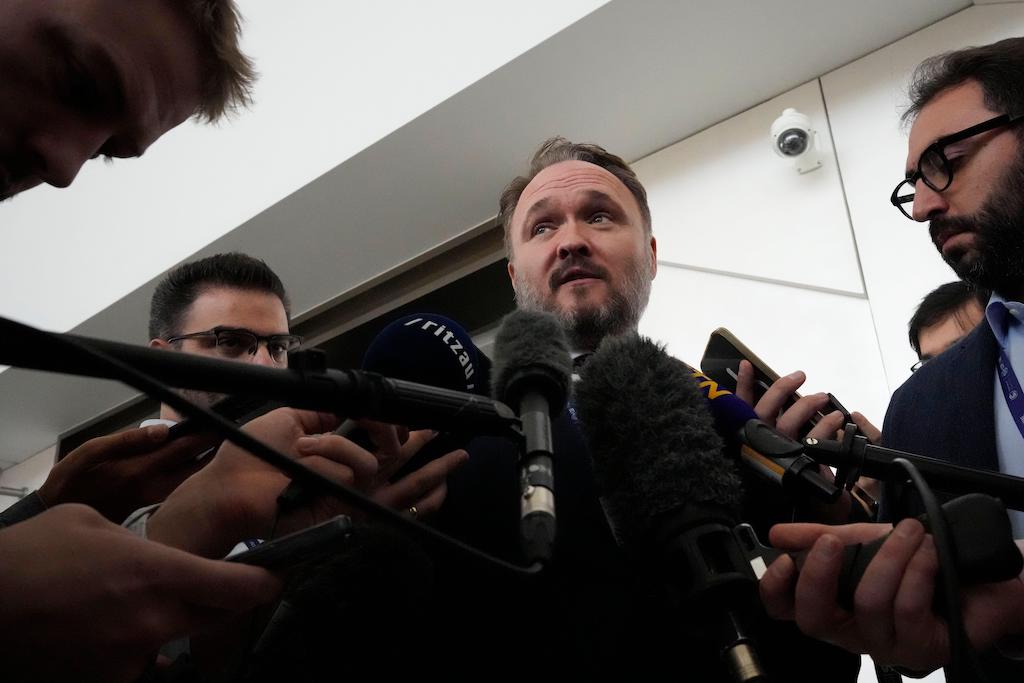
Denmark's Minister for Climate Dan Jorgensen speaks to members of the media at the COP28 U.N. Climate Summit in Dubai, United Arab Emirates, on 13 December 2023.
Denmark’s Minister for Climate Dan Jorgensen speaks to members of the media at the COP28 U.N. Climate Summit in Dubai, United Arab Emirates, on 13 December 2023. Credit: Peter Dejong / Alamy Stock Photo

However, it was neighbouring Sweden that was the first global north country to set a net-negative target.

Back in 2017, it committed to reaching net-zero greenhouse gas emissions by 2045 and net-negative emissions shortly after.

Reporting on Sweden’s climate law in 2017, New Scientist said it was the first country to significantly update its climate targets in light of the Paris Agreement.

One global north nation that has not yet set a net-negative target but has been advised to do so is Scotland.

Scotland has committed to reaching net-zero greenhouse gas emissions by 2045 – five years before the overall UK target of 2050. 

The UK’s independent climate advisers, the Climate Change Committee (CCC), says that its central scenario for how the UK as a whole can reach its 2050 net-zero target sees Scotland becoming net-negative “well before” 2050.

Under this central scenario – known as the “balanced pathway” – Scotland reaches net-negative emissions sooner to compensate for slower action in Wales, England and Northern Ireland.

This reflects that Scotland has the largest remaining intact forests of any nation in the UK – and that Wales and Northern Ireland face a particularly steep challenge in reducing emissions in agriculture, the CCC says.

(Under the CCC’s most ambitious net-zero scenario – known as “tailwinds” – the UK as a whole reaches net-negative emissions shortly after 2042. The UK government has not indicated that it intends to act based on the CCC’s most ambitious scenario – and is currently behind on meeting its less ambitious targets.)

Another global north power that has been advised to set a net-negative target is the EU. 

In advice published ahead of a recommendation for a new EU 2040 target in February, the bloc’s science advisers said that the EU could “improve the fairness” of its contribution to global climate action by adopting a net-negative target for “beyond 2050”.

EU members have not yet indicated that they are considering such a target.

Back to top

Does the world need to be net-negative to meet global climate goals?

The question of whether, scientifically speaking, the world needs to reach net-negative greenhouse gas emissions in order to meet the Paris Agreement’s targets depends on what actions countries take in the next few years. 

In its latest assessment of how the world can tackle climate change, the IPCC presents a range of scenarios for how the world can meet its temperature goals by the end of the century.

In some of these scenarios, global emissions fall extremely rapidly, avoiding the need for the world to reach net-negative greenhouse gas emissions.

However, because global emissions have remained so high in recent years, the path to limiting global warming to 1.5C or 2C is getting steeper and steeper, the IPCC says.

Many of its scenarios for keeping temperatures well below 2C by 2100 do rely on the world reaching net-negative greenhouse gas emissions in the second half of this century.

In these scenarios, failure to cut emissions fast enough in the next few years would see the world temporarily overshoot 1.5C. This is before large-scale CO2 removal techniques are rolled out globally, alongside ambitious measures to slash emissions, including rapid declines in fossil-fuel use.

At the point when greenhouse gas removals exceed emissions – when the world becomes net-negative – temperatures will be in decline and, depending on the scenario, may fall below 1.5C or 2C by the end of the century.

Summarising what the IPCC scenarios say about net-negative emissions, Rogelj says:

“Net-zero CO2 is a geophysical necessity, we need that to stop warming increasing. Net-zero greenhouse gases is more of a policy milestone. When we reach net-zero greenhouse gas emissions – let alone net-negative greenhouse gas emissions – global warming will be slowly reducing at the rate of a couple of tenths of a degree per century.”

Although many of the IPCC scenarios see the world turning net-negative this century, there are some scenarios where the world takes immediate action to rapidly cut emissions – meaning temperatures can be kept at 1.5C without large amounts of CO2 removal.

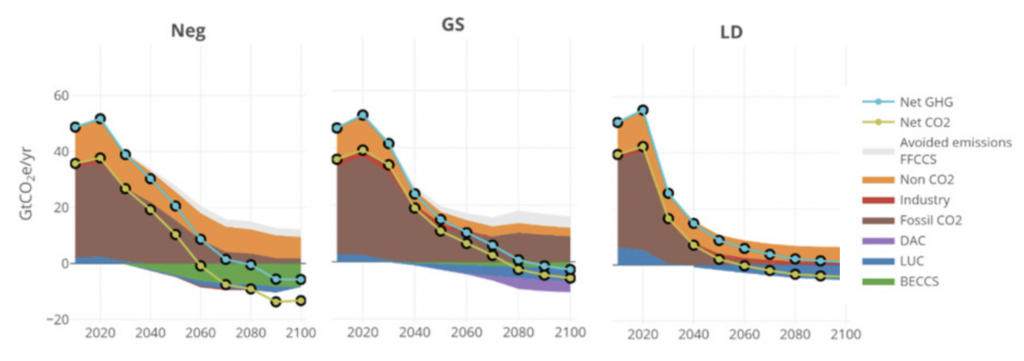
The charts below, adapted from the IPCC’s report on how to tackle climate change, illustrate how global greenhouse gas emissions change under various scenarios where temperatures are kept to 1.5C or well below 2C by 2100.

In the first scenario, “Neg”, temperatures are highly likely to overshoot 1.5C this century before returning to this level of warming by 2100. In this scenario, the extensive use of CO2 removal techniques sees the world reach net-negative greenhouse gas emissions (turquoise dotted line) by 2080.

(CO2 removal techniques include direct air capture (DAC – purple), land-use change such as tree planting (blue) and bioenergy with carbon capture and storage (BECCS – green). All of these methods are discussed in more detail below.)

In the second scenario, GS, there is a gradual strengthening of climate policies, giving the world a 66% chance of limiting warming to well below 2C by 2100. In this scenario, the world reaches net-negative greenhouse gas emissions around 2090.

In the third scenario, LD, a low demand for energy coupled with a rapid fossil fuel phaseout sees net greenhouse gas emissions drop to near – but not below – zero, limiting warming to below 1.5C without the world becoming net-negative.

(For a more thorough look at scenarios for keeping global warming below 1.5C or 2C, see Carbon Brief’s recently published interactive on the topic.)

Three IPCC illustrative scenarios for limiting global warming to 1.5C (Neg, LD) or well-below 2C (GS) by 2100.
Three IPCC illustrative scenarios for limiting global warming to 1.5C (Neg, LD) or well-below 2C (GS) by 2100. Adapted from IPCC (2022) Figure 3.7

Although almost all IPCC scenarios limiting warming to 1.5C – and most that stay below 2C – see a role for large-scale CO2 removal, the report also notes that the techniques available for doing this are at varying levels of readiness and pose different challenges and trade-offs.

Currently, tree-planting and ecosystem restoration are the only “widely deployed” forms of CO2 removal, according to the IPCC.

However, research suggests that relying too much on land-based CO2 removal methods, such as tree-planting and BECCS – a still emerging technique involving burning crops to produce energy before capturing the resultant CO2 – could take up large areas of land, threatening wildlife and food production.

DAC – which involves directly removing CO2 from air using giant fans that use chemical reactions to filter out the greenhouse gas – is currently limited by its large energy requirements and by cost, the IPCC says.

It is also worth noting that, while the IPCC sets out various scenarios for meeting the 1.5C and 2C targets, it does not map out the role that individual countries can or should play in meeting these goals.

Some argue that, given their wealth and historic responsibility for climate change, it is only fair that developed countries reach net-negative emissions in order to create space for ongoing emissions in developing nations. This is discussed in more detail below.

Back to top

Do some countries need to be net-negative to meet climate goals fairly?

When setting its net-negative target, Finland made it clear that the rationale was to do its “fair share” when it comes to tackling climate change.

Under the Paris Agreement adopted by nearly every country in the world in 2015, it is officially recognised that developed nations should “take the lead” with slashing their emissions. Additionally, developed nations committed to providing financial assistance to help developing nations transition their economies.

This reflects the fact that developed nations hold the most historic responsibility for climate change. For example, the US and Europe have produced nearly half of all of the greenhouse gas emissions released into the atmosphere since the 1800s. 

It also reflects the fact that developed nations have the most resources for addressing climate change.

It follows that developed nations should take the lead when it comes to reaching net-negative emissions, says Rogelj:

“Developed countries should decline emissions first and farthest. That also includes going net-negative, both CO2 and greenhouse gas emissions.”

Getting to net-negative emissions sooner could provide more room for developing nations to transition their economies while still prioritising development, he adds:

“When we think of the global pathway that needs to be achieved, the more ambitious that any country that is in a position to do so can be, the more leeway this provides for developing regions to pursue alternative paths.”

However, it is worth noting that not all countries will feasibly be able to go net-negative, he adds.

The ability of a country to go net-negative is defined by a variety of factors, including its land size, forest cover, economy and population size.

For example, heavily forested nations with relatively small populations will be more able to get to a position where they are removing more CO2 from the atmosphere than they are emitting each year.

Two out of three of the countries that are already at net-negative emissions, Bhutan and Suriname, are heavily forested with small populations.

Finland, which has the world’s most ambitious CO2 removal goals, has forests over nearly three-quarters of its land area.

Rogelj adds:

“I think countries that have CO2 removal potential should [set net-negative goals]. However, countries without CO2 removal potential, it’s useless to say you have to go net-negative.”

Prof David Reiner, a researcher of climate policy at the University of Cambridge, was part of a research effort to work out how the responsibility for CO2 removal could be shared equally between countries.

He says that trying to figure out who should be responsible for reaching net-negative greenhouse gas emissions is fraught with complicated questions, beyond which countries have the technical capacity. He tells Carbon Brief:

“It’s challenging to impose historical responsibility for climate change. We’ve seen in many areas, people chafe or resist what their grandparents might have done. One example is reparations for slavery. It becomes difficult to assign that. There are people here [in the UK] whose parents moved from the Indian subcontinent, whose emissions are they responsible for?”

He adds that there is a risk that more attention on setting net-negative targets could be a distraction from the urgent need for countries to reduce their emissions this decade:

“What I wouldn’t want to see is a rush for more and more countries to adopt net-negative targets to divert attention from the fact that they haven’t established how they’re going to get their net-zero targets. Or to say: ‘Well, now it’s even easier for us to justify missing our 2030 target, because look how tough our 2070 target is going to be.’”

Rogelj agrees that, while net-negative targets could have an important role to play in addressing climate change, there is a risk they could be a distraction unless coupled with more near-term action. He tells Carbon Brief:

“Any long-term target without a near-term plan is not credible.”

This article was amended after publication to clarify that Germany intends, but has not yet committed, to introduce a net-negative target.

Sharelines from this story

Categories
Energy

Aardex Debuts Stellera: Championing End-to-End Clean Energy Development Across the Rocky Mountain and Midwest

As the clean energy sector is undoubtedly on an upward trajectory, companies like the just-launched Stellera, a clean energy investment and development firm that develops end-to-end renewable energy projects, are part of the historic investment in the growth of community solar. By removing the barriers to capital access in a traditionally difficult borrowing market, Stellera aims to expand opportunities for communities disproportionately impacted by the energy transition.

Contact:

Sarah Cullen

Sarah@sidecarpr.com

303-931-19190

Aardex Debuts Stellera: Championing End-to-End Clean Energy Development Across the Rocky Mountain and Midwest regions

Led by industry veteran Eric Shannon, Stellera will focus on developing end-to-end community solar projects

DENVER – (March 28, 2024) Aardex, a data-driven, community-minded real estate investment and development firm that has built out more than 1.5 million square feet of projects over the last 40 years, today announced the launch of a new company, Stellera, which will focus on end-to-end development of community solar projects with a focus on communities disproportionately impacted by the energy transition.

The launch comes at a pivotal time for the energy industry. Amid a changing regulatory environment, communities nationwide are moving toward renewable energy sources to meet ambitious state and federal decarbonization targets. Demand for renewable energy is anticipated to grow exponentially in the coming years, with community solar as a leading growth market. In the next five years, community solar is expected to grow by an annual average of 8% with nearly 14 gigawatts (GW) of cumulative capacity expected by 2028.

“Aardex has a decades-long track record of successfully developing projects that positively impact communities,” said Caleb Hebel, Principal for Aardex and Stellera. “Stellera is the natural evolution of our growing understanding that incorporating clean energy is essential to the security, resilience and long-term prosperity of our communities. Our team brings extensive experience navigating the often-complex process of seeing renewable energy projects through to fruition, and we look forward to working alongside communities and utilities to continue to increase access to clean energy opportunities.”

Along with Hebel, Stellera will be helmed by Eric Shannon, an industry veteran with nearly a decade of energy project development experience. Shannon will oversee Stellera’s clean energy initiatives, primarily focused on community solar opportunities. Before joining Stellera, Eric managed utility-scale solar and wind projects totaling over 5 gigawatts in SPP and MISO with Invenergy.

Stellera is actively seeking project development opportunities and will focus primarily on community solar projects in the Rocky Mountain and Midwest regions. Collaborating with landowners, communities, utilities, and stakeholders, Stellera works to identify optimal land locations, assess the constructability of sites, secure grid access, explore state incentives, and maximize project value. Employing a data-driven development approach, Stellera aims to minimize risk and maximize positive impact for both partners and the communities it serves.

For more information on Stellera and how it’s bringing clean energy to North America, visit: www.stellera.com.

About Stellera

Founded in 2024, Stellera is a clean energy investment and development firm that develops end-to-end renewable energy projects across the Rocky Mountain and Midwest regions. The company champions a data-driven approach to developing clean energy solutions, focusing on community solar. Stellera is a subsidiary of Aardex, combining experience in development with a proven track record in sustainable energy projects. To learn more, please visit: www.stellera.com

About Aardex

Aardex is a data-driven, community-minded real estate investment and development firm focused on making a positive impact in the built environment. Our developments have historically spanned geographies and industries in healthcare, multifamily, office, government, and commercial work. Beyond projects, Aardex invests in the environment, the communities in which we operate, and philanthropic endeavors with the goal of doing well by doing good. For more information about Aardex, please visit www.aardexcorp.com.

# # #