









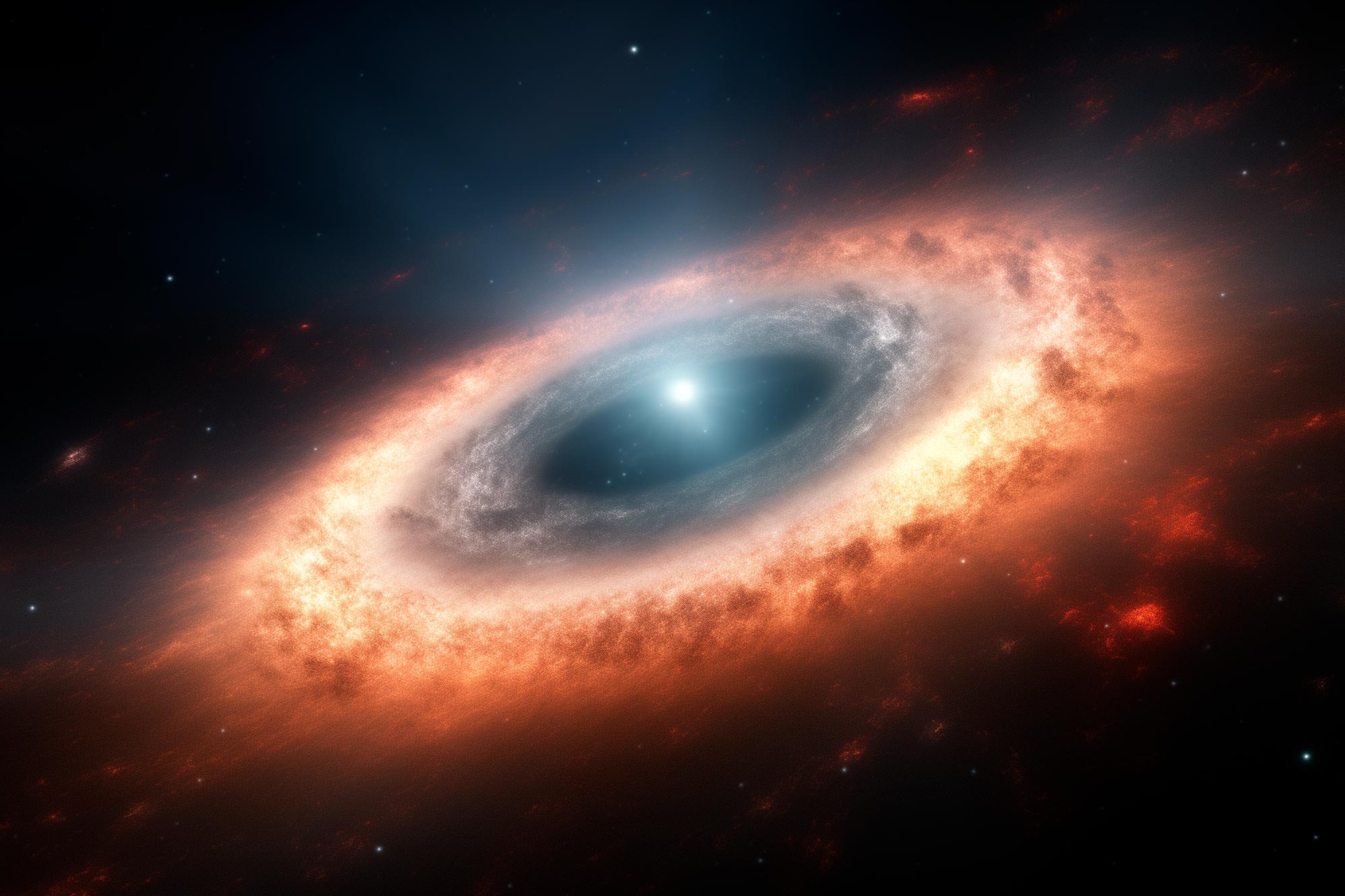
The formation of our solar system involved the accretion of gas and dust into a protoplanetary disk, with meteorites providing key insights into its early composition. The discovery of refractory metals in outer disk meteorites contradicts previous models, indicating a more complex disk structure influenced by Jupiter’s gravity, which helped trap these metals. Credit: SciTechDaily.com
Fragments from the early cosmos help unravel the mystery of our solar system’s birth.
- Iron meteorites are remnants of the metallic cores of the earliest asteroids in our solar system. Iron meteorites contain refractory metals, such as iridium and platinum, that formed near the sun but were transported to the outer solar system.
- New research shows that for this to have happened, the protoplanetary disk of our solar system had to have been doughnut-shaped because the refractory metals could not have crossed the large gaps in a target-shaped disk of concentric rings.
- The paper suggests that the refractory metals moved outward as the protoplanetary disk rapidly expanded, and were trapped in the outer solar system by

“Iron meteorites are hidden gems. The more we learn about iron meteorites, the more they unravel the mystery of our solar system’s birth,” UCLA planetary scientist Bidong Zhang said. Credit: UCLA Meteorite Gallery

Origins of the Solar System
Four and a half billion years ago, our solar system was a cloud of gas and dust swirling around the sun, until gas began to condense and accrete along with dust to form asteroids and planets. What did this cosmic nursery, known as a protoplanetary disk, look like, and how was it structured? Astronomers can use telescopes to “see” protoplanetary disks far away from our much more mature solar system, but it is impossible to observe what ours might have looked like in its infancy — only an alien billions of light years away would be able to see it as it once was.
Meteoritic Clues to Solar Beginnings
Fortunately, space has dropped a few clues — fragments of objects that formed early in solar system history and plunged through Earth’s atmosphere, called meteorites. The composition of meteorites tells stories of the solar system’s birth, but these stories often raise more questions than answers.
In a paper published in Proceedings of the National Academy of Sciences, a team of planetary scientists from 
Doughnut-shaped protoplanetary disk WSB 52. Credit: Sean Andrews, Jane Huang, Laura Pérez et al. 2018
Early Meteorites and Planetary Formation
Most meteorites formed within the first few million years of solar system history. Some meteorites, called chondrites, are unmelted conglomerations of grains and dust left over from planet formation. Other meteorites experienced enough heat to melt while their parent asteroids were forming. When these asteroids melted, the silicate part and the metallic part separated due to their difference in density, similar to how water and oil don’t mix.
Today, most asteroids are located in a thick belt between 
Atacama Large Millimeter/submillimeter Array image of the protoplanetary disk around young star HL Tauri. Credit: ALMA (ESO/NAOJ/NRAO), NSF









Discussion about this post