










Concept art of HD 189733 b, the closest transiting hot Jupiter to Earth. Credit: Roberto Molar Candanosa/Johns Hopkins University
Researchers using the 
HD 189733 b has been the benchmark planet for atmospheric characterization since its discovery in 2005. Credit: Roberto Molar Candanosa/Johns Hopkins University
Exoplanetary Atmosphere Studies
At only 64 light-years from Earth, HD 189733 b is the nearest “hot Jupiter” astronomers can observe passing in front of its star, making it a benchmark planet for detailed studies of exoplanetary atmospheres since its discovery in 2005, Fu said.
The planet is about 13 times closer to its star than Mercury is to the sun and takes only about two Earth days to complete an orbit. It has scorching temperatures of 1,700 degrees 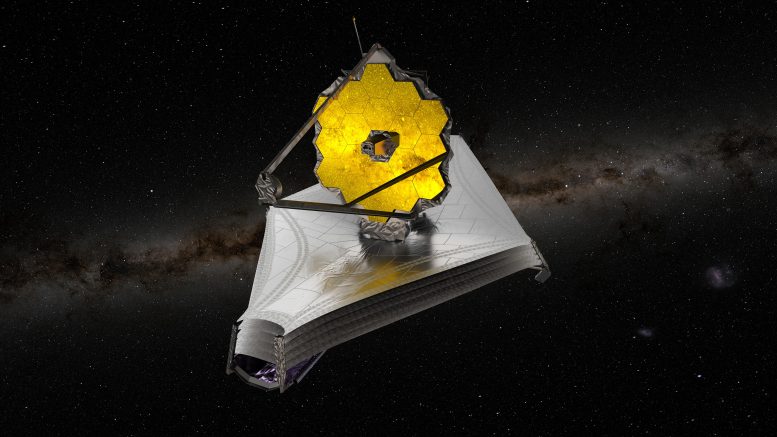
The James Webb Space Telescope (JWST) represents the next frontier in space observatories. Designed to succeed the Hubble Space Telescope, the JWST is equipped with advanced infrared capabilities that allow it to look further back in time and in greater detail than ever before. One of its key functions is the analysis of exoplanet atmospheres, enabling scientists to detect and study the chemical makeup of distant worlds. This capability has opened up new possibilities for understanding the composition, weather patterns, and potential habitability of exoplanets across the galaxy. Credit: ESA/ATG medialab
New Discoveries and Future Research
The new data also ruled out the presence of methane in HD 189733 b with unprecedented precision and infrared wavelength observations from the Webb telescope, countering previous claims about that molecule’s abundance in the atmosphere.
“We had been thinking this planet was too hot to have high concentrations of methane, and now we know that it doesn’t,” Fu said.
Implications for Exoplanet Metallicity
The team also measured levels of heavy metals like those on Jupiter, a finding that could help scientists answer questions about how a planet’s metallicity correlates to its mass, Fu said.
Less-massive giant icy planets like









Discussion about this post