• Home
  • Insight
  • Blog
  • Business
  • Entertainment
  • Health
  • Politics
  • Shop
    • Gift Shop
    • Value Shop
    • Store
    • Bargain Shop
    • Discount
  • Sports
  • Tech
  • Travel
  • USA
  • Video
  • World
    • Asia
    • Africa
    • South America
    • North America
    • Europe
    • Oceania
Thursday, November 19, 2026
No Result
View All Result
Subscribe Now
  • Home
  • Insight
  • Blog
  • Business
  • Entertainment
  • Health
  • Politics
  • Shop
    • Gift Shop
    • Value Shop
    • Store
    • Bargain Shop
    • Discount
  • Sports
  • Tech
  • Travel
  • USA
    FAA Administrator Takes Responsibility as Mullin Faces Tough Questions Over Nationwide Ground Stop

    FAA Administrator Takes Responsibility as Mullin Faces Tough Questions Over Nationwide Ground Stop

    Mary Peltola Emerges Victorious in Alaska Senate Race, Making History for Democrats

    Mary Peltola Emerges Victorious in Alaska Senate Race, Making History for Democrats

    Stranded in Conflict: Palestinians Navigate the Tenuous Balance of War and Peace Amid Ceasefire Efforts

    Stranded in Conflict: Palestinians Navigate the Tenuous Balance of War and Peace Amid Ceasefire Efforts

    Trump Administration Revokes Pay Increase for Head Start Educators

    Trump Administration Revokes Pay Increase for Head Start Educators

    Unexpected Triumph: Gay Candidates Achieve Unforeseen Victories in Challenging Races

    Unexpected Triumph: Gay Candidates Achieve Unforeseen Victories in Challenging Races

    Microsoft Outlook Experiences Prolonged Outage Affecting Users Nationwide

    Microsoft Outlook Experiences Prolonged Outage Affecting Users Nationwide

    Gunfire Erupts in D.C.: Authorities Search for Suspect Amid Rising Concerns Over Public Safety

    Gunfire Erupts in D.C.: Authorities Search for Suspect Amid Rising Concerns Over Public Safety

    LAUSD Takes Strong Action Against Hate Speech Following Racial Slur Incidents

    LAUSD Takes Strong Action Against Hate Speech Following Racial Slur Incidents

    Beloved Former Los Angeles Times Columnist Steve Harvey Passes Away at 80

    Beloved Former Los Angeles Times Columnist Steve Harvey Passes Away at 80

  • Video
  • World
    • Asia
    • Africa
    • South America
    • North America
    • Europe
    • Oceania
The Insight Post
  • Home
  • Insight
  • Blog
  • Business
  • Entertainment
  • Health
  • Politics
  • Shop
    • Gift Shop
    • Value Shop
    • Store
    • Bargain Shop
    • Discount
  • Sports
  • Tech
  • Travel
  • USA
    FAA Administrator Takes Responsibility as Mullin Faces Tough Questions Over Nationwide Ground Stop

    FAA Administrator Takes Responsibility as Mullin Faces Tough Questions Over Nationwide Ground Stop

    Mary Peltola Emerges Victorious in Alaska Senate Race, Making History for Democrats

    Mary Peltola Emerges Victorious in Alaska Senate Race, Making History for Democrats

    Stranded in Conflict: Palestinians Navigate the Tenuous Balance of War and Peace Amid Ceasefire Efforts

    Stranded in Conflict: Palestinians Navigate the Tenuous Balance of War and Peace Amid Ceasefire Efforts

    Trump Administration Revokes Pay Increase for Head Start Educators

    Trump Administration Revokes Pay Increase for Head Start Educators

    Unexpected Triumph: Gay Candidates Achieve Unforeseen Victories in Challenging Races

    Unexpected Triumph: Gay Candidates Achieve Unforeseen Victories in Challenging Races

    Microsoft Outlook Experiences Prolonged Outage Affecting Users Nationwide

    Microsoft Outlook Experiences Prolonged Outage Affecting Users Nationwide

    Gunfire Erupts in D.C.: Authorities Search for Suspect Amid Rising Concerns Over Public Safety

    Gunfire Erupts in D.C.: Authorities Search for Suspect Amid Rising Concerns Over Public Safety

    LAUSD Takes Strong Action Against Hate Speech Following Racial Slur Incidents

    LAUSD Takes Strong Action Against Hate Speech Following Racial Slur Incidents

    Beloved Former Los Angeles Times Columnist Steve Harvey Passes Away at 80

    Beloved Former Los Angeles Times Columnist Steve Harvey Passes Away at 80

  • Video
  • World
    • Asia
    • Africa
    • South America
    • North America
    • Europe
    • Oceania
No Result
View All Result
No Result
View All Result
Home Energy

Factcheck: Climate change is not making extreme cold more common

by Theinsightpost
March 10, 2025
in Energy
0 0
0
Factcheck: Climate change is not making extreme cold more common

The term “global warming” is typically used to describe increasing global temperatures as a result of human emissions of carbon dioxide (CO2) and other greenhouse gases. 

However, unusually cold events are often portrayed as being made worse by human activity, as a result of increased variability or a disruption of the “polar vortex” in a fast-warming world.

There is significant debate in the scientific community about whether rapid Arctic warming and sea ice loss could disrupt atmospheric circulation patterns and lead to cold-air outbreaks in the northern hemisphere mid-latitude regions.

In a new analysis, Carbon Brief shows that few places in the world have seen an increase in extreme cold days over the past 55 years. 

If climate change is influencing atmospheric circulation, any effects on extreme cold appear to be more than compensated by the rapid winter warming the world has experienced.

A controversial hypothesis 

In an episode of Marketplace’s How We Survive podcast last year, the host – US radio journalist Kai Ryssdal – noted that climate change is expected to cause “hotter hots [and] colder colds in unexpected parts of the world”. 

This is not an uncommon sentiment, with the media commonly attributing extreme cold events to human activity, particularly during episodes of bitter cold or polar-vortex events. 

Some researchers have argued that these extreme cold snaps might be becoming more frequent due to reduced sea ice and Arctic amplification – the phenomenon where the Arctic warms more quickly than the global average.

At the core of the hypothesis that Arctic warming could influence mid-latitude cold extremes is the fact that a rapidly warming Arctic changes the temperature difference between the poles and the equator. 

Normally, the strong contrast in temperature between these regions drives key patterns of atmospheric circulation, including the jet stream. According to proponents of this theory, when Arctic temperatures rise faster than those farther south, atmospheric circulation can weaken, meander, or buckle more frequently. As a result, cold polar air can spill down into areas that are usually less frigid.

A related argument focuses on how diminished sea ice – particularly in the Barents and Kara seas – might disrupt the atmosphere. Less sea ice means more heat and moisture escapes from the ocean surface into the air, which can potentially alter weather patterns downstream. This can boost the odds of “blocking high” weather systems, or unusual circulation patterns that pull cold air into mid-latitudes.

However, there are relatively few studies that attribute an increase in cold extremes – or an individual extreme cold event – to human activity. 

Carbon Brief’s attribution map – which charts extreme weather events around the world and their links to human-caused warming – includes 33 studies that examine extreme cold events specifically. 

Of these, 24 studies found that the extreme cold was made less likely due to climate change, six found no discernible human influence and three found insufficient data to conclude either way. Only one extreme event attribution study in the database found that a cold extreme – severe frosts in Western Australia in 2016 – was made more likely due to climate change. However, even that study noted that “warmer temperatures may have offset or countered this effect of the circulation driver”.

Many climate scientists disagree with the hypothesis that warming could lead to increased cold outbreaks, arguing that cold extremes are decreasing overall in a warming world. 

Others contend that causality cannot yet be proved and that both models and observations provide limited support for a significant role of climate change in mid-latitude cold events. 

In addition, observed data reveals that, although cold spells still occur, they have become less frequent and less intense over recent decades. Most modeling studies do not consistently reproduce more frequent or severe cold outbreaks. Instead, they often show that the overall warming trend dominates, making cold extremes rarer over time.

This suggests that, if there were a connection between climate change and extreme cold events, the long-term warming trend will still likely lead to fewer, milder cold outbreaks – and that any effect from Arctic amplification would be relatively small.

Have any regions experienced increased cold events?

To help assess the effects of climate change on extreme cold events, Carbon Brief used gridded daily minimum global temperature data from Berkeley Earth to calculate how the temperatures of the coldest 5% of the days of the year have changed since the 1970s. 

Minimum daily temperatures reflect the single coldest measurement taken over the course of the day. (While the coldest 5% of days is a somewhat arbitrary number, the results are largely similar for the coldest 10%, 5%, 2%, 1%, or the single coldest day of the year.)

The figure below shows the results for every one-by-one degree latitude-longitude grid cell on the Earth’s land (a size approximately equivalent to 100km by 100km). Grid cells coloured red experienced a decrease in extreme cold days, while those coloured blue had more extreme cold days. 

90% of days available) over the period to calculate trends.” class=”wp-image-56670″ srcset=”https://www.carbonbrief.org/wp-content/uploads/2025/03/coldest5_trend_1-scaled.webp 2560w, https://www.carbonbrief.org/wp-content/uploads/2025/03/coldest5_trend_1-300×184.webp 300w, https://www.carbonbrief.org/wp-content/uploads/2025/03/coldest5_trend_1-1024×627.webp 1024w, https://www.carbonbrief.org/wp-content/uploads/2025/03/coldest5_trend_1-768×470.webp 768w, https://www.carbonbrief.org/wp-content/uploads/2025/03/coldest5_trend_1-1536×941.webp 1536w, https://www.carbonbrief.org/wp-content/uploads/2025/03/coldest5_trend_1-2048×1254.webp 2048w” sizes=”(max-width: 2560px) 100vw, 2560px”/>
Trend in the coldest 5% of daily minimum temperature values in each year over 1970-2024. Areas in grey do not have sufficiently complete data (>90% of days available) over the period to calculate trends. Data from Berkeley Earth.

The vast majority of the planet has seen a strong decrease in extreme cold events, with the largest declines seen in high-latitude northern hemisphere regions (which have also experienced the fastest rate of warming overall).

The few regions that have seen an increase in extreme cold events tend to be those with the slowest average rates of warming, including India, South Africa and Antarctica. 

In India, this has likely been influenced by rapid increases in air pollution – particularly cooling sulfate aerosols – over this period. Causes of more extreme cold events in Antarctica are less clear, though it is possible that they could be linked to the seasonal loss of ozone layer over the past 50 years.

Another way to assess changes in cold events is to look at the change in the number of days where any hour of the day – that is, the daily minimum temperature – is below freezing (0C, 32F). The map below shows the change in average annual freezing days between 1970 and 2024.
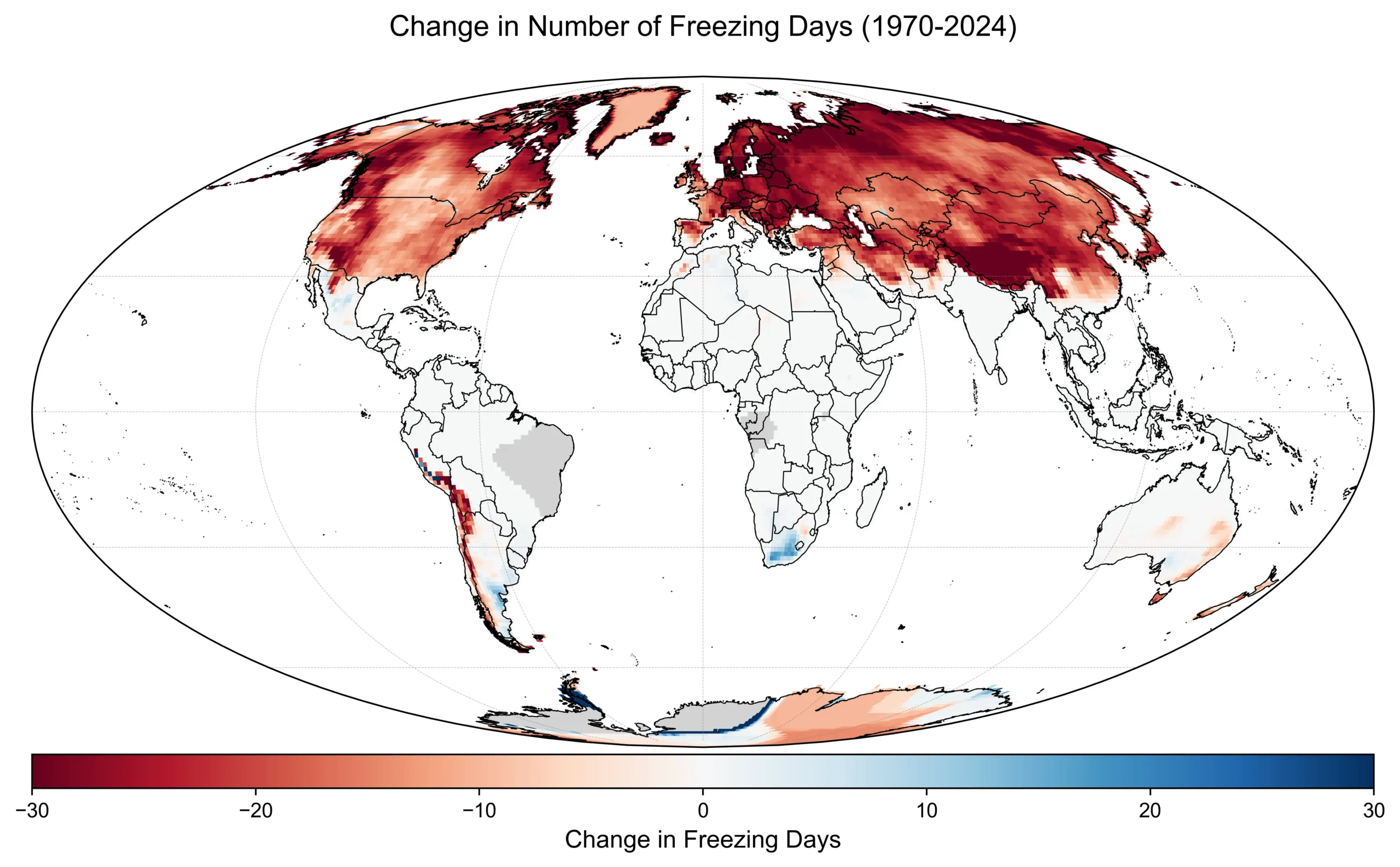
Change in the number of days with minimum daily temperatures below 0C over 1970-2024
Change in the number of days with minimum daily temperatures below 0C over 1970-2024, based on a linear trend in freezing days in each one-by-one degree latitude-longitude grid cell. Data from Berkeley Earth.

The map shows dramatic shifts in the number of freezing days in much of the high-latitude northern hemisphere, with nearly a month fewer freezing days over the Himalayas, eastern Europe and parts of Canada and the western US over the past 50 years. 

(White areas on the graph – such as much of the tropics and subtropics – represent regions of the world where temperatures below freezing almost never occur and thus changes over time cannot be calculated.)

Fewer cold outbreaks in the US

A sizable portion of the academic research on cold outbreaks has been focused on the contiguous US, as it is a region prone to occasional extreme cold conditions caused by intrusions of Arctic air. 

The map below shows there has been a warming trend in the coldest days of the year across  virtually the entire US over the past 50 years.

This suggests that the effect of Arctic amplification on cold-air patterns is smaller than the strong winter warming trend.
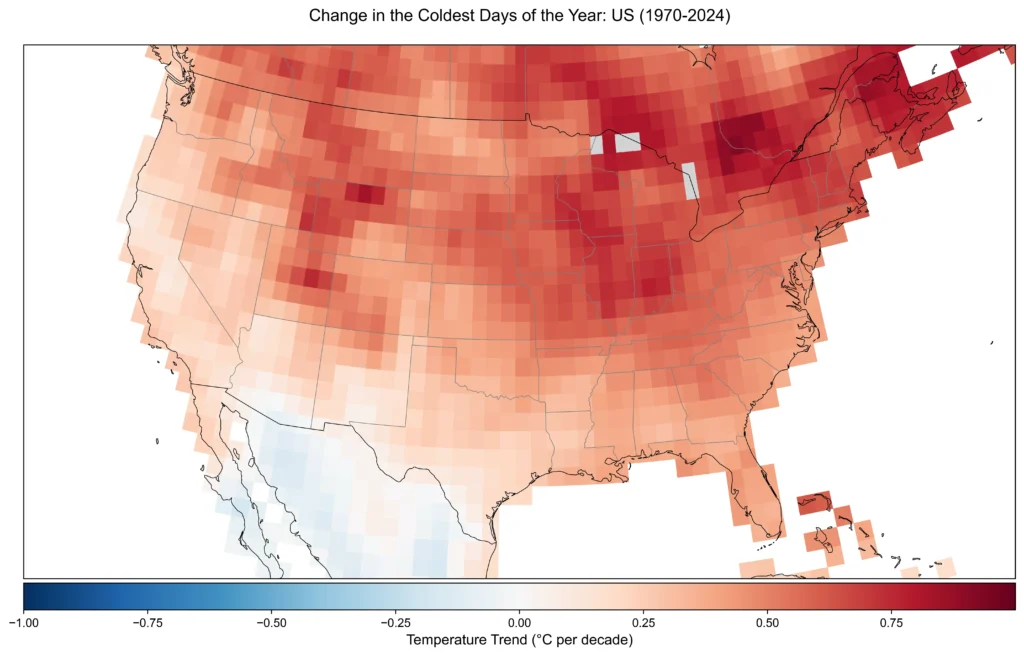
Trend in the coldest 5% of daily minimum temperature values of each year between 1970-2024 in the contiguous US.
Trend in the coldest 5% of daily minimum temperature values of each year between 1970-2024 in the contiguous US. Data from Berkeley Earth.

Almost no regions of the US have seen a cooling trend in the 5% coldest days of the year – and higher latitude regions have tended to experience the fastest winter warming. 

There has been a slight cooling trend in the coldest days of the year in northern Mexico and slower warming in California, Arizona, southern New Mexico and southern Texas. 

Similarly, the figure below examines the change in days where minimum temperatures are below freezing in the US.
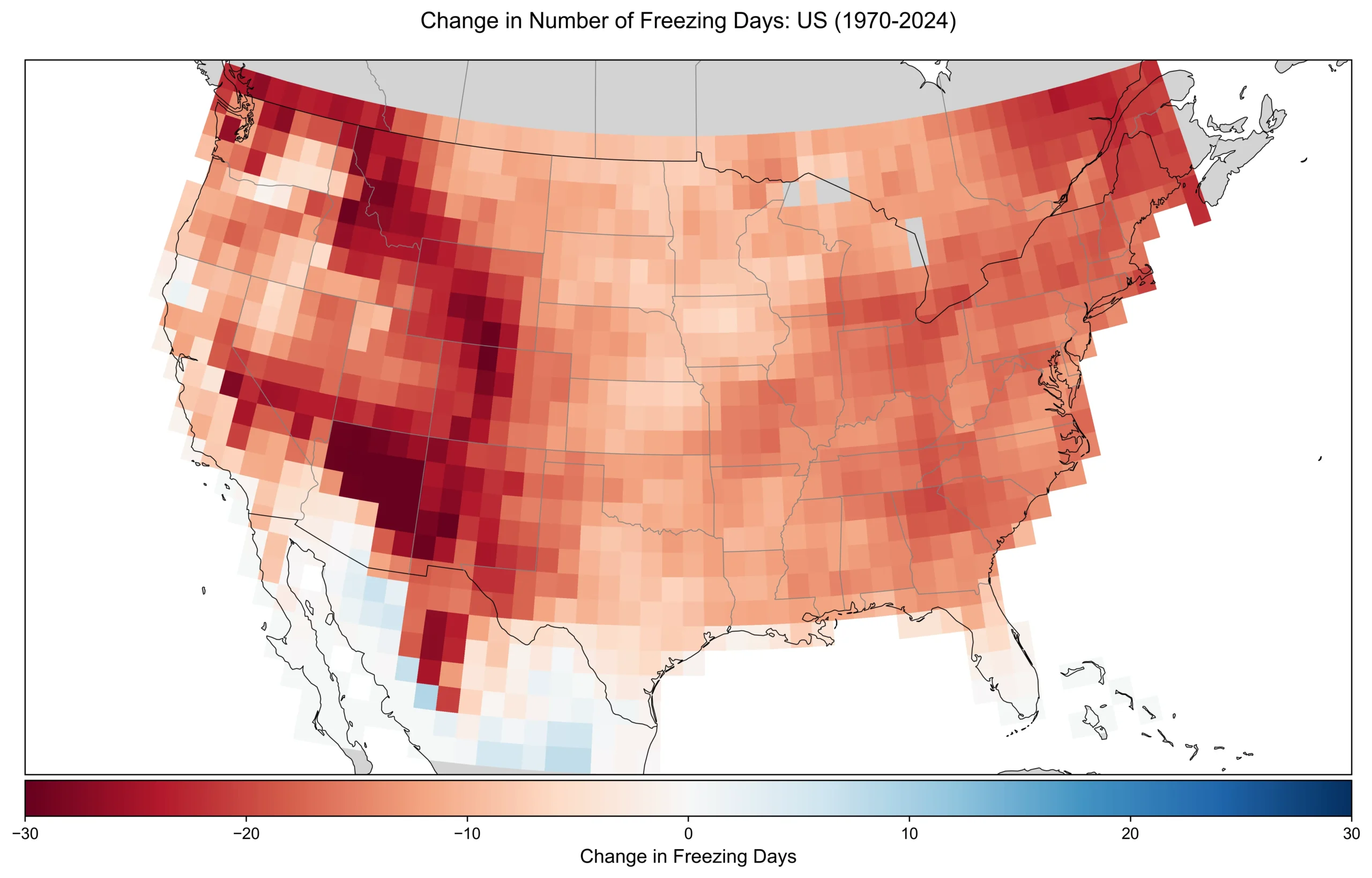
Change in the number of days with minimum daily temperatures below 0C over 1970-2024 in the contiguous US.
Change in the number of days with minimum daily temperatures below 0C over 1970-2024 in the contiguous US. Data from Berkeley Earth.

It shows that there are, on average, 13 fewer days below freezing each year compared to the 1970s. Or, to put it another way, there is half a month where daily minimum temperatures are no longer cold enough for icy and snowy conditions to occur.

Increasingly rare cold spells 

The latest climate models overwhelmingly project that cold extremes will continue to diminish as greenhouse gas concentrations rise. 

This means that, even if certain patterns occasionally transport freezing polar air southward, winters on the whole are likely to be milder than in the past. 

However, the scientific understanding of precisely how Arctic warming might – or might not – influence mid-latitude weather is still evolving. 

Researchers continue to refine models, incorporate better reanalysis data and examine how changes in atmospheric circulation dynamics might play out under different scenarios. Additional data – especially over multiple decades – will help clarify whether the Arctic’s role in mid-latitude cold extremes is significant or overstated. 

For now, observations over the past 50 years generally show a world with fewer cold extremes – and projections point toward increasingly rare cold spells in the future.

Sharelines from this story

ShareTweetSend
Previous Post

How to go on a first date in Wellington

Next Post

iQor CXBPO™ Redefines Customer Experience with AI-Driven BPO Solutions

Related News

Unveiling the Facts: Russia, Saudi Arabia, and Australia Lead the World in CO2 Exports
Energy

Unveiling the Facts: Russia, Saudi Arabia, and Australia Lead the World in CO2 Exports

November 18, 2026
Ed Miliband Engages Carbon Brief Readers: Insights from COP31 Question Session
Energy

Ed Miliband Engages Carbon Brief Readers: Insights from COP31 Question Session

November 12, 2026
COP31 Highlights Sharp 70% Decline in Climate-Finance Commitments Among Nations
Energy

COP31 Highlights Sharp 70% Decline in Climate-Finance Commitments Among Nations

November 11, 2026
Examining Global Participation: A Look at Countries Contributing the Most Delegates to COP31
Energy

Examining Global Participation: A Look at Countries Contributing the Most Delegates to COP31

November 10, 2026
Next Post
iQor CXBPO™ Redefines Customer Experience with AI-Driven BPO Solutions

iQor CXBPO™ Redefines Customer Experience with AI-Driven BPO Solutions

Discussion about this post

Subscribe To Our Newsletters

    Customer Support


    1251 Wilcrest Drive
    Houston, Texas
    77042 USA
    Call-832.795.1420
    e-mail – news@theinsightpost.com

    Subscribe To Our Newsletters

      Categories

      • Africa
      • Africa-East
      • African Sports
      • American Sports
      • Arts
      • Asia
      • Australia
      • Business
      • Business Asia
      • Business- Africa
      • Canada
      • Defense
      • Education
      • Egypt
      • Energy
      • Entertainment
      • Europe
      • European Soccer
      • Finance
      • Germany
      • Ghana
      • Health
      • Insight
      • International
      • Investing
      • Japan
      • Latest Headlines
      • Life & Living
      • Markets
      • Mobile
      • Movies
      • New Zealand
      • Nigeria
      • Politics
      • Scholarships
      • Science
      • South Africa
      • South America
      • Sports
      • Tech
      • Travel
      • Travel-Africa
      • UK
      • USA
      • Weather
      • World
      No Result
      View All Result

      Recent News

      Six Drainage Enhancement Projects Pending Financial Approval, Says Ahmed Ibrahim

      Six Drainage Enhancement Projects Pending Financial Approval, Says Ahmed Ibrahim

      November 19, 2026
      Jordan Poyer Takes Center Stage: A Look Ahead to November 18, 2026

      Jordan Poyer Takes Center Stage: A Look Ahead to November 18, 2026

      November 19, 2026
      Microsoft’s Satya Nadella Reveals Strategic Rationale Behind Layoff of 60,000 Employees

      Microsoft’s Satya Nadella Reveals Strategic Rationale Behind Layoff of 60,000 Employees

      November 19, 2026
      Super Eagles Rise to 29th in FIFA Rankings, Surpassing Algeria to Claim a Spot in Africa’s Elite Five

      Super Eagles Rise to 29th in FIFA Rankings, Surpassing Algeria to Claim a Spot in Africa’s Elite Five

      November 19, 2026
      • Home
      • Advertise With Us
      • About Us
      • Corporate
      • Consumer Rewards
      • Forum
      • Privacy Policy
      • Social Trends

      Theinsightpost ©2026 | All Rights Reserved. Theinsightpost is an Elnegy LLC company, registered in Texas, USA

      Welcome Back!

      Login to your account below

      Forgotten Password?

      Retrieve your password

      Please enter your username or email address to reset your password.

      Log In

      Add New Playlist

      We are using cookies to give you the best experience on our website.

      You can find out more about which cookies we are using or switch them off in .

      No Result
      View All Result
      • Home
      • Insight
      • Blog
      • Business
      • Entertainment
      • Health
      • Politics
      • Shop
        • Gift Shop
        • Value Shop
        • Store
        • Bargain Shop
        • Discount
      • Sports
      • Tech
      • Travel
      • USA
      • Video
      • World
        • Asia
        • Africa
        • South America
        • North America
        • Europe
        • Oceania

      Theinsightpost ©2026 | All Rights Reserved. Theinsightpost is an Elnegy LLC company, registered in Texas, USA

      The Insight Post
      Powered by  GDPR Cookie Compliance
      Privacy Overview

      This website uses cookies so that we can provide you with the best user experience possible. Cookie information is stored in your browser and performs functions such as recognising you when you return to our website and helping our team to understand which sections of the website you find most interesting and useful.

      Strictly Necessary Cookies

      Strictly Necessary Cookie should be enabled at all times so that we can save your preferences for cookie settings.

      Cookie Policy

      More information about our Cookie Policy