
The DESI collaboration is conducting a groundbreaking experiment to understand the universe’s expansion and acceleration. Their work with the DESI instrument has enabled them to map the cosmos from its early stages to the present, challenging existing models of the universe. Initial findings suggest there may be more to discover about dark energy and cosmic acceleration. The project’s innovative approach, including a fully blinded analysis, ensures that their conclusions are based on unbiased data, paving the way for future discoveries in astrophysics. Credit: SciTechDaily.com
The Nobel Prize in physics in 2011.
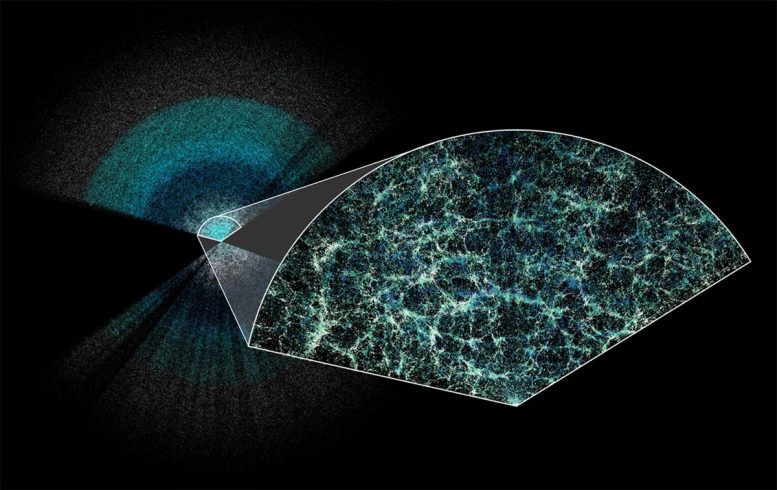
DESI has made the largest 3D map of our universe to date. Earth is at the center of this thin slice of the full map. In the magnified section, it is easy to see the underlying structure of matter in our universe. Credit: Claire Lamman/DESI collaboration; custom colormap package by cmastro
Cosmic acceleration is problematic because it counters how gravity, which causes objects with mass to be drawn together, is observed to work in our solar system and nearby space.
“Gravity pulls matter together, so that when we throw a ball in the air, the Earth’s gravity pulls it down toward the planet,” Ishak-Boushaki said. “But at the largest scales, the universe acts differently. It’s acting like there is something repulsive pushing the universe apart and accelerating its expansion. This is a big mystery, and we are investigating it on several fronts. Is it an unknown dark energy in the universe, or is it a modification of Albert Einstein’s theory of gravity at cosmological scales?”
Exploring Dark Energy and the Universe’s Expansion
Dark energy is thought by many scientists to play a key role in cosmic acceleration, but it is not well understood. Some theorize that it is a cosmological constant – an intrinsic property of space that drives the acceleration.
To study dark energy’s effects over the past 11 billion years, the DESI group has created the largest 3D map of the cosmos ever constructed using the most precise measurements to date. This is the first time scientists have measured the expansion history of the young universe with a precision better than 1%.
The leading model of the universe is known as Lambda-CDM. It includes both ordinary matter and a rarely interacting type of matter called cold dark matter (CDM) and dark energy, known as Lambda. Both matter and dark energy shape how the universe expands, but in opposing ways. Through gravitational attraction, matter and dark matter slow down the expansion, while dark energy speeds it up. The amount of each influences how the universe evolves. This model is effective at validating results from previous experiments and describing how the universe looks throughout time, Ishak-Boushaki said.
This animation shows how baryon acoustic oscillations act as a cosmic ruler for measuring the expansion of the universe. Credit: Claire Lamman/DESI collaboration and Jenny Nuss/Berkeley Lab
When DESI’s first-year results are combined with data from other studies, however, there are some subtle differences from what the Lambda-CDM model would predict.
“Our results show some interesting deviations from the standard model of the universe that could indicate that dark energy is evolving over time,” Ishak-Boushaki said. “The more data we collect, the better equipped we will be to determine whether this finding holds. With more data, we might identify different explanations for the result we observe or confirm it. If it persists, such a result will shed some light on what is causing cosmic acceleration and provide a huge step in understanding the evolution of our universe.”
More data will also improve DESI’s other early results, which weigh in on the Hubble constant – a measure of how fast the universe is expanding today – and the mass of particles called neutrinos.
Importance of Blind Analysis in Research
DESI is the first spectroscopic experiment to perform a fully blinded analysis, which conceals the true result from the scientists to avoid any subconscious confirmation bias. Researchers work “blind” with modified data and write computer code to analyze their findings. Once everything is finalized, they apply their analysis to the original data to reveal the actual answer.
“Dr. Ishak-Boushaki’s research and his collaboration with scientists at some 70 institutions is revealing important insights about our universe, and the results are fascinating,” said Dr. David Hyndman, dean of NSM and the Francis S. and Maurine G. Johnson Distinguished University Chair. “It’s inspiring to have such world-class research programs at UT Dallas and to see our scientists play key roles in fundamental discoveries.”
Reference: “Year 1 Cosmology Results” by DESI Collaboration et al., 4 April 2024.
DESI was constructed and is operated with funding from the Department of Energy (DOE) Office of Science and sits atop the National Science Foundation’s (NSF) Nicholas U. Mayall 4-meter Telescope at KPNO, which is operated by the NSF’s