

• Home
  • Insight
  • Blog
  • Business
  • Entertainment
  • Health
  • Politics
  • Shop
    • Gift Shop
    • Value Shop
    • Store
    • Bargain Shop
    • Discount
  • Sports
  • Tech
  • Travel
  • USA
  • Video
  • World
    • Asia
    • Africa
    • South America
    • North America
    • Europe
    • Oceania
Thursday, August 20, 2026
No Result
View All Result
Subscribe Now
  • Home
  • Insight
  • Blog
  • Business
  • Entertainment
  • Health
  • Politics
  • Shop
    • Gift Shop
    • Value Shop
    • Store
    • Bargain Shop
    • Discount
  • Sports
  • Tech
  • Travel
  • USA
    “The End of Oak Street” does pastiche right

    “The End of Oak Street” does pastiche right

    NTSB releases new videos, images from deadly Philadelphia medical jet crash

    NTSB releases new videos, images from deadly Philadelphia medical jet crash

    Iran Calls Trump ‘Delusional’ After He Claims Hormuz a ‘New U.S. Territory’

    Iran Calls Trump ‘Delusional’ After He Claims Hormuz a ‘New U.S. Territory’

    IPOs for Open AI, Anthropic could unlock 0B for charity

    IPOs for Open AI, Anthropic could unlock $430B for charity

    Poll showing Bass leading Raman by double digits was bogus, company says

    Poll showing Bass leading Raman by double digits was bogus, company says

    Multiple people dead as flooding continues in Indiana : NPR

    Multiple people dead as flooding continues in Indiana : NPR

    Sophie Cunningham defends stance on biological men in women’s sports

    Sophie Cunningham defends stance on biological men in women’s sports

    Democrats Make South Carolina the First Contest in 2028 Presidential Primary Calendar

    Democrats Make South Carolina the First Contest in 2028 Presidential Primary Calendar

    Has the Left Really Met Its Limit? 

    Has the Left Really Met Its Limit? 

  • Video
  • World
    • Asia
    • Africa
    • South America
    • North America
    • Europe
    • Oceania
The Insight Post
  • Home
  • Insight
  • Blog
  • Business
  • Entertainment
  • Health
  • Politics
  • Shop
    • Gift Shop
    • Value Shop
    • Store
    • Bargain Shop
    • Discount
  • Sports
  • Tech
  • Travel
  • USA
    “The End of Oak Street” does pastiche right

    “The End of Oak Street” does pastiche right

    NTSB releases new videos, images from deadly Philadelphia medical jet crash

    NTSB releases new videos, images from deadly Philadelphia medical jet crash

    Iran Calls Trump ‘Delusional’ After He Claims Hormuz a ‘New U.S. Territory’

    Iran Calls Trump ‘Delusional’ After He Claims Hormuz a ‘New U.S. Territory’

    IPOs for Open AI, Anthropic could unlock 0B for charity

    IPOs for Open AI, Anthropic could unlock $430B for charity

    Poll showing Bass leading Raman by double digits was bogus, company says

    Poll showing Bass leading Raman by double digits was bogus, company says

    Multiple people dead as flooding continues in Indiana : NPR

    Multiple people dead as flooding continues in Indiana : NPR

    Sophie Cunningham defends stance on biological men in women’s sports

    Sophie Cunningham defends stance on biological men in women’s sports

    Democrats Make South Carolina the First Contest in 2028 Presidential Primary Calendar

    Democrats Make South Carolina the First Contest in 2028 Presidential Primary Calendar

    Has the Left Really Met Its Limit? 

    Has the Left Really Met Its Limit? 

  • Video
  • World
    • Asia
    • Africa
    • South America
    • North America
    • Europe
    • Oceania
No Result
View All Result
No Result
View All Result
Home Energy

Guest post: How declining cloudiness is accelerating global warming

by Theinsightpost
March 26, 2026
in Energy
0 0
0
Guest post: How declining cloudiness is accelerating global warming

For the past two decades, low-level cloud cover has been declining, increasing the amount of sunlight absorbed by Earth and amplifying global warming.

As global temperatures have reached record highs in recent years, there has been concern that the decline in cloudiness may be enhancing warming more than previously expected.

In a new study, published in Atmospheric Chemistry and Physics Letters, we investigate how the decline in global cloudiness affects the Earth’s “energy imbalance” – the difference between absorbed solar energy and heat radiated into space that results in global warming.

This imbalance has more than doubled over the past 20 years, as greenhouse gases have trapped more heat in the atmosphere. 

We find that, since 2003, the decrease of cloudiness has been responsible for half of the increase of Earth’s energy imbalance.

Analysing the drivers of global changes to cloud cover, we find that the decrease in cloudiness over the past two decades has been primarily driven by humans, rather than being caused by natural variations in Earth’s climate. 

Taken together, our findings mean that scientists can even more confidently attribute recent warming to human activities. 

Low-level clouds and warming

Low-level clouds are those that have a base below 6,500 feet (2,000 metres) above Earth and include stratus, stratocumulus and cumulus. They are typically found over large areas of the global ocean, where there is a large moisture supply from evaporation. 

These clouds have a powerful impact on the Earth’s climate because they reflect a substantial fraction of incoming sunlight back into space. 

By acting as the Earth’s “sunscreen”, they keep the climate cooler than it would otherwise be.

Satellite observations reveal a global decline in these low-level clouds since the turn of the millennium. This is shown in the chart below, where the black line represents the average percentage of the Earth covered by low-level clouds and the dashed line the downward trend.

Low-level cloud amount (in percent of the globe) from July 2003 to June 2024, based on the CERES-FBCT satellite product. Adapted from Ceppi et al (2026).

Our research shows that the decline in cloudiness over the past 20 years has played a major role in increasing the Earth’s energy imbalance and, therefore, warming.

The Earth’s energy imbalance is the difference between the amount of energy arriving at the Earth from the sun and what is reflected and radiated back to space.

Rising greenhouse gas emissions from human activity are upsetting this balance by trapping more energy in the atmosphere, leading to warming.

A less cloudy atmosphere also helps supercharge the energy imbalance, because it means more sunlight reaches the Earth.

In our research, we use a simple model to assess how changes in low-level clouds between July 2003 and June 2024 contributed to the Earth’s energy imbalance. 

We find that, averaged globally, changes in low-level cloudiness caused an extra 0.22 watts per metre squared (W/m2) per decade of absorbed sunlight. This amounts to exactly half of the concurrent increase in Earth’s energy imbalance over the same time period. 

This is shown in the chart below, where the green line represents the increase in the Earth’s energy imbalance over 2003-24 and the black line shows the contribution of low-level clouds to that trend.
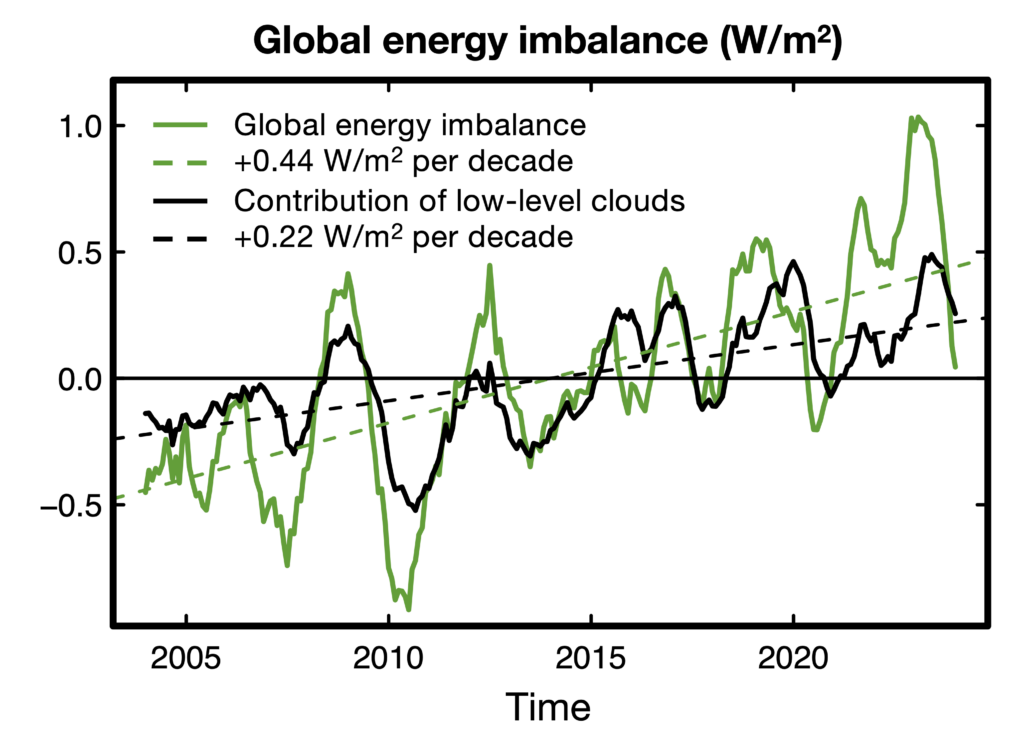
Anomalies in global energy imbalance (green, from CERES-EBAF satellite observations) and contribution of low-level cloudiness changes (black, from CERES-FBCT satellite observations) from July 2003 to June 2024. Adapted from Ceppi et al (2026).

Why is cloudiness changing?

Scientists have attributed declining cloud cover in the 21st century to three main causes. 

The first is a decrease in human-caused aerosol emissions over recent decades. Aerosols – tiny, light‑scattering particles produced mainly by burning fossil fuels – influence the formation of clouds, by acting as “seeds” for cloud droplets to form.

In recent years, aerosol emissions have been reduced due to efforts to clean up air pollution, such as cleaner shipping fuel regulations. Cleaner air has resulted in a decline in cloudiness. 

Second, increasing concentration of greenhouse gases in the atmosphere has led to a warmer and drier atmosphere, which also helps to dissipate clouds. 

Although a warmer atmosphere generally holds more water vapour in absolute terms, what matters for clouds is the “relative humidity” of the air, which has been declining in many places. This is a measure of how “saturated” the air is, or how much water vapour the air contains compared to the maximum it could hold. 

Finally, cloud cover decreases have also been linked to ocean surface warming, which affects atmospheric humidity and, thus, cloudiness. Reduced cloudiness leads to more sunlight being absorbed at the ocean surface – and more warming. This amplifying loop is known as a “cloud feedback”. 

However, the exact strength of these three effects on cloud cover is still unclear.

In fact, cloud feedbacks are among the main uncertainties in climate model projections of global warming. 

Attributing low-cloud cover changes

In the next step of our study, we explore how the three human-caused factors mentioned above – aerosols, greenhouse gases and cloud feedback – contributed to recent low-level cloud changes.

We also look at the extent to which cloud changes could be explained by natural climate variability, which causes substantial year-to-year fluctuations in cloudiness and energy imbalance.

To do this, we use a statistical technique known as “cloud-controlling factor analysis”.

This analysis involves calculating the sensitivity of clouds to their “controlling factors”, including meteorological variables, such as temperature, humidity and winds, as well as aerosol concentrations.

To calculate how each factor contributed to the bigger picture of declining cloud cover, we combine sensitivity calculations with observed trends in meteorology and aerosol emissions. 

This analysis allows us to attribute trends in cloud cover to known physical drivers: either natural climate variability, or human activities linked to aerosols, greenhouse gases and cloud feedback. 

Our research finds that about 40% of the low-level cloud decrease since 2003 was driven by warming of the ocean surface – in other words, the cloud feedback process. This is followed by the effects of greenhouse gases (21%) and aerosols (14%). 

Natural climate variability accounts for just 3% of the low-level cloud trend.

(The remaining 23% of the trend cannot be explained by our statistical method. This could be due to the limitations of cloud, temperature, humidity and aerosol concentration observations.)

The chart below shows how human-driven factors – the sum of aerosol effects (red), greenhouse gas emissions (pink) and cloud feedback (burgundy) – were responsible for almost three quarters of the decrease in low-level cloudiness over 2003-24. Natural climate variability (blue), on the other hand, played a minor role. 
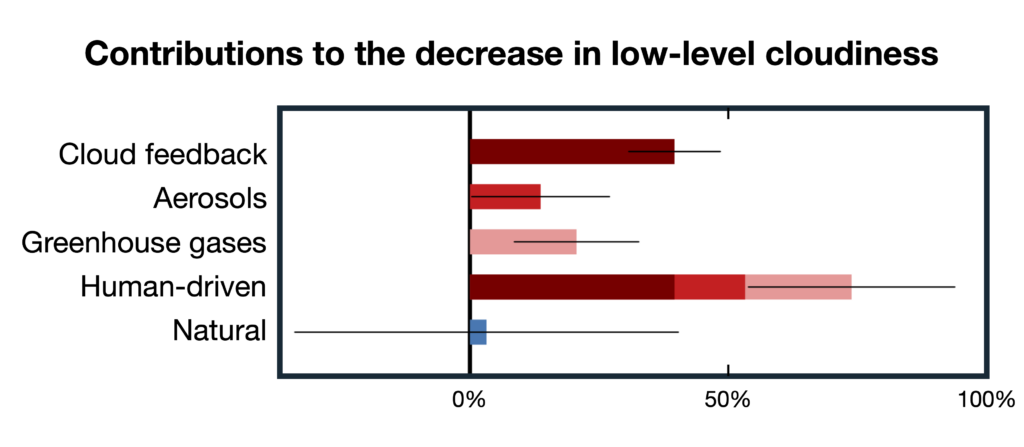
Contributions to the decrease in global low-level cloudiness between July 2003 and June 2024, in percent of the total observed trend, from: cloud feedback (40%, burgundy), aerosols (14%, red), greenhouse gases (20%, pink), their sum (“human-driven”, 74%), and natural climate variability (blue, 3%). The remaining 23% of the cloud decrease is unexplained by our statistical method. Thin black bars denote 67% confidence ranges. Adapted from Ceppi et al (2026).

Thus, our analysis indicates that, at global scales, the observed cloud decrease is primarily driven by humans, rather than being caused by natural variations in Earth’s climate. 

And, since low-level clouds contribute to half of the energy imbalance increase over the same period, it follows that a significant part of recent rises in energy imbalance can also be attributed to humans.

Clouds in climate models

So, should we be concerned that this cloudiness decrease means the Earth could see more warming than already anticipated? 

To answer this, we looked at whether the climate models used by scientists to project future global warming accurately simulate recent declines in low-cloud cover. 

While the models produce a wide range of outcomes, we found that, on average, the simulated changes in low-level cloudiness changes are in close agreement with real-world trends. 

This is reassuring, as it means the effects of low-cloud cover are already accounted for in existing warming projections. 

However, questions still remain around what is driving recent increases to the Earth’s energy imbalance, which have outpaced projections made by climate models. 

Our findings rule out declines in low-level clouds as the reason that climate models have been underestimating the Earth’s energy imbalance, and, as a result, warming. But it is still possible that models are underrepresenting future global warming to some extent. 

Low-level clouds are just one of several drivers of changes in energy imbalance. Future work will therefore need to assess other observed and simulated drivers of energy imbalance changes: for example, the impact of upper-level clouds, or changes in water vapour or sea ice.

Finally, it is important to stress that, while our findings are reassuring, they should certainly not make us complacent about the current global warming trend. The impacts of climate change are serious enough as they are – even if there is no evidence of a missing amplifying feedback in our projections.

Ceppi, P et al. (2026), Emerging low-cloud feedback and adjustment in global satellite observations, Atmospheric Chemistry and Physics Letters, doi:10.5194/acp-26-4153-2026

ShareTweetSend
Previous Post

The Marketing Association’s #OnSocial conference is back

Next Post

Frank Relle’s Photos Revel in Louisiana’s Otherworldly Swampland — Colossal

Related News

Q&A: What is ‘long-duration energy storage’ – and why does the UK need it?
Energy

Q&A: What is ‘long-duration energy storage’ – and why does the UK need it?

August 19, 2026
Explainer: How the ‘super El Niño’ will reshape the world’s weather
Energy

Explainer: How the ‘super El Niño’ will reshape the world’s weather

August 18, 2026
Why land-use emissions have fallen by a third this century – in six charts
Energy

Why land-use emissions have fallen by a third this century – in six charts

August 18, 2026
Analysis: The two largest reservoirs in the US have hit record-low levels
Energy

Analysis: The two largest reservoirs in the US have hit record-low levels

August 17, 2026
Next Post
Frank Relle’s Photos Revel in Louisiana’s Otherworldly Swampland — Colossal

Frank Relle's Photos Revel in Louisiana's Otherworldly Swampland — Colossal

Discussion about this post

Subscribe To Our Newsletters

    Customer Support


    1251 Wilcrest Drive
    Houston, Texas
    77042 USA
    Call-832.795.1420
    e-mail – news@theinsightpost.com

    Subscribe To Our Newsletters

      Categories

      • Africa
      • Africa-East
      • African Sports
      • American Sports
      • Arts
      • Asia
      • Australia
      • Business
      • Business Asia
      • Business- Africa
      • Canada
      • Defense
      • Education
      • Egypt
      • Energy
      • Entertainment
      • Europe
      • European Soccer
      • Finance
      • Germany
      • Ghana
      • Health
      • Insight
      • International
      • Investing
      • Japan
      • Latest Headlines
      • Life & Living
      • Markets
      • Mobile
      • Movies
      • New Zealand
      • Nigeria
      • Politics
      • Scholarships
      • Science
      • South Africa
      • South America
      • Sports
      • Tech
      • Travel
      • UK
      • USA
      • Weather
      • World
      No Result
      View All Result

      Recent News

      Austin Abrams fights to escape a 60-ton sperm whale in new ‘Whalefall’ trailer with Josh Brolin

      Austin Abrams fights to escape a 60-ton sperm whale in new ‘Whalefall’ trailer with Josh Brolin

      August 20, 2026
      Prince Harry and Meghan Markle reportedly returning to Britain – National

      Prince Harry and Meghan Markle reportedly returning to Britain – National

      August 20, 2026
      Holistic Health Hacks: Oils for Everyday Wellness

      Holistic Health Hacks: Oils for Everyday Wellness

      August 20, 2026
      Republicans Are Going To Get Destroyed Because Trump Won’t Talk About Affordability

      Republicans Are Going To Get Destroyed Because Trump Won’t Talk About Affordability

      August 20, 2026
      • Home
      • Advertise With Us
      • About Us
      • Corporate
      • Consumer Rewards
      • Forum
      • Privacy Policy
      • Social Trends

      Theinsightpost ©2026 | All Rights Reserved. Theinsightpost is an Elnegy LLC company, registered in Texas, USA

      Welcome Back!

      Login to your account below

      Forgotten Password?

      Retrieve your password

      Please enter your username or email address to reset your password.

      Log In

      Add New Playlist

      We are using cookies to give you the best experience on our website.

      You can find out more about which cookies we are using or switch them off in .

      No Result
      View All Result
      • Home
      • Insight
      • Blog
      • Business
      • Entertainment
      • Health
      • Politics
      • Shop
        • Gift Shop
        • Value Shop
        • Store
        • Bargain Shop
        • Discount
      • Sports
      • Tech
      • Travel
      • USA
      • Video
      • World
        • Asia
        • Africa
        • South America
        • North America
        • Europe
        • Oceania

      Theinsightpost ©2026 | All Rights Reserved. Theinsightpost is an Elnegy LLC company, registered in Texas, USA

      The Insight Post
      Powered by  GDPR Cookie Compliance
      Privacy Overview

      This website uses cookies so that we can provide you with the best user experience possible. Cookie information is stored in your browser and performs functions such as recognising you when you return to our website and helping our team to understand which sections of the website you find most interesting and useful.

      Strictly Necessary Cookies

      Strictly Necessary Cookie should be enabled at all times so that we can save your preferences for cookie settings.

      Cookie Policy

      More information about our Cookie Policy