








What do you research here in Svalbard?
I have a 10-year experiment in a place called Kongsfjordneset [a headland in Svalbard]. The aim of the experiment is to warm up plants and soils to see how they respond to about a degree increase in temperature over 10 years.
What does a day in your life look like when you’re conducting field research?
Hectic. You have to get up at a very small hour to get food because the Norwegians eat early. And then generally you work all day and, if you’re not reliant on other people, you’re working all weekend as well. Last week, for example, I did a 15-hour day, which is quite challenging. But it’s interesting work and people are all here for the same reason so it’s not too difficult. We go out to the experiment site by boat, otherwise it would be a nightmare because it’s 11km to walk back.
For how long have you carried out research in the Arctic?
I have been coming to the Arctic since 2012. I had a couple of years off during the pandemic, so I have come for 10 years in total. Prior to that I worked in the Antarctic, on Alexander Island, where I had a similar experiment, but the effects of climate change on the glacier meant the planes could no longer land on the glacier that was near the experiment, so we essentially lost a field site.
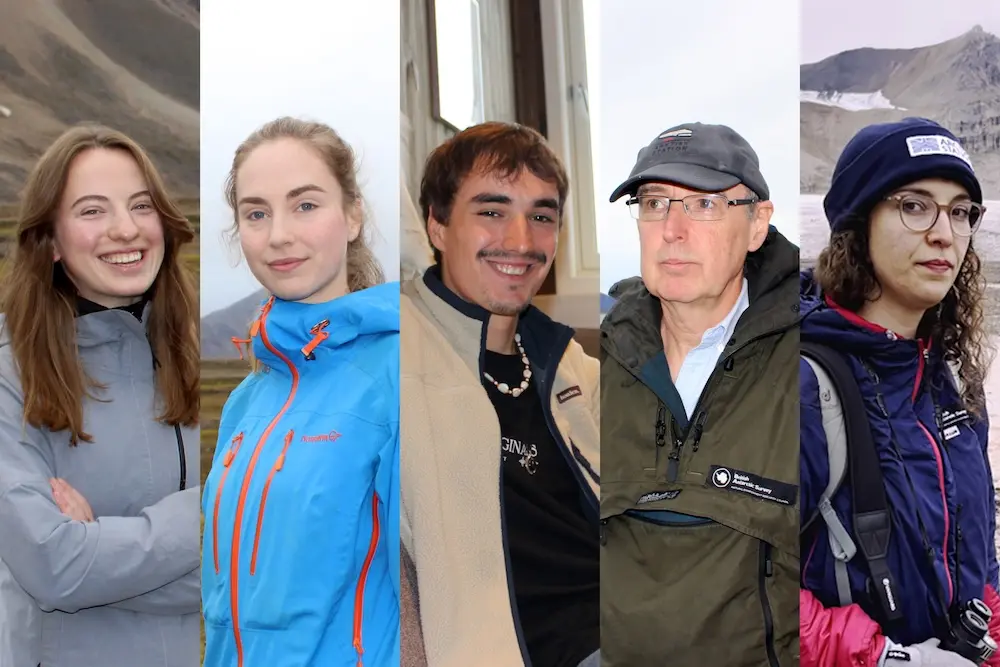
The author (top left) visited Svalbard in 2024. Credit: Daisy Dunne.
Have you witnessed any climate change impacts in the Arctic that have shocked you or stayed with you?
Yes, I suppose so. I do know people who worked here in the early 90s, around 30 years ago, and they told me it was very cold in the summer and it mostly snowed. Whereas now, it mostly rains. It’s supposedly a high Arctic semi-desert here in Svalbard, but it rains a lot now.
There was an avalanche in Longyearbyen in 2015. It killed three people. When you go to Longyearbyen now, you can see a load of fences to stop avalanches coming down the hillside from the top of the mountain.
Has working in the Arctic changed your perspective on life?
Crikey, I don’t know. There’s certain situations where I’m more confident than I was. For example, if encountering local wildlife, such as polar bears, I think I can give it a reasonable shot of dealing with the situation rather than screaming and running away.
The most recent time I encountered a polar bear was 2019. A bear was wandering down the beach, but luckily it was spotted by Nick Cox, the manager of the UK base at the time, while it was still a long way off. If he had not spotted it, it would have been walked between us and our boat, which would have been quite a dangerous situation.
What is one thing you wish people in your country knew about your research, the Arctic or climate change in general?
I think probably the one thing I’d really like people to appreciate is the importance of fungi. I study fungi, and I don’t think most people really appreciate how important they are in the natural environment, because they are invisible. For the most part, you do see macroscopic toadstalls in woodlands. But in a gram of soil, there’s enough fungal hyphae – very fine strands that are maybe two-hundreths of a millimeter in diameter – to fill a few kilometres if laid out end to end. They are super abundant in the natural environment, but nobody really understands what they do.






Discussion about this post