









Researchers have enhanced solar energy harvesting by developing organic semiconductors that offer a cheaper, more adaptable alternative to silicon. A recent breakthrough reveals these materials can achieve higher efficiencies through a unique mechanism where electrons gain energy, paving the way for more effective solar cells and fuel production technologies.
New research partially explains the exceptional performance of a new class of organic semiconductors called non-fullerene acceptors (NFAs).
Solar energy plays a vital role in the transition to a clean-energy future. Typically, silicon, a common semiconductor found in everyday electronics, is used to harvest solar energy. However, silicon solar panels come with limitations—they are costly and challenging to install on curved surfaces.
Researchers have developed alternative materials for solar-energy harvesting to solve such shortcomings. Among the most promising of these are called “organic” 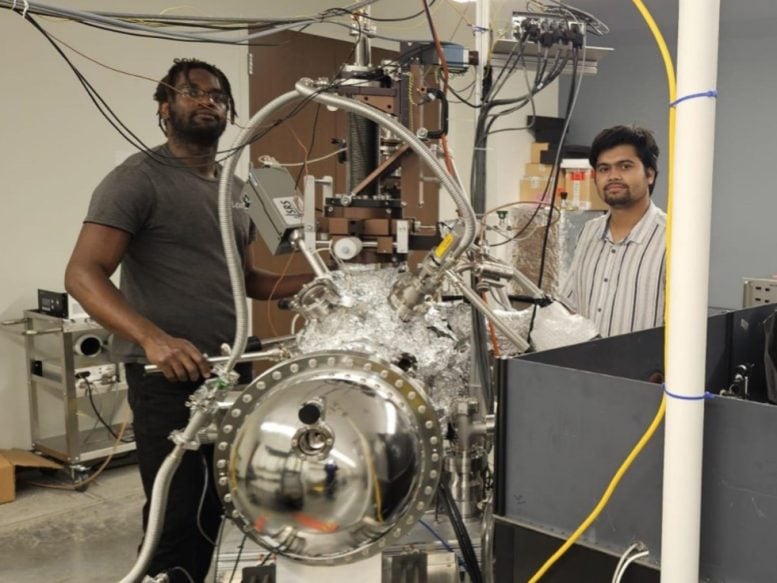
Lead author Kushal Rijal (right) and Neno Fuller (left) performed the TR-TPPE measurement using the ultra-high vacuum photoemission spectroscopy system shown in the picture. Credit: Kushal and Fuller
The key to this discovery was measurements taken by lead author Rijal using an experimental technique dubbed the “time-resolved two DOI: 10.1002/adma.202400578










Discussion about this post