







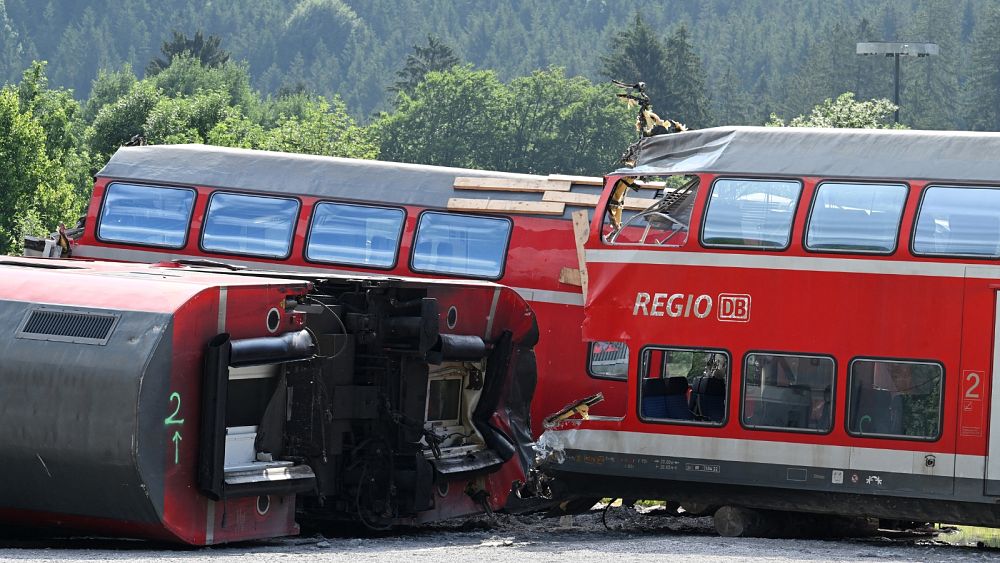
A deadly train crash in Greece this week left at least 36 people dead and dozens more injured.
It’s one of the worst railway disasters in Europe in recent years, but goes against an overall downward trend in the European Union in terms of the number of rail accidents and fatalities.
Here’s a look at some of the biggest rail disasters in recent years, plus a detailed look at the data across Europe.
Austria, Kaprun (2000)
A fire in a tunnel in Austrian killed 155 people in 2000 – most of the fatalities were on an ascending funicular, but some people were killed on the descending funicular and in the station. The victims were skiers who were going to the nearby Kitzsteinhorn Glacier. Only 12 people survived the fire.
Bioče, Montenegro (2006)
A failure of the braking system caused a train derailment at Bioče in Montenegro that left at least 45 people dead including five children. 184 people were injured in what was Montenegro’s worst train disaster, when the train fell into a 100m ravine above a river, about 10km north of the capital Podgorica.
Eschede, Germany (1998)
A high-speed train derailed and crashed into an overpass which crossed the railroad. The overpass then collapsed onto the Hannover-Humburg train. In total 101 people were killed and another 88 injured. The cause of the derailment was a fatigue crack on one wheel.
It was the world’s most severe high-speed rail crash.
Galicia, Spain (2013)
Eighty people were killed and more than 140 others were injured when a high-speed train derailed near Santiago de Compostela in July 2013. An investigation revealed that the train from Madrid was travelling 179 km/h along a stretch of track with an 80 km/h speed limit. It was the worst rail disaster in Spain since 1972.
Investigators also found that the driver had been talking to the conductor on his mobile phone just moments before the accident.
Lake Balaton, Hungary (2003)
At least 32 German tourists were killed in Hungary when their double-decker bus was sliced in two by a passenger train. The coach was crossing the tracks near Siofok on the shores of Lake Balaton, about 100 kilometres southwest of Budapest, when the accident took place. The train, which was travelling between Budapest to Nagykanizsa, was carrying mostly older tourists from the northern states of Lower Saxony and Schleswig-Holstein, Germany’s Foreign Ministry.










Discussion about this post