








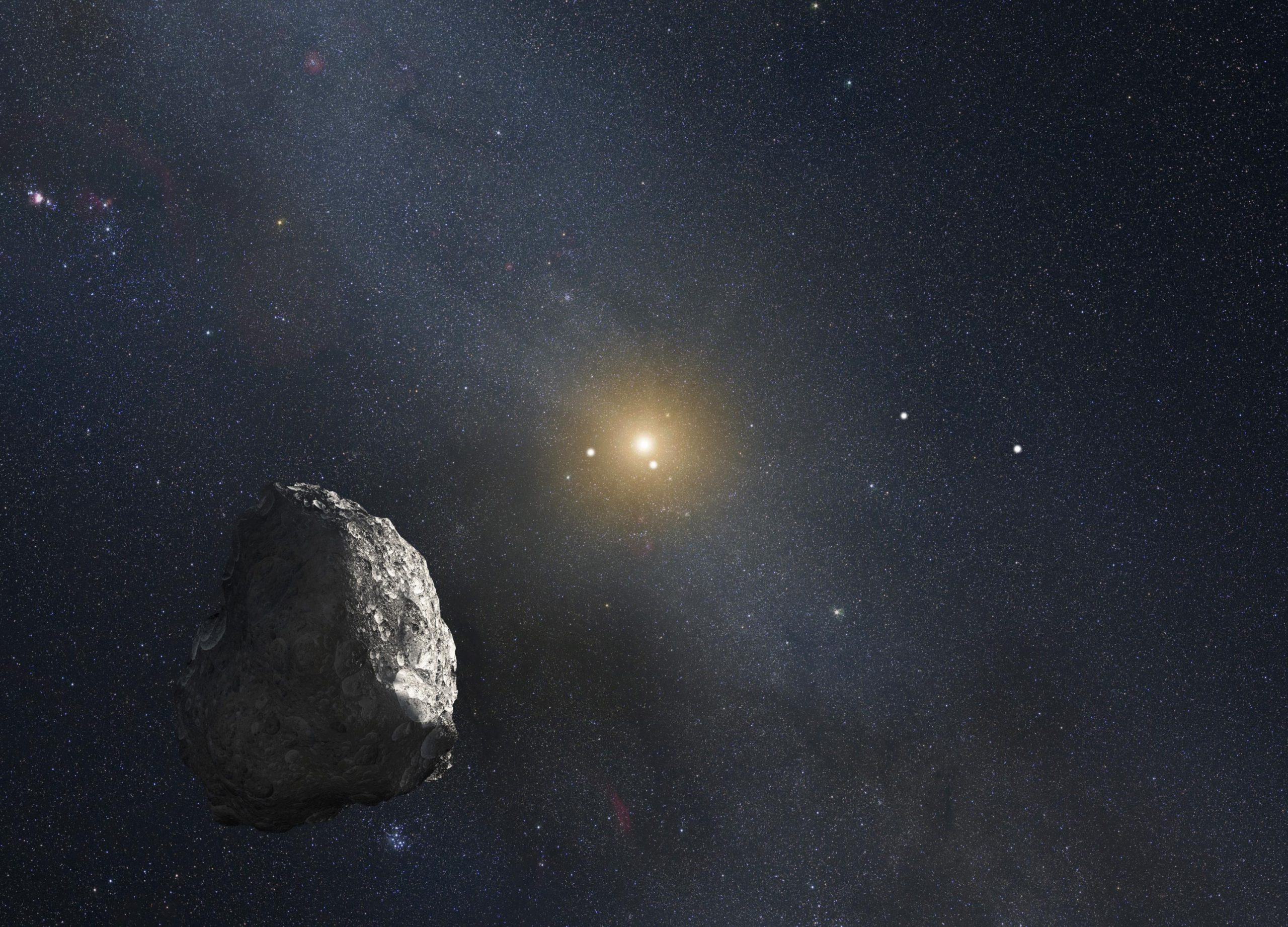
An artist’s impression of a Kuiper Belt object (KBO), located on the outer rim of our solar system at a staggering distance of 4 billion miles from the Sun. Credit: NASA, ESA, and G. Bacon (STScI)
A research team led by UCF discovered a significant presence of ancient carbon dioxide and carbon monoxide ices on trans-Neptunian objects, indicating that carbon dioxide may have been present during the formation of our solar system.
For the first time, ices of carbon dioxide and carbon monoxide have been detected on trans-Neptunian objects (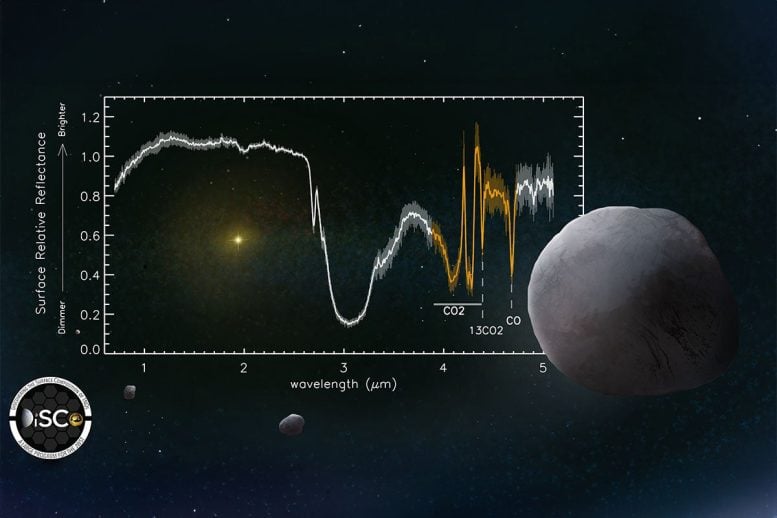
Spectrum of the surface of a trans-Neptunian object rich in carbon volatile ices obtained with JWST as part of the DiSCo Large Program. Absorptions of carbon dioxide (CO2), its isotopologue (13CO2), and carbon monoxide are highlighted in yellow. The light of the Sun (close to the center of the image) is dimmed billions of miles away, where the trans-Neptunian objects reside. Credit: William Gonzalez Sierra, Florida Space Institute
The work is part of the UCF-led Discovering the Surface Compositions of Trans-Neptunian Objects program (DiSCo-TNOs), one of the JWST programs focused on analyzing our solar system.
“It is the first time we observed this region of the spectrum for a large collection of TNOs, so in a sense, everything we saw was exciting and unique,” says de Prá, who co-authored the study. “We did not expect to find that carbon dioxide was so ubiquitous in the TNO region, and even less that carbon monoxide was present in so many TNOs.”
The discovery of the ices can further help us understand the formation of our solar system and how celestial objects may have migrated, he says.
“Trans-Neptunian Objects are relics from the process of planetary formation,” de Prá says. “These findings can impose important constraints about where these objects were formed, how they reached the region they inhabit nowadays, and how their surfaces evolved since their formation. Because they formed at greater distances to the Sun and are smaller than the planets, they contain the pristine information about the original composition of the protoplanetary disk.”
Chronicling Ancient Ice
Carbon monoxide ice was observed on DOI: 10.1038/s41550-024-02276-x
The research was funded by










Discussion about this post