
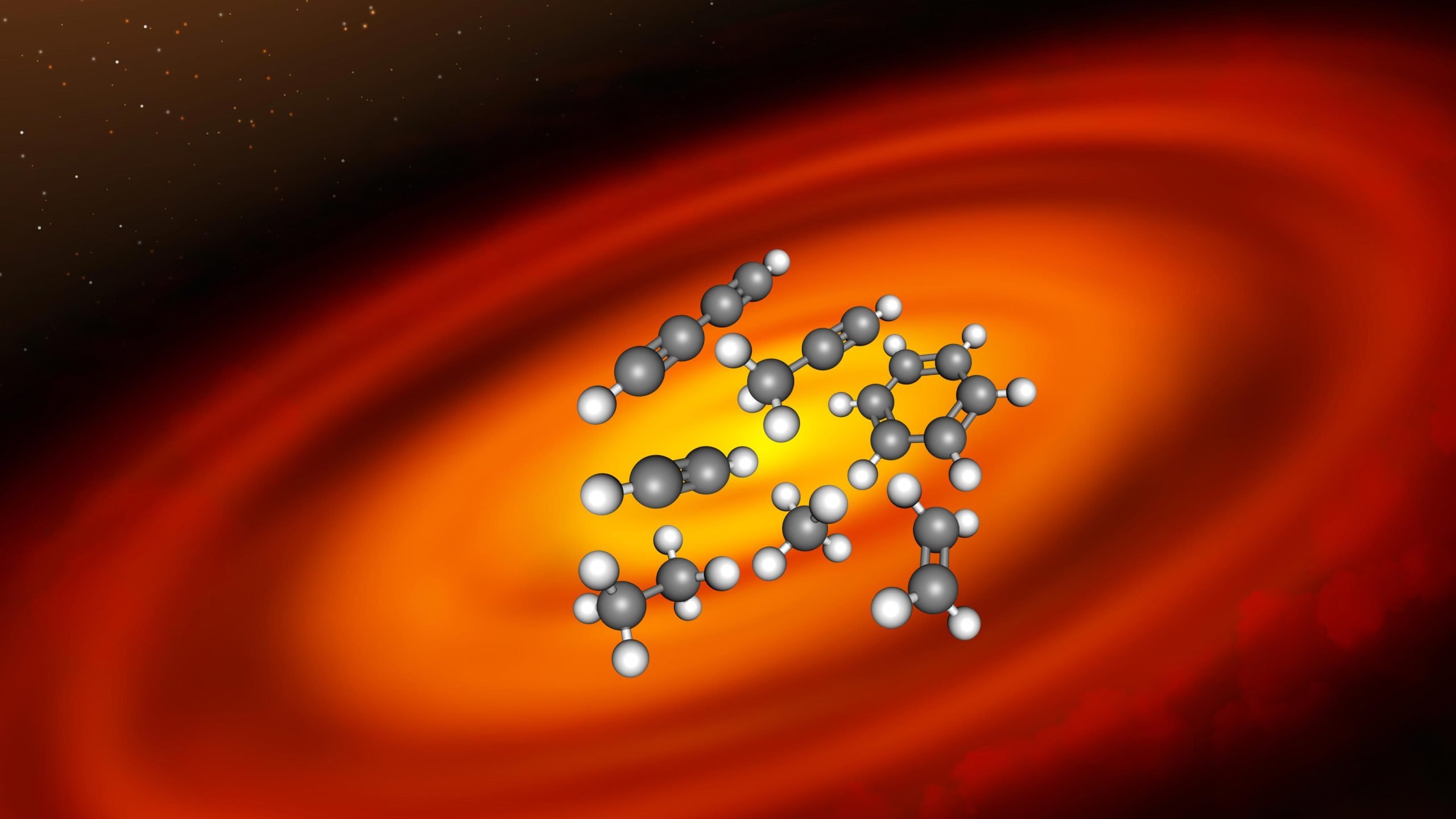
Artist’s impression of a protoplanetary disk around a very low-mass star. It depicts a selection of hydrocarbon molecules (Methane, CH4; Ethane, C2H6; Ethylene, C2H2; Diacetylene, C4H2; Propyne, C3H4; Benzene, C6H6) detected in the disk around ISO-ChaI 147. Credit: ALMA (ESO/NAOJ/NRAO) / MPIA
Observations from the 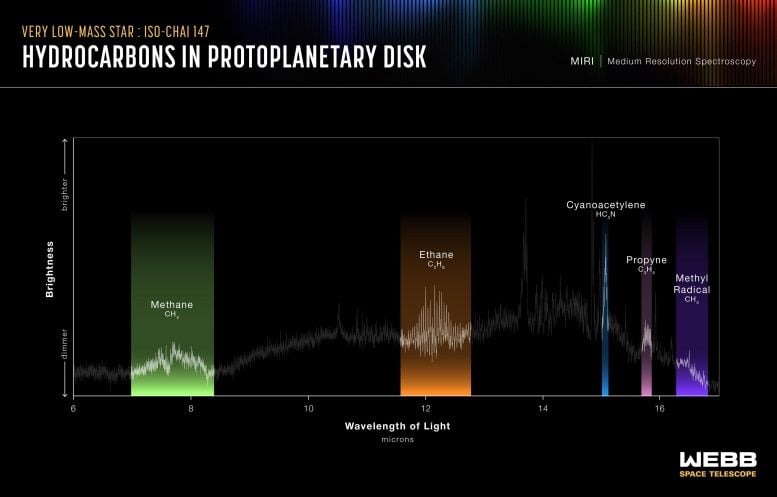
The spectrum revealed by Webb’s Mid-InfraRed Instrument (MIRI) shows the richest hydrocarbon chemistry seen to date in a protoplanetary disc, consisting of 13 carbon-bearing molecules up to benzene. This includes the first extrasolar detection of ethane (C2H6), the largest fully-saturated hydrocarbon detected outside our Solar System. Since fully-saturated hydrocarbons are expected to form from more basic molecules, detecting them here gives researchers clues about the chemical environment. The team also successfully detected ethylene (C2H4), propyne (C3H4), and the methyl radical CH3, for the first time in a protoplanetary disc. This graphic highlights the detections of ethane (C2H6), methane (CH4), propyne (C3H4), cyanoacetylene (HC3N), and the methyl radical CH3. Credit: NASA, ESA, CSA, R. Crawford (STScI)
Mid-Infrared Spectroscopy Reveals Disk Chemistry
Using the JWST’s mid-infrared spectroscopy instrument, Aditya Arabhavi and colleagues investigated the chemical composition of the planet-forming disk around ISO-ChaI 147, a young 0.11-solar-mass star in the Chameleon I star-forming region.
Implications of a High Carbon/Oxygen Ratio
The researchers found that the inner disk region surrounding this star has a carbon-rich chemistry featuring 13 carbon-bearing molecules, including ethane and benzine. This abundance in hydrocarbon molecules starkly contrasts the lack of observed oxygen-bearing molecules, suggesting that the region has a carbon to oxygen radio of >1.
According to the research team, this high carbon/oxygen ratio indicates radial transport of material within the disk, likely affecting the bulk composition of any planets forming within the disk.
For more on this discovery:
Reference: “Abundant hydrocarbons in the disk around a very-low-mass star” by A. M. Arabhavi, I. Kamp, Th. Henning, E. F. van Dishoeck, V. Christiaens, D. Gasman, A. Perrin, M. Güdel, B. Tabone, J. Kanwar, L. B. F. M. Waters, I. Pascucci, M. Samland, G. Perotti, G. Bettoni, S. L. Grant, P. O. Lagage, T. P. Ray, B. Vandenbussche, O. Absil, I. Argyriou, D. Barrado, A. Boccaletti, J. Bouwman, A. Caratti o Garatti, A. M. Glauser, F. Lahuis, M. Mueller, G. Olofsson, E. Pantin, S. Scheithauer, M. Morales-Calderón, R. Franceschi, H. Jang, N. Pawellek, D. Rodgers-Lee, J. Schreiber, K. Schwarz, M. Temmink, M. Vlasblom, G. Wright, L. Colina and G. Östlin, 6 June 2024, Science.
DOI: 10.1126/science.adi8147


Discussion about this post