



• Home
  • Insight
  • Blog
  • Business
  • Entertainment
  • Health
  • Politics
  • Shop
    • Gift Shop
    • Value Shop
    • Store
    • Bargain Shop
    • Discount
  • Sports
  • Tech
  • Travel
  • USA
  • Video
  • World
    • Asia
    • Africa
    • South America
    • North America
    • Europe
    • Oceania
Thursday, July 30, 2026
No Result
View All Result
Subscribe Now
  • Home
  • Insight
  • Blog
  • Business
  • Entertainment
  • Health
  • Politics
  • Shop
    • Gift Shop
    • Value Shop
    • Store
    • Bargain Shop
    • Discount
  • Sports
  • Tech
  • Travel
  • USA
    TX Rep. Brandon Gill Mocks James Talarico Over Fauci Action Figure Post

    TX Rep. Brandon Gill Mocks James Talarico Over Fauci Action Figure Post

    NBA players are ‘being taught’ to flop

    NBA players are ‘being taught’ to flop

    Industry was warned for years about chemical ‘runaway’ dangers. Then came near-catastrophe in O.C.

    Industry was warned for years about chemical ‘runaway’ dangers. Then came near-catastrophe in O.C.

    Trump administration seeks government-wide NDAs to stop leaks : NPR

    Trump administration seeks government-wide NDAs to stop leaks : NPR

    Dog discharges shotgun inside truck, striking woman at Nebraska traffic light

    Dog discharges shotgun inside truck, striking woman at Nebraska traffic light

    Toshifumi Suzuki, Japan’s ‘God’ of Convenience Stores, Dies at 93

    Toshifumi Suzuki, Japan’s ‘God’ of Convenience Stores, Dies at 93

     Judge Sanctioned CoreCivic for Destroying Video in ICE Death Suit

     Judge Sanctioned CoreCivic for Destroying Video in ICE Death Suit

    Suspect dead after opening fire near White House security checkpoint, Secret Service says

    Suspect dead after opening fire near White House security checkpoint, Secret Service says

    Trump trashes Colbert’s high-rated finale as “no ratings”

    Trump trashes Colbert’s high-rated finale as “no ratings”

  • Video
  • World
    • Asia
    • Africa
    • South America
    • North America
    • Europe
    • Oceania
The Insight Post
  • Home
  • Insight
  • Blog
  • Business
  • Entertainment
  • Health
  • Politics
  • Shop
    • Gift Shop
    • Value Shop
    • Store
    • Bargain Shop
    • Discount
  • Sports
  • Tech
  • Travel
  • USA
    TX Rep. Brandon Gill Mocks James Talarico Over Fauci Action Figure Post

    TX Rep. Brandon Gill Mocks James Talarico Over Fauci Action Figure Post

    NBA players are ‘being taught’ to flop

    NBA players are ‘being taught’ to flop

    Industry was warned for years about chemical ‘runaway’ dangers. Then came near-catastrophe in O.C.

    Industry was warned for years about chemical ‘runaway’ dangers. Then came near-catastrophe in O.C.

    Trump administration seeks government-wide NDAs to stop leaks : NPR

    Trump administration seeks government-wide NDAs to stop leaks : NPR

    Dog discharges shotgun inside truck, striking woman at Nebraska traffic light

    Dog discharges shotgun inside truck, striking woman at Nebraska traffic light

    Toshifumi Suzuki, Japan’s ‘God’ of Convenience Stores, Dies at 93

    Toshifumi Suzuki, Japan’s ‘God’ of Convenience Stores, Dies at 93

     Judge Sanctioned CoreCivic for Destroying Video in ICE Death Suit

     Judge Sanctioned CoreCivic for Destroying Video in ICE Death Suit

    Suspect dead after opening fire near White House security checkpoint, Secret Service says

    Suspect dead after opening fire near White House security checkpoint, Secret Service says

    Trump trashes Colbert’s high-rated finale as “no ratings”

    Trump trashes Colbert’s high-rated finale as “no ratings”

  • Video
  • World
    • Asia
    • Africa
    • South America
    • North America
    • Europe
    • Oceania
No Result
View All Result
No Result
View All Result
Home Science

Missing Milky Way black holes are bad news for this dark matter theory

by Theinsightpost
June 27, 2024
in Science
0 0
0
Missing Milky Way black holes are bad news for this dark matter theory

Scientists have found that unusually massive black holes seem to be absent from the diffuse outer halo of the Milky Way. 

The discovery could spell bad news for theories that suggest the universe’s most mysterious form of “stuff,” dark matter, is composed of primordial black holes that formed in the first moments after the Big Bang.

Dark matter is puzzling because, despite being effectively invisible because it does not interact with light, this substance makes up around 86% of the matter in the known universe. That means, for every 1 gram of “everyday matter” that composes stars, planets, moons and humans, there are over 6 grams of dark matter. 

Scientists can infer the presence of dark matter by its interactions with gravity and the influence it has on everyday matter and light. Yet, despite this and the ubiquity of dark matter, scientists have no idea what it might be composed of.

Related: If the Big Bang created miniature black holes, where are they?

The new dark matter results come from a look back through 20 years of observations conducted by a team of scientists from the Optical Gravitational Lensing Experiment (OGLE) survey at the Astronomical Observatory of the University of Warsaw.

“The nature of dark matter remains a mystery. Most scientists think it is composed of unknown elementary particles,” team leader Przemek Mróz, from the University of Warsaw’s Astronomical Observatory, said in a statement. “Unfortunately, despite decades of efforts, no experiment, including experiments carried out with the Large Hadron Collider, has found new particles that could be responsible for dark matter.”

The new findings don’t just cast doubt on black holes as an explanation for dark matter; they also deepen the mystery of why stellar-mass black holes detected beyond the Milky Way seem to be more massive than those within our galaxies’ limits.

Breaking space news, the latest updates on rocket launches, skywatching events and more!

Our primordial black holes are missing!

The team’s hunt for black holes in the Milky Way’s halo owes its origins to the Laser Interferometer Gravitational-Wave Observatory (LIGO) and its sister gravitational wave detector, Virgo, which seem to have uncovered a population of unusually large stellar-mass black holes.

Until the first detection of gravitational waves, which was produced by LIGO and Virgo in 2015, scientists had been finding that our galaxy’s population of stellar-mass black holes, born from the gravitational collapse of massive stars, tended to have masses between five and 20 times that of the sun.

Gravitational wave observations of mergers between stellar-mass black holes indicate a more distant population of black holes with much more mass, equivalent to between 20 and 100 suns. “Explaining why these two populations of black holes are so different is one of the biggest mysteries of modern astronomy,” Mróz pointed out.

A diagram showing the vast difference in scale between supermassive black holes and hypothetical primordial black holes. (Image credit: Robert Lea (created with Canva))

One possible explanation for this larger population of black holes is that they are leftovers from a period just after the Big Bang that formed not from the collapse of massive stars but from overly dense patches of primordial gas and dust.

“We know that the early universe was not ideally homogeneous — small density fluctuations gave rise to current galaxies and galaxy clusters,” Mróz said. “Similar density fluctuations, if they exceed a critical density contrast, may collapse and form black holes.”

These “primordial black holes” were first postulated by Stephen Hawking over 50 years ago but have remained frustratingly elusive. That could be because smaller examples would rapidly “leak” a form of thermal energy called Hawking radiation and eventually evaporating, meaning they would not exist in the current epoch of the 13.8 billion-year-old cosmos. Yet, this hindrance hasn’t stopped some physicists from positing primordial black holes as a possible explanation for dark matter.

Dark matter is estimated to comprise 90% to 95% of the Milky Way’s mass. That means, if dark matter is made of primordial black holes, our galaxy should contain many of these ancient bodies. Black holes don’t emit light because they are bound by a light-trapping surface called an “event horizon.” That means we can’t “see” black holes unless they feed on matter around them and cast their shadow on it. But, just like dark matter, black holes do interact with gravity.

Mróz and colleagues were thus able to turn to Albert Einstein’s 1915 theory of gravity, general relativity, and a principle it introduced to hunt for primordial black holes in the Milky Way.

Einstein lends a hand

Einstein’s theory of general relativity says objects of mass warp the very fabric of space and time, united as a single entity called “spacetime.” Gravity is a result of that curvature, and the more massive an object is, the more extreme the warping of spacetime it causes and, thus, the greater the “gravity” it generates.

Not only does this curvature tell planets how to orbit around stars, and tell stars how to race around the centers of their home galaxies, but it also bends the path of light coming from background stars and galaxies. The closer to the object of mass that light travels, the more its path is “bent.”

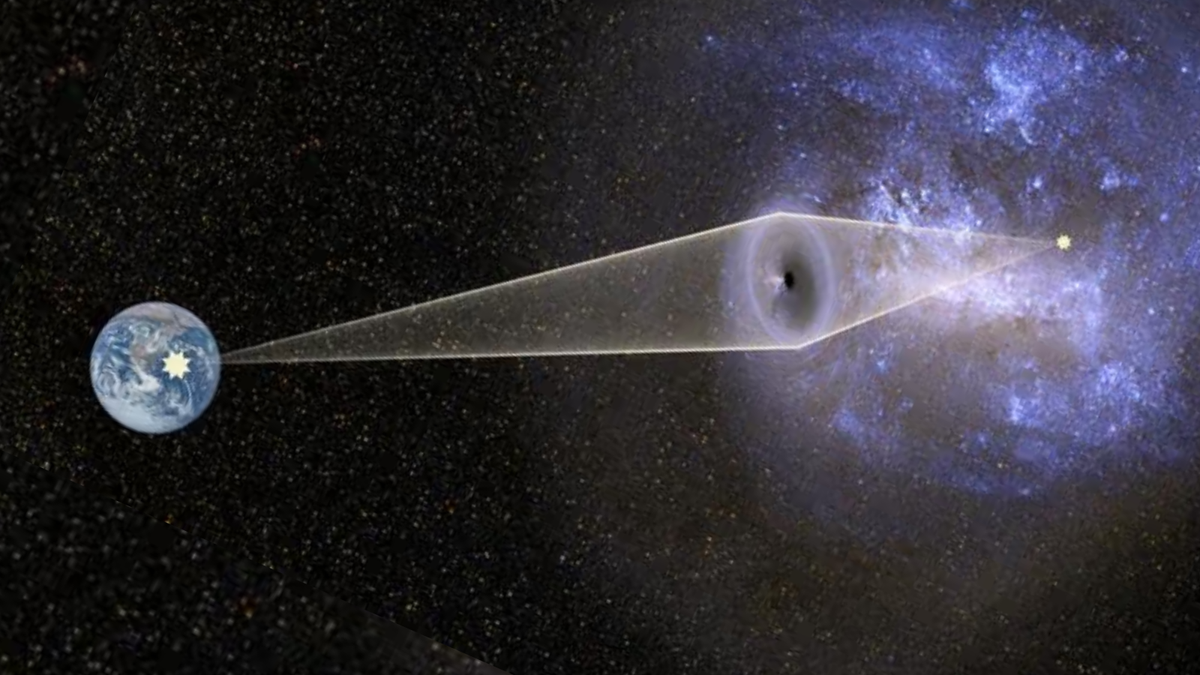
Different paths of light from a single background object can thus be bent, shifting the apparent location of the background object. Sometimes, the effect can even cause the background object to appear in multiple places in the same image of the sky. Other times, light from the background object is amplified, and that object is magnified. This phenomenon is known as “gravitational lensing,” and the intervening body is called a gravitational lens. Weak examples of this effect are called “microlensing.”

A bright blue blotch with white curved lines extended from it. At the center of these are two orange lines that curve around bright yellow spheres meeting at a dark blue sphere

A diagram shows how light from a background object is curved by a foreground body. (Image credit: NASA, ESA & L. Calçada)

If a primordial black hole in the Milky Way passes between Earth and a background star, then we should see microlensing effects on that star for a brief period of time.

“Microlensing occurs when three objects — an observer on Earth, a source of light, and a lens — virtually ideally align in space,” OGLE survey Principle Investigator Andrzej Udalski, said in the statement. “During a microlensing event, the source’s light may be deflected and magnified, and we observe a temporary brightening of the source’s light.”

How long light from the background source is brightened depends on the mass of the lensing body that passes between it and Earth, with objects of greater mass inducing longer microlensing events. An object around the mass of the sun should cause a brightening for around a week; for lensing bodies with masses 100 times that of the sun, however, the brightening should last as long as several years. 

Previous attempts have been made to use microlensing to detect primordial black holes and study dark matter. Prior experiments seemed to show that black holes less massive than the sun and could comprise under 10% of dark matter. The issue with these experiments, however, was they were not sensitive to extremely long-timescale microlensing events. 

Thus, because more massive black holes (similar to those recently detected with gravitational-wave detectors) would cause longer events, these experiments weren’t sensitive to that population of black holes either. 

Two diagrams showing the distribution of observed microlensing events. There are way more on the left-hand diagram.

On the left the expected gravitational lensing events if primordial black holes account for dark matter. On the right, the actual lensing events observed by OGLE between 2001 and 2020 (Image credit: J. Skowron / OGLE. Background image of the Large Magellanic Cloud: generated with bsrender written by Kevin Loch, using the ESA/Gaia database)

This team improved sensitivity to long-lasting microlensing events by turning to 20-year-long monitoring of almost 80 million stars located in a satellite galaxy or the Milky Way called the Large Magellanic Cloud (LMC).

The studied data, described as “the longest, largest, and most accurate photometric observations of stars in the LMC in the history of modern astronomy” by Udalski, was collected by the OGLE project from 2001 to 2020 during its third and fourth operating phases. The team compared the microlensing events seen by OGLE to the theoretically predicted amount of such events, assuming that the Milky Way’s dark matter is made up of primordial black holes.

“If the entire dark matter in the Milky Way was composed of black holes of 10 solar masses, we should have detected 258 microlensing events,” Mróz said. “For 100 solar mass black holes, we expected 99 microlensing events. For 1000 solar mass black holes — 27 microlensing events.”

In contrast to these estimated amounts of events, the team only found 12 microlensing events in the OGLE data. Further analysis revealed all of these events could be explained by the known stars in the Milky Way and in the LMC itself. After these calculations, the team found black holes of 10 solar masses could comprise at most 1.2% of dark matter, smaller 100 solar mass black holes could account for no more than 3.0% of dark matter and 1000 solar mass black holes could only comprise 11% of dark matter.

“That indicates that massive black holes can compose, at most, a few percent of dark matter,” Mróz explained.

“Our observations indicate that primordial black holes cannot comprise a significant fraction of the dark matter and, simultaneously, explain the observed black hole merger rates measured by LIGO and Virgo,” Udalski concluded. “Our results will remain in astronomy textbooks for decades to come.”

This leaves astronomers to return to the drawing board to explain the observation of overly massive stellar-mass black holes beyond the Milky Way while physicists continue to puzzle over the true nature of dark matter.

 The team’s research is published on June 24 the journals Nature and the Astrophysical Journal Supplement Series.

ShareTweetSend
Previous Post

Reusable Launch Vehicle (RLV) To Use GSLV With PSLV Last Stage

Next Post

Donald Trump’s Plan For Presidency

Related News

Daily multivitamin may help older adults stay independent
Science

Daily multivitamin may help older adults stay independent

July 30, 2026
1,200-year-old gold hoard discovered in Saudi Arabia may have been buried by a medieval pilgrim
Science

1,200-year-old gold hoard discovered in Saudi Arabia may have been buried by a medieval pilgrim

May 27, 2026
Making Changes to Major League Baseball ⚾ by Tumble Science Podcast for Kids
Science

Making Changes to Major League Baseball ⚾ by Tumble Science Podcast for Kids

May 27, 2026
The Paradox of AI and Climate – State of the Planet
Science

The Paradox of AI and Climate – State of the Planet

May 26, 2026
Next Post
Donald Trump’s Plan For Presidency

Donald Trump's Plan For Presidency

Discussion about this post

Subscribe To Our Newsletters

    Customer Support


    1251 Wilcrest Drive
    Houston, Texas
    77042 USA
    Call-832.795.1420
    e-mail – news@theinsightpost.com

    Subscribe To Our Newsletters

      Categories

      • Africa
      • Africa-East
      • African Sports
      • American Sports
      • Arts
      • Asia
      • Australia
      • Business
      • Business Asia
      • Business- Africa
      • Canada
      • Defense
      • Education
      • Egypt
      • Energy
      • Entertainment
      • Europe
      • European Soccer
      • Finance
      • Germany
      • Ghana
      • Health
      • Insight
      • International
      • Investing
      • Japan
      • Latest Headlines
      • Life & Living
      • Markets
      • Mobile
      • Movies
      • New Zealand
      • Nigeria
      • Politics
      • Scholarships
      • Science
      • South Africa
      • South America
      • Sports
      • Tech
      • Travel
      • UK
      • USA
      • Weather
      • World
      No Result
      View All Result

      Recent News

      US Navy to overhaul torpedo stockpile under new two-war strategy

      US Navy to overhaul torpedo stockpile under new two-war strategy

      July 30, 2026
      Free Cloud Computing Course | AWS Re/Start Program 

      Free Cloud Computing Course | AWS Re/Start Program 

      July 30, 2026
      Thirty Years Later

      Thirty Years Later

      July 30, 2026
      Announcing Codemagic Patch: an open-source CodePush rebuild for React Native

      Announcing Codemagic Patch: an open-source CodePush rebuild for React Native

      July 30, 2026
      • Home
      • Advertise With Us
      • About Us
      • Corporate
      • Consumer Rewards
      • Forum
      • Privacy Policy
      • Social Trends

      Theinsightpost ©2026 | All Rights Reserved. Theinsightpost is an Elnegy LLC company, registered in Texas, USA

      Welcome Back!

      Login to your account below

      Forgotten Password?

      Retrieve your password

      Please enter your username or email address to reset your password.

      Log In

      Add New Playlist

      We are using cookies to give you the best experience on our website.

      You can find out more about which cookies we are using or switch them off in .

      No Result
      View All Result
      • Home
      • Insight
      • Blog
      • Business
      • Entertainment
      • Health
      • Politics
      • Shop
        • Gift Shop
        • Value Shop
        • Store
        • Bargain Shop
        • Discount
      • Sports
      • Tech
      • Travel
      • USA
      • Video
      • World
        • Asia
        • Africa
        • South America
        • North America
        • Europe
        • Oceania

      Theinsightpost ©2026 | All Rights Reserved. Theinsightpost is an Elnegy LLC company, registered in Texas, USA

      The Insight Post
      Powered by  GDPR Cookie Compliance
      Privacy Overview

      This website uses cookies so that we can provide you with the best user experience possible. Cookie information is stored in your browser and performs functions such as recognising you when you return to our website and helping our team to understand which sections of the website you find most interesting and useful.

      Strictly Necessary Cookies

      Strictly Necessary Cookie should be enabled at all times so that we can save your preferences for cookie settings.

      Cookie Policy

      More information about our Cookie Policy