
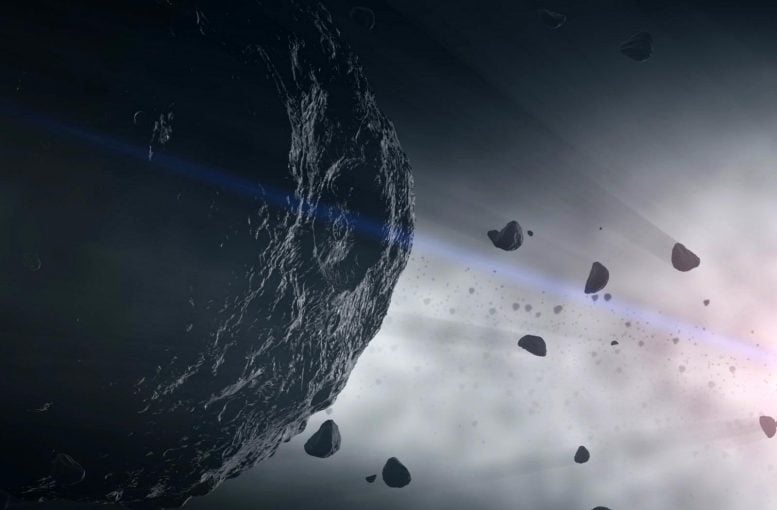
New study provides insights into the geophysics behind asteroid formation and evolution.
A University of Maryland-led study reveals new details about asteroid dynamics following “For the most part, our original pre-impact predictions about how DART would change the way Didymos and its moon move in space were correct,” said Derek Richardson, a professor of astronomy at the University of Maryland and a DART investigation working group lead. “But there are some unexpected findings that help provide a better picture of how asteroids and other small bodies form and evolve over time.” The paper published in Planetary Science Journal on August 23, 2024, by a team led by Richardson detailed notable post-impact observations and described possible implications for future asteroid research. One of the biggest surprises was how much the impact with DART changed the shape of Dimorphos. According to Richardson, the asteroid moon was originally oblate (shaped like a hamburger) but became more prolate (stretched out like a football) after the DART spacecraft collided with it. “We were expecting Dimorphos to be prolate pre-impact simply because that’s generally how we believed the central body of a moon would gradually accumulate material that’s been shed off a primary body like Didymos. It would naturally tend to form an elongated body that would always point its long axis toward the main body,” Richardson explained. “But this result contradicts that idea and indicates that something more complex is at work here. Furthermore, the impact-induced change in Dimorphos’ shape likely changed how it interacts with Didymos.” Richardson noted that although DART only hit the moon, the moon and the main body are connected through gravity. The debris scattered by the spacecraft on impact also played a role in the disturbed equilibrium between the moon and its asteroid, shortening Dimorphos’ orbit around Didymos. Interestingly, Didymos’ shape remained the same—a finding that indicates that the larger asteroid’s body is firm and rigid enough to maintain its form even after losing mass to create its moon. According to Richardson, Dimorphos’ changes have important implications for future exploration efforts, including the Reference: “The Dynamical State of the Didymos System before and after the DART Impact” by Derek C. Richardson, Harrison F. Agrusa, Brent Barbee, Rachel H. Cueva, Fabio Ferrari, Seth A. Jacobson, Rahil Makadia, Alex J. Meyer, Patrick Michel, Ryota Nakano, Yun Zhang, Paul Abell, Colby C. Merrill, Adriano Campo Bagatin, Olivier Barnouin, Nancy L. Chabot, Andrew F. Cheng, Steven R. Chesley, R. Terik Daly, Siegfried Eggl, Carolyn M. Ernst, Eugene G. Fahnestock, Tony L. Farnham, Oscar Fuentes-Muñoz, Edoardo Gramigna, Douglas P. Hamilton, Masatoshi Hirabayashi, Martin Jutzi, Josh Lyzhoft, Riccardo Lasagni Manghi, Jay McMahon, Fernando Moreno, Naomi Murdoch, Shantanu P. Naidu, Eric E. Palmer, Paolo Panicucci, Laurent Pou, Petr Pravec, Sabina D. Raducan, Andrew S. Rivkin, Alessandro Rossi, Paul Sánchez, Daniel J. Scheeres, Peter Scheirich, Stephen R. Schwartz, Damya Souami, Gonzalo Tancredi, Paolo Tanga, Paolo Tortora, Josep M. Trigo-Rodríguez, Kleomenis Tsiganis, John Wimarsson and Marco Zannoni, 23 August 2024, The Planetary Science Journal. This research was supported by NASA (Contract Nos. 80MSFC20D0004, 80NSSC22K1173, HST-GO-17292 and NAS 5-26555), U.S. National Science Foundation (Grant No. DGE 2040434), the Centre national d’études spatiales (CNES), the European Space Agency (ESA), the European Research Council, the Italian Space Agency, the Swiss National Science Foundation and the Grant Agency of the
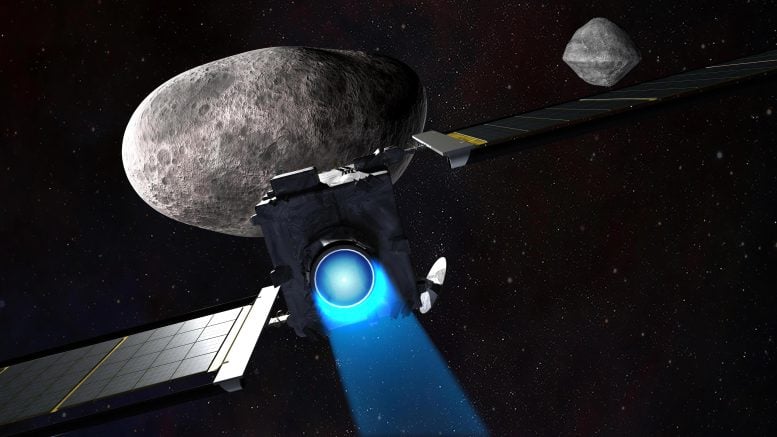
Insights From DART’s Collision With Dimorphos
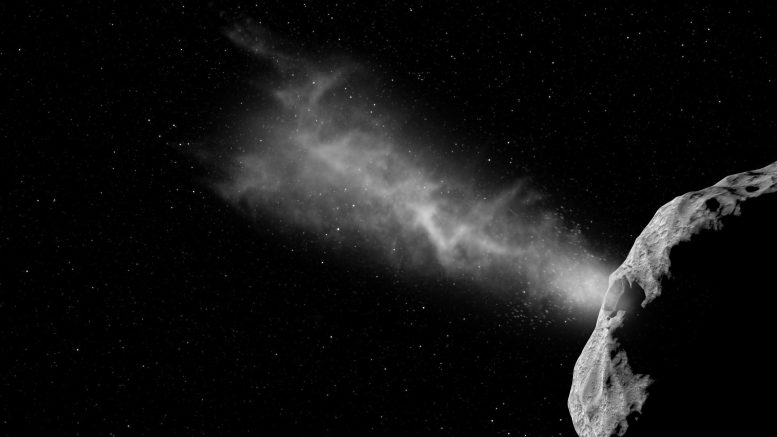
Unexpected Changes in Asteroid’s Shape and Dynamics
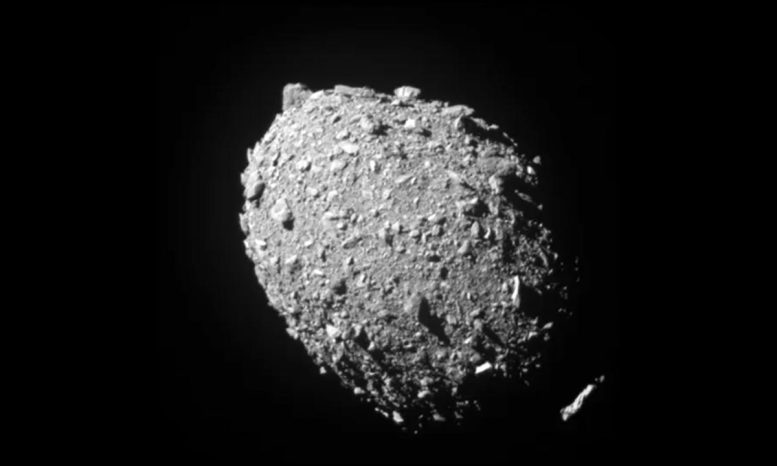
Implications for Future Space Missions
DOI: 10.3847/PSJ/ad62f5