








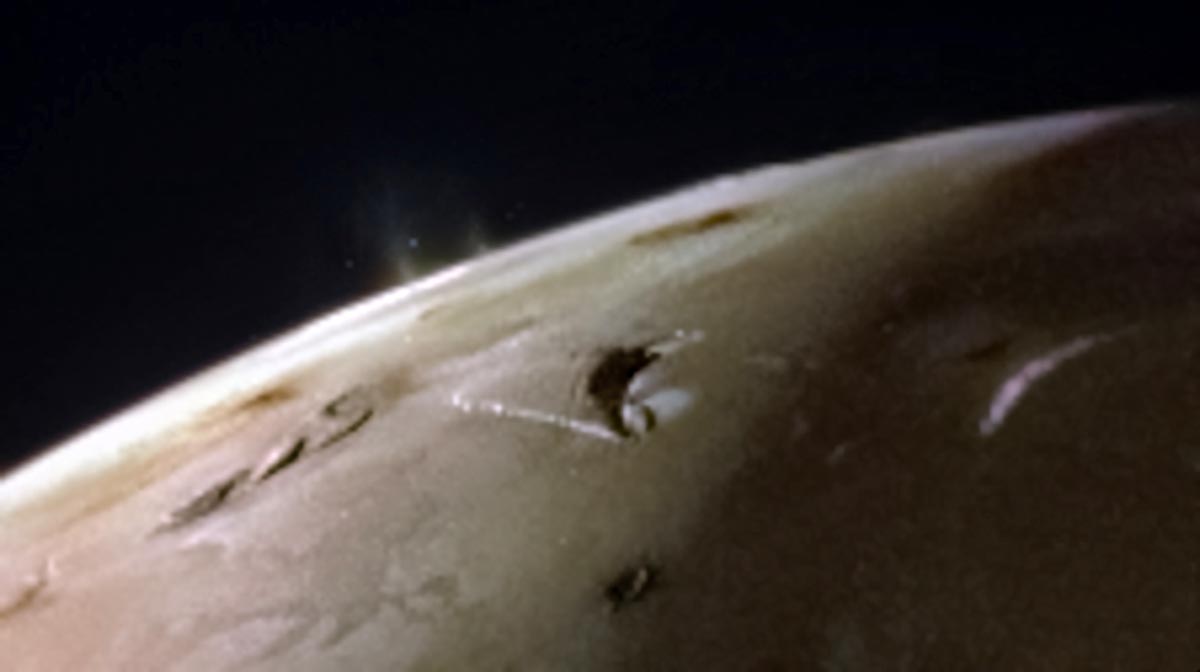
The JunoCam instrument aboard NASA’s Juno spacecraft captured two volcanic plumes rising above the horizon of Jupiter’s moon Io. The image was taken on February 3 from a distance of about 2,400 miles (3,800 kilometers). Credit: NASA/JPL-Caltech/SwRI/MSSS, Image processing by Andrea Luck (CC BY)
Infrared imagery from the Juno spacecraft heats up the discussion on the inner workings of Subsequent missions to Jupiter, with more Io flybys, discovered additional plumes — along with lava lakes. Scientists now believe Io, which is stretched and squeezed like an accordion by neighboring moons and massive Jupiter itself, is the most volcanically active world in the solar system. But while there are many theories on the types of volcanic eruptions across the surface of the moon, little supporting data exists.
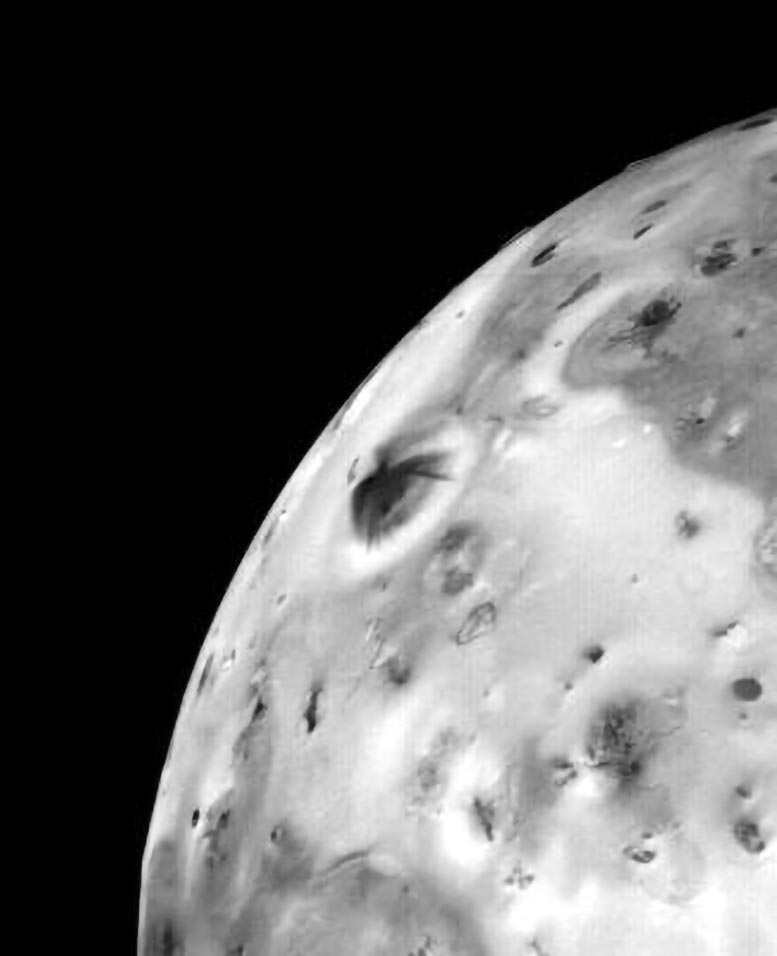
This photo of a volcanic eruption on Jupiter’s satellite Io (dark fountain-like feature near the limb) was taken March 4, 1979, about 12 hours before Voyager 1’s closest approach to Jupiter. This and the accompanying photo present the evidence for the first active volcanic eruption ever observed on another body in the solar system. This photo taken from a distance of 310,000 miles (499,000 kilometers), shows a plume-like structure rising more than 60 miles (100 kilometers) above the surface, a cloud of material being produced by an active eruption. Credit: NASA/JPL
Juno’s Close-Up View of Io
In both May and October 2023, Juno flew by Io, coming within about 21,700 miles (35,000 kilometers) and 8,100 miles (13,000 kilometers), respectively. Among Juno’s instruments getting a good look at the beguiling moon was JIRAM.
Designed to capture the infrared light (which is not visible to the human eye) emerging from deep inside Jupiter, JIRAM probes the weather layer down to 30 to 45 miles (50 to 70 kilometers) below the gas giant’s cloud tops. But during Juno’s extended mission, the mission team has also used the instrument to study the moons Io, 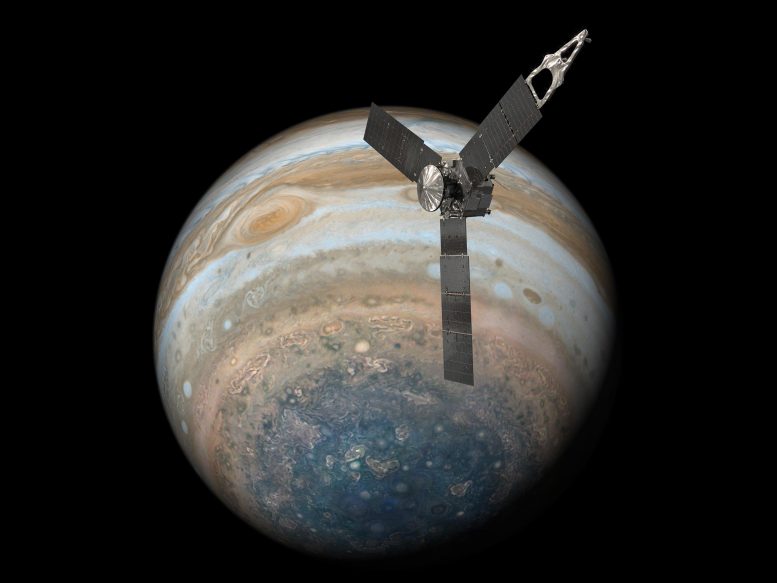
This illustration depicts NASA’s Juno spacecraft soaring over Jupiter’s south pole. Credit: NASA/JPL-Caltech
Fire-Breathing Lakes
JIRAM’s Io flyby data not only highlights the moon’s abundant lava reserves, but also provides a glimpse of what may be going on below the surface. Infrared images of several Io lava lakes show a thin circle of lava at the border, between the central crust that covers most of the lava lake and the lake’s walls. Recycling of melt is implied by the lack of lava flows on and beyond the rim of the lake, indicating that there is a balance between melt that has erupted into the lava lakes and melt that is circulated back into the subsurface system.
“We now have an idea of what is the most frequent type of volcanism on Io: enormous lakes of lava where magma goes up and down,” said Mura. “The lava crust is forced to break against the walls of the lake, forming the typical lava ring seen in Hawaiian lava lakes. The walls are likely hundreds of meters high, which explains why magma is generally not observed spilling out of the paterae” — bowl-shaped features created by volcanism — “and moving across the moon’s surface.”
JIRAM data suggests that most of the surface of these Io hot spots is composed of a rocky crust that moves up and down cyclically as one contiguous surface due to the central upwelling of magma. In this hypothesis, because the crust touches the lake’s walls, friction keeps it from sliding, causing it to deform and eventually break, exposing lava just below the surface.
An alternative hypothesis remains in play: Magma is welling up in the middle of the lake, spreading out and forming a crust that sinks along the rim of the lake, exposing lava.
Juno’s Continued Exploration
“We are just starting to wade into the JIRAM results from the close flybys of Io in December 2023 and February 2024,” said Scott Bolton, principal investigator for Juno at the Southwest Research Institute in San Antonio. “The observations show fascinating new information on Io’s volcanic processes. Combining these new results with Juno’s longer-term campaign to monitor and map the volcanoes on Io’s never-before-seen north and south poles, JIRAM is turning out to be one of the most valuable tools to learn how this tortured world works.”
Juno executed its 62nd flyby of Jupiter — which included an Io flyby at an altitude of about 18,175 miles (29,250 kilometers) — on June 13. The 63rd flyby of the gas giant is scheduled for July 16.
Reference: “Hot rings on Io observed by Juno/JIRAM” by Alessandro Mura, Federico Tosi, Francesca Zambon, Rosaly M. C. Lopes, Peter J. Mouginis-Mark, Heidi Becker, Gianrico Filacchione, Alessandra Migliorini, Candice. J. Hansen, Alberto Adriani, Francesca Altieri, Scott Bolton, Andrea Cicchetti, Elisa Di Mico, Davide Grassi, Raffaella Noschese, Alessandro Moirano, Madeline Pettine, Giuseppe Piccioni, Christina Plainaki, Julie Rathbun, Roberto Sordini and Giuseppe Sindoni, 20 June 2024, Communications Earth & Environment.
DOI: 10.1038/s43247-024-01486-5
More the Juno Mission
Initiated by NASA as part of its New Frontiers program, the Juno mission launched toward Jupiter on August 5, 2011, and successfully entered its orbit on July 4, 2016. The mission’s main objectives are to explore Jupiter’s atmosphere, magnetic environment, and internal structure to gather clues about the planet’s origins and its atmospheric phenomena like auroras. Juno orbits Jupiter from pole to pole, equipped with instruments shielded against intense radiation, allowing unprecedented views and data collection. The spacecraft’s detailed studies of Jupiter’s gravity and magnetic fields have provided profound insights, leading to extended missions that continue to push the boundaries of our knowledge about the gas giant and its moons.










Discussion about this post