

This graphic highlights part of a new simulation of what NASA’s Nancy Grace Roman Space Telescope could see when it launches by May 2027. The background spans about 0.11 square degrees (roughly equivalent to half of the area of sky covered by a full Moon), representing less than half the area Roman will see in a single snapshot. The inset zooms in to a region 300 times smaller, showcasing a swath of brilliant synthetic galaxies at Roman’s full resolution. Having such a realistic simulation helps scientists study the physics behind cosmic images –– both synthetic ones like these and future real ones. Researchers will use the observations for many types of science, including testing our understanding of the origin, evolution, and ultimate fate of the universe. Credit: C. Hirata and K. Cao (OSU) and NASA’s Goddard Space Flight Center
Researchers at the U.S. DOE’s Argonne National Laboratory have created nearly 4 million simulated images of the cosmos for the Nancy Grace 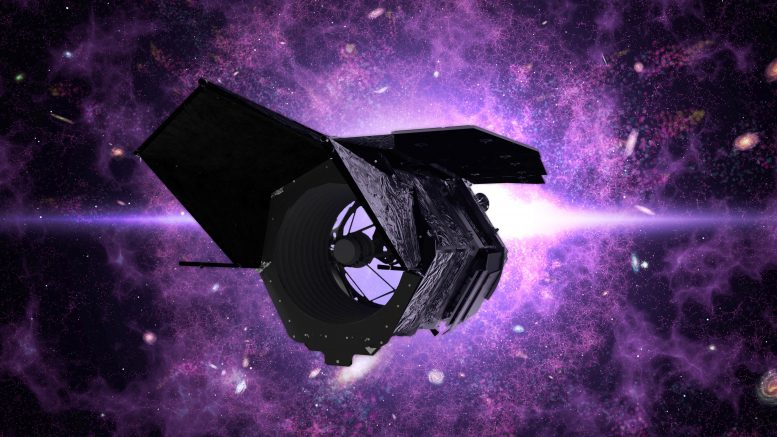
The Roman Space Telescope is a NASA observatory designed to unravel the secrets of dark energy and dark matter, search for and image exoplanets, and explore many topics in infrared astrophysics. Credit: NASA
Advanced Simulation Techniques for Observing the Cosmos
Michael Troxel, an associate professor of physics at Duke University in Durham, North Carolina, led the simulation campaign as part of a broader project called OpenUniverse. The team is now releasing a 10-terabyte subset of this data, with the remaining 390 terabytes to follow this fall once they’ve been processed.
“Using Argonne’s now-retired Theta machine, we accomplished in about nine days what would have taken around 300 years on your laptop,” said Katrin Heitmann, a cosmologist and deputy director of Argonne’s High Energy Physics division who managed the project’s supercomputer time. “The results will shape Roman and Rubin’s future attempts to illuminate dark matter and dark energy while offering other scientists a preview of the types of things they’ll be able to explore using data from the telescopes.”

View of Rubin Observatory at sunset in May 2024, on Cerro Pachón in Chile. Credit: Olivier Bonin/SLAC National Accelerator Laboratory
Unveiling the Universe’s Secrets Through Simulation
For the first time, this simulation factored in the telescopes’ instrument performance, making it the most accurate preview yet of the cosmos as Roman and Rubin will see it once they start observing. Rubin will begin operations in 2025, and NASA’s Roman will launch by May 2027.
The simulation’s precision is important because scientists will comb through the observatories’ future data in search of tiny features that will help them unravel the biggest mysteries in cosmology.
Roman and Rubin will both explore dark energy – the mysterious force thought to be accelerating the universe’s expansion. Since it plays a major role in governing the cosmos, scientists are eager to learn more about it. Simulations like OpenUniverse help them understand signatures that each instrument imprints on the images and iron out data processing methods now so they can decipher future data correctly. Then scientists will be able to make big discoveries even from weak signals.
“OpenUniverse lets us calibrate our expectations of what we can discover with these telescopes,” said Jim Chiang, a staff scientist at DOE’s SLAC National Accelerator Laboratory in Menlo Park, California, who helped create the simulations. “It gives us a chance to exercise our processing pipelines, better understand our analysis codes, and accurately interpret the results so we can prepare to use the real data right away once it starts coming in.”
Then they’ll continue using simulations to explore the physics and instrument effects that could reproduce what the observatories see in the universe.
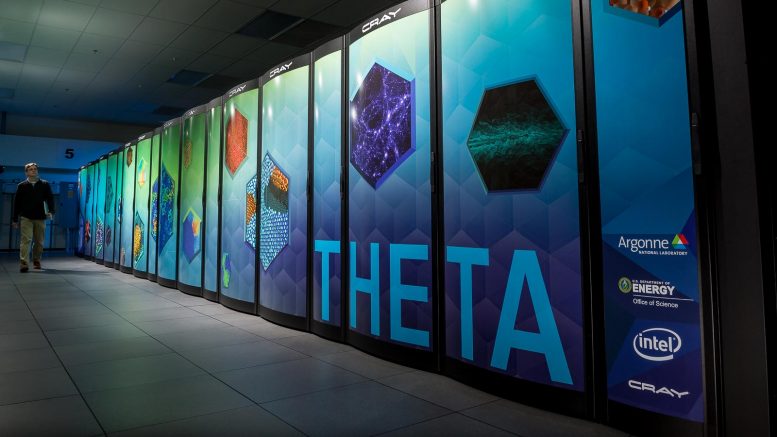
This photo displays Argonne Leadership Computing Facility’s now-retired Theta supercomputer. Scientists use supercomputers to simulate experiments they can’t conduct in real life, such as creating new universes from scratch. Credit: Argonne National Laboratory
Telescopic Teamwork
It took a large and talented team from several organizations to conduct such an immense simulation.
“Few people in the world are skilled enough to run these simulations,” said Alina Kiessling, a research scientist at NASA’s Jet Propulsion Laboratory (
This pair of images showcases the same region of sky as simulated by the Vera C. Rubin Observatory (left, processed by the Legacy Survey of Space and Time Dark Energy Science Collaboration) and NASA’s Nancy Grace Roman Space Telescope (right, processed by the Roman High-Latitude Imaging Survey Project Infrastructure Team). Roman will capture deeper and sharper images from space, while Rubin will observe a broader region of the sky from the ground. Because it has to peer through Earth’s atmosphere, Rubin’s images won’t always be sharp enough to distinguish multiple, close sources as separate objects. They’ll appear to blur together, which limits the science researchers can do using the images. But by comparing Rubin and Roman images of the same patch of sky, scientists can explore how to “deblend” objects and implement the adjustments across Rubin’s broader observations. Credit: J. Chiang (SLAC), C. Hirata (OSU), and NASA’s Goddard Space Flight Center