
• Home
  • Insight
  • Blog
  • Business
  • Entertainment
  • Health
  • Politics
  • Shop
    • Gift Shop
    • Value Shop
    • Store
    • Bargain Shop
    • Discount
  • Sports
  • Tech
  • Travel
  • USA
  • Video
  • World
    • Asia
    • Africa
    • South America
    • North America
    • Europe
    • Oceania
Thursday, October 22, 2026
No Result
View All Result
Subscribe Now
  • Home
  • Insight
  • Blog
  • Business
  • Entertainment
  • Health
  • Politics
  • Shop
    • Gift Shop
    • Value Shop
    • Store
    • Bargain Shop
    • Discount
  • Sports
  • Tech
  • Travel
  • USA

    Kansas Senate rivals clash over Trump, party loyalty in heated debate

    Is Rabies Making a Comeback?

    Kohen Wiley’s Family Says Investigators Didn’t Contact Them Before Concluding Cops Did No Wrong

    Peralta, Caminero, Diaz lead Rays to win over Guardians and a trip to the World Series

    What “Once Upon a Time in Harlem” can teach us about arguing over Black art

    4 dead, 39 injured in explosion at Canadian military training base

    Texas Man Found with Pipe Bombs, Guns, Three Illegal Aliens near Border

    Two players to bet on Sunday

    Arcadia surrogacy mansion mom previously fled U.S., prosecutors allege

  • Video
  • World
    • Asia
    • Africa
    • South America
    • North America
    • Europe
    • Oceania
The Insight Post
  • Home
  • Insight
  • Blog
  • Business
  • Entertainment
  • Health
  • Politics
  • Shop
    • Gift Shop
    • Value Shop
    • Store
    • Bargain Shop
    • Discount
  • Sports
  • Tech
  • Travel
  • USA

    Kansas Senate rivals clash over Trump, party loyalty in heated debate

    Is Rabies Making a Comeback?

    Kohen Wiley’s Family Says Investigators Didn’t Contact Them Before Concluding Cops Did No Wrong

    Peralta, Caminero, Diaz lead Rays to win over Guardians and a trip to the World Series

    What “Once Upon a Time in Harlem” can teach us about arguing over Black art

    4 dead, 39 injured in explosion at Canadian military training base

    Texas Man Found with Pipe Bombs, Guns, Three Illegal Aliens near Border

    Two players to bet on Sunday

    Arcadia surrogacy mansion mom previously fled U.S., prosecutors allege

  • Video
  • World
    • Asia
    • Africa
    • South America
    • North America
    • Europe
    • Oceania
No Result
View All Result
No Result
View All Result
Home Science

NASA’s Roman Space Telescope will peer all the way back to ‘cosmic dawn’

by Theinsightpost
August 2, 2024
in Science
0 0
0
NASA’s Roman Space Telescope will peer all the way back to ‘cosmic dawn’

When it opens its eye to the cosmos, NASA’s next big off-Earth observatory, the Nancy Grace Roman Space Telescope, will peer back to a distant period in the universe’s history called “cosmic dawn.”

Though Roman’s predecessor telescopes, the Hubble Space Telescope and the James Webb Space Telescope (JWST), take full advantage of the fact that the cosmos is now transparent to light, the universe wasn’t always this way.

Up to around 400,000 years after the Big Bang, the cosmos was opaque, full of an obscuring “fog” of particles absorbing photons, particles of light. Cosmic dawn, from between 50 million years to one billion years after the Big Bang, represents the period during which this fog began to clear and light began to travel freely.

It is also one of the most important periods in the 13.8 billion-year-old universe’s history, as it was also around the time when the first stars, galaxies, and black holes were born. The Nancy Grace Roman Space Telescope (Roman), set to launch in May 2027, will investigate the influence of these celestial objects during this crucial cosmic turning point.

“Something very fundamental about the nature of the universe changed during this time,” Michelle Thaller, an astrophysicist at NASA’s Goddard Space Flight Center in Maryland, said in a statement. “Thanks to Roman’s large, sharp infrared view, we may finally figure out what happened during a critical cosmic turning point.”

Related: NASA’s Nancy Grace Roman Telescope will hunt for tiny black holes left over from the Big Bang

Let there be light!

During the formative years of the universe, it was filled with a hot, dense sea of particles, including free electrons. These negatively charged particles endlessly scattered photons, making the universe opaque.

Breaking space news, the latest updates on rocket launches, skywatching events and more!

As the cosmos continued to expand, it also cooled, reaching a point at which electrons were able to bond with protons to form the first neutral atoms and the first elements, hydrogen and helium. This led to the formation of the first stars and galaxies. The removal of free electrons allowed the first light to travel through the universe. We see this light today as a “celestial fossil” called the cosmic microwave background (CMB).

Though light was no longer endlessly scattered by free electrons at this point, it still wasn’t completely free to travel very far. That was because the photons quickly hit neutral atoms that absorbed them.

This period, lasting between 380,000 to 200 million years after the Big Bang, was known as the cosmic dark ages. It ended over a period of a few hundred million years as the neutral atoms broke down or were ionized, resulting in the cosmic dawn. 

The question is: What caused this ionization of neutral atoms?

“We’re very curious about how the process happened,” said Aaron Yung from the Space Telescope Science Institute in Baltimore, who is part of Roman’s early universe observations team. “Roman’s large, crisp view of deep space will help us weigh different explanations.”

An artist’s depiction of the Nancy Grace Roman Space Telescope at work. (Image credit: NASA)

The early galaxies themselves are one possible source of the radiation that provided the energy to ionize early neutral atoms. The environment around the first black holes is another possible source of this high-energy light.

Roman will take a close look at both of these suspects.

“Roman will excel at finding the building blocks of cosmic structures like galaxy clusters that later form,” said Takahiro Morishita, an assistant scientist at the California Institute of Technology in Pasadena. “It will quickly identify the densest regions, where more ‘fog’ is being cleared, making Roman a key mission to probe early galaxy evolution and the cosmic dawn.”

The stars at cosmic dawn were different from those in the universe today, as the density of the early cosmos allowed them to grow to masses hundreds or even thousands of times that of the sun. The tremendous mass of these early stars meant they lived much shorter lives than the estimated 10-billion-year lifespan of the sun, but it also meant they blasted out more intense radiation than modern stars.

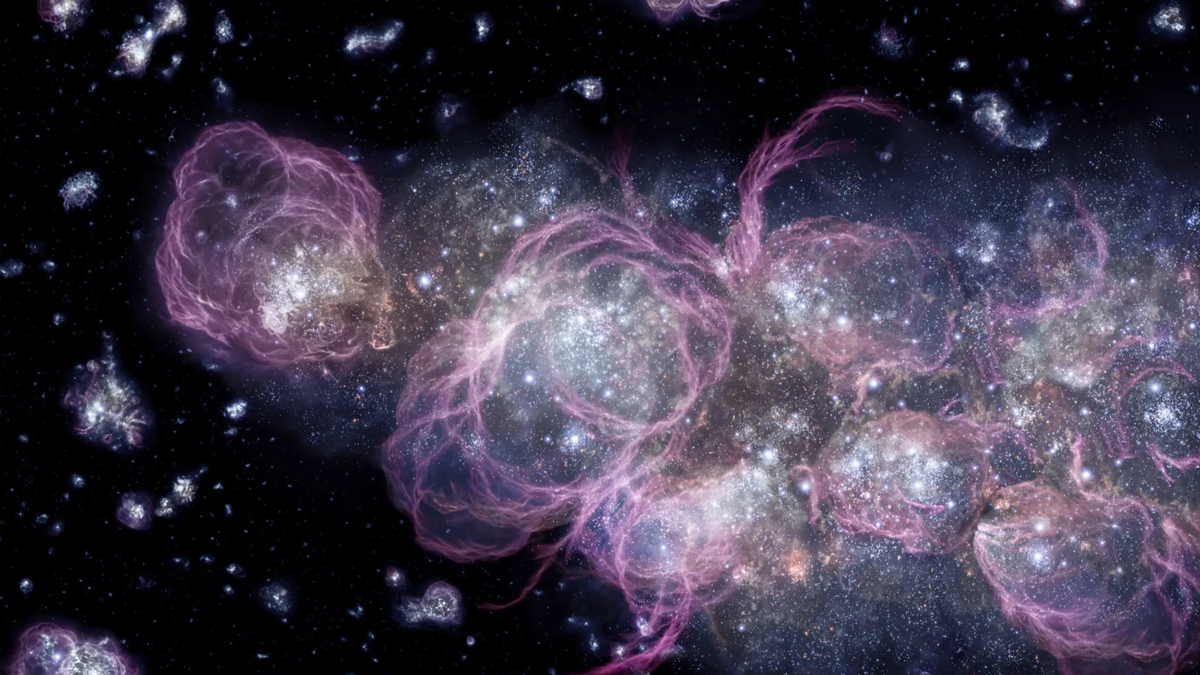
Huddled together in dense early galaxies, energy from these stars stripped electrons from protons in bubbles of space around them.

“You could call it the party at the beginning of the universe,” Thaller said. “We’ve never seen the birth of the very first stars and galaxies, but it must have been spectacular!”

Related: The 1st stars in the universe formed earlier than thought

Black holes join the cosmic dawn party

As these short-lived massive stars collapsed when their nuclear fuel was exhausted, they birthed the first black holes. In the dense environments common in the early universe, these black holes clashed and merged over and over again. 

This led to the creation of supermassive black holes with masses millions or billions of times that of the sun, though how black holes got so big so fast is still a pressing cosmic mystery.

A golden orange disk with a black center. Two light blue tubes extend from it.

An illustration shows a supermassive black hole bursting with eruptive jets. (Image credit: NAOJ/AND You Inc.)

Though black holes emit no light themselves due to the fact they are surrounded by a boundary called an “event horizon,” which marks the point where not even light can escape them, these early supermassive black holes could have still contributed to ionization.

When a supermassive black hole is surrounded by gas and dust that it feeds on, this material settles into a rapidly swirling cloud called an accretion disk. The massive gravitational influence of the black hole causes intense tidal forces in the accretion disk, generating friction and heating gas and dust, causing it to glow brightly across the electromagnetic spectrum.

Additionally, the magnetic fields of the black hole can channel material to its poles, from where it is blasted out as twin jets at near-light speeds. These jets are accompanied by blasts of electromagnetic radiation, too. Stretching out for hundreds of thousands of light-years, supermassive black hole jets are more than capable of ripping electrons from neutral atoms.

These active supermassive black hole regions, or active galactic nuclei, are known as quasars, and WST has been discovering them at distances that correspond to a period of less than one billion years after the Big Bang. The powerful space telescope is actually finding far more quasars than expected as it probes cosmic dawn.

When Roman is operational, its wider field of view could give a clearer picture of how common quasars were during cosmic dawn, possibly finding tens of thousands of these supermassive black hole-powered regions. 

“With a stronger statistical sample, astronomers will be able to test a wide range of theories inspired by JWST observations,” Yung explained. 

One question that researchers will be trying to answer with Roman is what type of galaxies were responsible for ionizing radiation at cosmic dawn. One major indicator of this will be the size of the ionized bubbles carved out by radiation.

“It could be that young galaxies kicked off the process, and then quasars finished the job,” Yung concluded. “Galaxies would create huge clusters of bubbles around them, while quasars would create large, spherical ones. We need a big field of view like Roman’s to measure their extent since, in either case, they’re likely up to millions of light-years wide — often larger than the JWST’s field of view.”

ShareTweetSend
Previous Post

Some F-16s are arriving in Ukraine, so what does it mean for war with Russia?

Next Post

The long road to prisoners deal

Related News

Science

Sleeping mice cleared amyloid twice as fast as awake ones in a 2013 Rochester study, while a 2024 Imperial College London team found brain dye clearance about a quarter lower in sleeping mice

October 21, 2026
Science

The Physics Behind Tesla’s Flying Roadster

October 20, 2026
Science

Can AI predict whether you’ll die from cancer from just an image of your face?

October 19, 2026
Science

Can science save meetings?

October 18, 2026
Next Post
The long road to prisoners deal

The long road to prisoners deal

Discussion about this post

Subscribe To Our Newsletters

    Customer Support


    1251 Wilcrest Drive
    Houston, Texas
    77042 USA
    Call-832.795.1420
    e-mail – news@theinsightpost.com

    Subscribe To Our Newsletters

      Categories

      • Africa
      • Africa-East
      • African Sports
      • American Sports
      • Arts
      • Asia
      • Australia
      • Business
      • Business Asia
      • Business- Africa
      • Canada
      • Defense
      • Education
      • Egypt
      • Energy
      • Entertainment
      • Europe
      • European Soccer
      • Finance
      • Germany
      • Ghana
      • Health
      • Insight
      • International
      • Investing
      • Japan
      • Latest Headlines
      • Life & Living
      • Markets
      • Mobile
      • Movies
      • New Zealand
      • Nigeria
      • Politics
      • Scholarships
      • Science
      • South Africa
      • South America
      • Sports
      • Tech
      • Travel
      • UK
      • USA
      • Weather
      • World
      No Result
      View All Result

      Recent News

      Pope Leo XIV won't need further lung cancer treatment, Vatican says

      October 22, 2026

      CAD to BOM Matching: New CAD Files to Existing Part Library

      October 22, 2026

      Trump, Biden loom large over crucial US Senate showdown in Kansas

      October 22, 2026

      Iran says 7 ships have been struck in Strait of Hormuz, Saudis intercept drones in airspace

      October 22, 2026
      • Home
      • Advertise With Us
      • About Us
      • Corporate
      • Consumer Rewards
      • Forum
      • Privacy Policy
      • Social Trends

      Theinsightpost ©2026 | All Rights Reserved. Theinsightpost is an Elnegy LLC company, registered in Texas, USA

      Welcome Back!

      Login to your account below

      Forgotten Password?

      Retrieve your password

      Please enter your username or email address to reset your password.

      Log In

      Add New Playlist

      We are using cookies to give you the best experience on our website.

      You can find out more about which cookies we are using or switch them off in .

      No Result
      View All Result
      • Home
      • Insight
      • Blog
      • Business
      • Entertainment
      • Health
      • Politics
      • Shop
        • Gift Shop
        • Value Shop
        • Store
        • Bargain Shop
        • Discount
      • Sports
      • Tech
      • Travel
      • USA
      • Video
      • World
        • Asia
        • Africa
        • South America
        • North America
        • Europe
        • Oceania

      Theinsightpost ©2026 | All Rights Reserved. Theinsightpost is an Elnegy LLC company, registered in Texas, USA

      The Insight Post
      Powered by  GDPR Cookie Compliance
      Privacy Overview

      This website uses cookies so that we can provide you with the best user experience possible. Cookie information is stored in your browser and performs functions such as recognising you when you return to our website and helping our team to understand which sections of the website you find most interesting and useful.

      Strictly Necessary Cookies

      Strictly Necessary Cookie should be enabled at all times so that we can save your preferences for cookie settings.

      Cookie Policy

      More information about our Cookie Policy

      Clear examples do more than decorate an explanation: they show how an idea behaves under recognizable conditions. In education and software documentation alike, strong illustrations begin with a defined goal, then reveal the steps, assumptions, and result without unnecessary detail. A practical test example should state the input, expected output, and boundary condition, because these elements show whether a rule works beyond the simplest case. Including a contrasting case also helps readers distinguish a valid application from a tempting but incorrect one, while concise notes explain why the outcomes differ. When examples are updated with current data and checked against the underlying rule, they remain useful across classrooms, product guides, and professional training.
      Bij toegang tot Belgische casino’s via een tablet kunnen spelers accountgegevens, spelvoorwaarden en betaalopties overzichtelijk raadplegen, terwijl informatie over casinos zonder cruks aanvullende context biedt bij het beoordelen van beschikbare toegangsregels. Een stabiele mobiele verbinding en goed leesbare beveiligingsfuncties zijn daarbij belangrijk voor leeftijdscontrole, accountbeheer en verantwoord spelen.