
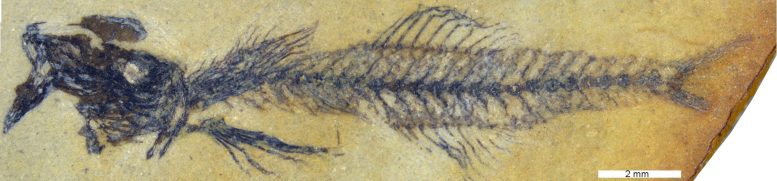
LMU paleontologists discovered a new genus of fossil goby shedding light on the early evolutionary stages and habitat adaptability of gobies, one of Europe’s most diverse fish groups. Fossil fish of the new genus †Simpsonigobius. Credit: Moritz Dirnberger
LMU paleontologists have discovered a new genus of fossil goby, unveiling the evolutionary mysteries of a lineage dating back millions of years.
Gobies, or Gobioidei, represent one of Europe’s most diverse groups of marine and freshwater fish. Typically found at the bottoms of shallow waters, they play a crucial role in the health and operation of numerous ecosystems.
With the identification of a new genus of a fossil freshwater goby, students of the international master program ‘Geobiology and Paleobiology’ at LMU and paleontologist Bettina Reichenbacher, professor at the Department of Earth and Environmental Sciences at LMU, have made a discovery that provides critical insights into the evolutionary history of these fish.
Measuring up to 34 mm, the small fish of the new genus †Simpsonigobius were discovered in 18-million-year-old rocks in Turkey and are marked by a distinct combination of morphological features, including otoliths (hearing stones) with a unique shape.
Modern research techniques elucidate the position in the family tree
To determine the relationships of †Simpsonigobius within the gobioid phylogenetic tree, the researchers utilized a “total-evidence” phylogenetic dataset, which they enhanced in order to combine a total of 48 morphological characters and genetic data from five genes for 48 living and 10 fossil DOI: 10.1080/14772019.2024.2340498