
New research from UC Riverside offers groundbreaking insights into Earth’s earliest life forms by combining ancient geological data with modern genetics and environmental studies, shedding light on their long-term evolutionary impact and relevance to climate change and space exploration.
A study from UCR could influence the search for life on other planets.
Despite years of extensive study, many aspects of the origins and early evolution of life remain a mystery to researchers. A recent paper from UC Riverside has provided new insights, paving the way for further research that could have implications for predicting climate change and searching for extraterrestrial life.
“This paper strives to inform the Earth sciences community where the research needs to go next,” said Christopher Tino, a UCR PhD candidate during the time of research and a first author.
Many studies have explored signs of early life preserved in ancient rocks, but this paper, recently published in the journal Nature Reviews Microbiology, weaves together this data with genomic studies of modern organisms and recent breakthroughs about the evolving chemistry of the early oceans, atmosphere, and continents.
The paper shows how Earth’s earliest life forms — microbes such as O2-producing bacteria and methane-producing archaea — shaped, and were shaped by, changes in the oceans, continents, and atmosphere.
“The central message in all of this is that you can’t view any part of the record in isolation,” said Timothy Lyons, a UCR distinguished professor of biogeochemistry and co-first author. “This is one of the first times that research across these fields has been stitched together this comprehensively to uncover an overarching narrative.”
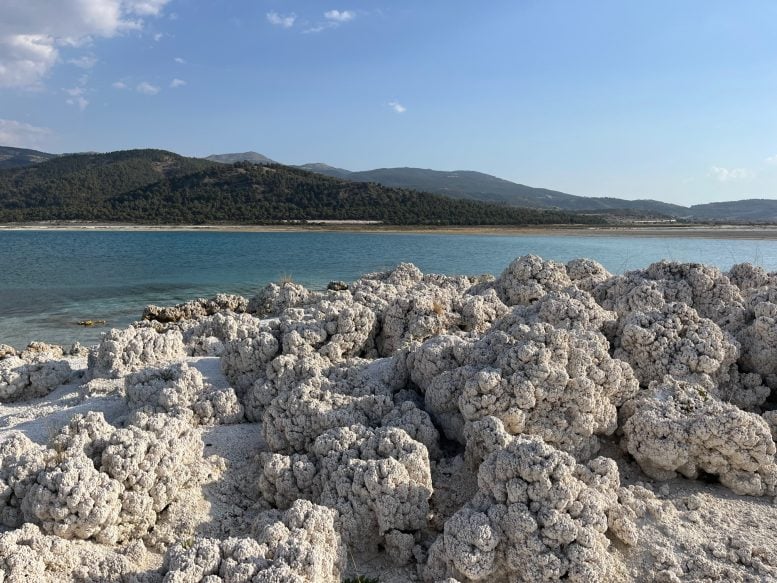
Many microbial structures on the shores of Lake Salda in Turkey are exposed as water levels drop, allowing scientists to study relationships between life and the surrounding environment. Credit: Tim Lyons/UCR
Bringing together experts in biology, geology, geochemistry, and genomics, the paper details the journey of Earth’s early life forms from their first appearances to their rise to ecological prominence. As their numbers increased, microbes began to affect the world around them, for instance by starting to produce oxygen via DOI: 10.1038/s41579-024-01044-y