



Enforcement of National Identity Register Amendment Regulations Begins
The National Identification Authority (NIA) has officially initiated the enforcement of the National Identity Register (Amendment) Regulations, 2026 (L.I. 2523). Institutions failing to adhere to the new requirements may be subject to fines reaching 2,000 penalty units.
Biometric Verification Implementation Task Force Deployed
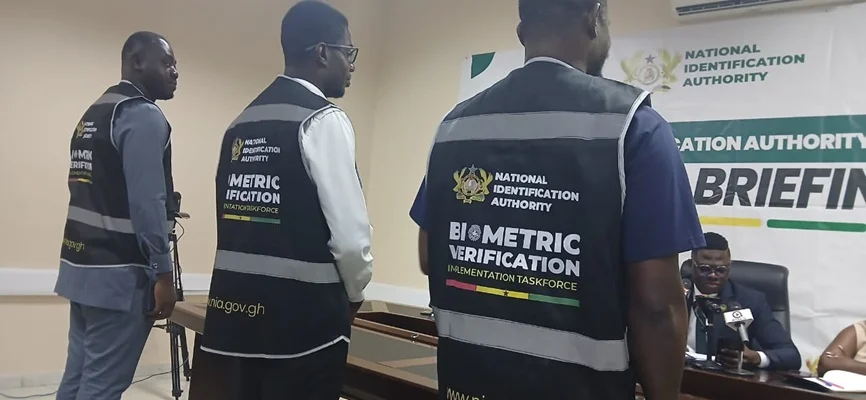
In a bid to ensure compliance, the NIA will establish a Biometric Verification Implementation Task Force tasked with inspecting institutions. This follows a three-month grace period that was originally granted to businesses and public entities to prepare for the new guidelines.
Press Briefing Highlights and Compliance Phase
During a press briefing held in Accra on November 2, 2026, NIA’s Corporate Affairs representative, William Ampomah Emmanuel Darlas, announced that the Authority’s public education and stakeholder engagement efforts have concluded. The NIA is now entering the enforcement and compliance monitoring phase.
Mandatory Use of Biometric Verification Platform
According to the new regulations, institutions involved in validating the identities of customers or applicants must utilize the NIA’s designated biometric verification platform. The reliance on visual inspection of the Ghana Card will no longer be sufficient.
Restrictions on Ghana Card Copies
The regulations explicitly prohibit institutions from photocopying, scanning, or retaining copies of the Ghana Card for identity verification purposes. Mr. Darlas emphasized that merely comparing an individual’s appearance with their Ghana Card photograph will not fulfill the verification requirements.
Reassurance on Ghana Card Validity
Mr. Darlas reassured citizens that the Ghana Card continues to serve as the nation’s official identity document. Under the new regulations, individuals are not obligated to re-register or re-capture their biometric data.
Aiming to Curb Identity Fraud
The newly implemented system is designed to combat identity fraud and impersonation, ensuring that the person presenting the Ghana Card is indeed the rightful owner. The biometric verification will utilize data previously collected during the Ghana Card registration process, including fingerprints, iris details, and facial features stored on the card’s chip.
Direct Access to Verification Platform
Mr. Darlas cautioned institutions against engaging third-party companies or individuals for access to the NIA’s identity verification platform. The NIA does not collaborate with intermediaries; institutions must go through an official onboarding process directly with the NIA.
Requirements for Institutional Access
This process entails institutions demonstrating their legal registration status within Ghana, securing certification from the Data Protection Commission, and coordinating with the NIA’s technical team to establish the requisite connection to the platform.
Prohibition of Subletting Access
Additionally, Mr. Darlas warned against the subletting of access by institutions already connected to the platform, especially to small and medium-sized enterprises. He highlighted reports of unauthorized third-party verification services and cautioned that violators could face legal repercussions.
Consequences for Non-Compliance
Institutions not adhering to L.I. 2523 may incur fines ranging from 500 to 2,000 penalty units, varying by the severity of the violation. The NIA does not impose fines directly; instead, offenders will be taken to court to receive appropriate penalties, which may also include barring them from future access to the NIA’s verification services.
Clarification on Ghana Card Usage
Mr. Darlas clarified that the regulations do not entirely restrict institutions from utilizing the Ghana Card for transactions. Telecommunications companies, for example, can still implement a match-on-card method requiring customers to present their physical cards, enabling biometric verification without simply inspecting or photocopying the card.
Data Protection Obligation
Institutions accessing the NIA’s platform are responsible for safeguarding customers’ personal data as stipulated by the Data Protection Act, 2012 (Act 843). Failure to comply with data protection standards could result in the loss of access to the verification platform and additional legal actions.
Final Call for Compliance
Mr. Darlas urged all affected institutions to reassess their identity verification protocols and ensure that they obtain services directly from the NIA, rectifying any non-compliant arrangements. He encouraged both the public and businesses seeking clarification on these regulations to reach out to the NIA.
Grace Period Background
The three-month grace period was announced in July 2026 by the Interior Minister, Muntaka Mohammed-Mubarak, allowing individuals and institutions to adjust prior to the adoption of L.I. 2523.
By: Jacob Aggrey









Discussion about this post