









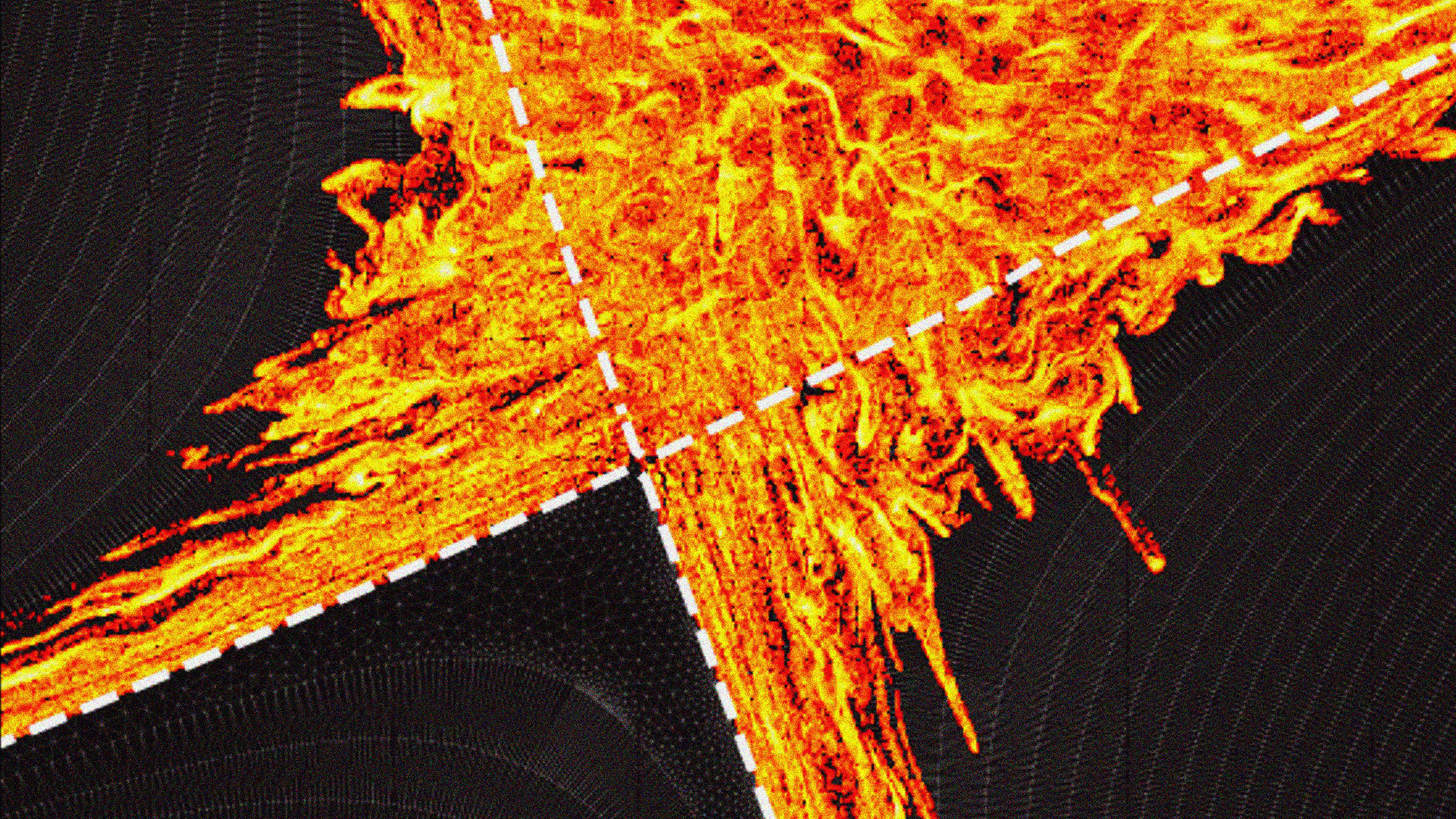
This still image from a new simulation shows how plasma from the pedestal region is connected through the supposedly last confinement surface into the divertor plasma region. The long and thin lobes are fluctuating in time and space. Simulation credit: Seung-Hoe Ku / Princeton Plasma Physics Laboratory on DOE’s Summit computer at Oak Ridge National Laboratory; Visualization credit: Dave Pugmire and Jong Youl Choi / Oak Ridge National Laboratory
Exhaust heat from commercial-scale fusion reactors might be less damaging than previously believed.
New research indicates that previous publications on the subject.
To achieve fusion, temperatures inside a tokamak — the doughnut-shaped device that holds the plasma — must soar higher than 150 million degrees 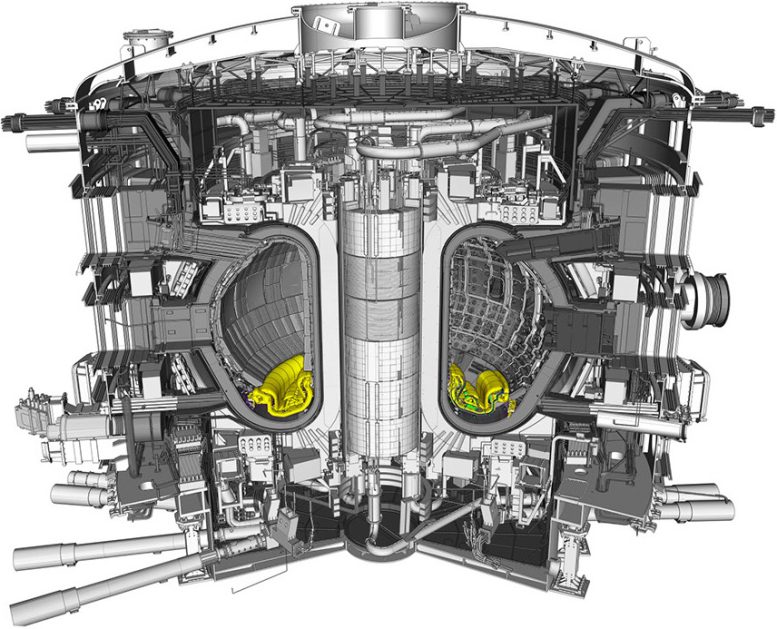
The experimental ITER tokamak will have a divertor running in a ring around the bottom of the tokamak chamber. In the image above, the divertor is highlighted in yellow. Credit: ITER Organization
“If all of this heat hits this narrow area, then this part of the divertor plate will be damaged very quickly,” said Chang, who works in the PPPL Theory Department. “It could mean frequent stretches of downtime. Even if you are just replacing this part of the machine, it’s not going to be quick.”
The problem hasn’t stopped the operation of existing tokamaks which are not as powerful as those that will be needed for a commercial-scale fusion reactor. However, for the last few decades, there has been significant concern that a commercial-scale device would create plasmas so dense and hot that the divertor plates might be damaged. One proposed plan involved adding impurities to the edge of the plasma to radiate away the energy of the escaping plasma, reducing the intensity of the heat hitting the divertor material, but Chang said this plan was still challenging.
Simulating the escape route
Chang decided to study how the particles were escaping and where the particles would land on such a device as ITER, the multinational fusion facility under assembly in France. To do so, his group created a plasma simulation using a computer code known as X-Point Included Gyrokinetic Code (XGC). This code is one of several developed and maintained by PPPL that are used for fusion plasma research.
The simulation showed how plasma particles traveled across the magnetic field surface, which was intended to be the boundary separating the confined plasma from the unconfined plasma, including the plasma in the divertor region. This magnetic field surface — generated by external magnets — is called the last confinement surface. A couple of decades ago, Chang and his co-workers found that charged particles known as ions were crossing this barrier and hitting the divertor plates. They later discovered these escaping ions were causing the heat load to be focused on a very narrow area of the divertor plates.
A few years ago, Chang and his co-workers found that the plasma turbulence can allow negatively charged particles called electrons to cross the last confinement surface and widen the heat load by 10 times on the divertor plates in ITER. However, the simulation still assumed the last confinement surface was undisturbed by the plasma turbulence.
“In the new paper, we show that the last confinement surface is strongly disturbed by the plasma turbulence during fusion, even when there are no disturbances caused by external coils or abrupt plasma instabilities,” Chang said. “A good last confinement surface does not exist due to the crazy, turbulent magnetic surface disturbance called homoclinic tangles.”
In fact, Chang said the simulation showed that electrons connect the edge of the main plasma to the divertor plasmas. The path of the electrons, as they follow the path of these homoclinic tangles, widens the heat strike zone 30% more than the previous width estimate based on turbulence alone. “This means it is even less likely that the divertor surface will be damaged by the exhaust heat when combined with the radiative cooling of the electrons by impurity injection in the divertor plasma. The research also shows that the turbulent homoclinic tangles can reduce the likelihood of abrupt instabilities at the edge of the plasma, as they weaken their driving force.”
“The last confinement surface in a tokamak should not be trusted,” Chang said. “But ironically, it may raise fusion performance by lowering the chance for divertor surface damage in steady-state operation and eliminating the transient burst of plasma energy to divertor surface from the abrupt edge plasma instabilities, which are two among the most performance-limiting concerns in future commercial tokamak reactors.”
Reference: “Role of turbulent separatrix tangle in the improvement of the integrated pedestal and heat exhaust issue for stationary-operation tokamak fusion reactors” by C.S. Chang, S. Ku, R. Hager, J. Choi, D. Pugmire, S. Klasky, A. Loarte and R.A Pitts, 16 April 2024, Nuclear Fusion.
DOI: 10.1088/1741-4326/ad3b1e
This research received funding from the DOE’s Fusion Energy Sciences and Advanced Scientific Computing Research to the SciDAC Partnership Center for High-fidelity Boundary Plasma Simulation under the contract DE-AC02-09CH11466.








Discussion about this post