








From the limits of freedom of speech to the prevalence of annoying neighbours and Germany’s not-so-proud tradition of coming last in Eurovision, here’s what we’ve been talking about at The Local this week.
Inside Germany is our weekly look at some of the news, talking points and gossip in Germany that you might’ve missed. It’s published each Saturday and members can receive it directly to their inbox by going to their newsletter preferences or adding their email to the sign-up box in this article.
Does Germany have free speech?
Speaking at the Munich Security Conference back in February, U.S. Vice President J.D. Vance launched what has since become an infamous attack on European democracies. Addressing a room of fuming EU politicians, the Republican politician accused countries like Germany of clamping down on free speech and stamping out difference of opinion.
It’s not just J.D. Vance: listening to American commentators, the assertion that Germany doesn’t have free speech has been repeated again and again. If they’re right in any sense, it’s only because the constitution uses a different word: Meinungsfreiheit, which can be translation as freedom of opinion.
In fact, Article 5.1 of the Basic Law lays out this right explicitly, sating: Jeder hat das Recht, seine Meinung in Wort, Schrift und Bild frei zu äußern und zu verbreiten. (“Everyone has the right to freely express and disseminate their opinions in speech, writing and images.”)
Two copies of the German Grundgesetz, or Basic Law, lie on a table in a library. Photo: picture alliance/dpa | Frank Molter
Given the years of Nazi dictatorship and the scars of East German oppression, Meinungsfreiheit is a treasured asset in Germany. But in light of this same dark past, tackling hate speech and aggression towards minorities is also seen as a moral duty.
That is one of the many reasons why using the tropes of National Socialism, from well-worn Nazi slogans to the Hiltergrüß (Hitler Salute), is banned under law in Germany. This came to light again recently after Kanye West (who now goes by artist name “Ye”) released his rampantly pro-Nazi and antisemitic track “WW3”.
Advertisement
In the track, Ye repeatedly chants the words “Heil Hitler“, uses excerpts from Nazi speeches and described reading chapters of Mein Kampf (Hitler’s manifesto) before bed each night. As Paul Krantz points out in his recent piece on the controversial song, this is pretty cut-and-dry case for a ban in Germany.
However, the realities of the digital age means it isn’t especially easy to do so. Despite attempts to block the song due its antisemitic content by platforms like Spotify, Youtube and Soundcloud, it’s still easy to find clips of the track online in Germany.
That hasn’t stopped German commentators lining up to condemn the track, slamming its open glorifications of Naziism. While Germans value their rights to freedom of opinion, most doubt that hatred can be called an opinion.
Tweet of the week
As a Brit who has heard the words “nul points” at the Eurovision Song Contest more times than I can recall, it’s hard not to feel some affinity with Germany in its endless last-place or second-to-last plight.
Unbelievably massive excitement into this weekend’s #Eurovision song contest. There’s only 2 rules: (i) all songs must suck; (ii) Germany comes last or next-to-last. The latter was violated spectacularly in 2024 when Germany came in 12th (out of 25 with an awful song). Will Germany again outperform?
[image or embed]
— Robin Brooks (@robin-j-brooks.bsky.social) May 13, 2025 at 5:49 PM
This Saturday, duo Abor & Tynna will be representing the Bundesrepublik in Basel with an up-tempo club banger called Baller, which you can listen to here on YouTube. So far, the electro track has been getting some rave reviews on social media – but we’ll see if it’s enough to translate into something more than “nul points”.
Advertisement
As everyone in Europe – and certain every Brit – knows, ESC voting can be surprisingly political.
Where is this?

Photo: picture alliance/dpa | Robert Michael
This week marked the end of an era as the council started its demolition of the collapsed Carolabrücke in Dresden. Dating back to GDR times, a large stretch of the bridge collapsed unexpectedly last September, shaking the residents of the city. It has been closed ever since, with experts saying the rest of the structure is in acute danger of collapsing too.
Over the coming weeks, the imploded bridge will be gradually demolished, making way for a replacement. There’s no certainly about what that will look like just yet, but the council is set to be leaning towards a simple, modern structure.
Advertisement
Almost half of Germans hate their neighbours
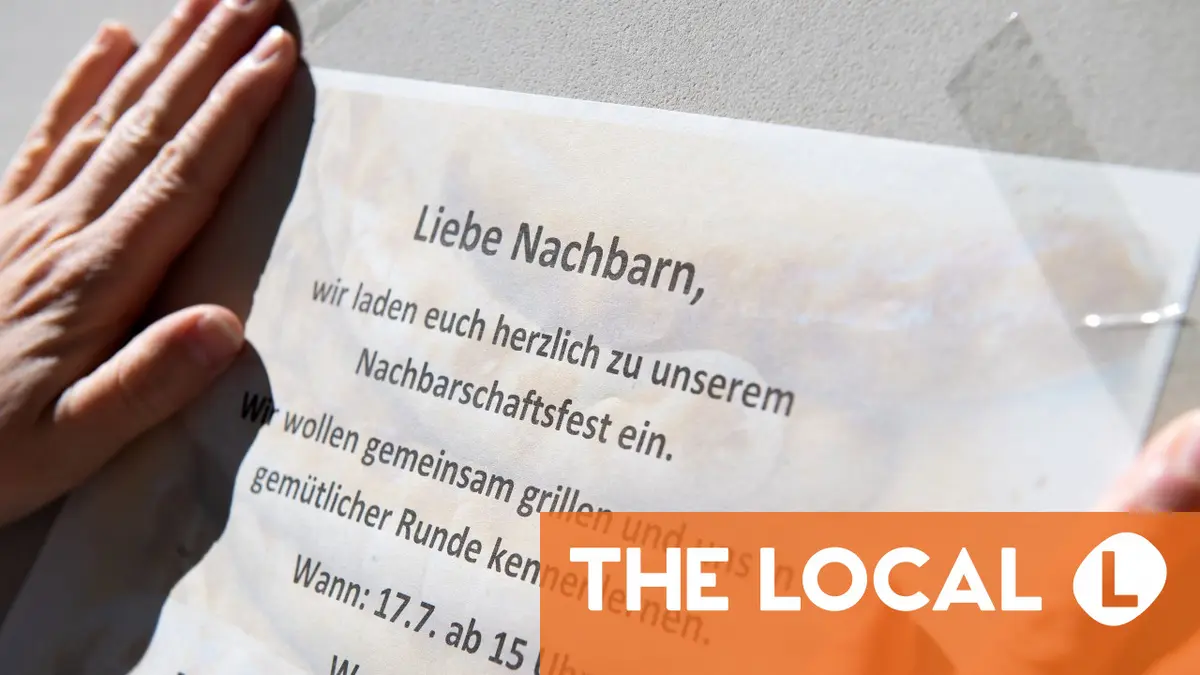
If Frau Schmidt downstairs has ever left a passive-aggressive note on your door, you may be able to relate: according to a new survey by Umzug 365, around 43 percent of Germans don’t get on with their neighbours.
Somewhat surprisingly, Berlin emerged in the study as one of the friendliest cities for living among others, alongside Schleswig-Holstein and Lower Saxony.
On the flip side, the populous state of North Rhine-Westphalia emerged as a nightmare location for apartment living, with more than half of residents here saying they hated their neighbours. (Bavaria and Baden-Württemberg were next, in case you’re wondering.)
But while Germans have a reputation for being overly direct, it seems they can sometimes be as avoidant as the rest of us: 32 percent of respondents said they’d rather move than have it out with their neighbours, and 21 percent had already moved due to a conflict.
Though the survey doesn’t explain the reasons for this animosity, it’s hard not to wonder if the sheer amount of ground rules set out in the Nachbarschaftsgesetz (Neighbourhood Law) may create more problems than it solves. Nobody likes to have someone tracking the number of times their dog barks or the number of cigarettes they have on their balcony.
Incidentally, if you want to find how you (yes, you) may be unwittingly annoying your German neighbours, we have an article on that very topic. It may help you steer clear of the worst faux pas and avoid getting a mention in Umzug 365’s next survey.








Discussion about this post