









Researchers applied quantum field theory to the early universe, predicting fewer primordial black holes than other models suggest, potentially impacting the dark matter theory. Credit: SciTechDaily.com
Quantum field theory reveals potential flaws in models predicting numerous primordial black holes, suggesting fewer exist, which may impact theories of dark matter and the universe’s structure.
Researchers have applied the well-understood and highly verified quantum field theory, usually applied to the study of the very small, to a new target, the early universe. Their exploration led to the conclusion that there ought to be far fewer miniature black holes than most models suggest, though observations to confirm this should soon be possible. The specific kind of black hole in question could be a contender for dark matter.
The study, which was published recently in 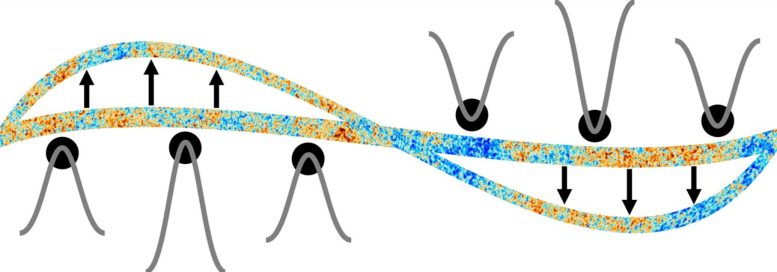
Humble beginnings. The study finds how large amplitude fluctuations generated on small scales can amplify large-scale fluctuations observed in the cosmic microwave background. Credit: © 2024 ESA/Planck Collaboration, modified by Jason Kristiano CC-BY-ND
Primordial Black Holes and Dark Matter
“We call them primordial black holes (PBH), and many researchers feel they are a strong candidate for dark matter, but there would need to be plenty of them to satisfy that theory,” said graduate student Jason Kristiano.
“They are interesting for other reasons too, as since the recent innovation of gravitational wave astronomy, there have been discoveries of binary DOI: 10.1103/PhysRevLett.132.221003
“Note on the bispectrum and one-loop corrections in single-field inflation with primordial black hole formation” by Jason Kristiano and Jun’ichi Yokoyama, 29 May 2024, DOI: 10.1103/PhysRevD.109.103541










Discussion about this post