









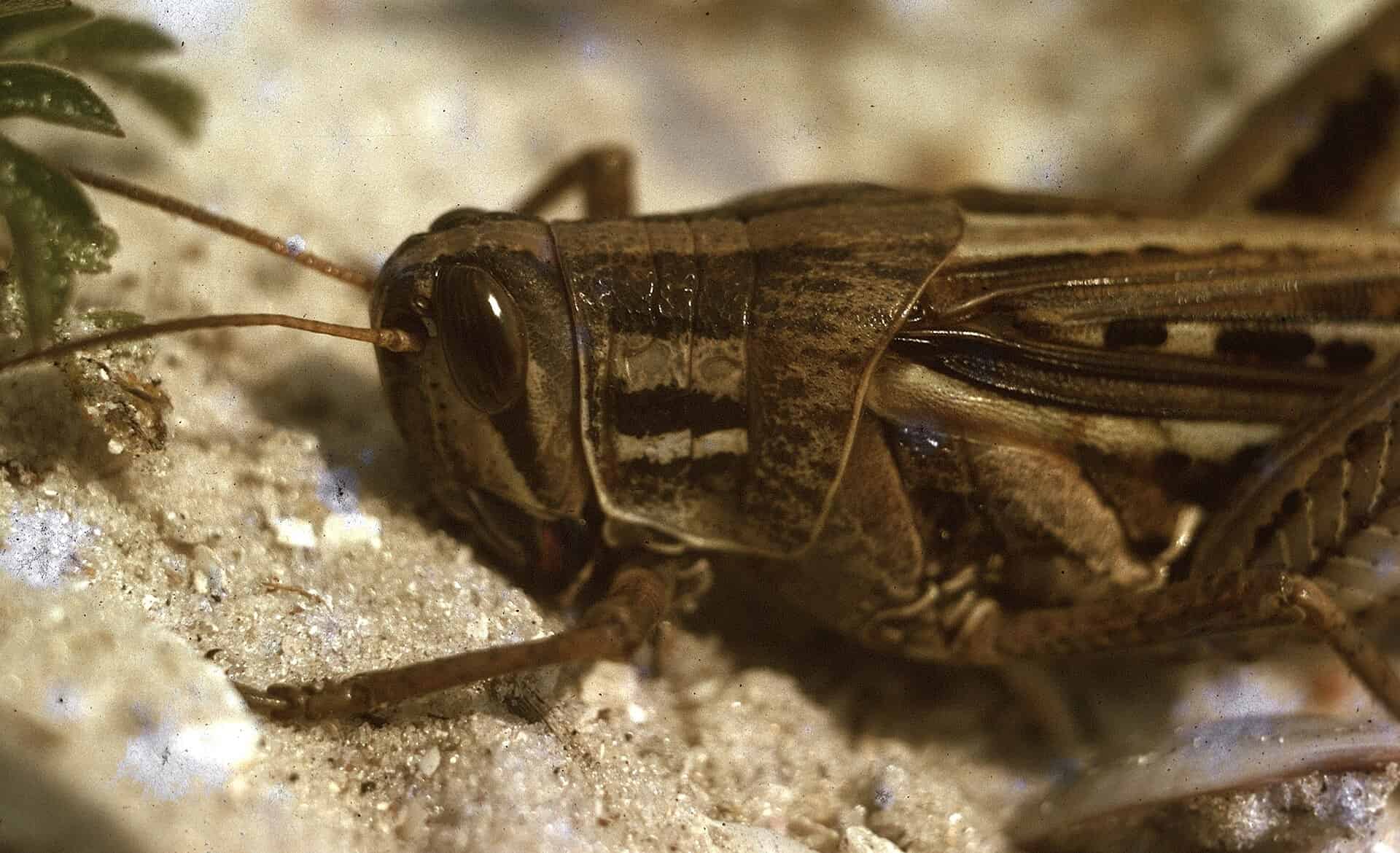
A groundbreaking study from Michigan State University reveals a novel approach to disease detection by utilizing the innate olfactory capabilities of locusts, effectively transforming insect brains into living diagnostic tools.
The researchers have adeptly harnessed the locusts’ remarkable ability to differentiate between free-floating bacteria and those residing in biofilms—protective communities that pose significant treatment challenges. Their ultimate goal includes creating a portable device capable of diagnosing persistent lung infections through breath analysis.
Nature’s Chemical Supercomputers
Unlike mammals, locusts lack noses; they primarily rely on their antennae for smelling. Each antenna is equipped with approximately 100,000 nerve cells designed specifically for odor detection. When airborne chemicals interact with these antennae, the nerve cells transmit electrical impulses to a designated area in the brain known as the antennal lobe. The brain synthesizes this data into a unique electrical pattern, akin to a neural fingerprint for each scent.
Intriguingly, only 800 neurons relay this processed information to other brain regions, allowing scientists to monitor the insect’s olfactory perceptions without requiring training.

“Our approach leverages the insect’s natural odor-processing capabilities while integrating our electronics and algorithms to convert neural activity into identifiable signals,” stated Debajit Saha, an associate engineering professor and lead author of the study.
Previous experiments from Saha’s team have demonstrated the potential of locust brains to differentiate between various human oral cancer cells by scent in 2023, followed by similar achievements with honeybees and lung cancer in 2024. Earlier this year, they successfully showcased locust brains’ ability to identify numerous PFAS compounds, infamous for their persistent environmental presence.
The latest study aimed to investigate whether locusts could not only identify the type of bacteria they detected but also discern their growth conditions.
Sniffing Out Bacterial Hideouts
Dental plaque serves as a common example of a biofilm, where bacteria adhere to teeth, multiply, and generate a sticky matrix composed of sugars and proteins. This protective layer secures bacteria in place, allowing some to slow their metabolism and evade antibiotic treatments, ultimately enabling them to reestablish their colonies. Similar biofilms can develop in wounds, on medical devices, and within the lungs, complicating treatment efforts.

Bacteria embedded in biofilms can withstand antibiotic concentrations up to 1,000 times greater than their free-floating counterparts, yet no non-invasive method exists for clinicians to determine biofilm presence in a patient’s lungs.
The cyborg locusts are designed to fill this gap.
As bacteria grow, they emit volatile organic compounds (VOCs). The Michigan State research team sought to uncover whether these chemical signatures could indicate the growth state of the bacteria.
The scientists cultivated two crucial bacterial strains, Pseudomonas aeruginosa and Staphylococcus aureus, in both biofilm and free-floating states.

The research team surgically exposed the brains of six American locusts, implanted thin electrodes, and directed air from bacterial culture flasks across their antennae.
By combining recordings from 32 neurons across the six insects, the researchers utilized a computer algorithm to identify the unique electrical patterns associated with each odor.
The system achieved up to 96% accuracy in differentiating between bacterial growth states. In a more rigorous examination involving five odors—four bacterial cultures and one control without bacteria—the system accurately identified 22 of 25 trials, correctly recognizing all biofilm odors while misclassifying one free-floating sample as a biofilm.
Remarkably, the system demonstrated speed, with a classification accuracy of 91% achieved using just half a second of brain activity recorded approximately one second after odor exposure.
From Insect Brains to Hospital Beds

While the results are promising, the pathway to a streamlined detection method remains challenging.
The researchers managed to obtain consistent neural recordings for approximately four hours post-surgery and had to amalgamate data from multiple locusts. They are now focused on developing specialized electrodes to gather sufficient data from individual insects.
Moreover, human breath analysis remains untested, as it comprises thousands of chemicals that could complicate the detection process. Distinguishing bacterial chemical signatures in a controlled lab setting versus a patient’s breath presents significant hurdles.
Jonathan Hardy, a microbiologist and co-author of the study, aims to assess breath samples from children with cystic fibrosis, a group particularly vulnerable to chronic bacterial lung infections.
Ultimately, the researchers aspire to create a portable diagnostic tool that integrates a living insect’s sensory system with compact electronics and artificial intelligence.
Engineers have long sought to replicate artificial noses capable of interpreting intricate chemical mixtures. Nature has been addressing this challenge for millions of years, suggesting that leveraging existing biological systems may yield superior results.
The findings of this study are detailed in the journal Communications Biology.








Discussion about this post