
They wanted our attention, and now they have it.
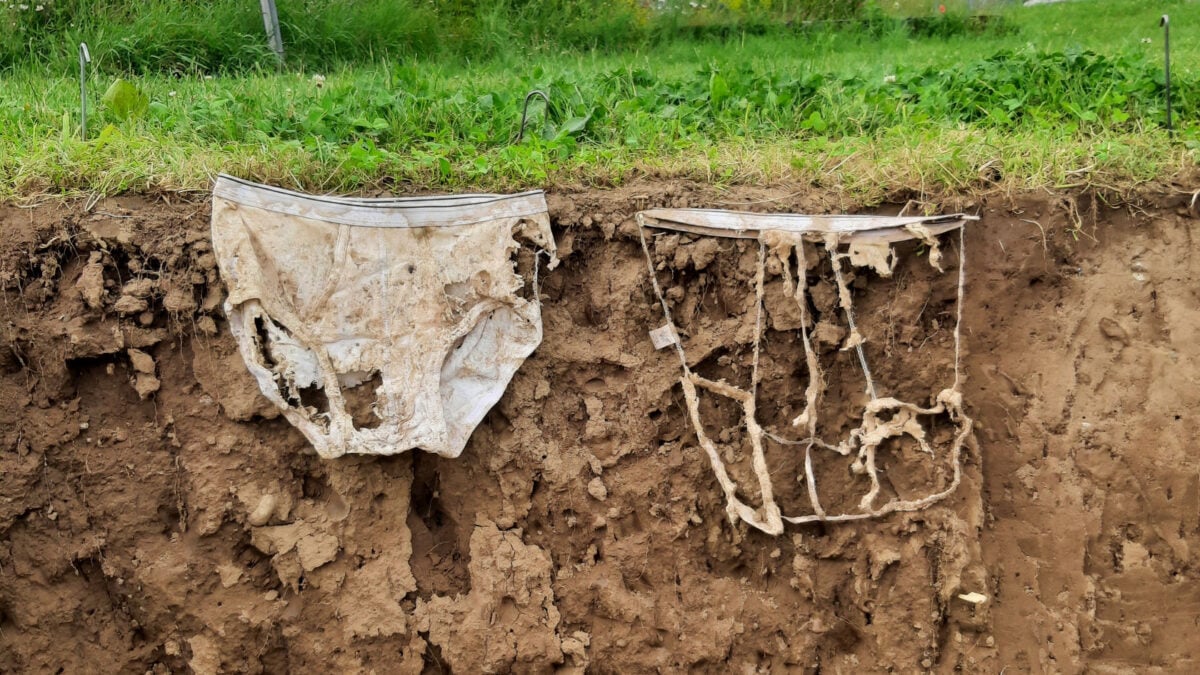
Scientists have buried more than 2,000 pairs of underwear in gardens, meadows, fields, and lawns scattered across Switzerland.
Sadly, this was not the start of some great, nationwide game of hide-and-seek.
It was simply a way to air our dirty laundry.
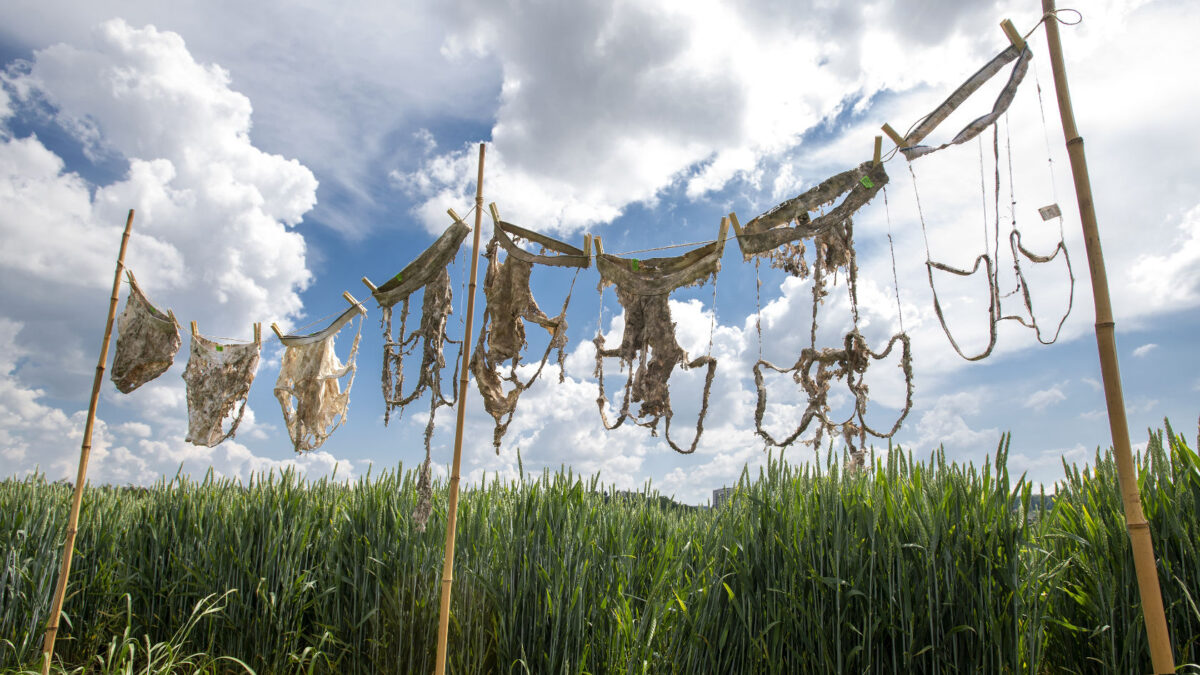
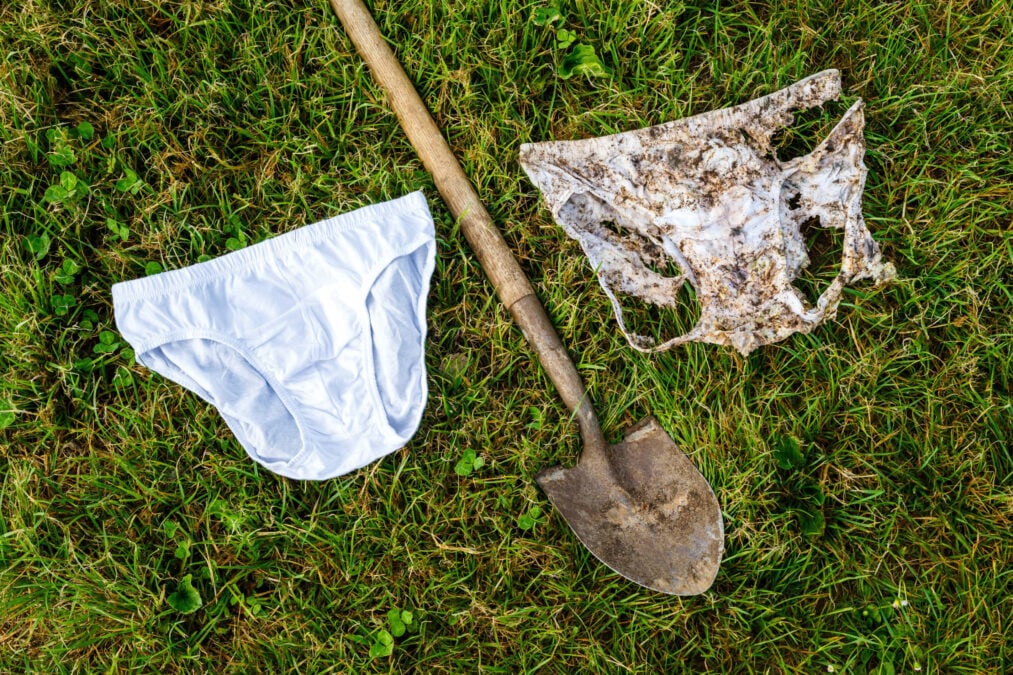
When researchers dug up the cotton undies two months later, some of the pairs had become mere skeletons of seams, while others just featured a hole or two.
The findings of the project, called “Proof by Underpants”, were published in the journal Plants, People, Planet.
It was designed to show us that some soils are hanging on by little more than a G-string.
“Overall,” write the study authors, “this project demonstrates that underpants can serve as a simple and easy-to-interpret tool, providing informative insights into the state of soils.
“Moreover, they are perfectly suited to raise attention in society for soil.”
To make more people aware of soil as a threatened resource, the research team, led by scientists at the University of Zurich, has proposed an “Underpants Index”.
They say that the lack of holes in some buried underwear is a conspicuous sign of missing nutrients, which feed rich biological activity, and that’s a big problem.
“This was one of the most intense but also most rewarding experiences of my scientific career so far.”
– agroecologist Franz Bender
Beneath our feet, the topsoil of our planet quietly helps provide 95 percent of our food.
It also hosts 59 percent of global diversity and is the second-largest carbon reservoir on Earth (after the oceans).
Without fertile, healthy soils, the foundation of our very society collapses.
Here comes the bad part:
“Soils are rapidly degrading, threatening food production, biodiversity, and Earth system functioning,” write the researchers behind “Proof by Underpants”.
“This threat is largely unrecognized in broader society, hindering effective steps towards soil protection.”
The good news is that there’s a solution. We have to change how we use the land.
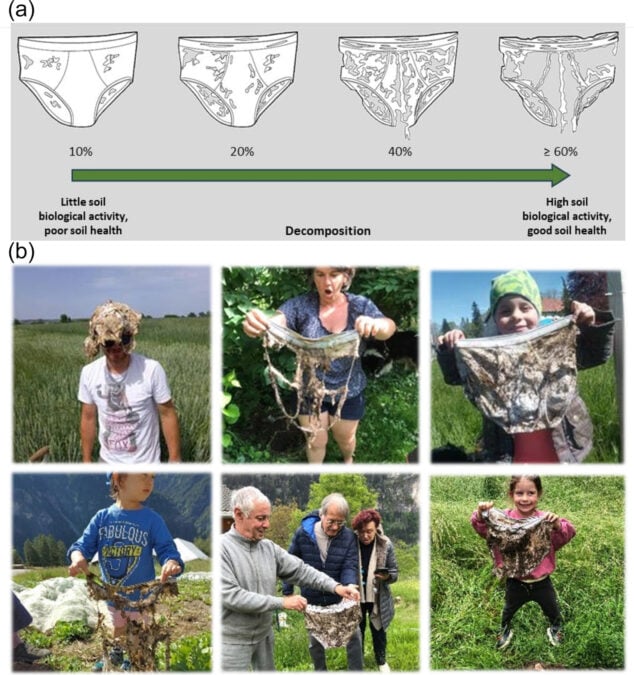
In the underwear study, land use was the single most important predictor of how well the underwear decomposed.
Lawns, croplands, and grasslands in Switzerland contained the lowest signs of biological activity.
In fact, monocultures of grass, which wrap around many houses and buildings, hosted the least fertile soil of them all.
On the flip side, private gardens seemed to host the most active degraders, such as worms, fungi, bacteria, and other soil-dwelling organisms.
They also hosted the highest levels of organic carbon and nutrients. Perhaps that is because gardens are often meticulously planted, fertilized, and aerated by their owners.
Around 58 percent of the cotton was decomposed after two months when it was planted in a private garden.
By contrast, lawns showed the least decomposition, averaging around 40 percent.
“Our results show that how soil is managed can significantly affect both soil life and soil quality,” says co-leader of the study Marcel van der Heijden, an agroecologist at UZH.
“Healthy, biologically active soil is crucial for fertility, nutrient cycling and many other ecosystem services.”
Tea bags and cotton strip have been used to measure soil health in the past, but researchers in Switzerland think underwear is more “playful” and an “excellent outreach tool”.
The underwear experiments were conducted five years ago, with the assistance of 1,000 volunteers. Together, they buried cotton undies as well as 12,000 tea bags in a variety of different landscapes across the nation.
Two months later, they retrieved the items and sent them to the lab for further analysis.
Both the undies and the tea bags produced similar results. They degraded fastest in private gardens.

The results agree with another recent citizen science study conducted in Hungary, which also found underpants decomposed faster in managed kitchen gardens.
But even though these private lands show greater signs of nutrition and biological activity, an increase in soil fertility isn’t always a good thing.
Phosphorus, nitrogen, and potassium concentrations were higher in private gardens in Switzerland. This is a sign of fertilizer use. But too much of a good thing can also disrupt soil health.
Phosphoros levels in private gardens often far exceeded thresholds for soil management and crop production, and that could threaten the health of surrounding waterways and local biodiversity.
“Maximum decomposition is not desirable in every ecosystem,” explains co-project leader and UZH agroecologist Franz Bender.
“In near-natural habitats such as forests, very high nutrient levels can indicate disruptions to the natural balance of nutrients. In gardens, too, rapid decomposition of the underwear may point to an oversupply of nutrients.”
The Underwear Index may, therefore, indicate which soils are most ‘fertile’, but not necessarily which are healthier.
To find that out would require further analysis on the ground.
Related: Scientists Analyzed Earth’s Hidden Seed Vaults And Made a Disturbing Realization
As a start though, Switzerland’s citizen science project has successfully formed one of the country’s most comprehensive datasets on soil life.
“This was one of the most intense but also most rewarding experiences of my scientific career so far,” Bender said in a post.
Its findings can point researchers toward soils that may be in need of greater help and attention.
Perhaps in the future, dirty underpants will be dug up in other parts of the world, too.
The study is published in Plants, People, Planet.
This article was fact-checked by Clare Watson and edited by Clare Watson. While we pride ourselves on our process, we are only human. If you spot a mistake, please let us know.
Discussion about this post