
From the establishment of a powerful Mongolian regime by Genghis Khan until the abolition of traditional writing during the reform of the Mongolian writing system in the mid-20th century, the Mongols continuously used bichig, the traditional Mongolian alphabet derived from the Uyghur language, for over 800 years.
Starting in the 1940s, however, Mongolia adopted a new script, based on the Cyrillic alphabet, which replaced bichig. Apart from the tradition of using both the Cyrillic and bichig alphabets in government seals at all levels, Mongolian citizens under the age of 30 generally do not understand bichig.
After 1980, some high schools in Mongolia began offering courses in bichig, but promotion efforts were lackluster and interest was tepid. At present, although some schools in Mongolia offer classes teaching the Uyghur-style traditional Mongolian script, neither parents now students attach much importance to building such knowledge.
Now, however, Mongolia is on the cusp of re-introducing bichig as an official script. It is supposed to be used, alongside the Cyrllic alphabet, in all government documents starting in 2025.
The Soviet Union had a vast territory with numerous ethnic minorities. The Soviet government decided to reform the minority writing systems and replace them with the Cyrillic alphabet commonly used in Russia. Not long after declaring independence, the Mongolian People’s Republic, one of the satellite countries of the Soviet Union, also underwent a transformation of its traditional alphabet and began to use Cyrillic comprehensively.
In 1931, Mongolia complied with the requirements of the Soviet Union to reform its writing system, which led to the emergence of Cyrillic Mongolian alphabet. Although Cyrillic Mongolian has a Mongolian character, it looks more like Slavic (Russian) languages.
In 1946, Mongolia announced that it would change its official alphabet to Cyrillic, ceasing the use of bichig. Mongolia’s government continues to use the Cyrllic alphabet to this day.
Abandoning the Uyghur-derived traditional Mongolian alphabet had its drawbacks and benefits for Mongolia. On the positive side, pronunciation and writing are consistent in Cyrillic Mongolian, which reduces the difficulty of promoting the script and is beneficial for improving the literacy rate of the public. The bad news was that when the Soviet Union became determined to promote Cyrillic script, there was an expected result – a cultural and historic rift.
Abandoning a traditional writing style to some extent means abandoning traditional culture, which is intricately linked to one’s own history. After the promotion of the Cyrillic Mongolian alphabet, many traditional historical and cultural documents became unreadable and thus inaccessible for the general public. The transition to the Cyrillic alphabet has restructured the Mongolian people’s understanding of traditional Mongolian.
Given this, from the first day of replacing the bichig alphabet with Cyrllic, there were voices of opposition within Mongolia. The use of Cyrillic has had a profound impact on Mongolian society. Most notably, it accelerated the infiltration of Soviet culture into Mongolia, while severing from the connection between Chinese and Turkic civilizations in terms of written language. Inner Mongolia in China continued to use bichig, while the Uyghur homeland – now part of China under the name Xinjiang – continued the use of the Uyghur script.
The adoption of Cyrllic thus successfully achieved a “de-sinicization” transformation in Mongolia. Due to political considerations, voices objecting to this change were taken seriously until after the fall of the Soviet Union.
Starting in 1990, Mongolia began to rediscover the bichig script, and voices advocating for its re-adoption gained strength. In fact, the Mongolian government was not very enthusiastic about promoting the transformation of the writing system, and has been delaying due to issues such as funding, technology, and talent gaps. It was not until recent years that the transformation process has significantly accelerated.
In 2011, the Mongolian government issued regulations requiring government officials to use bichig when communicating with international or foreign official institutions. All types of certificates and documents should be written side by side, in both bichig and Cyrillic Mongolian.
Back in 2015, the Mongolian parliament approved a plan requiring the introduction of the traditional Mongolian alphabet in the Uyghur style within 10 years, although the Cyrillic Mongolian alphabet remains the main form of writing.
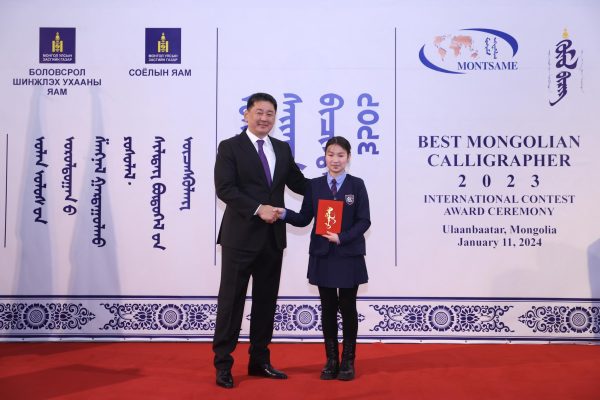
In March 2020, the government of Mongolia officially adopted a national program to promote bichig and decided to fully resume the use of the traditional Mongolian alphabet starting from 2025. While bichig was already being used in official correspondence from government leaders, it will now also appear – alongside Cyrllic Mongolian – on all documents issued by the government, including ID cards, birth certificates, marriage certificates, and diplomas.
In 2021, nearly 150,000 Mongolian national civil servants were surveyed on the question of whether to use both Cyrillic Mongolian and bichig in official documents. A majority (53.6 percent) approved of the plan, but gave various different reasons for supporting the policy.
Viewed through one lens, Mongolia’s decision to fully restore the use of traditional alphabet is not surprising. After the collapse of the Soviet Union, many countries affiliated with the former USSR, such as Azerbaijan, Turkmenistan, and Uzbekistan have reintroduced their original traditional scripts or adopted new alphabets. Even Kazakhstan is undergoing such a process. This marked a trend toward the restoration of traditional culture after decades of Soviet influence.
On the one hand, then, the change it can be seen as a recognition of and return to Mongolia’s long history. As Mongols have used bichig for centuries, the script carries the glorious history of the nation.
On the other hand, it can also be seen as a gradual elimination of dependence on a neighboring country. After all, Mongolia adopted the Cyrillic alphabet under pressure from the Soviet Union. Thus the promotion of bichig can be seen as a step to break away from dependence on Russia in politics, economy, and culture, and to embark on an independent and autonomous path.
Indeed, the decision to restore the traditional Mongolian alphabet is not entirely based on cultural considerations. The historical origins and practical needs between China and Mongolia have created a natural foundation for friendly exchanges and cooperation between the two countries. A return to the bichig script emphasizes those historical connections.
China’s province of Inner Mongolia and the independent country of Mongolia have historically belonged to the same polity, and their language and writing are also of the same origin. During the Ming and Qing dynasties, the Mongolian language family widely used the bichig script. Inner Mongolia has largely retained the traditional Mongolian alphabet, while the writing system Mongolia has undergone multiple reforms and is now based on Cyrllic. As a result, ethnic Mongolians on different sides of the border could easily find themselves completely unable to communicate in written Mongolian, despite sharing a mother tongue.
While the return to bichig might be seen as an attempt to emphasize shared history with China, Ulaanbaatar’s promoting of the script strikes an interesting contrast with China’s new policy on bilingual education in Inner Mongolia. Scholar James Leibold has argued that under Xi Jinping, the Chinese Communist Party began to abandon the Soviet-style localization policy and instead adopted a national “melting pot” policy, emphasizing the integration of all ethnic groups with Han Chinese culture. This so-called “second-generation of ethnic policies” was seen as the right solution to China’s ethnic problems.
In 2020, the provincial government in Inner Mongolia scrapped Mongolian-language textbooks, mandating the use of Chinese-language instructional materials. While Mongolian language is still offered as an option, the change meant that even nominally Mongolian-language schools had to teach classes on politics, history, and ethics in Mandarin.
The sidelining of Mongolian language sparked rare pushback, including student strikes, but ultimately the changes were pushed through. Two years later, Shi Taifeng, who was the party chief of Inner Mongolia at the time, was rewarded with a promotion to the Politburo. He nows head the United Front Work Department.
Further complicating the geopolitics of Mongolia’s language policy, in addition to expanding the use of bichig starting in 2025, Mongolia has also revised its education law and announced that English will be officially designated as the first foreign language in secondary education, following in the footsteps of Taiwan and other governments.
Promoting English is more easily accepted by all parties, as it is devoid of the historical baggage that comes with teaching Russian or Chinese. In addition, English is widely used as a common tongue, whether on the internet or in the business world, and English-language popular culture is widely loved by young people. Although the Mongolian government vigorously promotes English, however, Mongolians’ English proficiency is generally not high. Ulaanbaatar has relatively abundant English teachers, but in the vast countryside, there is still an extreme shortage of English teachers. Russian language teaching remains deeply embedded in Mongolia’s education system.
On the whole, the history of Mongolian script reform and official foreign language education is not about a natural process of cultural evolution, but an artificial political project. Political decisions ultimately determine the type of alphabet to be used. In the long run, then, Ulaanbaatar’s efforts to strengthen the restoration of bichig while promoting English education may directly or indirectly affect Moscow’s and Beijing’s policies toward Mongolia.


Discussion about this post