
A new report on land grabbing and urban forced evictions, published by a network of independent Uzbek civil rights activists in collaboration with the University of Ulster and Uzbek Forum for Human Rights, exposes the vulnerability of farmers and citizens to arbitrary abuse of the law when developers and the state lay claim to their farms and homes for commercial gain.
On January 18, 2019, some 450 district farmers received an order from Azamjon Sultanov, governor of Pop District in Namangan region, to attend a meeting at the district’s culture center. There, farmers were instructed to sign statements confirming the voluntary termination of their land leases in order for it to be returned to the state reserve. Some farmers who refused to attend were forcibly escorted to the meeting by police officers late at night. Despite their protests, the farmers were told that none of them would be allowed to leave before they had signed the statements, effectively giving up their land and livelihoods.
Not all farmers signed statements that night. Some took advantage of the confusion to hand over a blank slip of paper while others wrote and signed an incomprehensible text in the hope that they might avoid losing their land. Even those invalid statements were used to secure “voluntary terminations” and when farmers went to court to try to get their land back, they lost.
Land grabbing in the agriculture sector has taken place throughout Uzbekistan since the adoption of the government decree on the “optimization” of farm land in 2019 “for the efficient use of agricultural land.” The mass seizure and redistribution of agricultural land in Uzbekistan has been imposed three times in the last 11 years, each time on the pretext of increasing the efficient use of land. However, the government has thus far failed to develop objective or effective mechanisms for selecting beneficiaries and redistributing land to ensure efficient use. Furthermore, although the 2019 governmental decree was intended to identify inefficient land use, there are no feasible legal grounds for seizing land from almost all farmers in a single district simultaneously.
No one appears to have questioned why the heads of 1,005 farms in Pop district, out of a total of 1,021, would agree to give up their land en masse in the space of one day without any apparent reason. Some 6,000 hectares of land that was taken away from farmers was transferred to the Art Soft Tex cluster, created by a government decree in September 2019.
In Uzbekistan, all agricultural land is owned by the state. Farmers depend on the state for the allocation of land through multiple year leases, usually for a period of up to 49 years. Private property is therefore dependent on the state’s strict adherence to the rule of law preventing unwarranted state interventions.
Until recently, land leased by farmers from the state was excluded from certain market activities and the rights to its use could not be subleased. Only since March 2024 have tenants of agricultural land received limited opportunities to transfer their rights and obligations relating to the use of land by other persons. However, the land lease itself cannot be used as collateral for credit and there are limitations to subleasing.
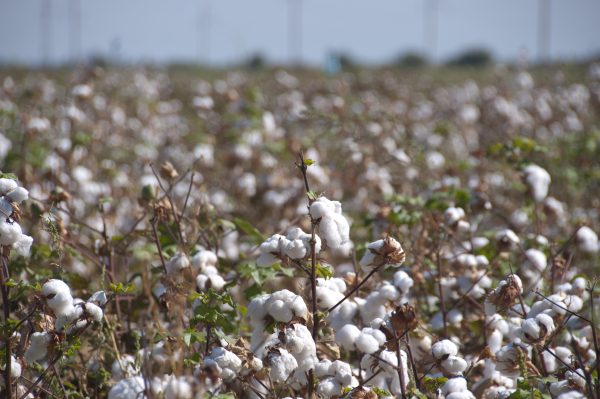
As of 2017, a series of government reforms saw the establishment of so-called clusters, vertically integrated enterprises responsible for the production, processing, and often the manufacture of cotton goods. According to official sources, there are now approximately 96 cotton-textile clusters that have ostensibly taken over the role of cotton production from the state, which until then had enjoyed monopoly control. Although the vast majority of cotton and grain is still produced by farmers who lease their land directly from the state, a series of government decrees facilitated the transfer of 268,000 hectares of land (allocated for cotton and wheat) to clusters, mainly via “voluntary” land lease terminations.
The seizure of farmland and loss of livelihoods of farmers has been well documented by human rights organizations and the Uzbek media. Farmers have reported coercion to sign land lease terminations under threat of penalty, leaving them without compensation or income. Unemployment among farmers and farmworkers in rural communities has soared as a result.
In accordance with an August 10, 2018 government decree, 54,196 hectares of land was allocated to Indorama Agro, a private cotton producing company financed by the European Bank for Reconstruction and Development (EBRD) and the International Finance Corporation (IFC), the private lending arm of the World Bank. According to the Livelihood Restoration Plan of 2020, 1,068 farms in Kashkadarya and Syrdarya regions that employed an estimated 4,337 full-time farm positions and 9,000 seasonal workers are now under the control of Indorama Agro. Some of these workers were offered employment opportunities with the company, which is now the subject of an investigation by EBRD’s independent accountability mechanism for serious labor rights violations and retaliations against workers who speak out.
As a client, Indorama Agro is obliged to comply with EBRD and IFC performance standards and requirements on land acquisitions. Both banks insist that the land lease terminations that enabled the transfers to Indorama Agro were “voluntary.” The truth is that farmers were given no choice. As land leases are usually held with local administrations, farmers were powerless to prevent them from being stamped with a date for termination on lease agreements that had been pre-signed. Most farmers did not even have a copy of their land leases. In addition, IFC’s guidelines on land acquisitions states that “clients are encouraged to use negotiated settlements meeting the requirements of this Performance Standard, even if they have the legal means to acquire land without consent.”
In interviews with Uzbek Forum, some farmers said they were not even informed that their land leases had been terminated until they arrived at their fields and that no consultations with either Indorama Agro or lenders took place.
One farmer said:
After Indorama started working in Akaltyn district, in June 2017, after the grain harvest, agricultural land was transferred to the Indorama cluster. I was not informed at all that my land would be taken away. I was also not served with any warning letter. After the 2017 grain harvest, I was told by the authorities that my land had automatically been transferred to the Indorama cluster. I did not write an application for the transfer of the land, nor did I see a decision of the local governor.
Those farmers whose land was not transferred to Indorama were nonetheless obliged to produce for the company. During the initial phase of privatization there was only one cluster established in each district, leaving farmers with no choice over which cluster to supply their cotton to and even less bargaining power to negotiate prices, which continued to be set the state until December 2023. Although subsequent legislation has addressed these issues, at least in theory, farmers have essentially been excluded from the entrepreneurial transition, instead stuck in the role of producers who are obliged to provide a steady, guaranteed supply of cheap cotton for the benefit of private actors.
According to experts, the agricultural clusters created in recent years are an inefficient form of state-monopolistic management, capable of surviving only in artificially created conditions. The system is based on structures that hinder the implementation of agrarian reform, such as the forced placement of crops, which denies farmers the ability to choose which crops are most profitable and best suited to their land.
The privatization of Uzbekistan’s cotton sector has shone a spotlight on the lack of autonomy of Uzbek farmers and their vulnerability to abusive state control. The Uzbek government must implement effective measures to combat arbitrary abuse of power by local officials, who can unilaterally terminate land leases under threat of penalty with impunity. In addition, the forced placement of crops for cotton and grain should be ended to allow farmers to choose what and how much they grow. This would open the way forward for them to enter into real entrepreneurial relationships with private actors that allow them to negotiate fair prices and determine their own production targets. Until such fundamental reforms are implemented, farmers will continue to be at the mercy of clusters and the state, both of whom ruthlessly exploit their labor.


Discussion about this post