





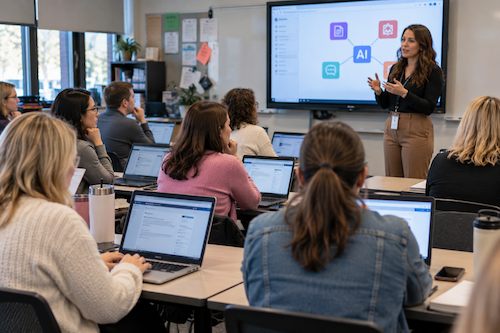
Accelerating AI Understanding in K–12 Education
K–12 school districts are rapidly enhancing teachers’ comprehension of artificial intelligence (AI) through a variety of initiatives. These include workshops, well-crafted guidance, the identification of approved AI tools, and the development of resources aimed at promoting responsible AI usage.
The Importance of Guidance for Educators
The significance of this initiative cannot be overstated. Educators require explicit guidance regarding privacy, accessibility, academic integrity, and the appropriate integrations of AI into their teaching practices. Moreover, they need to grasp the potential of these tools before effectively incorporating them into their curricula.
However, teachers may exit an AI workshop equipped with knowledge yet remain uncertain about how to apply it in upcoming lessons. Consequently, their decisions regarding AI usage hinge on contextual factors, such as whether employing the tool enhances student learning, its reliability, equitable access for all students, and the extent of personal judgment required in its application.
Navigating Instructional Challenges
Teachers face a landscape filled with instructional design choices, assessment revisions, and responsive actions toward students, often in situations that do not fit neatly into professional development frameworks. To aid educators in these dynamic circumstances, it is crucial to provide sustained opportunities for learning, experimentation, and collaborative discourse about their classroom experiences.
Insights from Educators and Research
This approach draws inspiration from research conducted in higher education. A partnership led by Digital Promise, in collaboration with D2L, involved faculty and instructional leaders examining AI’s usage in various higher education settings. The findings, while not directly applicable to K–12 contexts due to differing structures and teacher responsibilities, revealed that educators found AI support most beneficial when it addressed real issues they were facing.
One educator, despite being aware of available professional development, postponed participation until encountering a specific challenge in creating weekly course overviews. An instructional designer’s demonstration of an AI capability related to that task led to a moment of realization: “I need it.” This illustrates how contextual relevance enhances educators’ learning experiences.
The Value of Trusted Collaboration
In K–12 settings, teachers often make their own instructional choices, making access to reliable colleagues invaluable for thoughtful integration of AI into lessons or assessments. This collaboration fosters an environment where educators can discuss AI’s role within their specific instructional contexts.
Developing Instructional Judgment
While workshops can provide foundational knowledge on terminology, district expectations, and issues related to privacy and ethics, cultivating sound instructional judgment around AI necessitates ongoing practice. Teachers require opportunities to apply what they learn, analyze outcomes, and adjust their approaches in response to the evolving understanding of both the technology and their instructional goals.
Additionally, suitable strategies may differ significantly across grade levels, underscoring the importance of collaborative learning with knowledgeable colleagues who understand local contexts.
Promoting AI Learning within the Classroom Context
Districts need not abandon workshops or turn every instructional coach into an AI specialist. Instead, an evolving AI strategy is necessary, adapting to shifts in technology, district policies, and educators’ needs. Professional learning must align with this strategy, enabling teachers to practically apply AI insights in their classrooms and contribute feedback to refine district approaches.
Moreover, district leaders must strategize on instructional goals, governance, tool evaluations, student interactions, and the educator’s role in shaping AI’s educational integration. Providing professional learning allows teachers and their support teams to connect these decisions to daily classroom realities.
Empowering Supporting Educators
As districts construct their AI frameworks, they should also consider the individuals responsible for supporting teachers. Instructional coaches and teacher leaders often face new expectations without adequate preparation or time to accommodate additional responsibilities. Designating someone as an “AI champion” falls short without enabling that individual to balance their primary workload.
Those supporting their peers require time for experimentation, collaborative opportunities, and access to district leaders for addressing policy-related queries. It’s vital that they possess the authority to voice concerns when a tool fails to serve its instructional purpose effectively.
Building Capacity for Real-Time Decision Making
Given the rapid evolution of AI, educators will continually confront situations that defy conventional workshops. Professional learning must maintain flexibility, allowing teachers to analyze real-world applications and adapt their strategies accordingly after reflection and discussion with trusted colleagues.
Higher education research suggests that educators benefit from connecting AI learning to pressing instructional needs, collaborating on those specific challenges. K–12 districts can leverage this evidence by listening to educators, observing their AI-related decision-making processes, and providing adequate time for those who support teachers to learn collaboratively.
The Path Forward for Educators
In preparing teachers for AI integration, the emphasis should remain on the sound judgment they exercise daily. They must cultivate the confidence to discern when AI can enhance learning, when alternative methods may be more effective, and what their students genuinely need at any moment.
This judgment develops organically over time through practice, dialogue, and reflection with trusted peers. By equipping teachers with the necessary time and support, districts can facilitate the connection of innovative AI capabilities to the diverse needs of their students and fulfill the higher educational purposes that inspire their careers.










Discussion about this post