









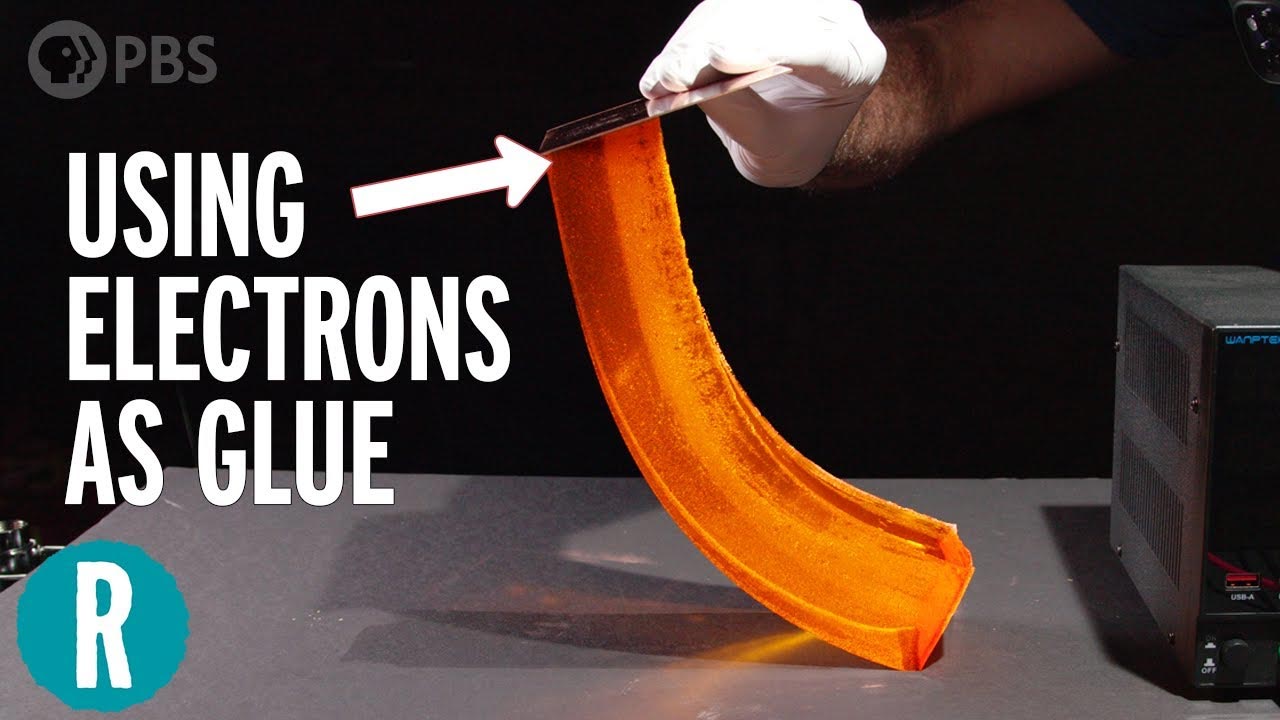
“Hard-soft electroadhesion” is a new method enabling the attachment of various hydrogels to metals using an electric current, as detailed in ACS Central Science. This versatile and reversible technique can be applied to a broad range of materials, including food items and different metals.
A novel electroadhesion process allows for the easy and reversible attachment of hydrogels to metals using electricity, effective on a variety of materials from food to metals.
How would you stick a slice of banana to a sheet of copper? Until a few months ago, you couldn’t. But a new discovery called “hard-soft electroadhesion” enables chemists to stick almost any hydrogel to almost any metal, using nothing but an electric current. And you can unstick the materials simply by reversing the current.
Recently reported in ACS Central Science, this astonishingly general phenomenon works with a wide variety of gels (including fruits, vegetables, meat, and fish) and conductors (including metals and graphite). Join our host George as he attempts to replicate electroadhesion in his basement and tries to discover what — if anything — this remarkable phenomenon shares with super glue.
Video Transcript:
I’m gonna show you a chemistry magic trick. This is a banana, this is a DC power supply, and these are copper electrodes, because I am testing what seems like a huge new chemistry breakthrough that was just published a few months ago.
Now, let’s see. Yeah, that just came off. So did that. It didn’t work, so I’m just gonna give up.
I’m just kidding, I’m gonna crank the voltage up as high as it will go. There’s 0.007 amps running through that banana right now.
And this time after passing a tiny bit of current through this banana… What if I kind of- Okay that, so that holds, look at that. That holds.
This is called electroadhesion. Gluing things together using only electrical current. And it’s not just bananas. Supposedly you can do this with jello too. Pretty good. Do I need the knife? Could this just pop out? Oh, yeah, look at that.
That’s 0.055 amps flowing through this block of jello. Oh my god, it’s actually bubbling the bottom of the jello. This was not mentioned in the paper at all. That’s so cool. I can hear it.
I got so excited that I forgot to set a timer. So who knows how long this has been going on.
All right, here we go. And again, one side sticks, the other does not. Okay? Bottom did not stick at all. This is reasonably well stuck on like you can see.
I’m trying to get it off and it’s not coming off. I mean, but that’s not even the magic part. That is stuck. The magic part comes when I reverse the polarity. Red’s going on the bottom. So now the current is flowing the opposite direction, and the adhesion is undone. So that came right off. That was the part that was stuck. before reversible electroadhesion, magic.
So then I had to test it with graphite electrodes and that worked. And then graphite and a banana and that worked. Okay, this is definitely stronger than it was upstairs.
And then I tried a clear gel. And now it’s just straight-up foaming. That didn’t really work. Ah. But it did give an interesting result. I am pretty sure it was not blue before. Yeah, look at that. This is before and this is after.
Then my adhesion research got a little sidetracked when I learned that hairspray is basically aerosolized Elmer’s glue. So I had to test that out. So to test my hairspray naturally I bought a head. Let’s give her some less creepy lighting. There we go. Nope, that’s more creepy. Couple sprays have diluted Elmer’s. Oh, yeah, that’s pretty good. This one is pretty floppy, this is pretty rigid. Now is it good hairspray? No. Does it work? Yes.
Okay, back to electroadhesion. This video is about electroadhesion. Yes, yes. I had to go bigger. It’s working. Wow. Again, one side didn’t stick, but the other side…
No. No. I don’t believe this. Are you not entertained? Oh, it’s breaking, it’s breaking, it’s breaking. Ah. Oh my god, that was incredible.
Man, look at that jiggle. Do this in slow motion. Okay, now I didn’t numerically test the strength of this joint, but this jello thing weighs at least a pound. So I think I can confidently say that I replicated the main finding of this paper. And it is a weird main finding. Like we’re taking a block of jello and we’re gluing it to a piece of copper using no actual glue, but only using electrons, electricity.
So how does this thing, which by the way, is called electroadhesion hard-soft work? And for that matter, how does regular glue even work? To find out, I picked a glue at random, Super Glue, and I Googled it. And I quickly found a really bad explanation repeated all over the internet. So we’re gonna start there, with that terrible explanation. Are you ready? Here it is.
Super Glue is usually ethyl-2-cyanoacrylate, this molecule right here. Now, these two functional groups mean that this carbon is actually electron deficient, which means that this carbon is susceptible to nucleophilic attack, by let’s say water. That gives you this molecule, which then goes on to react with another molecule of ethyl-2-cyanoacrylate.
Now at this point you’ve got two monomers which react to give you a dimer. Then that dimer goes on to react with another molecule of ethyl-2-cyanoacrylate, and that gives you a trimer. Then that trimer reacts with another molecule and you get the idea of where I’m going with this, right? That happens over and over and over again until you get a polymer, poly ethyl cyanoacrylate.
So fun fact, I had COVID while shooting this scene, and that made me absolutely botch every polymer structure in this video. Am I blaming COVID? Yes I am. This is the actual correct structure for polyethyl cyanoacrylate. You can see that in my structure I added an extra carbon for no reason whatsoever, and I put the N on the top like a mathematician instead of on the bottom like a chemist.
So overall, you’ve gone from lots of small molecules in this tube, to fewer larger molecules, polymers. Now these polymers can’t move around because everything around them is also a polymer. So on the macro scale, you’ve got hardened glue. These are stuck. Did you notice that in that explanation we learn a lot about how super glue sticks to itself, but we learn nothing about how super glue sticks to something else? And sticking to something else is the whole point of a glue. So really it’s actually explaining nothing.
So I switched over from looking at the internet to looking at textbooks, and I found, yeah, still nothing about how super glue sticks to other stuff. But I did find one-half sentence in the handbook on adhesives that I found particularly intriguing. And that half sentence is, “Ice will adhere to almost any surface.”
Ice. And I had this moment of like, yeah, of course it will. Like look, ice cube tray. Do these ice cubes just come out on their own? No, they do not. You have to crack the tray to release them because the ice adheres to the tray.
So does that mean that water is a glue? Hear me out on this, okay? Water starts off as a liquid, which is not sticky, doesn’t stick to stuff. But then you apply it to two materials and you crank the temperature down, which I’m doing here with my fancy cold plate. And as the water freezes, it hardens, which adheres the two materials together.
Here on the right is water and here on the left is super glue. And both of these things are applied in liquid form, they harden, and when they harden, they adhere the two materials together. Glues typically don’t harden by freezing, they harden in other ways, but that’s really the main difference.
As a chemist, I have always known that individual water molecules are sticky because of hydrogen bonding. The hydrogen bond to DOI: 10.1021/acscentsci.3c01593









Discussion about this post