
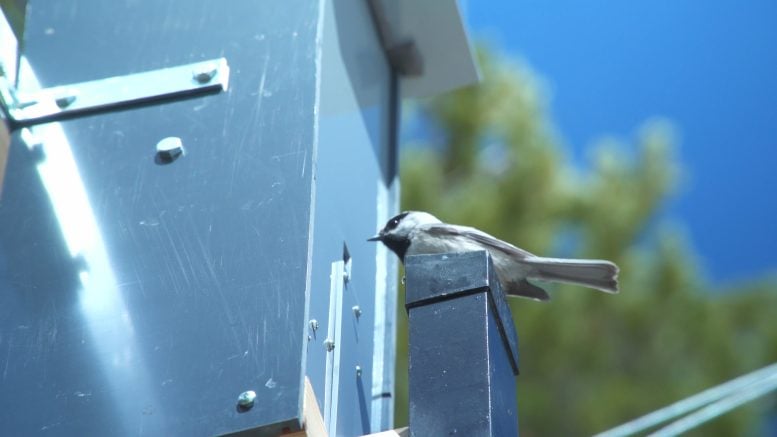
Mountain chickadees have exceptional spatial memory, recalling thousands of food cache locations in winter. Researchers found nearly a hundred genes tied to this ability, indicating a trade-off between long-term memory and forming new ones. A mountain chickadee eats seeds from a feeder at CU Boulder’s Mountain Research Station. Credit: Nicholas Goda/CU Boulder
Mountain chickadees demonstrate remarkable spatial memory for surviving winters by recalling numerous food cache locations, with new research uncovering the genetic basis of this trait and its implications for adaptation.
Lost your keys? Can’t remember where you parked the car? If only you had the memory of a mountain chickadee.
These tiny birds, each weighing half an ounce and possessing brains just a bit larger than a pea, store tens of thousands of seeds in various hiding spots like tree bark, beneath dead leaves, and within pinecones throughout the mountains. As winter sets in, they are able to remember the precise locations of these stashes, a remarkable ability that aids their survival through harsh winters and heavy snowfall.
In a new study recently published in the journal DOI: 10.1016/j.cub.2024.03.058