
Performance and scalability
If your organization manages multiple apps or runs frequent builds, MobSF may require additional setup to keep up. It runs as a single-instance tool by default, so when your operations scale, you’ll need to account for the extra overhead in performance and resource management.
False positives
Like many other mobile app security testing tools, you might encounter false positives with MobSF where vulnerabilities are flagged but aren’t actually present. This will eat up your team’s time to validate the findings.
Look for MobSF alternatives that use deeper static + dynamic analysis, and take context into account. They’re less likely to mislabel secure code as vulnerable and will allow your team to focus on real threats.
?Pro tip: Appknox helps you cut through the noise with less than 1% false positives and negatives, so your team can focus on resolving real vulnerabilities instead of wasting time validating false alerts.
CI/CD integration
MobSF supports automation through APIs, but integrating it into your CI/CD pipelines will likely involve custom scripting and hands-on configuration. If you’re aiming for streamlined DevSecOps, this can slow down velocity and create friction across your development and security teams.
Platform coverage
MobSF covers native Android, iOS, and Windows apps, which suits many mobile teams. However, if your products are built using hybrid frameworks or rely heavily on backend APIs and cloud services, you may find that additional layers of your architecture aren’t fully accounted for in testing.
Update frequency and support
As an open-source tool, MobSF relies on community updates. That’s a strength in many ways, but without guaranteed support or a structured update cycle, you will face delays when it comes to fixes or critical feature enhancements.
Dynamic analysis on emulators
MobSF includes dynamic analysis, especially for Android, but the setup involves managing emulators and instrumentation manually. This can be resource-intensive and isn’t easily automated.
If you’re looking for runtime and risk management insights, choose a MobSF alternative, like Appknox, that runs DAST scans on real devices.
Reporting and compliance
You’ll get detailed, technical reports from MobSF. But if you need outputs aligned with standards like OWASP or GDPR, or summaries suited for regulatory review or board-level reporting, you’ll likely need to invest time transforming the raw data into business-aligned insights.
User experience
If your teams span multiple roles from developers to security analysts, onboarding can take time. A more intuitive interface could improve adoption and reduce reliance on specialized knowledge within your security function.
Suggested read: Why MobSF Isn’t Ideal for Mobile Application Security Testing?
Best MobSF Alternatives
1. Appknox
-1.png?width=2996&height=1912&name=Appknox%20(3)-1.png)
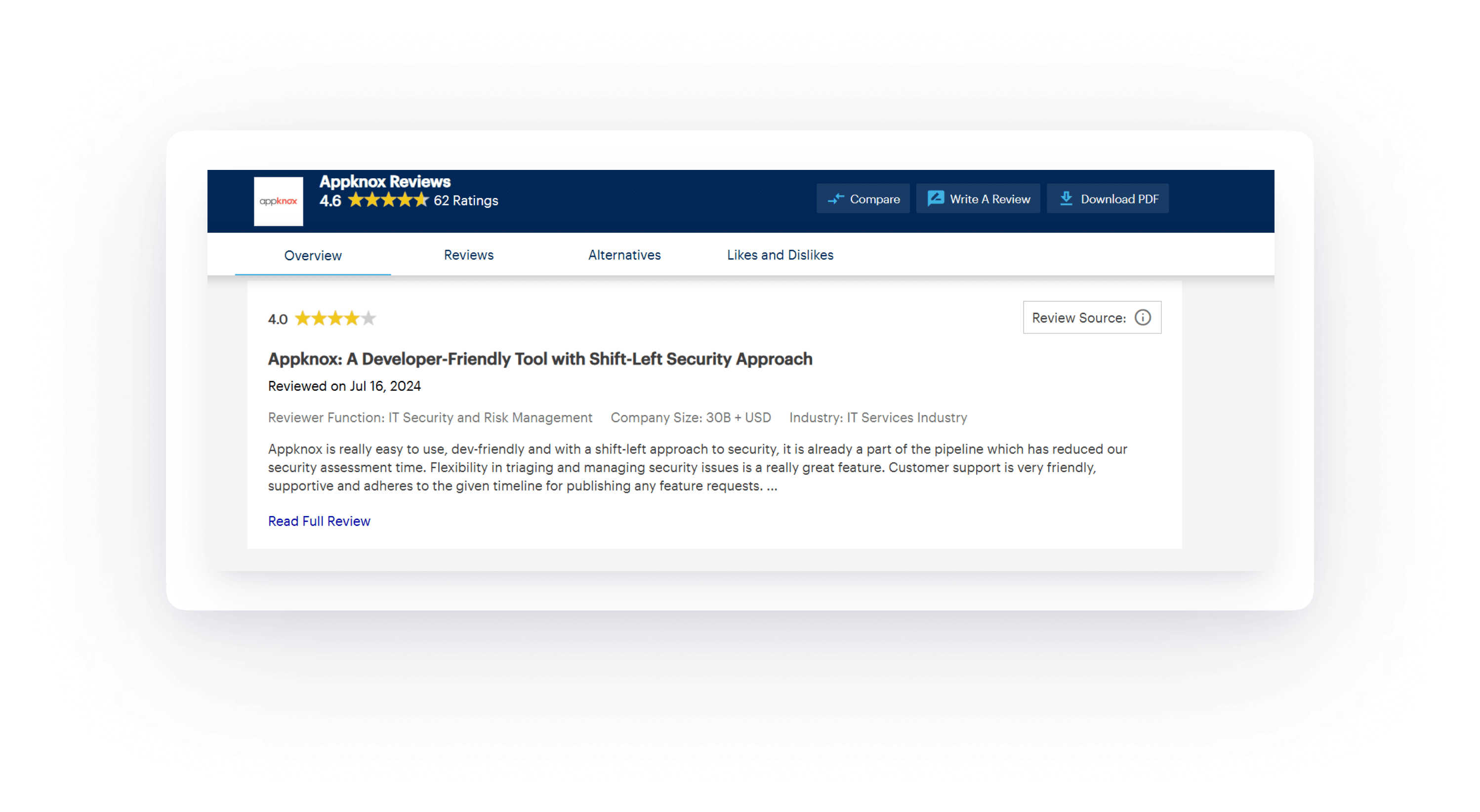
Appknox is an end-to-end mobile app security testing platform built to help you find and address vulnerabilities in your Android and iOS apps. It supports static, dynamic, and API testing, offering you a complete picture of your mobile app’s security posture.
You can run a complete scan in under 60 minutes and get clear, actionable reports with CVSS scores that anyone in your team can understand.
With less than 1% false positives, you can spend less time validating non-issues and more time fixing what matters. If you’re working in a DevSecOps environment, Appknox fits right into your CI/CD pipeline, making it easy to run security checks without slowing down development.
Appknox key features
SAST
Appknox provides simplified, binary-based SAST to scan your application’s APK, AAB, or IPA files without needing source code access. You can get detailed reports in under 60 minutes and even complete static scans in less than 2 minutes.
DAST
Think of Appknox’s DAST scans as putting your app through a real-world security simulation on actual devices, not emulators. You can observe how your app behaves when it runs on real hardware. It mimics real user interactions to uncover threats like insecure data flow, improper session handling, and man-in-the-middle (MitM) attacks.
API security testing
When it comes to testing API security, Appknox makes the process easy and thorough. The platform automatically discovers all the APIs (including shadow APIs) within your app and ensures nothing is overlooked.
You can also customize your security scans to meet your specific needs, such as targeting particular API endpoints, authentication methods, or data payloads, allowing you to focus on the most critical areas of your app.
SBOM analysis
With Appknox’s SBOM Analysis, you get complete visibility into the components powering your software. It identifies third-party libraries and their versions, flagging any vulnerabilities in the mix. This helps you stay on top of security risks, ensuring your software remains compliant with standards like OWASP.
Storeknox
Building on your SBOM efforts, Appknox’s Storeknox takes your app security a step further by continuously monitoring your apps in the app stores.
It helps you detect unauthorized versions, fake apps, and malware, ensuring that only legitimate and secure versions are available for download. Storeknox gives you real-time visibility, protecting your brand and ensuring compliance across all platforms.
Pros
- Less than 1% false positives and negatives
- Mobile-first vulnerability assessment
- DAST testing on real devices, not emulators
- Remediation reports with CVSS-based scores
- Integrates seamlessly into your CI/CD workflows
Pricing
Appknox offers flexible, usage-based pricing based on the customer’s requirements, with add-ons for manual testing.
Appknox rating
Gartner: 4.8/5
2. QARK
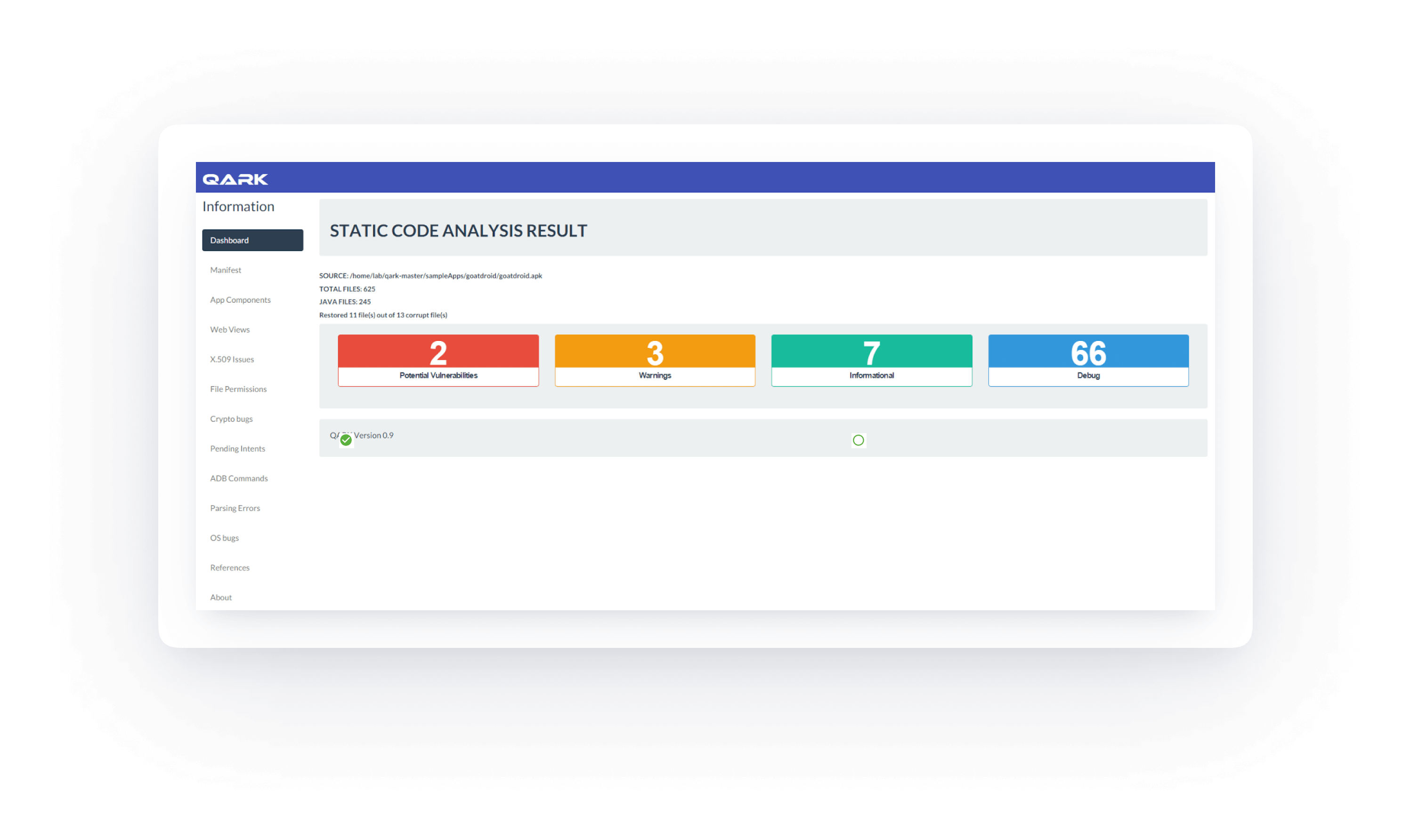
QARK (Quick Android Review Kit) is a static analysis tool that helps you uncover security vulnerabilities in your Android applications. QARK thoroughly scans your app’s structure to identify a broad spectrum of issues like inadvertently exported components, poorly protected services, and intents that can be intercepted or eavesdropped on.
By generating Android Debug Bridge (ADB) commands or even full proof-of-concept APKs, it turns potential risks into concrete examples you can test and learn from. The platform also uses multiple decompilers to reverse-engineer your APK more accurately, giving you a clearer picture of how your code behaves.
QARK key features
- Supports scanning both Java source files and compiled APKs
- Flags hardcoded sensitive information like API keys, access tokens, or passwords embedded directly in the code
QARK limitations
- Primarily focuses on static analysis, meaning it doesn’t account for runtime vulnerabilities or dynamic behaviors that could emerge during app execution
QARK pricing
- Open-source, free-to-use tool
QARK rating
3. OWASP ZAP
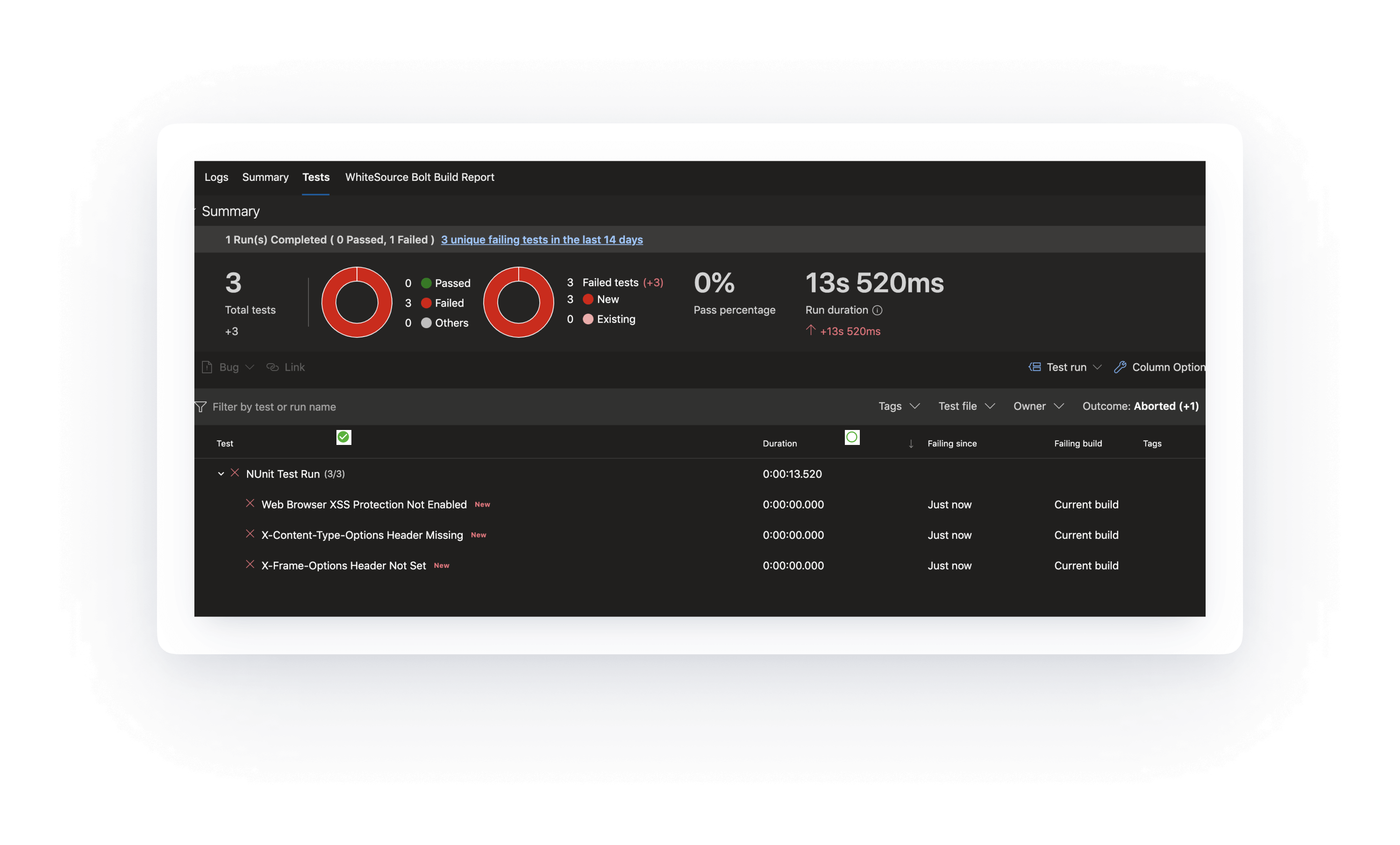
OWASP ZAP is a DAST tool that gives you a hands-on way to uncover security flaws in your web applications. You can start with active scanning to simulate real attacks using crafted payloads that reveal issues like SQL injection and XSS. Then, let passive scanning inspect your app’s traffic for signs of weak security settings like insecure cookies or missing headers.
To go deeper, use fuzzing to test how your app handles unexpected or malformed inputs, which can expose hidden input validation flaws. If your app relies heavily on JavaScript, AJAX Spidering helps you discover dynamic content and endpoints that traditional crawlers might miss.
OWASP ZAP key features
- Customize scan policies to suit specific application requirements. You can adjust the threshold to control the likelihood of flagging vulnerabilities and set the strength to manage the number of requests per test.
- Intercept and analyze WebSocket traffic to manipulate messages and identify potential vulnerabilities in real-time communication channels.
OWASP ZAP limitations
- Designed for web applications and does not natively support testing of mobile applications
OWASP ZAP pricing
- Open-source, free-to-use tool
OWASP ZAP rating
4. Drozer
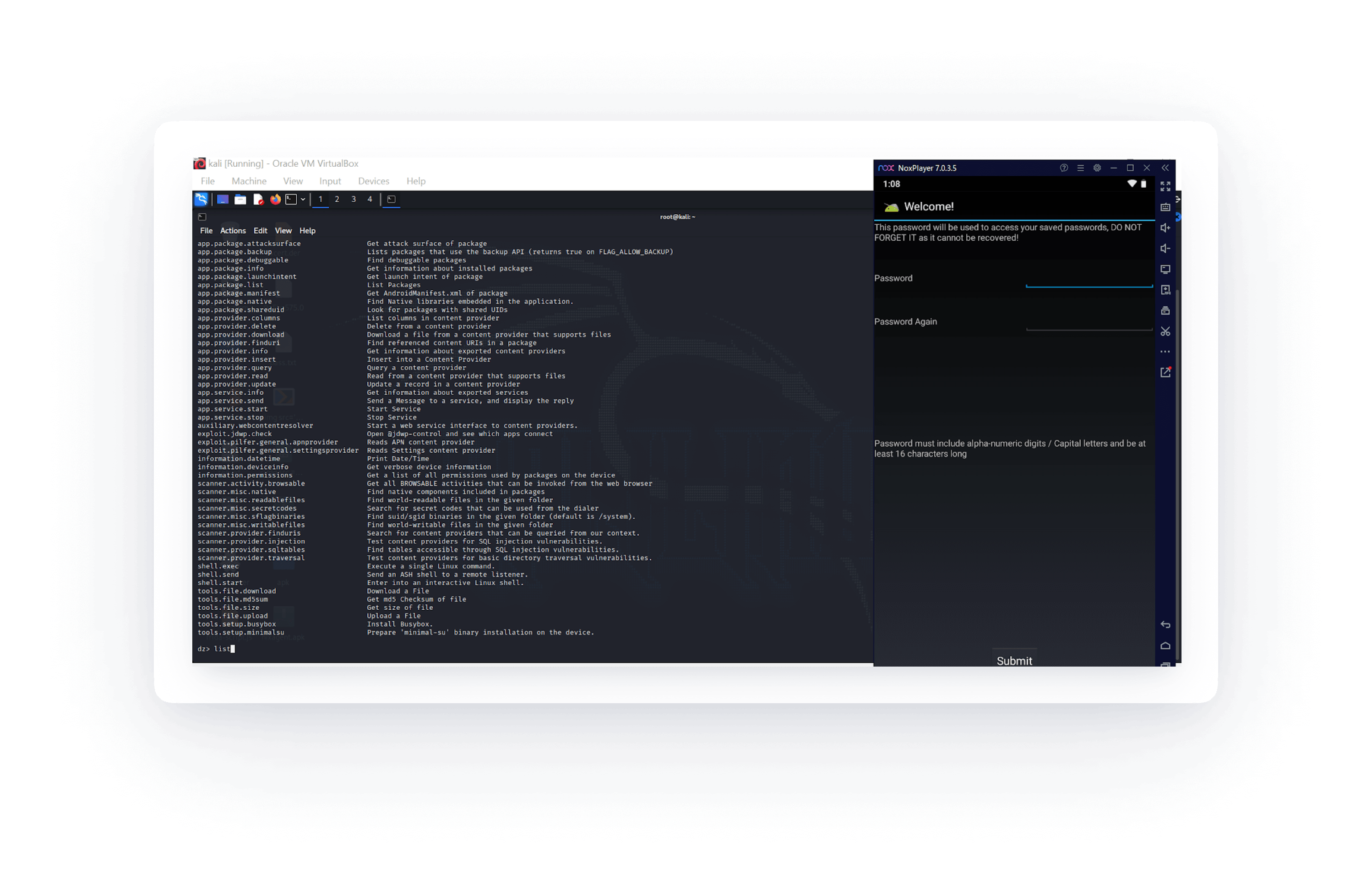
Drozer is a dynamic security testing tool built specifically for Android applications. By running an agent on your real device and emulators, Drozer simulates real-world attack scenarios to help you identify vulnerabilities such as insecure inter-process communication (IPC) or unprotected interfaces.
It lets you interact directly with Android app components like Activities, Services, and Content Providers, helping you uncover exposed surfaces and misconfigurations. Drozer is ideal for black-box testing, allowing you to work directly with compiled APKs to identify vulnerabilities.
Drozer key features
- Executes dynamic Java code directly on the device without needing to compile or install separate test scripts.
- Automates regression testing using built-in scripting capabilities for efficient, repeatable checks
- Leverages full app-level access to interact with Android’s IPC mechanisms and the underlying operating system like a regular app.
Drozer limitations
- Only designed for Android apps. It doesn’t support iOS or cross-platform mobile testing
- It doesn’t perform any source code or APK-level static analysis, limiting its ability to detect vulnerabilities that don’t manifest at runtime
Drozer pricing
- Open-source, free-to-use tool
Drozer rating
5. SonarQube
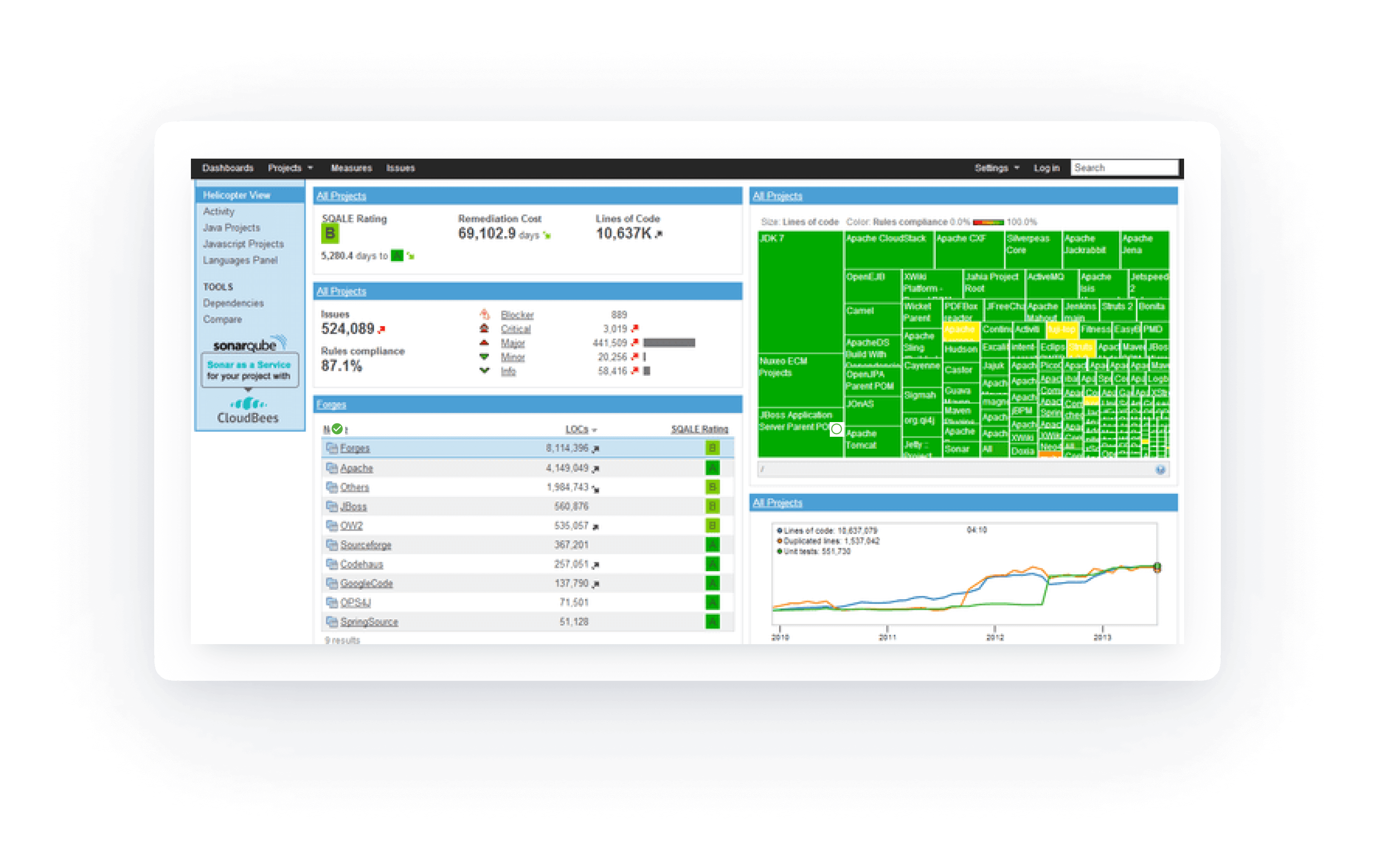
SonarQube is a static analysis tool that digs deep into both first-party, AI-generated, and third-party code to identify hidden vulnerabilities with fewer false positives. In addition, Taint Analysis tracks the flow of untrusted data across your codebase, helping you pinpoint SQL injection, XSS, SSRF, Deserialization, and other injection vulnerabilities.
If you’re looking to prevent data exposure, you can use the platform’s secrets detection capabilities to detect exposed secrets like API keys, tokens, passwords, and credentials before they’re ever committed. And with Software Composition Analysis (SCA), you can get a clear view of third-party dependencies, stay on top of license compliance, and generate an SBOM when needed.
SonarQube key features
- Deploy SonarQube on-premise, in the cloud, or through dockers
- Leverage over 6,000 built-in rules for code quality, security, secrets detection, and maintainability
- Create custom rules to align with your organization’s coding standards and team’s requirements
SonarQube limitations
- SonarQube mainly offers static code analysis. It lacks runtime vulnerability detection, such as issues that arise during app execution or interactions with backend servers.
SonarQube pricing
- Free
- Team: $32 per month
- Enterprise: Custom pricing
SonarQube rating
At a glance: MobSF alternatives
|
Tool |
Key features |
Best for |
|
Appknox |
|
Enterprises looking for a comprehensive, mobile-first security solution with automation and compliance readiness |
|
QARK |
|
Developers seeking a free, open-source tool for static analysis of Android apps |
|
OWASP ZAP |
|
Security testers focusing on web application security with customizable scans |
|
Drozer |
|
Penetration testers needing in-depth dynamic analysis of Android apps without source code |
|
SonarQube |
|
Development teams looking for deep static analysis across web and mobile codebases with code quality and compliance features |
Choosing the right MobSF alternative for your team
MobSF is a powerful open-source tool, especially if you’re just getting started with mobile app security. But as your need for speed, automation, and scalability increases, it may no longer be enough on its own.
If you’re looking for a more advanced, enterprise-ready solution, Appknox stands out as the best MobSF alternative. Here’s why:
- Real-device dynamic testing that reflects real-world conditions, not just emulator results
- Binary-based static scans with reports ready in under 60 minutes, no source code needed
- Automated API security testing, including shadow APIs and custom targeting
- Less than 1% false positives, helping you save time and focus on real risks
- Seamless CI/CD integration to keep security in step with your DevOps pipeline
- SBOM analysis and store monitoring for full-stack and post-release visibility
- CVSS-scored, remediation-ready reports that your developers and security team can both act on
- Enjoy a broader scope of mobile app security assessment with continuous store monitoring.
Looking for a scalable, reliable, and DevSecOps-aligned alternative to MobSF? Appknox can help you future-proof your mobile app security strategy.
Try Appknox for free