









Understanding Forward Deployed Engineers in Enterprise AI
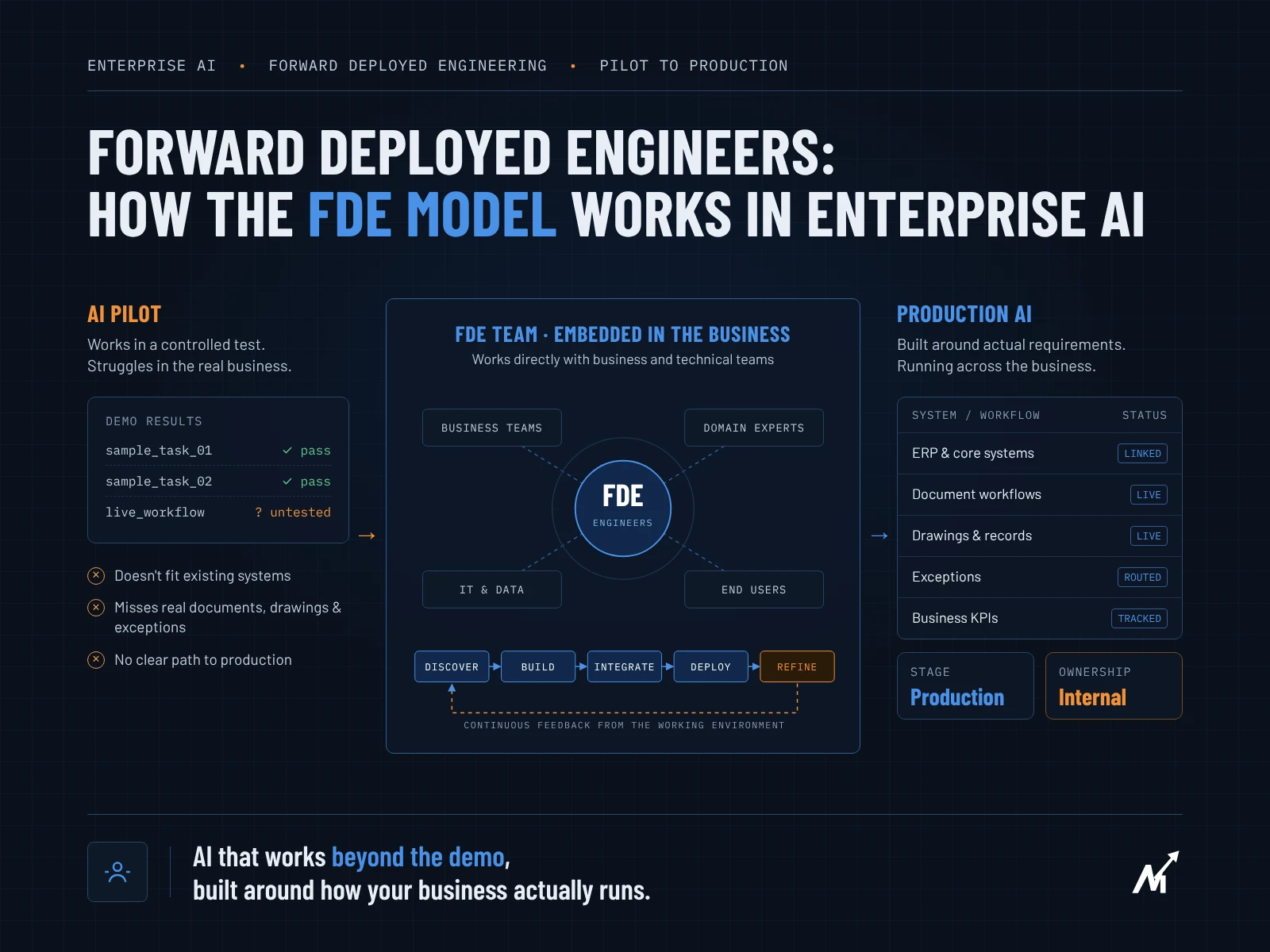
Implementing an AI solution successfully for specific tasks does not guarantee that it will function effectively across an entire organization. To ensure seamless operation, the solution must integrate with existing infrastructures, consider employee workflows, and accommodate real-world documentation, designs, and exceptions not covered in controlled tests. This is where Forward Deployed Engineers (FDEs) offer a transformative approach.
FDEs collaborate directly with both business and technical teams to gain insight into the organization’s operations. They create solutions tailored to meet actual demands, extending their role from development to integration, deployment, and ongoing refinement within the operational environment.
This article delves into the FDE model’s application within enterprise AI, its distinctions from traditional engineering methods, and scenarios where businesses should embrace this approach. Additionally, we will examine how Markovate’s FDEs implement this strategy to fulfill enterprise needs.
Defining Forward Deployed Engineers
A Forward Deployed Engineer is a specialized software engineer who focuses on resolving complex business issues that generic software products cannot effectively address. They engage directly with business and technical teams, whether onsite, remotely, or through a hybrid model, depending on project specifics.
Unlike product engineers, who operate primarily based on a predetermined product roadmap, FDEs begin with the unique challenges presented by the customer. They assess what must be created, adapted, or integrated to find effective solutions.
In the realm of enterprise AI, their responsibilities encompass various areas, including solution architecture, AI application development, data engineering, enterprise integrations, testing, and deployment into production. Furthermore, they assist internal teams in facilitating adoption, ongoing optimization, and knowledge transfer.
The Necessity of Forward Deployed Engineers in Enterprises
AI projects within enterprises often encounter issues that transcend mere model performance. Factors such as existing systems, internal processes, data accessibility, and business requirements significantly influence whether an AI solution can add value to an organization.
FDEs tackle these concerns by bridging the gap between engineering and the teams involved in operations. The following points highlight the advantages of employing FDEs.
Connecting AI with Existing Business Systems
Diverse systems within a company often manage data differently, each with its own formats and access protocols. For instance, in engineering environments, a PDF drawing and a CAD file may not be consistent after modifications. FDEs scrutinize these systems and develop essential integrations, allowing AI to function harmoniously alongside existing tools.
Without proper connections, employees may still have to toggle between applications or manually enter data, which undermines the anticipated benefits of AI implementation.
Aligning AI with Real Business Workflows
A solution that demonstrates effectiveness in a controlled setting may fail to consider the intricacies of daily employee tasks. Different departments often adhere to specific approval processes and rules.
If an AI application overlooks these essential elements, employees may circumvent it instead of using it actively. Enterprises require solutions that fit smoothly into their operations rather than compelling staff to overhaul existing processes.
Preparing AI for Operational Use
Just because a proof of concept proves successful does not mean that an AI solution is ready for full-scale enterprise use. Production environments entail security, data permission, reliability, performance, and user access requirements.
Attention to these aspects is crucial before introducing a solution to everyday users. Additionally, businesses need established protocols for managing errors, ambiguous outputs, and cases that necessitate human review.
Evaluating the Value of AI Investments
Organizations must ascertain whether an AI solution enhances the processes it was intended to improve. Successful implementation should yield quantifiable results, rather than simply demonstrating the technology’s capabilities.
Metrics such as processing time, manual effort, output accuracy, operational costs, or staff productivity help teams evaluate the solution’s effectiveness and pinpoint areas for further enhancement.
Markovate’s FDEs engage comprehensively with these business and technical requirements, from understanding initial problems to implementing and supporting solutions in operational contexts. Let’s take a closer look at the FDE model in action.
Operational Model of Forward Deployed Engineering
The FDE model integrates business teams with engineers throughout the AI project lifecycle. FDEs work cooperatively with stakeholders to define challenges, devise solutions, and ensure compatibility with the organization’s framework.
The methodology varies by project but typically proceeds through five stages.
Step 1: Identify Business Challenges and Priorities
FDEs initiate by consulting the individuals involved in processes to comprehend how teams operate, which information sources they tap into, and where delays or excess manual effort arises. They evaluate existing applications, data sources, and infrastructure.
For example, a manufacturing purchasing team might spend significant time verifying supplier details, production schedules, and inventory records. FDEs analyze how these decisions are made and identify tasks that AI can assist with.
Expected outcome: A precisely defined business issue, a prioritized use case, and measurable targets.
Step 2: Define the Solution and Validate Its Approach
With requirements established, FDEs outline how the solution is to function, selecting suitable AI models, planning data flows, determining necessary integrations, and deciding the type of solution—application, agent, or workflow automation.
The team may create a prototype and test it using representative business data to verify the technical direction prior to further development.
Expected outcome: An approved solution design featuring explicit technical needs and success criteria.
Step 3: Build the Solution to Integrate with Existing Systems
FDEs develop the application and link it to pre-existing systems the business employs. Their work typically involves software development, API integration, data pipeline construction, model configuration, and workflow automation.
As an example, an engineering firm may receive RFQs containing specifications in various formats. An FDE might craft a workflow to extract and organize this information for estimators, flagging ambiguities for review. At Markovate, we tailor this process around client-specific documents and estimating procedures.
Engineers also ensure compliance with data permissions, access controls, and business regulations throughout the development phase.
Expected outcome: A functional solution which interfaces seamlessly with the required enterprise systems.
Step 4: Validate Performance Prior to Production Deployment
Before execution, FDEs rigorously test the solution against actual business scenarios, scrutinizing output quality, accuracy, reliability, and performance while observing how the system manages exceptions and unreliable outputs.
An AI-supported customer service agent, for instance, must recognize refund exceptions and defer inquiries that exceed standard policy to human operators. We incorporate human oversight and escalation pathways into the workflow, so that the team understands which outputs warrant immediate attention. Once the system complies with predetermined requirements, it is deployed.
Expected outcome: A thoroughly tested solution ready for real-world application.
Step 5: Enhance Performance and Foster Team Ownership
Post-deployment, FDEs continue evaluating the solution. They monitor performance, assess user feedback, and remedy issues that manifest during routine use.
For example, a supply chain team may initially deploy an application for inventory analysis. As usage increases, planners might request additional information on supplier delays or forecast data. FDEs can analyze these needs and enhance the application accordingly.
They also document the process and share technical know-how with internal teams to ensure sustainable maintenance and future enhancements.
Expected outcome: A solution that internal teams can manage, maintain, and evolve according to business needs.
While this explains how FDEs guide enterprise AI projects from conception to production, it is also essential to highlight the distinctions between their role and that of traditional software engineers and AI consultants.
Comparing Forward Deployed Engineers, Software Engineers, and AI Consultants
These roles contribute uniquely to enterprise technology initiatives, with key differences in responsibilities and implementation engagement.
| Area | Forward Deployed Engineers | Software Engineers | AI Consultants |
|---|---|---|---|
| Primary Focus | Business problem-solving and implementation | Software Development | AI strategy and recommendations |
| Requirements | Help define business requirements | Work from defined requirements | Identify business needs and AI use cases |
| Main Role | Build and implement custom solutions | Develop and maintain software | Assess opportunities and guide adoption |
| Business Involvement | Work directly with users and stakeholders | Collaborate primarily with product and engineering teams | Engage with business leaders |
These contrasts illustrate how Forward Deployed Engineers contribute to enterprise solutions differently than software engineers and AI consultants.
Forward Deployed Engineers vs. Software Engineers
Software engineers generally build applications based on established criteria. In contrast, FDEs assist in defining these requirements through direct interaction with teams experiencing challenges. They remain actively engaged in both shaping and executing solutions within the business environment.
Forward Deployed Engineers vs. AI Consultants
AI consultants focus on identifying viable AI opportunities and formulating strategic recommendations. Conversely, FDEs assume a more hands-on engineering role, aiding in the development of solutions and addressing implementation specifics. The collaboration between both can be synergistic, with consultants guiding direction while FDEs deliver technical solutions.
Collaborative Synergies Among These Roles
Enterprise projects often see the involvement of all three roles. AI consultants help establish overall direction, software engineers contribute software development expertise, and FDEs bridge technical development with tangible business needs.
Expertise Brought by Forward Deployed Engineers to Enterprise AI
FDEs require skills extending beyond standard software development practices. They must grasp AI system behaviors, the essentials for their reliable operation, and the ways business teams utilize outcomes. Three critical expertise domains stand out:
1. Applied AI and Model Expertise
FDEs must comprehend various AI technologies and their applications to select appropriate methods rather than defaulting to a singular model for diverse business challenges.
Areas of knowledge may include:
- Large language models: Understanding how these models process information and generate responses suitable for various business applications.
- Retrieval-augmented generation (RAG): Enables AI applications to extract and utilize pertinent information from internal documents and resources.
- AI agents: This expertise allows for the development of systems capable of accessing data, utilizing tools, and completing designated tasks within specified boundaries.
- Model evaluation: Skills in assessing output quality, validating accuracy, and identifying scenarios necessitating human intervention.
Choosing the right approach hinges on the specific use case, available data, and required accuracy levels.
2. Production Engineering and Governance
AI solutions must demonstrate consistent performance beyond initial trials; thus, FDEs must comprehend the infrastructure and control measures necessary for successful application deployment.
This encompasses cloud environments, application rollout, container technology, and performance monitoring, alongside governance, security requirements, access constraints, and operational supervision. Certain industries may require AI to function within their networks, which shapes model and infrastructure choices.
3. Business Understanding and Problem-Solving
FDEs collaborate with personnel familiar with business challenges, even if they lack a technical background. They must pose relevant questions, understand operational priorities, and articulate technical decisions clearly.
Adaptability is vital when addressing shifting requirements or pivotal insights from testing results. This necessitates practical problem-solving, flexibility, and close cooperation with both business and technical teams.
The most effective FDEs fuse these capabilities with sound engineering judgment, allowing them to discern business needs, select suitable technical paths, and make decisions that align with desired outcomes.
Advantages and Considerations of the FDE Model
The forward-deployed engineering model provides far-reaching value beyond merely developing a functioning application. A proper implementation can enhance daily operations, optimize team efficiency, and grant businesses increased control over AI evolution.
Business Advantages of FDE Models
1. Enhanced Connection Between AI Investment and Business Outcomes
FDEs concentrate on specific business challenges rather than developing unaligned technology, aligning AI endeavors with measurable objectives such as reduced processing times, enhanced accuracy, or decreased operational expenses.
2. Solutions Reflecting Genuine Business Needs
Developing solutions grounded in a company’s requirements ensures that they effectively tackle the daily challenges encountered by employees. Teams can utilize AI to augment existing workflows rather than forcing adaptation to generic tools.
3. Reduced Manual Labor and Improved Efficiency
AI applications can automate repetitive tasks, expedite information retrieval, and facilitate multi-step processes. Consequently, employees can devote more time to strategic decision-making which leverages their expertise.
4. Strengthened Collaboration and Longevity of Knowledge
FDEs demystify the development process by involving both business stakeholders and technical teams, enhancing engineers’ comprehension of operational requirements and guiding business teams as they gain insight into the solution.
Documentation and knowledge transfer strategies empower internal teams to maintain applications, address future needs, and facilitate further advancements.
Crucial Factors for a Successful Implementation
While the FDE model can deliver meaningful advantages, organizations must be cognizant of specific considerations.
1. Engage Relevant Domain Experts
FDEs bring engineering and AI proficiency, but internal teams possess critical contextual knowledge. Involving those with insights into workflows helps pinpoint essential requirements, exceptions, and necessary decision-making processes that solutions need to accommodate.
2. Prepare for Scalability
Solutions tailored for one team may require adaptation for others. Organizations must contemplate anticipated demands during the design phase, employing reusable components and modular structures to foster smoother expansion without overhauling entire applications.
3. Establish Long-Term Ownership
Companies ought to designate who will oversee the solution post-deployment, encompassing maintenance, monitoring, updates, and user assistance. Documentation and knowledge transfer need to be integral to the partnership rather than an afterthought.
4. Find the Balance Between Customization and Reusability
Though certain business needs may necessitate specialized features, constructing every component from the ground up can escalate development and upkeep costs.
FDE teams should differentiate between aspects requiring customization and those that can be standardized across workflows, enabling businesses to satisfy unique needs while keeping future maintenance sustainable.
Assessing Business Impact
Enterprises should define success metrics from the outset of development. Appropriate measurements depend on the specific problems the AI solution aims to solve.
| Business Objective | Metrics to Track |
|---|---|
| Enhance processing speed | Average task completion time, turnaround duration |
| Minimize manual effort | Hours dedicated per task, steps eliminated |
| Boost accuracy | Error rates, validation stats, frequency of exceptions |
| Elevate productivity | Tasks managed per employee, overall throughput |
| Improve system reliability | Uptime, failure rate, response duration |
| Increase adoption | Active user counts, usage frequency, workflow assimilation |
| Control operating costs | Cost per transaction, infrastructure, and support expenses |
For instance, organizations automating invoice processing can compare processing and manual review times pre- and post-implementation. Customer support teams can analyze resolution timings, escalation trends, and successfully managed inquiries.
We strive to establish these parameters with clients before any development begins and report outcomes post-launch. Establishing a baseline and setting realistic benchmarks prior to implementation is critical. Following deployment, organizations can juxtapose actual results against these targets to reveal whether the solution provides substantive operational benefits, beyond simply meeting technical criteria.
The following scenarios can help determine an enterprise’s interest in the FDE model.
Identifying Situations for FDE Model Application
The urgency for an FDE team often hinges on the specific tasks an organization intends for AI to manage. Certain initiatives demand close cooperation with internal teams, while others necessitate engineering to tackle specific technical and operational challenges. Here are scenarios where adopting the FDE model may prove advantageous.
1. Off-the-Shelf AI Tools Fall Short of Business Requirements
Standard AI solutions may lack support for proprietary data, specialized workflows, or sector-specific necessities. An FDE team can design an approach tailored to meet these requirements.
2. AI Pilots Struggle to Transition to Full Production
A prototype can perform admirably in testing but still require additional engineering for employee daily use. FDEs can bridge the gaps to prepare the solution for broader use.
3. Specialized Data Needs Within Your Organization
Some enterprises possess unique datasets, proprietary documents, or specific industry datasets. Such projects necessitate engineers capable of comprehending these data intricacies and crafting an AI solution accordingly.
4. AI Projects Requiring Close Collaboration with Internal Teams
Your IT or engineering teams may require further AI acumen for specific initiatives. FDEs can collaborate with them, offering specialized skills while supporting implementation efforts.
5. Expanding Usage of Successful AI Applications
An AI solution performing effectively for one group may need adaptations before broader adoption across other departments. FDEs can assist in modifying the solution to accommodate fresh requirements.
Starting with a focused workflow and scaling up once its value is confirmed is also a viable strategy.
The optimal engagement model ultimately hinges on the project’s objectives, technical demands, and the expected level of engineering collaboration required.
Selecting the Ideal Forward Deployed Engineering Partner
Choosing the right forward-deployed engineering partner necessitates an understanding of your business goals alongside the requisite technology for their realization. Seek a team adept at navigating business workflows, AI development, and production deployment.
Consider the following areas during your evaluation:
1. Understanding Business Workflows
Your engineering partner should grasp how your teams function before proposing an AI solution. They should uncover operational gaps, existing practices, data dependencies, and your business’s expected outcomes.
At Markovate, we prioritize understanding these prerequisites and identifying opportunities where AI can resolve real-world business challenges, ensuring our solutions align with actual workflows.
2. Expertise in Enterprise AI Development
Crafting an AI prototype demands different capabilities than delivering a production-ready enterprise solution. Prospective partners should have experience with custom AI applications, AI agents, data architectures, and integrations with existing enterprise systems.
Markovate possesses extensive experience in full-stack AI engineering, encompassing custom enterprise applications, LLM integration, intelligent workflow automation, and multi-agent systems. Our engineers choose models and frameworks based on project particulars, avoiding a one-size-fits-all approach.
3. Capability for Integration and Deployment
An AI solution must conform to your existing applications, databases, and infrastructure. Evaluate potential partners’ abilities to handle system integrations, deployment requirements, security needs, and readiness for production.
Markovate’s FDEs construct AI solutions designed to slot into established enterprise environments, taking integration intricacy, human oversight, validation, and deployment prerequisites into account throughout development. Our support adapts to cloud, private cloud, hybrid, or on-premises deployment needs.
4. Emphasis on Long-Term Performance
The successful deployment marks merely the beginning of an AI initiative. Both models and business requirements evolve over time. Ideal partners should demonstrate the capability to monitor performance, troubleshoot issues, and refine the solution as demands shift.
Markovate extends support for AI implementation beyond initial development, facilitating production deployment, performance enhancement, and ongoing engineering assistance. We ensure documentation and knowledge transfer, empowering internal teams to manage and extend their solutions.
5. Flexibility in Collaboration and Engagement Models
Every organization has different collaboration prerequisites. Onsite engineers are ideal for intensive discovery and sensitive integrations, while dedicated remote teams are better suited for projects with pre-established criteria. A hybrid approach combines both modalities.
Markovate provides onsite, hybrid, and dedicated remote engagement options, allowing businesses to select the level of engineering involvement that aligns with their project scope, internal capacity, and implementation requirements.
Discover Markovate’s Forward Deployed AI Engineering services to explore how our engineers facilitate enterprise AI development, integration, and deployment.
Conclusion: Empowering Enterprises Through Forward Deployed Engineers
Forward Deployed Engineers empower businesses to translate AI capabilities into actionable solutions. They foster closer alignment between engineering, personnel, systems, and processes, which are pivotal for successful implementations.
From addressing business needs to integrating systems and aiding in production deployment, FDEs unify technical development with operational requirements.
Success requires a well-defined business problem, the right engineering competencies, and clear, measurable objectives. By establishing these elements, enterprises can transcend isolated AI trials and create solutions that integrate seamlessly into the fabric of daily operations.
If you are contemplating an AI initiative or need engineering assistance to transition an existing solution to production, contact us to discuss your requirements.
FAQs
1. Are forward-deployed engineers restricted to AI projects?
No, the FDE model can be valuable for broader software and technology implementations. Its importance has surged in enterprise AI contexts due to the frequent need for customized integrations, workflow alterations, and hands-on deployment support.
2. Which industries can benefit from forward-deployed engineering?
Industries like manufacturing, financial services, healthcare, retail, logistics, and construction can all benefit. The model shines in scenarios involving specialized workflows, intricate systems, or unique data requirements.
3. Is it possible for forward-deployed engineers to operate within our network or on-premises?
Yes, depending on technical feasibility, we can implement AI solutions via cloud platforms, private clouds, hybrids, or on-premises settings to ensure your data remains within your required infrastructure.
4. What do we need to provide at the outset of an engagement?
Access to personnel who manage workflows, representative datasets, and the systems the solution will connect with is essential. Having a business owner available for decision-making accelerates progress.
5. How long does a forward-deployed engineering project typically take?
The timeline varies based on the business challenge, data preparedness, integration complexity, and deployment needs. A focused workflow usually requires less engineering than more expansive solutions involving numerous enterprise systems.
6. Can forward-deployed engineers collaborate with our current IT team?
Absolutely. FDEs frequently partner with in-house software engineers, data teams, IT administrators, and business stakeholders to supplement specialized engineering expertise while keeping internal teams involved.
7. What metrics should businesses track during an FDE engagement?
Organizations should monitor metrics that align with the specific problem being addressed. Relevant measures might include processing velocities, manual effort, error rates, workflow throughput, system reliability, user adoption, and operational costs.
8. Do forward-deployed engineers provide support after deployment?
FDEs can facilitate monitoring, optimization, documentation, and knowledge transfer throughout the engagement. Specific responsibilities vary based on the agreed-upon scope and ongoing support framework.








Discussion about this post