
Forecast International attended this year’s Air & Space Forces Association conference in National Harbor, Maryland, that showcased several new products and emerging market trends.
SkyCourier UX
Textron Aviation and Merlin introduced an autonomous unmanned transport aircraft aimed at closing the contested aerial logistics gap. Dubbed SkyCourier UX, the concept aircraft was unveiled on day one of the Air, Space & Cyber Conference in Washington, D.C. The platform is a highly modified version of a Cessna SkyCourier aircraft, a proven twin-turboprop engine, high-wing, medium-payload freighter. The UX concept is outfitted with Merlin’s “Pilot” aircraft-agnostic software program for autonomous aviation that removes the requirement for a cockpit. Similar to the S-70UAS U-Hawk, the SkyCourier UX is designed with forward-loading cargo architecture as well as an aircraft-kneeling capability and integrated loading systems for easier and quicker loading and unloading of cargo. The concept is expected to have a payload capacity of up to 6,000 pounds and a range of up to 900 nautical miles, with the ability to operate from austere runways. The aircraft is modular and can be outfitted for passenger or cargo transport, or as a medevac platform.
Speaking during a media briefing on the proven reliability of the aircraft, Bob Gibbs, vice president of Defense and Special Mission Sales at Textron Aviation, stated, “The aircraft is being operated literally from the Arctic to the Amazon. There are three different island nations in the Pacific that have airline fleets of them.”
Merlin CEO and founder Matt George cited Textron Aviation’s current full production line in Wichita, Kansas, when speaking on the partnership between the two companies: “None of this matters without production.” George went on to state that Merlin’s Pilot system is already integrated and flying in other aircraft. According to Merlin’s website, these include single-engine and multi-engine aircraft, with full-size military transport and tanker classes in development. Of note is Merlin’s partnership with U.S. Special Operations Command to bring autonomy to its C-130J fleet.
FI’s Thoughts: The Textron Aviation and Merlin partnership looks to address the issue of medium-sized contested logistics transport across a theater-wide area of operations. When an Unmanned Aerial System’s (UAS) capabilities do not suffice, but a C-130 transport aircraft cannot and will not be devoted to such missions, the SkyCourier UX is meant to fill that gap. Moreover, this concept is set up to potentially play a key role as an island-hopping aircraft in the Pacific theater of operations and has an established industrial production footprint for immediate output. As China continues to show its commitment to autonomous transport aircraft, the SkyCourier UX concept will indeed need to deliver on its projected capabilities to close the contested logistics gap if a conflict in the Pacific arises.
The aircraft is still in the concept phase, with a flight-worthy prototype yet to be built.
Gamera
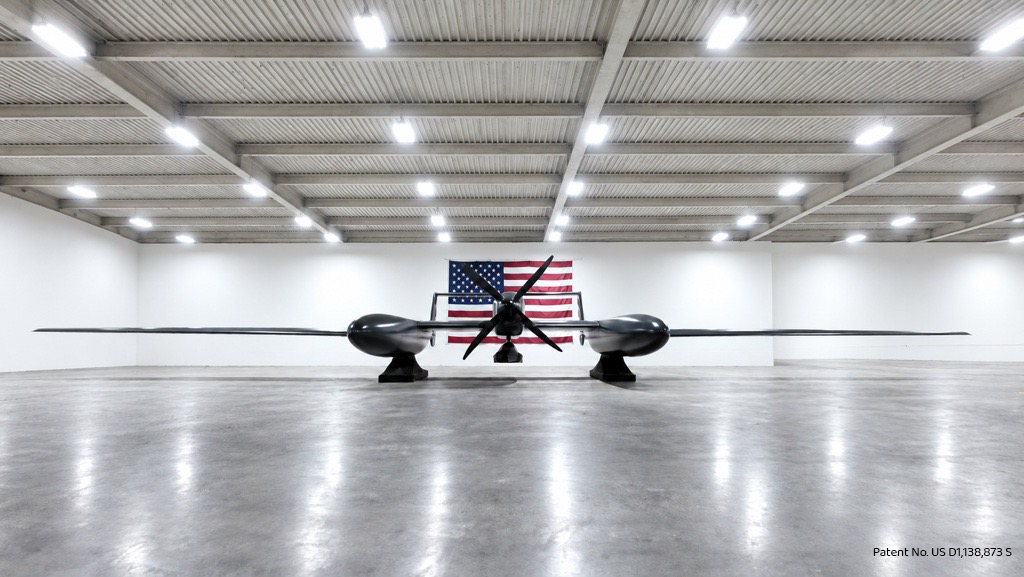
The biggest product on display at the Air, Space & Cyber Conference was without a doubt Swarm Aero’s Gamera Unmanned Aerial System (UAS). The Oxnard, California-based company unveiled the Group 5 UAS with a full-sized, roughly 72-foot-wide wingspan mockup. The Gamera is looking to challenge several other competitors in the Defense Innovation Unit’s (DIU) Mass Modular Aircraft (MMA) program, which is seeking a lower-cost, modular UAS. The MMA program seeks to replace much more expensive systems, such as the legacy MQ-9A Reaper UAS, with those that can be manufactured at significant scale while providing a minimum payload capacity of 2,800 pounds, an unrefueled radius of 2,300 nautical miles, and an 8,000 nautical mile self-deployment range.
Swarm Aero claims the Gamera will have a mission radius of 2,500 nautical miles and a max range of 9,000 nautical miles. Additionally, it will use Honeywell Aerospace’s TPE331 turboprop engine, the same engine that propels the MQ-9A, and easily manage the 2,800 pound payload via seven hardpoints while also offering Intelligence, Surveillance, and Reconnaissance (ISR) capabilities. It is aiming at a price of approximately $10 million per unit, depending on mission specifications and eventual serial production quantities, a price tag much lower than the $30million to $50 million of a single Reaper.
FI’s Thoughts: Modern conflicts have shown a persistent need for cheaper, mass-produced UAS options that can still offer a robust range of operations and modular architecture. Thus, theater-based UAS options such as the Gamera will be needed to project air dominance in future war zones. Current options available for offensive missions, such as the B-2 Spirit and B-1B Lancer bombers, offer near-unlimited range with the help of air refueling, yet they cost hundreds of millions of dollars and place crews in contested environments. UAS options such as the Gamera will provide a similar ability without placing humans in unnecessarily dangerous situations. Additionally, Swarm Aero claims its C2 autonomy system, Legion, will allow dozens of its drones to be deployed simultaneously and be controlled by small teams in order to provide a force multiplier on a theater-wide scale.
Currently, the Gamera UAS is set for its first flight sometime in 2027 as Swarm Aero continues to fast-track testing and evaluation. DIU has several entrants to consider, including defense prime General Dynamics’ own design dubbed Wildfire, which appears to share many similarities to its legacy Reaper system. The Gamera will have to deliver fully on its claimed capabilities to compete with defense giants and cement its place in today’s drone landscape.
Market Trends
The platform unveilings at AFA 2026 are not isolated industry developments. They are a direct response to the structural shifts reshaping U.S. drone procurement:
Trend 1: Rapid Acquisition. The Pentagon is aggressively compressing multi-year development cycles into rapid, tournament-style fly-offs. Programs like DIU’s MMA and the Army’s Drone Dominance Program use competitive trials to place immediate production orders. By pairing commercial-off-the-shelf (COTS) components with active assembly lines, the military is transitioning from slow prototyping to high-volume fielding.
Trend 2: Distributed Capabilities. Firepower and intelligence are shifting away from centralized strategic assets and moving directly down to squad and platoon levels. Programs like Short Range Reconnaissance (SSR) and Low Altitude Stalking and Striking Ordnance (LASSO) put scouting and strike capabilities into the hands of warfighters. On the show floor, this philosophy is reflected in platforms like Gamera, whose Legion C2 software allows small forward teams to directly manage dozens of drones simultaneously.
Trend 3: Cheap Hardware, Sophisticated Software. High-volume drone warfare requires cheap, disposable hardware paired with smart, upgradeable software. Programs like the Army’s Defense Autonomous Warfare Group (DAWG) initiative and Shield AI’s Hivemind integration into the Low-Cost Uncrewed Combat Attack System (LUCAS) demonstrate a pivot toward decoupling cheap airframes from sophisticated software. Merlin’s “Pilot” software on the SkyCourier UX mirrors this trend: flashing software onto existing commercial frames so autonomous flight capabilities can be updated over the air as threats evolve, preserving the technological edge without risking multi-million-dollar assets.

Juan Lopez pursued an undergraduate degree in Political Science with an emphasis in International Relations and a minor in Russian studies from the University of California, Riverside. Juan’s diverse background includes his work as a staffer in the U.S. House of Representatives and in federal law enforcement which gave him extensive experience and knowledge in federal government operations, international affairs, counter terrorism, and national security. His interests include land-based weapon systems, small arms, military fixed wing aircraft, and Latin American relations. He is proficient in the Spanish language at a native level.

Anna Miskelley has cultivated a deep interest in global security, emerging technologies, and military systems throughout her academic and professional career. She is currently a Defense Industry Analyst with Forecast International.
Before joining Forecast International, Anna was a research fellow at the Center for Security, Innovation, and New Technology, where she researched the impact of artificial intelligence on U.S. nuclear command and control systems. Proficient in Mandarin Chinese, Anna has published research on topics including strategic stability, internal Chinese politics, and artificial intelligence.
Discussion about this post