










The degradation of trees at the edges of tropical forests is more widespread than previously thought, according to new research.
The study, published in Nature, explains that trees near deforested or degraded areas of the forest are more vulnerable to drought, as well as to human activity such as logging. These “edge effects” are measurable up to 1.5km into the forest, the authors find.
This is an “amazing result”, a study author tells Carbon Brief, because previous studies detected these effects only within the first 120 metres of the forest edge. The new figure indicates that 18% of the remaining tropical moist forests are impacted by edge effects – an area more than 200% larger than previously estimated.
Experts not involved in the study tell Carbon Brief that quantifying tropical forest degradation is “frustratingly elusive”. And while some praise the methods used in the paper, others advise caution when interpreting the conclusions.
Two Brazilian scientists also tell Carbon Brief that the study overlooks important work from institutions in the global south who are also working on this problem. They advise that scientists from local groups should be invited to contribute to research in this area.
Forest height
Tropical forests account for around 45% of forest cover globally. These forests are well-known for their high biodiversity and the crucial ecosystem services that they provide. They also hold around one-quarter of all land-based carbon.
The new study assesses how deforestation and degradation affect “moist tropical forests” – tropical forests in the equatorial belt with a fairly consistent annual temperature and high levels of rainfall. Tropical dry forests and deciduous forests are not included in the analysis.
Research shows that around 17% of tropical moist forests disappeared over 1990-2021, largely due to human activity such as logging and fires. Of the 1,071m hectares that remained globally in 2019, around 10% were degraded, the new study says. This means that they suffered human-induced “disturbances” that led to a partial loss of their tree cover or function.
Furthermore, trees at the edges of tropical forests have higher mortality rates than trees in the centre, because they are more exposed to disturbances such as fire and drought. When intact forest landscapes become fragmented – for example, due to logging, fire, drought or the construction of roads into the forest – these “edge effects” can lead to further forest degradation.
The authors use data collected by the Global Ecosystem Dynamics Investigation (GEDI) instrument on the International Space Station to assess the forest structure – such as canopy height and aboveground biomass – over the past four years.
To measure canopy height, the authors calculate the “RH98” value – the height of the top of the canopy or the nearest tallest vegetation in the area. This is an important measure of forest health and maturity. Aboveground biomass measures the aboveground woody biomass per unit area and is also a good measure of forest health.
They combine this with data from the Tropical Moist Forest dataset, which uses Landsat satellite imagery to show how tropical moist forests have changed over 1990-2022.
The plot below shows the canopy height for different types of moist tropical forests. The rows show intact forests at least 3km from a forest edge (top row), degraded forests (second row), the edges of forests (third row) and forest regrowth (bottom row), as shown in the maps below.
Darker blues indicate taller forest canopies. The map shows where the forests are located, and the bar charts on the right hand side show the overall distribution of different tree heights.
The tallest intact moist tropical forests are found in south-east Asia, where the average canopy height is 34m, the study finds. West and central Africa and Central and South America have average forest heights of 29m. This is because intact tropical forests in Asia, which are typically dominated by “hardwood wind-dispersed species”, are typically taller, the authors say.
The map also shows that degraded forests, forest edges and areas of forest growth have a greater proportion of shorter trees on average.
The forest edge
The study investigates two different types of forest edge effects, exploring how areas of deforested and degraded land impact nearby trees.
Dr Lilian Blanc is an author on the study and researcher at the French Agricultural Research Centre for International Development. He tells Carbon Brief that the effect of nearby degraded land “was not considered in previous studies”.
The graphs below show how areas of deforested land affect tree canopy height. The charts at the top show the average distribution of canopy heights of undisturbed forests in the Americas, Africa and Asia. The line colours indicate the distance of those trees from the forest edge, with yellow indicating a short distance and blue indicating a large distance.
The bottom map shows how far into the forest edge effects are present, by measuring the distance from the forest edge at which the height of the forest reaches 95% of the height of the intact, undisturbed forest.
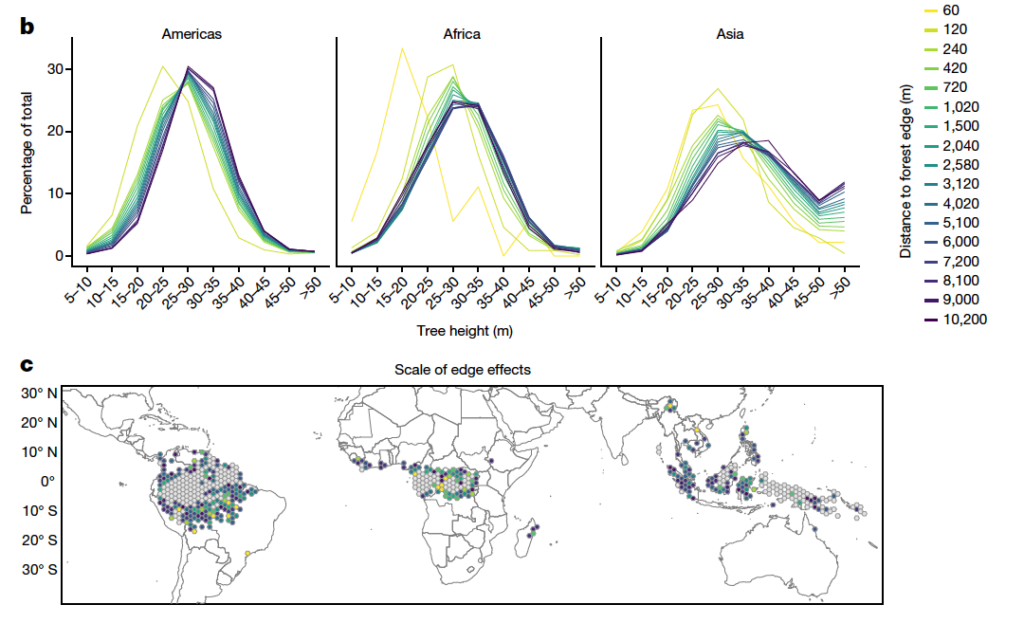
The authors find the greatest edge effects from deforestation along the “forestation fronts of the Amazon”, in Borneo and Sumatra coasts marked by high fragmentation levels, and on the borders of the Congo basin.
They also record a decrease in canopy height up to 350, 400 and 1,500 metres from the deforested edge in the Americas, Africa and Asia, respectively.
The authors find that within 120 metres of trees that have been degraded due to logging and burning, the average canopy height in undisturbed forests is 15% and 22% lower, respectively.
The authors also investigate how quickly the forest can recover from logging and fires, concluding that while there is “fast regrowth of pioneer and understory species”, there is “no significant recovery in canopy height in the 30 years following the creation of a forest edge”.
Forest degradation can also increase the likelihood of deforestation, the authors say. They warn that forest height and distance to the edge of the forest are “strong predictors of deforestation”, as forest fragmentation makes the interior of the forest more accessible to loggers.
It adds that there has been selective logging 500 metres from the forest edge in Africa and the Americas, and even deeper in Asia.
Agriculture and road expansion trigger a 20-30% reduction in canopy height and biomass at the forest edge, with “persistent effects” measurable up to 1.5km inside the forest, the authors find. Blanc tells Carbon Brief that this is “an amazing result” as previous studies only looked for edge effects up to 120 metres from the forest edge.
The authors also calculated the edge effect using total above ground woody biomass, instead of canopy height. Using this metric, the authors conclude that the total area of forest with this edge effect is 18% of total global forest area in 2022 – an area more than 200% larger than previously estimated.
Prof Simon Lewis – a professor of global change science at University College London’s department of geography – tells Carbon Brief that this is a “striking new result”.
It implies that “the negative impacts on remaining forest from the creation of forest edges are much more extensive than has been commonly documented”. It also means that “forest protection of large blocks of forest is going to be more important than we previously thought”, he says.
Overall, the study is “an important step forward in monitoring forest disturbance, which is a very tough problem”, Lewis says. However, he adds that “care is needed” when looking at some of the observational data, saying that he “trust[s] the broad patterns of biomass loss following logging, edge creation and fires, but not the specific biomass loss values from these disturbances”.
Dr Peter Potapov – a researcher in the department of geographical sciences at the University of Maryland, whose work was cited extensively in the new study – says “the conclusion that edge effects are degrading 18% of the remaining humid tropical forest is an overstatement”.
He says that forest degradation depends on other factors, such as land-use regulations, and argues that “the assumption that all forests 1.5km away from the edges are degraded may undermine ongoing conservation efforts.
Expert response
These comments reflect the mixed response that the new study has received.
Prof Matthew Hansen – a remote sensing scientist at the University of Maryland’s department of geography – tells Carbon Brief that forest degradation is “a frustratingly elusive dynamic to quantify”. However, he praises the study for being “very clear and ambitious”.
Potapov, who has published research with Hansen, tells Carbon Brief that the results broadly confirm existing findings, but warns that there are some “major limitations” with the study.
For example, he says the method does not include a “matching technique” to separate the effect of human management on tree height from the natural factors such as elevation, soil quality and floods. He also warns that the observations “failed to correctly map anthropogenic disturbances in humid tropical forests”, adding:
“The authors greatly underestimate selective logging in Gabon, while the natural non-fire disturbances like river meandering and windfalls in South America were probably treated as human-caused degradation.”
Dr Flávia de Souza Mendes, a programme manager in forest and land use at satellite imagery firm Planet Labs, says the study is “well written”. However, she laments that “there are several local groups from the global south that have been studying this topic and are not part of this study”. She suggests that scientists carrying out similar studies should “invite more local researchers to take part”.
She also tells Carbon Brief that this paper “did not take into account studies carried out by local researchers on the relationship between degradation and deforestation”.
For example, she highlights a report by Brazilian researchers which finds that, in some regions of the Amazon, 86% of degraded areas were not subsequently cleared in the following decades. This is not in line with the findings of the new study, where degradation “has a crucial role in predicting future deforestation”, she says.
Prof Celso Silva-Junior – a research scientist in amazon ecology and remote sensing at Brazil’s Universidade Federal do Maranhão – tells Carbon Brief that the study “reproduces the findings of our research group, which has been investigating large-scale forest edge effects, using remote sensing technologies, since 2016”.
He says that the paper’s findings concerning biomass loss beyond 120 metres from the forest edge are “critical”. However, he emphasises the importance of the “local knowledge of tropical scientists” who are “deeply involved in the establishment of the conceptual framework for treating this relevant problem”.
Sharelines from this story










Discussion about this post