
In 2015, researchers reported a wonderfully strange finding: men whose index fingers were relatively short compared with their ring fingers seemed to behave more agreeably toward women.
It was the kind of study that instantly made headlines. Measure a man’s fingers, and you might learn something about the hormones he encountered before birth — and perhaps even how he would behave around women.
But is that really the case?
This measurement is known as the second-to-fourth digit ratio, or 2D:4D. On average, men tend to have slightly lower 2D:4D ratios than women, although there is substantial overlap between the sexes.
For years, researchers have investigated 2D:4D as a possible indirect marker of exposure to sex hormones such as testosterone before birth. So what does the science of 2026 say?
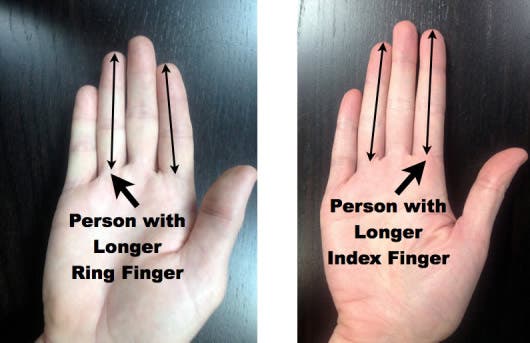
What the original study found
During the 20-day study, 155 participants were asked to log any social interaction that lasted more than five minutes and check a list of behaviours. These could be agreeable or quarrelsome. Men with small digit ratios reported approximately a third more agreeable behaviours and approximately a third fewer quarrelsome behaviours than men with large digit ratios.
“When with women, men with smaller ratios were more likely to listen attentively, smile and laugh, compromise or compliment the other person,” says Debbie Moskowitz, lead author and Professor of Psychology at McGill.
These men were also less quarrelsome with women than with men, whereas the men with larger ratios were equally quarrelsome with both. For women, digit ratio variation did not seem to predict how they behaved, the researchers reported.
This was an observational association (correlation, not causation). The researchers did not manipulate prenatal hormones, and measuring someone’s fingers cannot by itself establish that prenatal testosterone caused the behavioural differences.
Follow-up studies didn’t find the same result
In 2021, researchers Michelle Spix and Marije aan het Rot published a study explicitly intended to replicate the earlier work. They again had participants record everyday social interactions and examined agreeableness and quarrelsomeness depending on whether people were interacting with men or women.
But they couldn’t.
They couldn’t replicate the original digit-ratio finding in men. Male participants behaved more agreeably and less quarrelsomely toward women than toward men, but this did not depend significantly on their 2D:4D ratios.
There is an important caveat: the replication included 81 participants overall and relatively few men, which the authors themselves identified as a possible reason they failed to detect the earlier effect. So this isn’t a clean knockout blow to the 2015 result, but it raises a big question mark.
Other evidence hasn’t been especially encouraging either. In 2019, researchers studied 560 people playing economic games involving real money and found no robust relationship between 2D:4D and generosity, bargaining, punishment, trust or reciprocity. Those experiments measured different social behaviours and therefore aren’t a direct replication, but they provide little support for using someone’s fingers as a general personality divining rod.
The original researchers also suggested that their finding might help explain previous reports that men with shorter index fingers relative to ring fingers had more children.
This might serve to explain why men with shorter index figures have more children, the researchers write in the journal Personality and Individual Differences.
“Our research suggests they have more harmonious relationships with women; these behaviors support the formation and maintenance of relationships with women,” Moskowitz says.
What finger ratios actually tell us remains disputed
Ultimately, 2D:4D might still have a significance. But that’s not clear at this moment.
Some researchers continue to argue that digit ratio — particularly right-hand 2D:4D — contains useful information about prenatal androgen exposure. A 2025 commentary in Hormones and Behavior, for instance, defended it as the best available non-invasive retrospective indicator of prenatal androgen exposure in humans.
But the strongest recent quantitative assessment is difficult to square with the simple explanation presented in 2015. The 2024 meta-analysis found no overall relationship between digit ratios and prenatal testosterone across the studies it examined.
So there may still be biology hidden in the lengths of our fingers. What they don’t currently provide is a reliable way of determining how much testosterone an individual encountered before birth — much less whether a particular man will be kind or quarrelsome toward women.
Transparency note: This article was originally published in 2015 and has been substantially updated to reflect research published since then, including attempts to replicate the original findings and newer evidence questioning the use of finger-length ratios as a proxy for prenatal testosterone exposure. This update is part of an ongoing ZME Science effort to revisit older studies we’ve covered and see how the science has held up over time.
Science rarely ends with a single paper, and findings that once seemed compelling can become stronger, weaker, or more complicated as new evidence emerges. We believe our coverage should evolve with that evidence.


Discussion about this post