










Super El Niño Expected to Reach Record Global Temperatures by End of 2026
The current “super El Niño” phenomenon is projected to peak by late 2026, potentially driving average global temperatures to unprecedented highs next year. This forecast comes from Carbon Brief’s recent “state of the climate” report, which evaluates El Niño projections from multiple climate models as well as various global temperature datasets.
Analysis of El Niño’s Impact
Dr. Zeke Hausfather, a key climate science contributor for Carbon Brief, characterized the current El Niño event as “simply staggering” during a Q&A session for CB+ members. El Niño is a naturally occurring climate cycle in the tropical Pacific Ocean that releases additional heat into the atmosphere, resulting in temporary spikes in global temperatures.
Since June, this year’s El Niño has already established several new records, significantly altering global weather patterns and contributing to increased wildfire activity in Indonesia as well as powerful typhoons in the western Pacific region.
Measuring El Niño’s Strength
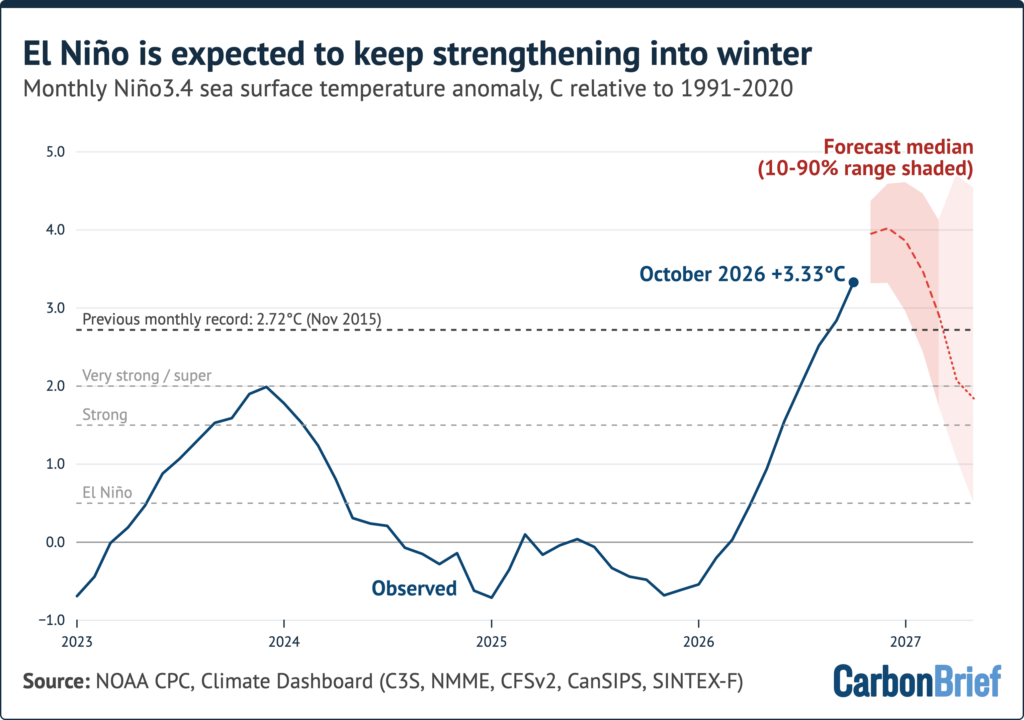
The strength of an El Niño event is assessed using the “Niño3.4 anomaly,” a metric that measures deviations in sea surface temperatures from the average in a specific area of the central Pacific.
Analysis conducted on over 600 forecasts derived from 14 different climate models suggests that this year’s El Niño could peak with a Niño3.4 anomaly of approximately 4°C, exceeding the previous record set during the 2015-16 El Niño by over one degree.
Historical Context and Future Projections
In his commentary on CB Connect, Hausfather emphasized the rapid development and extreme ocean temperatures observed this year, stating, “We haven’t seen anything like this in the historical record, and it may end up being the strongest El Niño event in the past millennium.” He noted that this year’s El Niño surpassed prior events by a significant margin since June.
Several milestones have already been recorded, including a daily Niño3.4 regional anomaly that exceeded the former satellite-era record of 3.11°C on September 18. Additionally, September marked the highest monthly average anomaly of 2.84°C since records began in the mid-19th century.
Hausfather also indicated that the El Niño’s strength will continue to escalate through December, with 10 out of 14 models predicting a peak in the Niño3.4 region by the end of this year. The remaining models foresee a November peak.
Long-Term Climate Consequences
While human-induced greenhouse gas emissions drive long-term global warming, El Niño events significantly influence year-to-year temperature variations. The “state of the climate” report projects that the most significant impacts on global temperatures from this year’s El Niño will manifest in 2027 due to a typical three-month lag in temperature responses to changes in the tropical Pacific.
Carbon Brief anticipates that average global temperatures could reach approximately 1.74°C above pre-industrial levels by 2027, with a 96% likelihood that next year will witness the highest recorded temperatures on record. This prediction is based on historical correlations between seasonal temperature shifts and preceding El Niño conditions.










Discussion about this post