
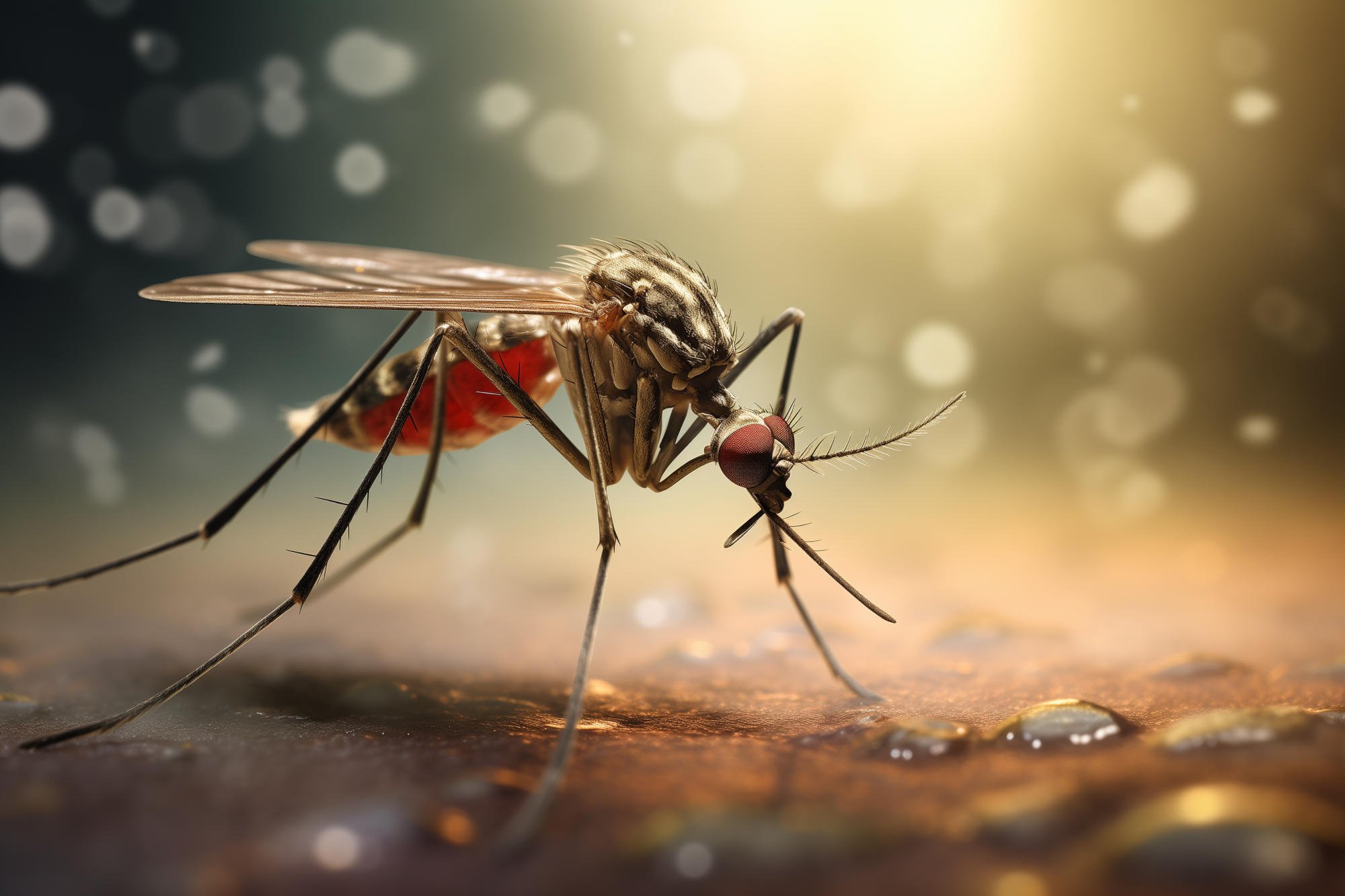
Malaria continues to affect millions globally, causing substantial mortality and shaping human evolutionary history. Recent studies leveraging ancient DNA have illuminated the historical spread and origins of malaria, showing its adaptation across continents and its profound impact during colonial times. Advances in understanding these patterns offer insights into combating current and future malaria challenges. Credit: SciTechDaily
Research into malaria’s history through ancient 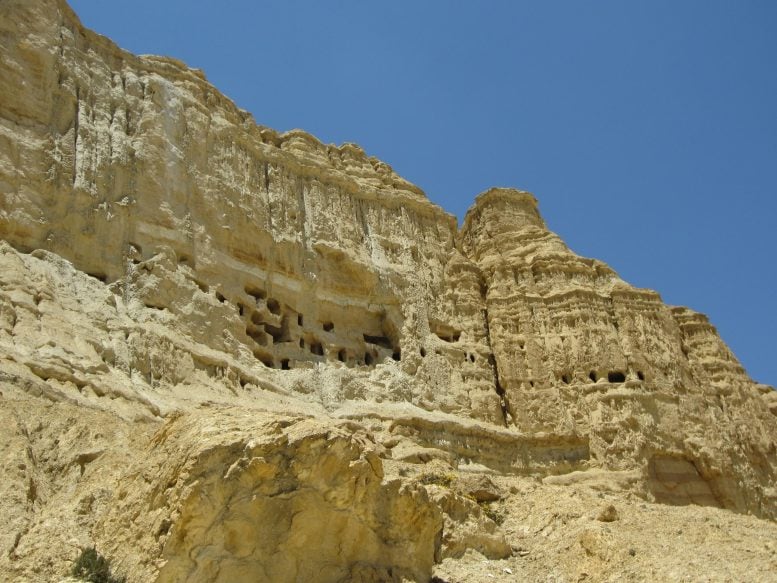
Ancient tombs are visible throughout the Upper Mustang region of Nepal. Credit: Christina Warinner
Unraveling the Mystery of Malaria’s Origins
The origins and spread of the two deadliest species of malaria parasites, Plasmodium falciparum and Plasmodium vivax, remain shrouded in mystery. Malaria infections leave no discernible traces in human skeletal remains, and scant references in historical texts can be difficult to decipher. However, recent advances in the ancient DNA field have revealed that human teeth can preserve traces of pathogens present in a person’s blood at the time of death, providing an opportunity to study illnesses that are normally invisible in the archaeological record.
To explore malaria’s enigmatic history, an international team of researchers from 80 institutions reconstructed ancient Plasmodium genome-wide data from 36 malaria-infected individuals spanning 5,500 years of human history on five continents. These ancient malaria cases provide an unprecedented opportunity to reconstruct the worldwide spread of malaria and its historical impact at global, regional, and even individual scales.
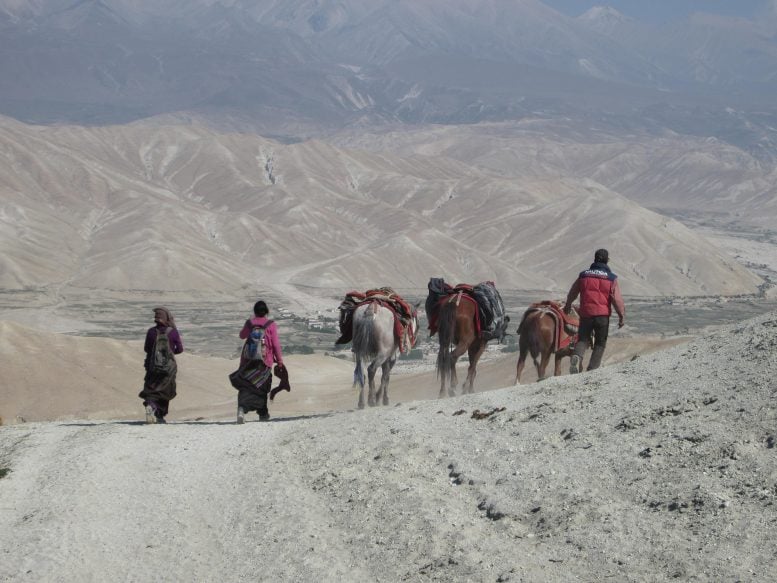
Present-day traders and travelers in the Upper Mustang region of Nepal. Credit: Christina Warinner
Malaria’s Path through the Americas
Malaria is endemic in tropical regions of the Americas today, and scientists have long debated whether P. vivax, a malaria species adapted to survive in temperate climates, may have arrived via the Bering Strait with the peopling of the continent or traveled in the wake of European colonization.
To track the parasites’ journey into the Americas, the team analyzed ancient DNA from a malaria-infected individual from Laguna de los Cóndores, a high-altitude site situated in the remote cloud forests of the eastern Peruvian Andes. Genomic analysis revealed remarkable similarities between the Laguna de los Cóndores P. vivax strain and ancient European P. vivax, strongly suggesting that European colonizers spread this species to the Americas within the first century or so after contact
“Amplified by the effects of warfare, enslavement, and population displacement, infectious diseases, including malaria, devastated Indigenous peoples of the Americas during the colonial period, with mortality rates as high as 90 percent in some places,” says coauthor Evelyn Guevara, a postdoctoral researcher at the University of Helsinki and the MPI-EVA.
Remarkably, the team also uncovered genetic links between the Laguna de los Cóndores strain and modern Peruvian P. vivax populations 400 to 500 years later. “In addition to showing that malaria spread rapidly into what is a relatively remote region today, our data suggest that the pathogen thrived there, establishing an endemic focus and giving rise to parasites that are still infecting people in Peru today,” says co-author Eirini Skourtanioti, a postdoctoral researcher at MPI-EVA and MHAAM.
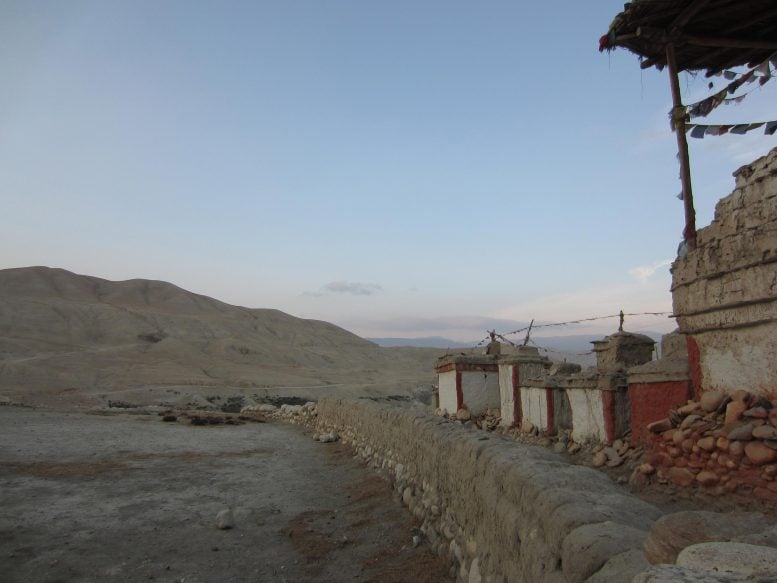
Upper Mustang region of Nepal. Credit: Christina Warinner
Military Movements and Malaria Spread in Europe
While the role of colonialism in the spread of malaria is evident in the Americas, the team uncovered military activities that shaped the regional spread of malaria on the other side of the Atlantic. The cemetery at the Gothic cathedral of St. Rombout’s in Mechelen, Belgium was located adjacent to the first permanent military hospital (1567-1715 CE) in early modern Europe.
Ancient human and pathogen DNA identified local cases of P. vivax among the general population buried before the construction of the military hospital, while individuals buried after its construction included cases of the more virulent P. falciparum malaria.
“Most interestingly, we observe more cases of malaria in non-local male individuals from the military hospital period,” explains co-author Federica Pierini, a postdoctoral researcher at the MPI-EVA. “We also identified several individuals infected with P. falciparum, a species that thrived in Mediterranean climates before eradication but was not thought to be endemic north of the Alps during this period.”
These virulent cases were found in non-local male individuals of diverse Mediterranean origins, who were likely soldiers recruited from northern Italy, Spain, and other Mediterranean regions to fight in the Hapsburg Army of Flanders during the 80 Years’ War.
“We find that the large-scale troop movements played an important role in the spread of malaria during this period, similar to cases of so-called airport malaria in temperate Europe today,” explains Alexander Herbig, Group Leader of Computational Pathogenomics at the MPI-EVA.
“In our globalized world, infected travelers carry Plasmodium parasites back to regions where malaria is now eradicated, and mosquitoes capable of transmitting these parasites can even lead to cases of ongoing local transmission. Although the landscape of malaria infection in Europe is radically different today than it was 500 years ago, we see parallels in the ways in which human mobility shapes malaria risk.”
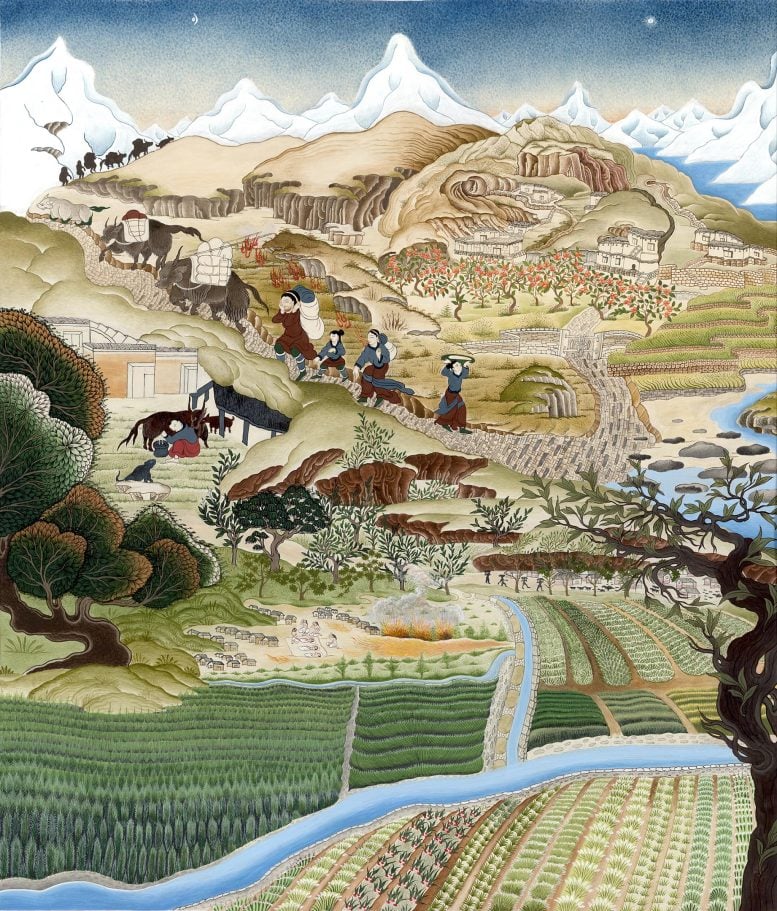
Artist reconstruction of the life of CHO001, a long-distance trader analyzed in this study who suffered from malaria and was buried at the site of Chokhopani, Nepal, ca 800 BCE. The foreground depicts agricultural fields in the province of Lumbini, a lowland region afflicted with endemic malaria until the 21st century, with the Kali Gandaki River cutting across. The river’s course has long served as an ancient trade route in Nepal. Chokhopani is depicted in the upper right, nestled among the cliffs in which CHO001’s tomb was found. In the middle of the painting, CHO001 is depicted carrying trade goods with his family and traveling up well-worn paths towards the Kora La pass. He is surrounded by fires symbolizing the cyclical malaria fevers he is experiencing after having contracted Plasmodium falciparum at low elevation. Credit: Purna Lama, Boudha Stupa Thanka Centre, Kathmandu, Nepal
Unexpected Discoveries in High-Altitude Malaria
On the other side of the world, the team unexpectedly identified the earliest known case of P. falciparum malaria at the high Himalayan site of Chokhopani (ca. 800 BCE), located along the Kali Gandaki River Valley in the Mustang District of Nepal. At 2800 meters above sea level, the site lies far outside the habitat range for both the malaria parasite and the Anopheles mosquito.
“The region surrounding Chokhopani is cold and quite dry,” said co-author Christina Warinner, Associate Professor of Anthropology at Harvard University and Group Leader at the MPI-EVA. “Neither the parasite nor the mosquitoes capable of transmitting malaria can survive at this altitude. For us, this raised a key question: how did the Chokhopani individual acquire the malaria infection that may have ultimately led to his death?”
Human genetic analysis revealed that the infected individual was a local male with genetic adaptations for life at high altitudes. However, archaeological evidence at Chokhopani and other nearby sites suggests that these Himalayan populations were actively engaged in long-distance trade.
“We think of these regions today as remote and inaccessible, but in fact the Kali Gandaki River Valley served as a kind of trans-Himalayan highway connecting people on the Tibetan Plateau with the Indian subcontinent,” says co-author Mark Aldenderfer, Distinguished Professor Emeritus at the University of California, Merced, whose excavations in the region have revealed its long-distance trade connections.
“Copper artifacts recovered from Chokhopani’s burial chambers prove that the ancient inhabitants of Mustang were part of larger exchange networks that included northern India, and you don’t have to travel very far to reach the low-lying, poorly drained regions of the Nepalese and Indian Terai where malaria is endemic today.”
The team believes that the man likely traveled to a lower-altitude malaria-endemic region, possibly for trade or other purposes, before returning or being brought back to Chokhopani, where he was later buried. The intimate details revealed by ancient DNA give clues to the myriad ways that infectious diseases like malaria spread in the past, giving rise to our current disease landscape.
The Ongoing Challenge of Malaria Today
Today, the human experience of malaria is at a crossroads. Thanks to advances in mosquito control and concerted public health campaigns, malaria deaths reached an all-time low in the 2010s. However, the emergence of antimalarial drug-resistant parasites and insecticide-resistant vectors threatens to reverse decades of progress, while climate change and environmental destruction are making new regions vulnerable to malaria vector species. The team hopes that ancient DNA may provide an additional tool for understanding and even combating this public health threat.
“For the first time, we are able to explore the ancient diversity of parasites from regions like Europe, where malaria is now eradicated,” says senior author Johannes Krause, Director of Archaeogenetics at the Max Planck Institute for Evolutionary Anthropology.
“We see how mobility and population displacement spread malaria in the past, just as modern globalization makes malaria-free countries and regions vulnerable to reintroduction today. We hope that studying ancient diseases like malaria will provide a new window into understanding these organisms that continue to shape the world we live in today.”
Reference: “Ancient Plasmodium genomes shed light on the history of human malaria” by Megan Michel, Eirini Skourtanioti, Federica Pierini, Evelyn K. Guevara, Angela Mötsch, Arthur Kocher, Rodrigo Barquera, Raffaela A. Bianco, Selina Carlhoff, Lorenza Coppola Bove, Suzanne Freilich, Karen Giffin, Taylor Hermes, Alina Hiß, Florian Knolle, Elizabeth A. Nelson, Gunnar U. Neumann, Luka Papac, Sandra Penske, Adam B. Rohrlach, Nada Salem, Lena Semerau, Vanessa Villalba-Mouco, Isabelle Abadie, Mark Aldenderfer, Jessica F. Beckett, Matthew Brown, Franco G. R. Campus, Tsang Chenghwa, María Cruz Berrocal, Ladislav Damašek, Kellie Sara Duffett Carlson, Raphaël Durand, Michal Ernée, Cristinel Fântaneanu, Hannah Frenzel, Gabriel García Atiénzar, Sonia Guillén, Ellen Hsieh, Maciej Karwowski, David Kelvin, Nikki Kelvin, Alexander Khokhlov, Rebecca L. Kinaston, Arkadii Korolev, Kim-Louise Krettek, Mario Küßner, Luca Lai, Cory Look, Kerttu Majander, Kirsten Mandl, Vittorio Mazzarello, Michael McCormick, Patxuka de Miguel Ibáñez, Reg Murphy, Rita E. Németh, Kerkko Nordqvist, Friederike Novotny, Martin Obenaus, Lauro Olmo-Enciso, Päivi Onkamo, Jörg Orschiedt, Valerii Patrushev, Sanni Peltola, Alejandro Romero, Salvatore Rubino, Antti Sajantila, Domingo C. Salazar-García, Elena Serrano, Shapulat Shaydullaev, Emanuela Sias, Mario Šlaus, Ladislav Stanco, Treena Swanston, Maria Teschler-Nicola, Frederique Valentin, Katrien Van de Vijver, Tamara L. Varney, Alfonso Vigil-Escalera Guirado, Christopher K. Waters, Estella Weiss-Krejci, Eduard Winter, Thiseas C. Lamnidis, Kay Prüfer, Kathrin Nägele, Maria Spyrou, Stephan Schiffels, Philipp W. Stockhammer, Wolfgang Haak, Cosimo Posth, Christina Warinner, Kirsten I. Bos, Alexander Herbig and Johannes Krause, 12 June 2024, Nature.
DOI: 10.1038/s41586-024-07546-2


Discussion about this post