










Concerns Rise Over the Use of GLP-1 Weight-Loss Injections in Australia
This article contains references to eating disorders.
For Kansasin Darwan, residing in Bajool, central Queensland, weight-loss injections were meant to be a remedy. However, she claims they rendered her nearly incapacitated.
I was dizzy, nauseous, and I lost my appetite. To put it simply, I could barely live.
The 48-year-old noted that her weight gain during perimenopause led her to seek medical intervention. She felt her Australian general practitioner would likely deny her a prescription for weight-management medication due to not meeting clinical criteria.
In Australia, GLP-1 weight loss medications are typically prescribed for adults with a body mass index (BMI) of 30 or over, or a BMI ranging from 27 to under 30 with at least one weight-related health issue.
While on vacation in Thailand, Darwan procured an injectable drug branded as Mounjaro from a beauty clinic near Bangkok.
Though beauty clinics in Thailand are generally overseen by medical professionals, the evaluation processes for GLP-1 prescriptions may not be as rigorous as those found in Australian medical practices. As such, individuals without diabetes or those within a healthy weight range may still be prescribed these medications.
Darwan returned to Australia, began using the injections, and quickly experienced troubling side effects.
“I couldn’t concentrate while driving. I wasn’t feeling like myself. I couldn’t sleep. Even my children noticed that I was different,” she shared with SBS Thai.
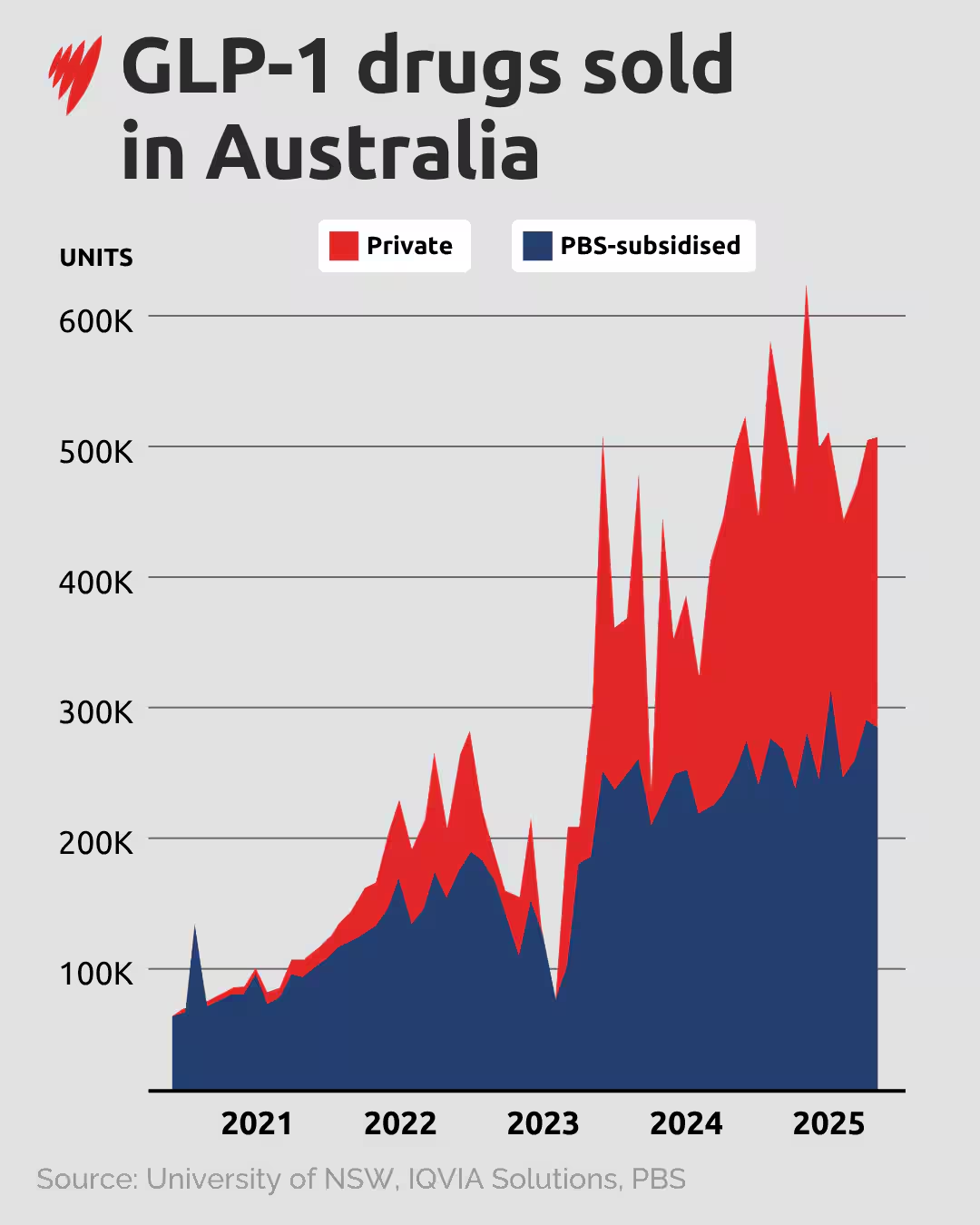
Approximately 2% of Australians—roughly 18 out of every 1,000—are now using GLP-1 medications regularly, as highlighted by a study from the University of New South Wales (UNSW) published in November 2025.
Darwan’s situation highlights the rapidly expanding market for weight-loss injections, where some Australians are seeking treatment abroad, while others resort to social media sellers and informal supply pathways.
An SBS Thai investigation uncovered weight-loss drugs being marketed without a prescription within Australian community groups, alongside reports of unapproved products entering the country through unregulated channels.
However, many Australians still access these medications through licensed healthcare providers and pharmacies.
Navigating this landscape can be challenging for consumers, as the line between approved prescription drugs, experimental treatments, and unapproved products can become blurred. Experts urge caution, warning that using medications outside sanctioned methods may pose serious health risks.
The Unregulated Supply Chain
For some individuals, acquiring these medications does not necessitate international travel.
SBS Thai found GLP-1 injectable substances openly advertised within Australian Thai community Facebook groups, where certain sellers offered products without the need for a prescription.
In a test inquiry, we contacted a Melbourne-based seller, feigning interest in purchasing “Mounjaro.” The seller proposed a 5mg vial for $750, claiming it had been sourced from a beauty clinic in Udon Thani, a city in northeast Thailand.
Contacting the cited clinic revealed that they did indeed supply products to the Melbourne seller.
SBS Thai did not verify the legitimacy of every transaction and whether each item sold through this channel adhered to Australian regulations.
The pricing for a 5mg multi-dose injectable pen appeared significantly inflated compared to registered Australian pharmacy listings, where it ranged between $375 and $415 and required a prescription.
The seller’s assertion of easy access raises serious regulatory and health concerns.
In response to inquiries, a Therapeutic Goods Administration (TGA) representative stated, “It is illegal to import GLP-1 medicines or peptide products into Australia for commercial use without proper authorization and declaration.”
According to the TGA, GLP-1 receptor agonists, including semaglutide and tirzepatide, are restricted to prescription use in Australia and should be administered under the guidance of qualified healthcare professionals.
The TGA has also alerted the public about unregistered products marketed as GLP-1 medications, especially those acquired online or from international sources. In March, testing by the TGA discovered several imported items claiming to contain GLP-1 or its analogues contained none of these ingredients. The agency advises obtaining prescription medications from certified Australian pharmacies instead of social networks or digital platforms.
Moreover, the regulator has intensified its scrutiny of unapproved peptide products.
Recently, with assistance from NSW Police, the TGA seized over $120,000 worth of unapproved peptide and anabolic steroid items from two properties in NSW. These products allegedly were imported, relabelled, and marketed via social media and a dedicated website.
Among the products recovered was one labeled “retatrutide,” a name that also surfaced in SBS Thai’s investigation.
Retatrutide is distinct from approved GLP-1 medications like Ozempic and Wegovy, as it is an experimental substance operating on three hormonal pathways that regulate appetite and metabolism, and is not sanctioned for sale in Australia.
While SBS Thai did not independently assess the product or confirm its contents, the TGA warns that unapproved peptide substances have not been scrutinized for safety, efficacy, or quality.
In June, Victoria’s Department of Health announced being alerted to six instances of acute liver injury since January among individuals who used products labeled as retatrutide, with investigations still ongoing.
Surging Demand Amidst Growing Awareness
The informal market is emerging alongside a rapid increase in the legitimate consumption of GLP-1 medications.
Research from UNSW indicates that sales of GLP-1 medications surged from around 58,000 in May 2020 to 500,000 by April 2025. A significant sales disruption occurred from late 2022 to early 2024 due to a drug shortage, which caused an 80% drop in sales.
The researchers observed that private, non-subsidized access to these medications sharply increased, constituting about 43.8% of estimated usage as of April 2025, with costs soaring as high as $600 per month.
This study did not encompass Wegovy and Saxenda, which are specifically marketed for weight loss, meaning their findings could represent a conservative estimate of the total GLP-1 use.
Amidst this growth, discussions around the expanding market are prevalent on social media.
Similar to Darwan, Ople Petchdee, residing in Croydon South in Melbourne, procured a GLP-1 injectable from a beauty clinic near Bangkok.
Having lived in Australia for fifteen years, Petchdee was influenced by her friends’ posts concerning their success with weight-loss medications.
“Everyone posted on their social media that these medications helped them lose weight, so my friends recommended I try them too,” she explained to SBS Thai.
The Broader Implications of Using GLP-1 Medications
Trevor Steward, an associate professor of psychology at the University of Melbourne, is concerned with not only the means by which individuals access GLP-1 medications but also public perceptions formed through social media channels.

Steward is currently conducting a clinical trial to explore how GLP-1 medications affect individuals suffering from binge eating disorder.
It’s not about aesthetics. It’s not about achieving a certain number on a scale.
“It’s about someone’s mental and physical wellbeing, which should be assessed holistically with a doctor involved,” Steward stated to SBS Thai.
He emphasized uncertainty surrounding the effects of treatment cessation for those with eating disorders.
“Should weight re-emerge, the risk is that food-related anxieties will return. We must consider how these individuals cope with feelings of regaining their previous patterns of behavior,” he emphasized.
Steward criticized social media for oversimplifying complex issues, framing GLP-1 drugs as quick fixes for attaining specific body types rather than serious medications that require comprehensive consideration of an individual’s overall mental and physical health.
For Darwan, who sought a solution for weight loss, the reality proved to be much more challenging.
“My mood was psychologically draining. I dealt with severe fatigue,” she expressed.
I will not use [GLP-1 drugs] again.
This story was produced in collaboration with SBS Thai.
For mental health support, contact Beyond Blue at 1300 22 4636. More information is available at beyondblue.org.au. Embrace Multicultural Mental Health offers additional support for individuals from diverse cultural backgrounds. Visit embracementalhealth.org.au for more information.
For support regarding eating disorders or body image concerns, contact the Butterfly National Helpline at 1800 ED HOPE (1800 33 4673) or visit www.butterfly.org.au.
Disclaimer: This article serves as general information and should not be considered a substitute for professional medical advice. It is advisable to consult a qualified healthcare provider for personalized guidance.
For the latest updates from SBS News, download our app and subscribe to our newsletter.










Discussion about this post