
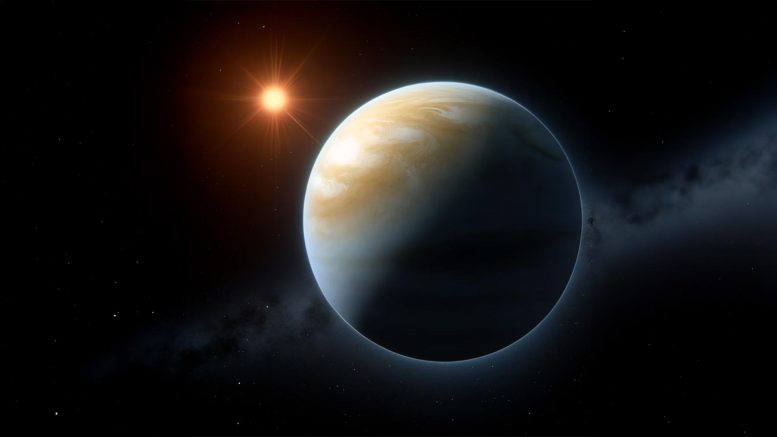
The sulfur-laden atmosphere discovered on gaseous exoplanet GJ 3470 b, shown here in an illustration orbiting its star in the constellation Cancer, could help researchers figure out how it (and similar planets) were formed. Credit: University of Wisconsin–Madison, edited
GJ 3470 b is a gas dwarf with unexpected sulfur dioxide in its atmosphere. This discovery provides insights into planet formation and chemical reactions.
A surprising yellow haze of sulfur dioxide in the atmosphere of a gas “dwarf” 
Thomas Beatty is an assistant professor of astronomy at the University of Wisconsin–Madison. Credit: University of Wisconsin–Madison
Sulfur Dioxide: A Rare Find
“The thing is, everybody looks at these planets, and often everybody sees flat lines,” says University of Wisconsin–Madison astronomy professor Thomas Beatty. “But when we looked at this planet, we really didn’t get a flat line.”
They saw evidence of water, carbon dioxide, methane and sulfur dioxide, findings Beatty presented in Madison today at the 244th meeting of the American Astronomical Society and that he will soon publish in Wisconsin Center for Origins Research who specialize in proto-planetary disks and migration dynamics, GJ 3470 b may help Beatty and others understand how planets like it got to be so appetizing — at least from the astronomers’ perspective.
This research was supported by grants from NASA.