





The news that Ulster shipbuilding company Harland and Wolff will receive £1.6bn of ministry defence funding is a significant and very symbolic development in Northern Ireland’s politics.
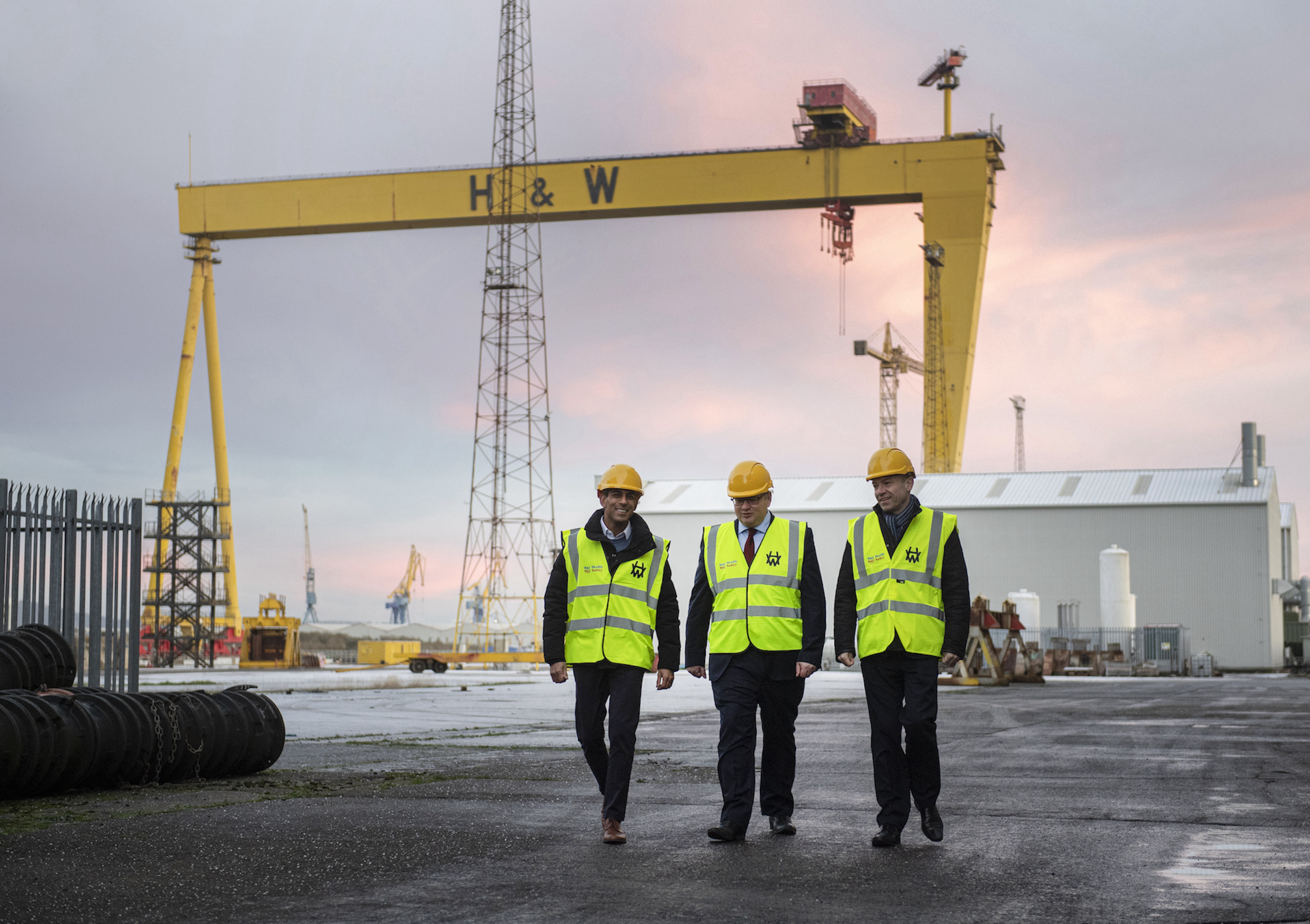
Founded in 1861, Harland and Wolff’s shipyard, which built the Titanic and many other vessels, is a symbol of Ulster’s once formidable industrial prowess. Its giant cranes, nicknamed Samson and Goliath, dominate the Belfast skyline. But their stoicism belies Northern Ireland’s industrial stagnation.
It is no secret that Ulster’s long and cruel economic decline has been implicated in a broader crisis of unionist identity. And thanks to the six counties’s post-Brexit political stasis, this crisis is only getting sharper.
On Friday, during his first trip to Northern Ireland as prime minister, Rishi Sunak made a point of visiting the famous Harland and Wolff shipyard. He understood the symbolism of the moment, saying: “If you think about it, Belfast used to be home to the world’s largest shipyard so I think it is really fitting that it is going to complete the next generation of our navy support ships, which increase our security at sea”.
Bakers Union and MP’s Tell Scrooge Bosses to Pay Workers Redundancy Before Christmas

BASC condemns Yorkshire Dales nest incident
This was a statement of intent. Indeed, by announcing a billion-pound investment in Harland and Wolff and prioritising a trip to its shipyard, Sunak was reaffirming in the strongest possible terms his support for the Union.
But this is the very same Union that Brexit, in a horde of complicated ways, has put at risk.
The abstract nouns that drove the Brexit argument, namely “freedom”, “sovereignty” and “control”, have very different meanings in the six counties. But the 2019 Brexit deal, negotiated and passed by Boris Johnson, nonetheless insisted on total delivery.
Johnson’s Brexit deal was deliberately designed to do as little damage as possible to Northern Ireland’s constitutional settlement. The agreed solution was the “Northern Ireland Protocol” which would avoid a so-called “hard border” between Northern Ireland and the Republic while instituting checks for goods passing across the Irish Sea border. It was a compromise that critics in the hardline Democratic Unionist Party (DUP) see as undermining the integrity of the internal British market and the UK as a whole.
The DUP of course played a starring role in the Brexit drama that led to this point.
In what increasingly looks like a profound political miscalculation, the DUP put itself in league with the hard-right Eurosceptic wing of the Conservative party (ERG) in the Brexit debates from 2016-2020. It even propped up Theresa May’s second administration (2017-2019) through a hastily organised confidence and supply deal.
The DUP took this stance despite the fact that Northern Ireland is a political entity inherently tied to Europe, given roughly half of the population are Irish citizens, and therefore EU citizens.
Unionism in crisis
Because of their opposition to the NI Protocol, the DUP resigned its first minister from the Stormont executive in February 2022. It has subsequently demanded that action be taken to mitigate its impact in Northern Ireland as the basis for it re-entering the power-sharing arrangements established by the 1998 Good Friday Agreement.
The result is familiar but by no means reassuring: a state of total political deadlock in Northern Ireland.
Indeed, among all the Brexit legacies which Sunak and the Conservative party can deny, Northern Ireland’s political stasis is simply impossible to overlook. There is no disguising that the first minister’s office is unoccupied and that vital legislation relating to cost-of-living in the six counties is caught in limbo.
The response to the deadlock from both Johnson and Liz Truss (who also served as Johnson’s foreign secretary) was the “Northern Ireland Protocol bill”, proposed legislation which is currently the subject of a legal challenge by the EU. You can understand the EU’s antagonism — if passed, the bill would empower ministers to scrap post-Brexit arrangements without the approval of Brussels.
Upon becoming prime minister, Rishi Sunak has been anxious to signal key breaks with the past Conservative administrations. The NI Protocol bill is no different.
According to a report in The Sunday Times, Sunak has now placed the contentious bill, which the DUP wants to see enacted, “on ice”. After six years of chaos and recrimination between London and Brussels, it is thought to be a gesture of “goodwill” amid ongoing negotiations between UK and EU counterparts.
A tone of contrition has been adopted across government — including by Northern Ireland minister Steve Baker, once the hardest of the hardline Brexiteers. His humility in a recent interview with Ireland’s RTÉ radio was striking: “I recognise in my own determination and struggle to get the U.K. out of the European Union that I caused a great deal of inconvenience and pain and difficulty”. He added: “Some of our actions were not very respectful of Ireland’s legitimate interests. And I want to put that right”.
In a further sign of the improving mood music, during his meeting with President Joe Biden last month, Sunak voiced his hope that a deal could be done with the EU early in the new year. This would avoid the need for another contentious Stormont election which is currently being mooted for a similar time.
The Pro-Protocol parties
But Sunak’s predicament is especially difficult because the NI Protocol is actually popular in Northern Ireland, notwithstanding unionism’s concerted remonstrations. In fact, in a post-conflict society struggling with a legacy of industrial decline (see Harland and Wolff), the protocol offers an opportunity for economic growth. It provides the region with unparalleled dual market access to both the UK and EU Single Market.
For many observers, the protocol is a well-defined practical solution to Northern Ireland’s intricate geographical and political challenges: the best of both worlds.
Former DUP leader Edwin Poots admitted as much last July in a letter to the UK government while serving as Northern Ireland’s agriculture minister. The politician said it would be “unacceptable” that the Northern Ireland Protocol bill, if enacted, would force the region’s farmers to accept the same agricultural subsidy regime as the rest of the UK. This episode underlines unionism’s diverging political and economic incentives; “there’s nothing wrong with cherry picking”, Poots insisted.
But the politics are thus that any climbdown from the DUP’s staunch anti-Protocol positioning looks very difficult indeed. Not backing down is hardwired into ulster unionism’s political instincts: “not an inch”, “what he have we hold”, “no surrender”, are all familiar phrases in the unionist vernacular. Indeed, that the DUP’s grassroots are so fiercely against the Protocol, makes movement from its leaders essentially impossible
The unhappy compromise to come…
Northern Ireland’s precarious political settlement is predicated on the principles of cooperation and compromise, but the “one-side-takes-all” approach to the Brexit debate, advanced since 2016, leaves little room for productive negotiation.
Sunak is keen to bill himself as a “problem solver” politician — but only time will tell whether he can forge a compromise between the varied stakeholders on the Protocol issue. Sunak needs to find political consensus between the EU, Northern Ireland’s non-unionist parties, the unionist parties, the Republic, the British government, the ERG and probably the United States as well.
And given the realities of post-Brexit politics, compromise is a difficult word indeed. Good luck, Mr Sunak.





Discussion about this post