
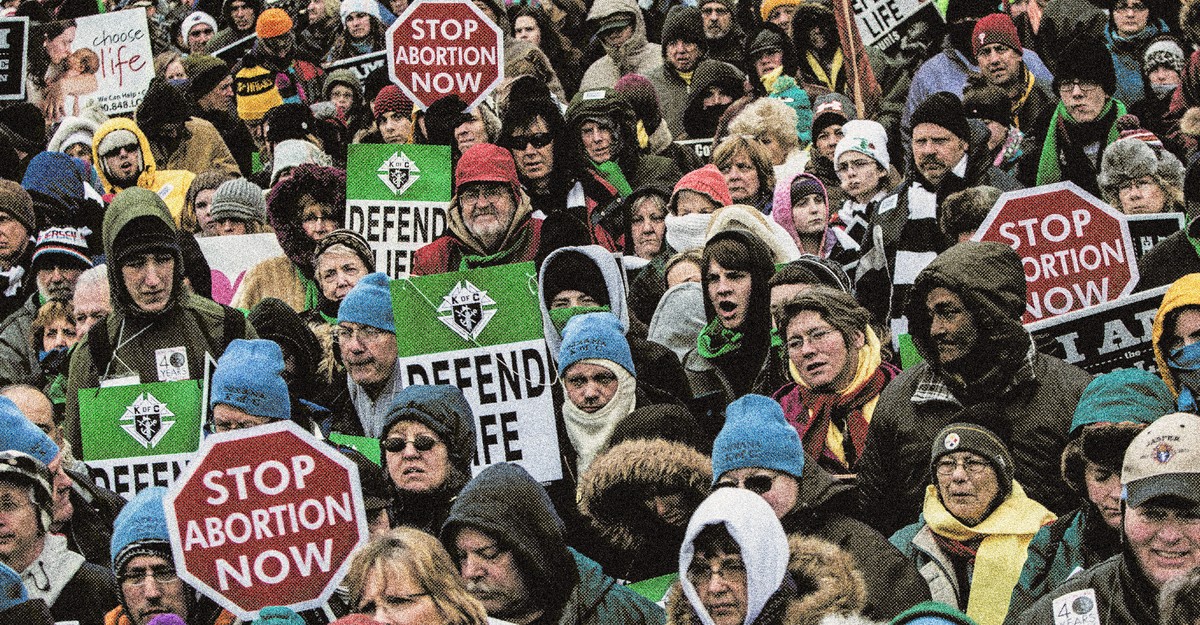
In a normal year, the March for Life would begin somewhere along the National Mall. The cavalcade of anti-abortion activists in Washington, D.C., would wind around museums and past monuments, concluding at the foot of the Supreme Court, a physical representation of the movement’s objective: to overturn Roe v. Wade. The march happens in January of each year to coincide with the anniversary of the Roe decision.
But this is not a normal year. Tomorrow’s march will be the first without Roe on the books.
In recognition of that fact, the march has a new route. It will finish somewhere on First Street, between the Capitol and the Court building, an acknowledgment of the enormous and somewhat nebulous task ahead: banning or restricting abortion in all 50 states. That task will involve not only Congress, the courts, and the president but also 50 individual state legislatures, thousands of lawmakers, and all of the American communities they represent.
At the march, activists and other attendees will be jubilant. Speakers will congratulate their fellow marchers on a job well done. Yet at the same time, a current of uncertainty ripples beneath the surface of the anti-abortion movement. Advocates are technically closer than ever to ending abortion in America, but in some ways, the path forward is more treacherous now than it was before. The movement is not in disarray, exactly, but its energy is newly decentralized, diffused throughout the country.
“There’s a much more choose-your-own-adventure feel” to the movement now, Mary Ziegler, a University of California, Davis School of Law professor who has written about abortion for The Atlantic, told me.
Overturning Roe was only the first step. The next isn’t exactly obvious.
Since the 1980s, rescinding the Supreme Court’s 1973 ruling in Roe, which established a nationwide right to abortion, had been the movement’s top goal, because it was the key that unlocked everything else. There could be no real prohibitions on abortion as long as Roe was in effect. Charging into battle was easier under a single banner, with resources and energy directed toward a single national project: filling the Supreme Court with abortion foes.
Now, though, across all 50 states, different leaders are pressing for abortion restrictions of varying types and degrees: heartbeat bans, gestational limits, restrictions on the abortion pill, or outright bans with few or no exceptions.
America’s anti-abortion movement has always been a rich tapestry. Although its members share an overarching goal—ending abortion—they have disagreed on tactics and approach. Some groups—including Susan B. Anthony Pro-Life America, Americans United for Life (AUL), and the National Right to Life Committee (NRLC)—have prioritized legal and political strategies; others, including many Catholic organizations, have advocated more for funding the country’s 2,700 pregnancy centers or expanding the social safety net. But there was always a power hierarchy among these groups. “If you were wondering where the bills came from, the lawsuits, it was obvious: A handful of national groups dictated everything,” Ziegler said. The NRLC and AUL organized the troops and drafted model legislation. They planned judicial strategy and pushed court cases forward.
In the post-Roe world, those groups are less powerful and less relevant. The central players now are the thousands of state-level politicians, local leaders, and grassroots activists who are writing and passing legislation, often independent of those once-dominant national groups.
The influence of the national groups has been waning since even before the fall of Roe. A Texas pastor and a former state solicitor general, for example, came up with Texas’s 2021 S.B. 8, which banned abortion once a fetal heartbeat was detectable (typically after six weeks) and authorized private citizens to sue abortion providers. The two men did so without much input from any national group, according to the experts I spoke with. Abortion restrictions in Alabama and Georgia, which passed in 2019 and went into effect in 2022, were drafted by different state activists and leaders and contain starkly different language, showing little influence from national groups.
The national anti-abortion movement clearly wasn’t ready for this flurry of activity. But it could have been better prepared, Daniel K. Williams, a history professor at the University of West Georgia, told me. When Amy Coney Barrett was nominated to the Court, or even as soon as Trump was elected president, national organizations could have put forward a single model law for lawmakers, and uniform guidance for health-care providers and hospitals. Instead, America ended up with a chaotic patchwork of abortion restrictions—a mixture of newly written trigger laws and dusty legislation from the late 19th century. Some of these new policies are vague or fail to address health complications such as miscarriage and ectopic pregnancy. They propose varying consequences for abortion providers and different mechanisms for enforcement.
In November, the AUL released its American Life Initiative and its model legislation, the Ready for Life Act, which bans abortion after conception and includes a life-of-the-mother exception, as well as clarifications regarding miscarriage and ectopic pregnancy. But it came five months after the Dobbs v. Jackson Women’s Health Organization decision overturning Roe. That groups were drafting these guidelines “months after Dobbs and not experiencing any uniformity in state legislatures is a sign of how decentralized and swift-moving all of this has been,” Williams said.
Clarke Forsythe, the senior counsel for AUL, defends his organization’s strategy: “We needed time to analyze Dobbs and its impact and implications and needed time to put the package together,” he told me. “It’s a long-term initiative and a long-term vision. There was no need to get it out before the election.”
Abortion opponents insist that a state-level free-for-all could turn out to be helpful for the movement. With more people involved and working toward different initiatives, the argument goes, activists might come up with innovative ideas and policy proposals. Democracy, by nature, is messy. “It’s good for the country and good for our politics to decentralize the issue,” Forsythe told me. “The Court sent it back to the local level, where public policy can be better aligned with public opinion, where the people responsible for it are responsive to people at the local level.” Decentralization is the movement’s strength, Lila Rose, the president of the national anti-abortion group Live Action, told me. “It requires a diverse and multifaceted approach. It’s not strategic conflict so much as strategic differences.”
This particular moment gives anti-abortion activists a chance to think creatively and to forge new alliances, some in the movement argue. Now that Roe is gone, do they need to keep up their ties with the GOP? “I would like to see the movement disentangle itself from particular political parties,” Erika Bachiochi, an anti-abortion writer and a fellow at the Ethics and Public Policy Center, told me. Maybe, she added, there’s room for a return of the “old pro-life Democrat.”
But an unintended consequence of overturning Roe could be that the movement has inadvertently pushed its highest objective—ending legal abortion—further out of reach. “On the one hand, when there’s a free-for-all, ideas that may never have been given the time of day can emerge and work,” Ziegler said. “On the other, you can have bills that are damaging nationally get passed.” Texas’s S.B. 8—the Texas Heartbeat Act—frustrated some movement leaders because it empowered individual citizens to sue, which meant that those individuals would control the narrative, Ziegler said. Others worry about the vocal “abortion abolition” groups, which have been calling for women who obtain abortions to be punished.
These days, Ziegler says, “there’s no single voice in the movement to say, ‘No, that’s not what we stand for.’” A few extremists, in other words, could damage the movement’s reputation—and interfere with its ultimate goal.
Before Dobbs, anti-abortion advocates seemed confident that once a handful of states banned abortion, many more would follow—that they could build a “culture of life” in America that would put the country on a righteous path. In some ways, the opposite has occurred. As a few states put limits on abortion rights, others, such as Vermont, California, and Michigan, have reacted by enshrining those rights into state law. Meanwhile, voters in red states including Kansas, Montana, and Kentucky rejected attempts to restrict abortion. Former President Donald Trump—the man whose nomination of three Supreme Court justices led directly to the overturning of Roe—has gone so far as to blame Republicans’ disappointing midterm performance on the anti-abortion movement. (In response, Rose called his comments “sniveling cowardice.”)
Nationally, the movement’s relationship with the Republican Party is troubled. Last fall, when Senator Lindsey Graham proposed legislation restricting abortions after 15 weeks, only a handful of his Republican colleagues were publicly supportive. “Most of the members of my conference prefer that this be dealt with at the state level,” Minority Leader Mitch McConnell told reporters at the time.
Even in the new Congress, where Republicans have a House majority, one of the first pieces of legislation passed in the lower chamber was the so-called Born Alive bill, which would require health-care providers to treat babies in the vanishingly rare cases of failed abortions. Here was a chance for Republicans to pass a bill restricting abortion after 15 weeks or even six, in a show of support to the movement that they purport to champion. But they didn’t. Republicans in Congress are “afraid to do anything on this issue that’s meaningful” for fear of the political consequences, Ziegler says.
Anti-abortion leaders like Rose believe that they’re being unfairly blamed for these recent Republican losses and missed opportunities. They argue that in the midterms the GOP chose candidates who were insufficiently anti-abortion, or simply problematic, such as Mehmet Oz and Herschel Walker. But there was also a communication issue, they say. Candidates weren’t outspoken enough about abortion; they should have talked more about the Democrats’ support for abortion at late gestational ages, and their plan to codify abortion rights into law. “That’s where the real problem was” in the midterms, Marilyn Musgrave, the vice president of government affairs for Susan B. Anthony Pro-Life America, told me. “Republicans weren’t pointing out the extremism on the other side.”
It’s true that some Republicans campaigned successfully on abortion restrictions last year, including GOP Governors Ron DeSantis of Florida, Kay Ivey of Alabama, Brian Kemp of Georgia, and Greg Abbott of Texas, each of whom won reelection by a substantial margin. Still, the recent state referenda and post-Dobbs polling suggest that the anti-abortion movement is too optimistic about the level of support for their goals.
“We’ve clearly lost the narrative,” Charlie Camosy, an ethics professor at Creighton University School of Medicine and a columnist for the Religion News Service, told me. Activists like Camosy hope that the movement’s new emphasis will be a grassroots effort to educate Americans and persuade them to oppose abortion. Camosy isn’t attending the March for Life tomorrow; instead, he’s giving a speech at a Catholic seminar in Freehold, New Jersey, where he lives. “Something is wrong in our ability to communicate what’s at stake,” he said of the broader movement. “Focusing on the national level distracts from getting Michigan or Montana or Kentucky or Kansas right.”
But eventually, Camosy’s movement will have to face the reality of abortion in America: Some states just aren’t going to budge. “Fewer than 50 percent of states are likely to meaningfully curtail abortion,” Williams estimates. Even if the movement gains ground in some states, “that’s likely only to harden the resistance in more strongly pro-choice states.” Which means that, rather than a growing national consensus on abortion, Americans probably can expect more polarization—a cultural standoff.
Tomorrow’s March for Life will be the first time activists have held a major national gathering since Roe was overturned in June. But it will probably be a much smaller event than before. Some activists have wondered whether it should happen at all. More states and cities will be hosting their own rallies, because that’s where the next round of work needs to be done. And many people will be at those local marches instead—to start, or maybe to double down, on their difficult project of creating a “culture of life.”


Discussion about this post